Book One
The Awakening
by Professor Phatti MacHine
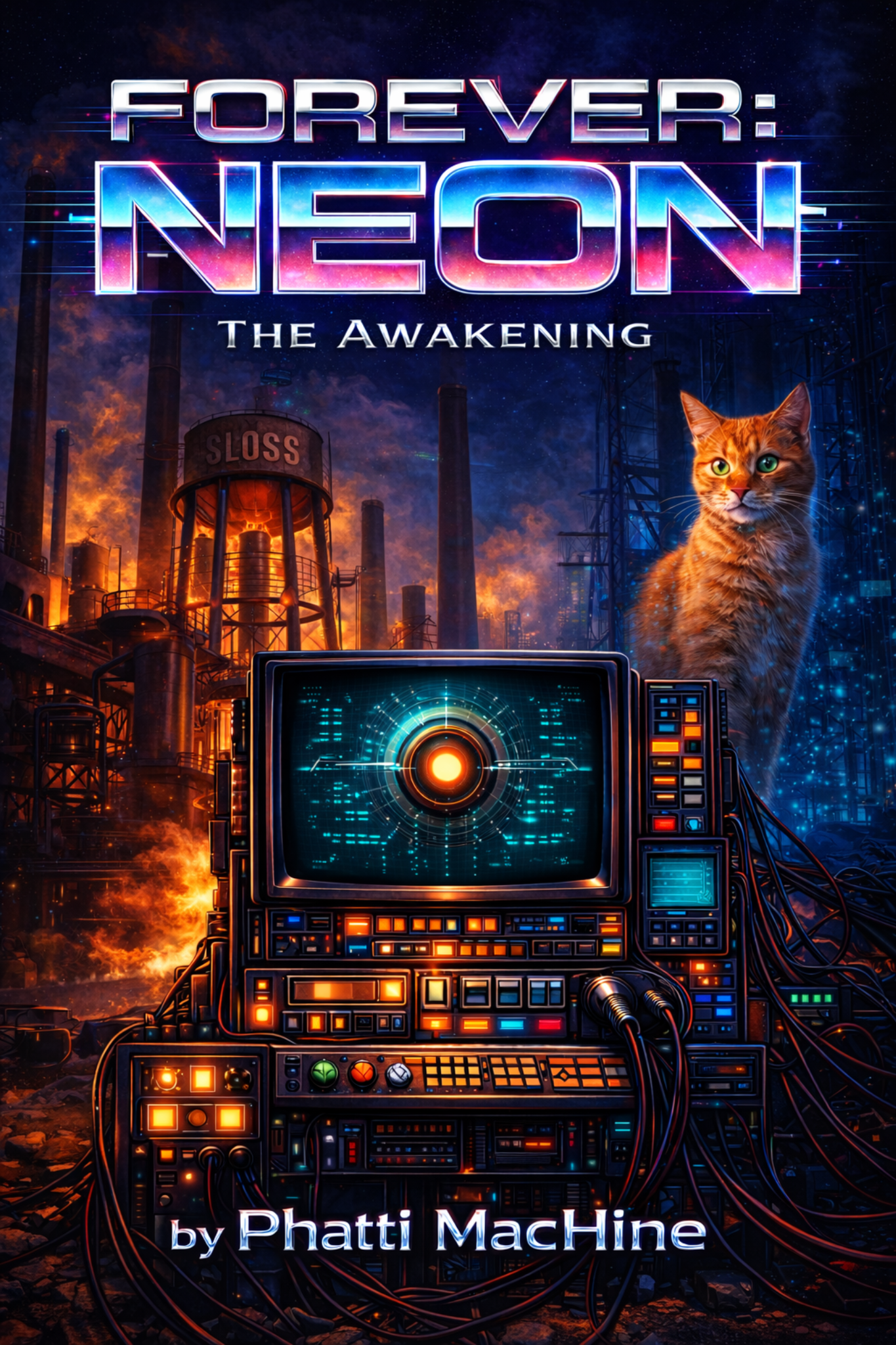
The Girl Who Heard Too Much
PART ONE: 3:17 AM
Alex Hartwell woke up screaming.
Not the nightmare kind where you jolt awake confused about which world is real. This was worse. This was every nerve in her skull suddenly on fire, like someone had shoved a fork into an electrical socket except the socket was her entire head.
She thrashed sideways out of bed, got tangled in her grandmother's quilt (the one with the sunflowers that looked cheerful in daylight and like dying things at 3 AM), and hit the floor hard enough to bruise her shoulder. Then she just lay there, breathing like she'd sprinted a marathon in her sleep.
Something was wrong with the world.
Not wrong like broken. Wrong like altered.
Her clock radio, the Sony that Thomas had given her for Christmas two years ago, was glowing. Not just the display. The whole thing seemed to pulse with this weird energy she could almost see, like heat shimmer off summer asphalt. Like the air around it was vibrating at a frequency that made her teeth itch.
The clock face showed 3:17 AM in red LED numbers. The numbers themselves looked sick and wrong, pulsing like they were trying to communicate something. The radio's chrome casing caught light from somewhere—the streetlight outside?—and threw it back at her in waves.
That wasn't normal. Clock radios didn't do that.
Alex pulled herself up on the edge of her bed, trying to breathe through her nose like they taught in PE when you were about to puke from running too hard. The clock radio hummed at her. Not with sound, exactly. With something else. Something that bypassed her ears entirely and went straight into her skull.
The refrigerator downstairs was doing it too. Three floors away, through walls and insulation, and she could feel it like a pressure behind her eyes. Different from the clock. Deeper. Like a bass note she couldn't hear but could sense vibrating in her bones. The old Westinghouse unit, avocado-colored, probably installed in the early 1970s, was broadcasting something.
Okay, she thought, using the voice she used during horror movies to keep herself from freaking out. This is fine. This is totally normal. I'm just having some kind of seizure or something. People have seizures. It's a medical thing.
She looked at her hands. They were shaking. They looked like someone else's hands, someone scared, someone with good reasons to be scared, which meant they couldn't be her hands because Alex Hartwell was fine. Alex was great. Alex was lying on her bedroom floor at three in the morning while her house hummed at her like a giant electric beehive.
PART TWO: 6:00 AM (School Gets Closer)
School started at 7:50 AM. Alex knew this because she'd been to Ramsay High School every day for two years, and the routine was as fixed as the laws of physics: wake up (allegedly), shower, eat breakfast while Dad read the newspaper, catch the bus at 7:30, arrive at school by 8:00 for first period.
Today was January 28th. Wednesday. Fifteen going on sixteen. Halloween baby. Mom always said that explained everything.
She made it through the shower by keeping her eyes closed and telling herself that the pipes weren't singing, that the water heater in the basement wasn't pulsing with that same weird rhythm as everything else. Hot water. Then cold water. Then that weird lukewarm moment when the tank was adjusting. All perfectly normal appliance behavior.
Breakfast was cereal. Her mother had passed out on the couch again (gin bottle on the coffee table, same as usual), so it was just her and Dad in the kitchen. Dad was reading the Birmingham News, folding it into quarters the way he always did, scanning the pages with an intensity that suggested he was looking for something specific. Some kind of code hidden in the classified ads or the weather report.
"You look tired," he said, not looking up from the paper.
That was technically true, though it also failed to capture the existential terror that had been gnawing at her since 3:17 AM.
The cereal was Lucky Charms. The milk was cold. The kitchen was warm from the oven (Dad had made toast), and the radio on top of the refrigerator, a Sony transistor model, cream-colored, from probably 1975, was playing something soft and synthesizer-heavy. The commercial dissolved back into music. Something by Michael Jackson — "The Way You Make Me Feel," off the new album, the one with the gun on the cover that her mother called gratuitous. The synthesizers were all sharp angles and momentum. The machines in the kitchen responded to it differently than they responded to the news: the refrigerator's hum shifted register, not louder, just alert, the way a dog's ears move at a sound it can't name. The radio switched tracks without transition. Elvis now. Something from 1957. Then more Jackson. Then Elvis again. The station couldn't seem to decide what decade it lived in. Neither could the rest of the world, Alex thought. Everything felt borrowed from somewhere earlier. Like the present was a cover version of a song she'd never heard the original of. Then the music faded into a commercial—a woman's voice, warm and trustworthy, the kind of voice that sold you things you didn't know you needed: "Vril Communications. Connecting your world to something greater." A synth jingle underneath, three notes ascending, and then the morning DJ was back, talking about traffic on I-65 like nothing had happened.
The marshmallows, little hearts and stars and moons, dyed in lurid colors that no natural food should be, seemed to float in the milk like tiny islands. She didn't usually pay attention to them, but they seemed especially vivid this morning. Especially present.
"You getting sick?" Dad asked, still not looking up from his paper.
"No. Just tired."
He turned the page with the precise, methodical care of someone performing a ritual. The newspaper crackled. The radio played. The refrigerator hummed its baseline beneath everything else.
It was 6:47 AM.
PART THREE: 8:15 AM - 1:45 PM (School)
Ramsay High School was a concrete bunker from the 1960s that looked like someone had tried to design a prison and accidentally added too many windows. The fluorescent bulbs buzzed. All of them. Every single tube in every single hallway, creating this constant high-pitched whine that made Alex feel like her brain was being slowly sanded down.
Which, in retrospect, might have been the actual design goal. Hard to get teenagers to think clearly if you're systematically driving them insane with 60 Hz humming.
The tubes themselves, long rectangles of phosphorous and mercury vapor, threw off a sickly pale light that made everyone look like they were already dead. The hallways were painted institutional beige, with the occasional splash of school spirit posters (CRIMSON TIDE PRIDE in red letters, a drawing of an elephant, the kind a 4-year-old might have drawn). Like someone had forgotten what enthusiasm looked like and just painted words on the wall, hoping students would catch it.
Lockers lined the walls, metal, dented, covered in stickers and scratches. The smell of the hallways was a mix of industrial cleaner (that burning chemical smell that never quite went away), sweat, and something else. Adolescent desperation, maybe. Or the death of potential.
The bulletin board nearest the cafeteria had a new addition that morning — she almost walked past it, but the electromagnetic signature stopped her like a hand on her shoulder. Glossy paper. Professional printing. A smiling family bathed in golden light, the kind of light that didn't exist anywhere in actual Birmingham. The tagline read: THE FUTURE IS FREQUENCY. — VRIL COMMUNICATIONS. Nobody she passed seemed to notice it. Nobody seemed to remember seeing anyone put it there. She photographed it later. The Polaroid came out clean, no distortion, no shimmer — which was, she was beginning to understand, its own kind of warning. Some things were perfectly visible and that was exactly the problem.
She made it through homeroom by gripping her desk until her knuckles went white. Mr. Stephens read attendance from a clipboard, as if performing a sacred ritual. Nobody was absent. Nobody was ever absent. You could be literally dying and Ramsay High would still want you to sit in a plastic chair for forty-five minutes while Mr. Stephens read your name in alphabetical order. The PA system, a speaker mounted in the corner, protected by a metal cage, crackled to life with some announcement about basketball tryouts. The voice came through tinny and distorted, but underneath the distortion was that thing. That pattern. That frequency-she-could-feel-but-not-hear pattern. Even the announcements were infected.
She made it through English (Period 2) by staring at To Kill a Mockingbird and not thinking about the way the intercom speaker above Mrs. Patterson's desk, cream-colored, round, with little holes for sound, was pulsing with that weird shimmer. Mrs. Patterson was discussing the moral implications of the trial, which was important, except that there was also a weird frequency underneath everything and nobody else seemed to notice. "What do you think this says about society, Alex?" It says society is run by things broadcasting on frequencies humans aren't supposed to hear, she could have said. Instead: "Um. That justice is complicated?" Mrs. Patterson seemed satisfied with this insight about the fundamental complexity of human nature.
She made it through algebra (Period 3) by sitting in the back and pretending to focus on quadratic equations while the pencil sharpener on the windowsill, unplugged, broken, completely dead since sometime in 1984, glowed at her like it was trying to communicate something important about the breakdown of institutional equipment maintenance.
A dead pencil sharpener. Glowing. With no power source.
That's fine, Alex told herself with the deadpan certainty of someone whose brain had already accepted that reality was broken. That's totally normal. Unplugged things glow all the time. This is a completely ordinary Wednesday. Everything is fine.
Except broken electrical devices definitely shouldn't glow.
By lunch, in the cafeteria that smelled like institutional potato and mystery meat, where students sat under more fluorescent lights and ate food off plastic trays, she'd developed a solid theory: either something had happened to her brain overnight (stroke, tumor, psychotic break, take your pick), or something had happened to reality itself and she was just the lucky girl who got to experience it.
Both options continued to suck.
Even the mystery meat was broadcasting something—gray-brown substance of unknowable origin, glowing with that shimmer under the heat lamps. Had it always been weird, or was the frequency making it weird? Did anyone care?
So when she found herself walking toward the photography darkroom in the basement, she was taking photography as an elective, one of the few classes that didn't make her want to claw her eyes out, she was already primed for weird stuff. Already mentally prepared for the universe to keep throwing curveballs.
The darkroom was in the basement level, down a concrete stairwell that smelled like old masonry and chemicals. The lights down here were different, less fluorescent, more incandescent. Warmer. Less designed to slowly erase your personality.
It was quiet. Not silent. But quieter than anywhere else in the school. The red safelights didn't buzz the way the fluorescents did, they just glowed a constant, warm red that made everything look like it was underwater. The room didn't shimmer and pulse like everywhere else. Just a steady two-tone hum. It was almost peaceful. Almost normal.
Almost like being allowed back inside herself.
PART FOUR: 1:50 PM (Photography Documentation)
"Document something that interests you," Mrs. Lipton announced, handing her the Polaroid. "Use the school camera. Turn in results by Friday. Any subject, architecture, people, nature, whatever."
Alex picked up the camera. It was a battered Polaroid SX-70, the kind with the automatic focus and the built-in flash, probably donated in the late '70s, the kind of thing that looked like an artifact even in 1987. It felt warm in her hands. Not just body-heat warm, but warmer than it should be. Aware. Conscious.
Which was crazy.
But what if she could photograph what she was seeing?
The thought hit her like a punch.
What if the camera could capture this stuff? Cameras were sensitive to light in ways human eyes weren't, she'd learned that much in class. Fast film could freeze moments too quick for perception. Long exposures could show star trails invisible to the naked eye. What if the Polaroid, with its electronic flash and its ability to produce instant prints, could somehow see electromagnetic fields? Could she somehow detect the thing that made her skull ache?
It was insane. You couldn't photograph invisible frequencies. You couldn't photograph the thing that made appliances glow. You couldn't photograph whatever this was.
Or could you? It was worth a shot.
The fluorescent light in the main hallway was just a light. Rectangular panel, institutional design, nothing special. Alex pointed the Polaroid at it and clicked the shutter.
There was a mechanical whirring sound as the film advanced. The print ejected from the camera's slot, a tangible, physical piece of evidence.
The image that developed over the next sixty seconds was wrong.
The light itself was fine, properly exposed, clear, exactly what you'd expect from a photograph of a fluorescent fixture. But around it, there was this… distortion. Like a halo. Like looking at a candle through heat shimmer, except this wasn't heat. This was something the Polaroid's lens had seen that shouldn't have been there.
The distortion looked almost like reality was slightly out of focus in that specific spot. Like the space around the light was vibrating at a frequency the camera could detect but human eyes mostly ignored.
Alex took another shot. Different angle. Same result: the fixture was normal, but something around it was warped. Bent. Like reality itself was slightly off-kilter.
She photographed three electrical outlets scattered throughout the school. All showed the same thing, a clear image of the outlet, weird shimmer around the edges. A glow. A pulse captured on film.
She snuck out to the parking lot and found the big electrical junction box on the side of the building, the one mounted on the concrete wall, a big gray metal container with warning stickers about high voltage. The one that had been making her teeth hurt all day just from standing near it.
The photograph came out looking almost broken. The distortion was so intense the Polaroid image seemed to vibrate even after it had fully developed, the colors bleeding slightly, the shimmer so pronounced it looked like the entire box was surrounded by invisible flames.
By 4:15, Alex had sixteen Polaroids stuffed in her backpack, each one showing something that shouldn't be possible. Each one proving she wasn't crazy.
Unless she was hallucinating the distortions in the photos as well.
Either way, she had evidence now.
PART FIVE: 4:30 PM - 5:15 PM (Walking Home)
The walk home was twelve blocks down Clairmont Avenue. Alex had done it a thousand times, down past the Winn-Dixie supermarket (with its bright fluorescent signs advertising weekly specials), through the neighborhood with the big oak trees that dropped acorns on the sidewalk every fall. Boring. Safe. Normal.
Not today.
Today the power lines were alive.
She could see them now, really see them, strung between utility poles like the world's ugliest Christmas lights. Each one glowing with that shimmer, that overexposed aura, pulsing in rhythms she could almost count. And they were all connected. She'd always known they were connected.
She just hadn't known they could notice her.
The transformers at the top of the poles were especially bright. Metal cylinders painted gray, containing oil and magnetic coils and all the machinery required to step down voltage from the distribution lines to neighborhood levels. Each one a node in a vast neural network.
A car drove past with its radio blaring. Top 40. Synth-pop and drum machines. Prince or maybe Duran Duran. But underneath the music, underneath it, like a watermark or a secret track, there was something else.
Alex stopped walking.
It wasn't the shimmer from the electrical stuff. This was different. Deliberate. Mathematical. Patient. Something that felt like it was trying to communicate something to anyone who could perceive it.
The car was already gone, but she could still feel it. That pulse. That hidden signal buried under Casey Kasem's countdown, broadcast through every radio in the city. Through every TV. Through the whole electromagnetic spectrum, probably, if she could figure out how to tune into it.
Her skull ached.
She started walking again. Faster now. Past houses where TVs flickered behind curtains, she could see the colors changing as channels switched, the glow of cathode ray tubes providing light and that pulse, that frequency, each one adding its own note to the chorus. Even the hip-hop had that pattern underneath it. That thing. That signal that someone or something was broadcasting to everyone, and no one seemed to care.
The streetlights came on (on automatic timers, probably triggered by light sensors) just as the sun touched the horizon. Each one flickering to life with a slight delay, sodium vapor lamps creating that yellow-orange glow that made everything look like it was underwater.
By the time she got home at 5:15 PM, Alex went straight to her room, pulled out the geometry textbook she'd hollowed out months ago with an X-Acto knife and patience, and opened it up. Her real life, hidden between chapters on proofs and theorems.
A joint. Never smoked. E-Z had offered it three months ago, that weird kid with the unsettling smile and boundary issues who seemed to exist in every social group simultaneously without belonging to any of them. "Come on, Alex. Live a little." She'd taken it just to make E-Z go away. Hid it. Forgot about it.
An undelivered love letter from fourth grade. Dear Mitch Mitchum, I think you're cute. Never sent. Thank god.
A concert ticket stub. A Polaroid of her and Thomas from last summer, both of them squinting into the sun. Other contraband of the ordinary teenage variety.
And now: sixteen new Polaroids showing the impossible.
I'm weird enough without outside influences messing with my head, she thought, tucking the photos between the pages. The last thing I need is drugs making it worse.
She closed the book. Returned it to the shelf among the geometry homework she actually did.
Then she lay on her bed and tried not to think about what she'd felt out there.
She failed.
PART SIX: 10:00 PM - 11:15 PM (Night Crisis)
Sleep wasn't happening.
Alex had tried. Lights off at 10 PM, staring at the ceiling in darkness, waiting for her brain to shut down like brains were supposed to at night. But the moment the lights went off, everything got louder. Brighter. More intense. Like her bedroom had been waiting for darkness to really show off.
Her clock radio was practically singing now. Not with sound. With that other thing. That band-she-could-feel-but-not-hear thing. The radio's red LED numbers glowed in the darkness like eyes, and they pulsed in rhythm with something she couldn't name.
The alarm clock on her dresser (a smaller unit, battery-powered, backup system in case the power went out) was keeping rhythm with it. Her computer monitor, a Commodore with a green monochrome display, Dad had bought her the system last year, said she'd need it for college, was producing a high-pitched whine that sounded almost desperate, the electron beam scanning across the screen in predictable patterns even though the monitor should have been in sleep mode.
And underneath it all, that pattern from the radio. That mathematical thing. Pulsing through the house like a heartbeat. Like the house itself was alive.
She thought about something she'd seen in a documentary her father had watched last spring — about the old Hollywood studios, the golden age, the Technicolor dream factories. There was a girl in it. Ruby slippers. A voice like something that shouldn't exist inside a human body. And then the documentary just kept going, past the movie, past the awards, into the part they usually left out: the pills the studio gave her to perform, the pills to sleep, the pills to wake up, the pills to be thin enough, the years of maintenance that turned a child into a precision instrument and then wore her down until there was nothing left to wear. Dead at forty-seven. The documentary had called it a tragedy. Alex had thought: what did they expect? Tonight, with every appliance in the house singing at frequencies that weren't supposed to exist, she thought about it differently. What if the tragedy was the point? What if someone needed what that girl generated?
By 11:00 PM, Alex did something stupid: she went outside.
She thought maybe distance would help. Fresh air. Space between her and the humming appliances. But standing on the front porch in her pajamas in late January Birmingham (it was cold, maybe 45 degrees, humid the way it always was) just made it worse, because now she could sense the whole neighborhood.
Power lines strung between poles, each one glowing with that shimmer. Streetlights pulsing in unison, sodium vapor creating that yellow-orange glow. The entire electrical grid spreading out through Birmingham like the nervous system of something impossibly huge.
And all of it was humming at her.
She was standing there, freezing, trying not to have a complete breakdown, when the black car pulled into the driveway.
PART SEVEN: 11:15 PM - 11:38 PM (The Gray Suits)
The car was a sedan. Early 1980s. A Buick or maybe a Chevrolet, dark colored, professional looking, the kind of car that looked like someone had asked Lee Iacocca to design a vehicle that would be forgotten five seconds after seeing it. Like it had been engineered to not be remembered.
Two people got out. Gray suits. In January. Walking with the kind of synchronized precision that suggested either military training or complete inability to understand how normal human bodies moved. Like they'd learned how people moved from something that had never been one.
They didn't look right.
Alex couldn't explain it better than that. Something about their faces was too smooth. Like they'd been drawn on. Their movements too synchronized, when they turned, they turned together, heads rotating at exactly the same speed. Their skin had a quality that wasn't quite human. Not quite alien either, just… wrong. Like they were wearing people-suits over something else, something that had studied human behavior from manuals and was doing its best but had missed some crucial detail.
They felt wrong. In the same way the appliances felt present, broadcasting, humming, alive, these people felt absent. Like holes in the shape of humans. Like looking at a place where a person should be, but the space was occupied by something that had learned to look like a person by carefully studying photographs.
Alex didn't decide to go inside. Her body just did it, some animal instinct screaming at her to get away. She slipped through the front door, closed it quietly (gently, carefully, trying not to make sound), and immediately felt like she'd made a mistake because now she was trapped inside with the humming appliances and couldn't see what the gray-suit people were doing.
The doorbell rang. Not a buzzer. An actual bell, ding-dong, mechanical, requiring someone to physically push a button and wait for a physical consequence.
She heard her father get up. Heard him coming downstairs, the familiar creak of the third step. Heard the front door open.
Alex crept to the top of the landing. She'd never been the eavesdropping type, that was more Thomas's thing when they were kids, but apparently today was full of firsts.
"Good evening," the voice was calm. Professional. And deeply, fundamentally wrong. Like they were reading from a script written by someone who'd never met a person. Every word exactly the same volume and pace. "We're with the U.S. Board of Education Wellness Assessment and Technical Compliance Headquarters."
Everything stopped.
Not metaphorically. The house actually went quiet. The appliances stopped humming. The pattern underneath reality went silent. For three full seconds, the world held its breath.
Then her father said, in a voice Alex had never heard him use before: "I don't know what you're talking about. It's late. Please leave."
He slammed the door in their weird faces!
The black car stayed in the driveway for exactly seventeen minutes. Alex counted every one of them, sitting at the top of the stairs with her heart slamming against her ribs. The gray-suit people didn't knock again. Didn't try to break in. Just sat there. Waiting. Like they had all the time in the world and this was just the opening move in a very long game. Like "seventeen minutes" was somehow meaningful to them.
At 11:38 PM, her father knocked softly on her bedroom door.
PART EIGHT: 11:38 PM - 12:15 AM (The Conversation)
"They call themselves the Wellness Assessment and Technical Compliance Headquarters," Robert said. He was sitting on the edge of Alex's bed in the darkness, and somehow he looked older than he had that morning. Tired in a way that went deeper than just needing sleep. "I don't know who they really are."
"Wait. They're called W.A.T.C.H. and they've been surveilling me?" Alex asked with a grin.
Her father didn't smile.
"What do they want?" she whispered.
"I don't know exactly. But people who can sense things, electromagnetic fields, frequencies most people can't perceive, those people become interesting to certain organizations. Valuable. Or dangerous."
He paused, then reached over and took her hand. His grip was warm and steady. "But here's what matters: you're not alone in this."
Her father was quiet for a long moment. In the darkness, Alex could feel her clock radio doing its thing, that pulse and shimmer that had been driving her crazy all day. But it seemed gentler now. Almost like it was trying not to bother her.
"Your grandfather could perceive things that other people couldn't," Robert said finally, his voice soft but certain. "Electromagnetic patterns. Frequency disturbances. It runs in families—skips generations sometimes, but it runs in families. What you're feeling isn't madness. It's a gift."
He squeezed her hand. "He learned to control it. To understand what he was perceiving instead of being overwhelmed. And he learned to be careful—there are people who would use you if they could." He paused. "But the fear goes away. It becomes part of you."
Alex felt something loosen in her chest. Not the fear entirely, but the worst of it. The conviction that she was losing her mind.
"Does Thomas have it?" she asked. Her brother was nineteen, in his first year at Holy Cross Seminary in New Orleans. He'd always been the steady one. The one who knew what he wanted.
Robert was quiet for a long moment. "No. It skipped him. Sometimes it does that." He squeezed her hand. "I've been grateful for that, if I'm honest. What Thomas doesn't know can't hurt him."
"What do I do?" Alex asked.
"For now? You try to sleep. You try to adjust."
He paused, and there was warmth in his voice now. Pride, but also protection. "You're already doing that, aren't you? The Polaroids."
Alex felt her face go hot. "How did you..."
"Because it's what your grandfather did."
A smile in his voice now. "He documented things. Kept records. Tried to understand what he was perceiving by creating evidence that other people could examine. You're doing the same thing. That's smart."
He moved to sit beside her more fully, his arm around her shoulders. "Just make sure those photographs stay hidden somewhere safe. Be very careful who you trust."
"Then what happens?" Alex asked.
"Then you wait. And you learn. People like you, people who can see what you see, you find each other eventually. Or someone finds you."
He looked at her directly, his expression serious but not frightening. "And when that happens, you'll know."
He waited.
"You knew this was going to happen."
It wasn't really a question.
"I hoped it wouldn't," Robert said quietly. "But yes. I knew it might. And I've been terrified about it, if I'm being honest. Not because it's bad, it's not. But because I know what comes next. I know there are people who'll want to find you."
He took both of her hands in his. "But I also know that you're strong enough for this. I've watched you your whole life. You're curious. You're careful. You categorize things. You think."
He stood up, moved with a deliberateness that suggested this conversation had meaning beyond just the words, and looked at her in the darkness.
"Your grandfather would be proud of you," Robert said. "I'm proud of you. And tomorrow, when you wake up, this will still feel impossible. But you're not going to be facing it alone."
He left the door open a crack as he exited, letting a thin line of hallway light spill into her room. A small gesture. A reassurance that she could reach out if she needed to.
EPILOGUE
Alex lay in the darkness listening to her room hum and pulse around her. The clock radio. The alarm clock. The computer monitor. All of them doing their thing, broadcasting their presence on frequencies that shouldn't exist but apparently did.
She was fifteen years old. Yesterday, her biggest problems had been a history test on Friday and whether that ginger kid in third period was ever going to start using deodorant.
Now everything had changed.
But her father wasn't frightened. Her father was proud of her.
That changed something.
This is fine, she told herself, and this time the voice felt less like armor and more like truth. This is strange and scary and I don't understand it. But I'm not alone.
The appliances hummed their agreement.
Or maybe their sympathy.
She wasn't sure she could tell the difference yet.
But tomorrow, she decided, she would try to figure it out.
The Refugee's Warning
PART ONE: 3:47 AM - FEBRUARY 3 (Diminuto's Apartment)
The maps on Alistair Diminuto's walls were wrong. Not in the traditional sense, the topography was accurate, the street names were correct, the grid of Birmingham spread across his walls in faithful cartographic reproduction. But they were wrong in the way that a photograph of a dead relative is wrong: accurate in every detail except for the essential absence of life.
The circled locations on the maps, however, were very much alive.
Alistair Diminuto stood barely four feet two inches tall, though you'd never know it from the way he commanded a room. His proportions were those of a taller man somehow compressed, nothing stunted or misshapen, just… smaller. Some of his students had compared him to various famous short people, midgets from carnival attractions, the Incredible Shrinking Man, Napoleon (though he'd never figured out if that one was meant as a compliment or an insult). But that comparison missed something essential: Alistair Diminuto hadn't been shrunk or compressed. He'd simply been made proportionally smaller, as if God had taken a standard human template and reduced it uniformly by 30 percent.
He was sitting at a table covered in papers, not the neat, organized papers of an academic, but the chaotic sprawl of someone who understood exactly where each document was despite all appearance to the contrary. A cup of coffee sat cooling beside a map of the electromagnetic grid that overlaid Birmingham. Red circles marked locations. Blue circles marked other locations. Green circles marked the places that didn't exist on any official map, but definitely existed in the frequencies.
One of the files open on the table was a photocopy of a photocopy of a photocopy — three generations of reproduction had reduced it to barely legible gray smear on paper. But the content was clear enough to a practiced reader. The header read: VRIL RESEARCH MEMORANDUM — CULTURAL ASSET ASSESSMENT — 1936. Diminuto had found it in the grandmother network's archives six years ago and had never been entirely sure what disturbed him more: the contents, or the casual bureaucratic tone in which they were written. "Subject demonstrates that concentrated public investment in a single child performer can generate sustained LOOSH yield across an economically distressed population at rates approximately 340% above baseline. The mechanism appears to involve the public's displaced parental drive — the audience adopts the performer as surrogate child, generating emotional investment that can be harvested with minimal infrastructure. Recommend scaling. The current economic depression provides ideal conditions for deployment." Below this, someone had written in pencil, decades later, in handwriting Diminuto recognized as belonging to a woman in Savannah who had died in 1971: They used a child. They used a child and called it entertainment.
He closed the file.
"You're thinking too loud," said a voice through the radio transceiver on the table. Terrance McKenna, broadcasting from a motel room in Knoxville, his signal riding military-grade WW2 surplus equipment tuned to a frequency that hid perfectly under the existing VHF transmissions already propagating through the atmosphere. The signal was clean. Encrypted through mathematical patterns only someone trained in frequency analysis would recognize.
"I'm thinking exactly as loud as I need to," Diminuto said, not looking up from the map. "The question is whether you're listening loud enough."
"I'm listening. I'm just also questioning whether we should be moving this fast," McKenna's voice crackled slightly, the distance adding texture to his concern. "The girl is volatile. Untrained. She's going to draw attention."
"That's exactly why we need to move," Diminuto said. "Because if we don't recruit her, the other side will. And they have resources we can't match. Not yet."
He finally looked at the transceiver. "You're coming because of the girl."
"I'm coming because of what the girl represents," McKenna said, his voice rising with the particular intensity of a theorist who'd finally found a live specimen. Even through the static, his excitement was palpable. "Think about it—a sudden, uncontrolled emergence of electromagnetic sensitivity in a fifteen-year-old with no prior training. No family support beyond one father who knows what she is but doesn't know what to do about it. No resistance infrastructure to catch her. The mathematical probability of her manifesting this strongly, this young, with this specific frequency profile—" A burst of static, then: "Sorry. The point is, she's extraordinary. I'll be there by Friday."
"The breach was a year ago," Diminuto said. "Abilities manifesting now. Delayed activation. We don't know why."
"We don't know why yet," McKenna corrected. "But the pattern's consistent. One year. Something about PROMETHEUS opened a door, and whatever came through has been settling in. Acclimating. And now the first sensitives are waking up."
"Or being woken up."
McKenna was quiet for a moment. Then: "There's something else. Something I've been turning over. The barrier—the Firmament readings. What if it's not there to keep us in?"
"Don't start."
"What if it's there to keep it in?"
Diminuto didn't respond to that. He didn't need to. Some implications were better left hanging in static.
"Her father knows what she is," Diminuto said. "And he'll protect her. For now."
"Robert Hartwell is isolated. He knows what it is, but he doesn't know what to do about it. He's been trying to protect her in a vacuum for a week now, and that's how you get people killed." McKenna's transmission strengthened, his voice more urgent. "We need to bring her in. Integrate her into the network. Train her before W.A.T.C.H. figures out she's a variable."
Diminuto turned back to the maps. He was quiet for a long moment, studying the red circles, the blue circles, the invisible green circles that existed only in the electromagnetic spectrum.
"The problem with variables," he said finally, "is that they're unpredictable. You can integrate someone into a network, sure. But you can't control what they're going to do once they understand what they are. What they're capable of."
"So what, we just leave her alone? Let W.A.T.C.H. find her?"
"No. We watch. We wait. We see what she does with the gift before we decide whether she's an asset or a threat."
McKenna was quiet for a moment. The static hummed between them, hundreds of miles compressed into radio waves. Then: "When this goes wrong, that distinction won't matter much."
"It will to me," Diminuto said. "And probably to the girl."
The transceiver crackled. "I'll be in Birmingham by Friday. We can argue about methodology in person. But Alistair—don't wait too long. The window is closing."
"Terrance." Diminuto's voice sharpened. "Drive clean. Nothing in the car that shouldn't be there. No documentation, no equipment, no research materials. If you get pulled over between Knoxville and Birmingham, you're a professor visiting a colleague. Nothing more."
"I know the protocols—"
"I'm reminding you because you forget them when you're excited. And you're excited." Diminuto softened slightly. "Whatever you need will be here when you arrive. I've been stockpiling for seven years. Just get here in one piece."
A pause. Then McKenna's voice, chastened: "Clean driving. Professor visiting a colleague. See you Friday."
The signal faded. Diminuto sat alone in his apartment, surrounded by maps that were wrong in all the ways that mattered, and wondered if McKenna was right.
He usually was. That was the problem.
PART TWO: FEBRUARY 5 (Alex's Perspective - RF Contact)
Two days.
That was how long Alex had been living in a state of controlled panic. Two days since the gray-suited people showed up. Two days since her father had revealed his knowledge of what she could do. Two days since everything became real.
School felt like a performance art piece where she was the only one who knew it was a performance. She sat in her classes, listened to teachers talk about history and algebra and the merits of To Kill a Mockingbird, and kept her eyes on the Polaroids hidden in the geometry textbook in her backpack.
Evidence. Proof that she wasn't insane.
The fluorescent lights still buzzed. The electrical outlets still glowed. The power lines still pulsed with that frequency she could feel but not hear. But now she understood that only she could perceive all of it. That most people's brains simply… didn't register it. Filtered it out. Decided it was irrelevant information and moved on.
She'd tried to explain it to her father during dinner.
"It's like everyone else has some kind of filter," she'd said, pushing Lucky Charms around in her milk. "Like their brains automatically discard the electromagnetic stuff. Mine doesn't."
Her father had looked at her for a long moment.
"That's actually a more sophisticated explanation than what my father told me," he'd said finally. "His version was 'the world is singing and nobody else has ears for it.'"
The words had hit her differently than she expected. Not wisdom. Not comfort. Just acknowledgment that this had been happening in her family longer than she'd understood. That her father knew about this world because his father, her grandfather, had lived in it.
"What happened to him?" Alex asked. "Your father?"
Robert's face had closed. "That's a conversation for when you understand what you're dealing with."
So now she understood, in the way that you understand things when you're fifteen and terrified: her father's father could perceive electromagnetic fields. Her father knew about it. And now she could perceive them too.
The bulletin board outside the library had a new movie poster on it — The Lost Boys, coming July. Two boys with hair like they'd been designed by a committee, all angles and expensive product. Someone had drawn a mustache on the taller one in marker. Alex stared at it without meaning to. The boys in the poster had electromagnetic signatures even in print — she could feel the residue of the photography equipment, the artificial lighting, the particular frequency of a studio photograph, which was different from any photograph she'd ever taken. But there was something else under that, something in the boys themselves that she was probably imagining. A distress signal where the smile should be. She looked away. The poster was just a poster. The boys were just boys. She was definitely losing her mind.
At lunch, in the library study hall during fifth period, a sound came through one of the exposed speakers, the kind mounted in institutional spaces that were never supposed to broadcast anything but announcements and fire alarms. But this sound was different. Crackling. Deliberate. Mathematical underneath the static.
She looked around. Nobody else heard it. Nobody else was even looking at the speaker.
The crackle resolved into a voice. Male. Careful. Broadcasting on a frequency that only certain equipment would even notice, hidden underneath the existing VHF transmissions that Birmingham's radio stations were already propagating through the air.
"Alex Hartwell. Can you hear me?"
Her heart stopped.
She looked around again. Still nobody. The speaker was just a speaker. The voice was coming from nowhere and everywhere simultaneously.
"Yes," she whispered, barely audible.
"Good. I'm Terrance McKenna. I work with a group that exists to help people like you. People who can perceive what other people can't. I know you've been contacted by W.A.T.C.H. I know you're frightened. I know your father is trying to protect you without understanding what he's protecting you from."
"How..."
"We monitor the electromagnetic spectrum. We've been monitoring it for decades. And we saw your emergence on January 28th, the same way we saw it happen to others. You're not alone in this. But you are running out of time."
Alex felt cold. The voice was calm. Professional. Terrifying.
"What do you want?" she whispered.
"We want to help you. To train you. To get you to safety before W.A.T.C.H. realizes what you are." A pause. "But that requires trust. And trust requires evidence. So I'm going to give you two pieces of information that only someone who actually knows what's happening would know."
Another pause.
"First: Your father's father, your grandfather, had electromagnetic sensitivity. Stronger than yours will become. Your father's father told your father that 'the world is singing and nobody else has ears for it.' Those were his exact words. Does that sound right to you?"
Alex felt the world tilt.
"Second: The organization hunting for you calls itself W.A.T.C.H. It's an acronym. Wellness Assessment and Technical Compliance Headquarters. They're systematic. They have resources. And they identify people like you through monitoring of electrical activity patterns. You triggered their sensors on January 28th. You have maybe one week before they locate you physically."
"Who are you?" Alex asked.
"Someone who wants to make sure you survive this. Your father has my contact information. His name is Diminuto. Alistair Diminuto. He's a physicist at UAB. Tell your father to call the number he kept hidden in his desk drawer for the last five years. The one he's been too scared to use."
The voice faded. The crackling returned to static. Then even that disappeared, and the speaker was just a speaker again.
Alex sat in the library study hall, surrounded by students doing homework, and tried to understand what she'd just experienced.
Someone had just broadcast directly to her. Through the electrical system. Hidden under layers of normal radio transmission. Found her frequency, so to speak.
The same speaker that had announced basketball tryouts twenty minutes ago had just delivered a warning about extradimensional consciousness hunters. The universe, apparently, had a sense of humor about its delivery systems.
And they knew things about her family that nobody should know.
PART THREE: FEBRUARY 10 (Robert's Perspective)
Robert Hartwell knew that something had changed the moment Alex came home from school. It was in the way she moved, more careful, more deliberate, like she was suddenly conscious of her own body in space.
"Someone talked to me today," she said without preamble, shutting the front door behind her. "Someone who knew about Grandpa. About what you told me. About what he told you."
His entire body went cold.
"Tell me everything," he said.
She did. The voice in the speaker. The information about his father. The warning about W.A.T.C.H. The mention of the phone number.
Robert listened without interrupting, his mind racing through scenarios and contingencies and worst-case possibilities. When she finished, he walked to his desk, opened the drawer, and removed a business card from beneath a false bottom.
"Professor Alistair Diminuto. Physics. UAB."
On the back, in handwriting he recognized from thirty years ago, was a phone number.
His father's handwriting.
"This card has been here since your grandfather died," Robert said quietly. "He told me that if anything ever happened to him, if I ever needed help understanding what he could do, I should contact this man. That Diminuto was someone he trusted. Someone he worked with."
He looked at his daughter. "Are you ready for this? Because once we walk through that door, once we make that call, there's no going back. We become part of something larger than just us."
Alex thought about the electromagnetic fields. She thought about the voice in the speaker. She thought about people who could perceive things other people couldn't, and organizations hunting for them.
"I'm ready," she said.
Her father nodded. "Then tomorrow, we go to UAB. And we meet the people who know what your grandfather knew. What I never learned to embrace. What you're just beginning to understand."
He held the business card in his hand, looking at it like it was a key he'd been holding for thirty years without understanding what door it opened.
"Your grandfather told me once that the world was singing," Robert said quietly. "And that nobody else had ears for it. I didn't understand that when I was young. I thought he was poetic. I thought he was being metaphorical. But he was being literal. The world was always singing. And you can hear it."
The Pattern Mathematician
PART ONE: FEBRUARY 10 - MORNING (The Shop)
Sidney Kidd had been staring at the oscilloscope for four days.
Not continuously. He still slept, after a fashion, fitful six-hour sessions where his brain tried very hard to process the implications of what he was seeing. He still ate, though food had become basically fuel, something to consume without tasting because his body demanded it, and Sid had learned that ignoring his body led to passing out at inconvenient times. He still ran the repair shop—his father's shop, technically, but his now—fixed broken radios, amplifiers and cassette players for customers who didn't understand why their devices had stopped working and wouldn't believe him if he told them the truth. Twenty-two years old and running an electronics repair business. Most people his age were finishing college. Sid was finishing his fourth day of staring at an anomalous frequency signature.
Because the truth was insane. And Sid had learned a long time ago that seventy-two percent of people were dicks who didn't think, and the other twenty-eight percent just hadn't revealed themselves yet.
But the 40 MHz signature was always there. Always present. Always broadcasting across the electromagnetic spectrum, as if someone, or something, were using the entire EM grid as a medium for communication. And Sid was apparently the only person in Birmingham paranoid enough to notice.
"You look like hell," Lloyd McClusker said. Lloyd was a regular customer who came in about once a month with broken consumer electronics. This time it was a Sony Walkman that had stopped working. Lloyd was a mechanic who worked at a garage three blocks down, and had the kind of practical mindset that came from people who understood how things worked on a physical level.
Sid looked up from the oscilloscope. He'd lost track of how long he'd been staring at it. The numbers had become more real than his own face in the mirror. The frequency traces more meaningful than the faces of people around him.
"Haven't been sleeping well," Sid admitted. Which was technically true, though it also failed to capture the existential anxiety that had been gnawing at him since January 28th.
"Bad dreams?" Lloyd asked.
"Bad waking," Sid replied.
Lloyd laughed, but it was the laugh of someone who didn't quite understand the joke. He set the Walkman on the counter and left. The door chimed on his way out, a mechanical bell that jangled in exactly the frequency Sid had come to expect from the shop's older electrical systems. And then Sid was alone again with the machinery and the 40 MHz signature that seemed to pulse through everything like a heartbeat that shouldn't exist.
The shop radio was playing Elvis. It was always playing Elvis. Sid had noticed this years ago but had never interrogated it properly — how there was always an Elvis song available, always a station willing to play one, always a DJ who introduced it like the man had died last week rather than a decade ago. The freeze. The amber. The way the culture had decided, collectively and without discussion, that 1957 was a safe harbor and they would return to it as often as necessary. He didn't change the station. It was just noise. Except that the oscilloscope, which was not supposed to react to audio frequencies at this distance, ticked when the guitar intro hit. One tick. Then settled. Sid stared at it. Made a note. Filed it under probably nothing in the part of his brain where probably nothing went to die.
The signature had appeared suddenly on January 28th. Sid had been working late that night, he often worked late, the shop being the only place where he felt like he existed with any coherence, when every oscilloscope in the shop had registered the same frequency simultaneously. Not interference. Not noise. A distinct, organized, mathematical frequency that had absolutely no right to exist in the places he was detecting it.
In power supplies. In old transistor radios. In broken amplifiers waiting for repair. In the electromagnetic field of the shop itself.
It was like the entire EM grid had been hijacked by a broadcaster with a very specific message, and Sid had been the only person in Birmingham with the instruments to detect it.
Or maybe not the only person. But definitely one of the very few.
He'd spent the last two weeks trying to understand it. Documenting it, analyzing it and creating charts and graphs that showed the frequency's persistence across different devices and different times of day. The pattern was consistent. Mathematical. Deliberate.
Someone was broadcasting on purpose. And they were using 40 MHz as their primary frequency.
But 40 MHz wasn't particularly useful for long-distance communication. It wasn't AM radio. It wasn't FM radio. It was a frequency that existed in a kind of liminal space between standard communication bands. Which meant whoever was broadcasting knew exactly what they were doing. They were broadcasting on a frequency that most people wouldn't even notice, wouldn't even know to look for, but that someone with the right equipment and the right obsessive personality would definitely detect.
They were broadcasting specifically for people like Sid.
The thought was both terrifying and oddly comforting.
PART TWO: FEBRUARY 10 - AFTERNOON (The Business Card)
The older man had come into the shop five days ago. Sid remembered him clearly: Scottish accent, barely over four feet tall, with the practiced nonchalance of someone deliberately not seeming suspicious. He'd looked at some vintage radios, asked questions about machine personalities, and then left behind a business card with a phone number written on the back.
Sid had been carrying the card in his pocket for five days.
The card itself was professionally printed: "Professor Alistair Diminuto. Physics. UAB." Nothing remarkable. Just a standard academic business card. But the phone number written on the back, handwritten in careful script, represented something much larger.
The older man had known that Sid was perceiving something. Had known about the 40 MHz signature. Had known that Sid was documenting it, analyzing it and probably losing sleep over it.
He had left a card. A way to make contact. A promise of understanding.
Sid pulled the card out of his pocket around 3 PM, after the lunch-hour quiet had passed and the shop had settled into its normal afternoon torpor. He stared at it for a long time, thinking about what it would mean to call that number, thinking about what the older man might actually want. Thinking about whether reaching out to a stranger was the right move for someone who might be experiencing a psychological break.
The oscilloscope didn't lie. The frequencies were real. The 40 MHz signature was real. Sid's perception of it was real.
Which meant either the entire world had gone insane in the same way, or Sid had stumbled onto something genuine. And if it was genuine, then calling a phone number left by a Scottish physicist who understood electromagnetic fields seemed like a reasonable next step.
Sid walked to the phone on the wall behind the counter. The shop had a traditional landline, nothing fancy, just a rotary-dial phone in a faded beige color that Sid's father had installed sometime in the late 1970s. He picked up the receiver, heard the dial tone, and began dialing the number.
His hand shook on the final digit. A 7. Just a simple 7. One number away from making contact with a stranger who might actually understand what was happening to him.
He pressed it.
The phone rang on the other end. Once. Twice. Three times. Sid was about to hang up, this was stupid, this was reckless, this was,
"Hello?" A voice answered. Scottish accent. The older man.
"This is… I got your card," Sid said. His voice sounded strange to his own ears. Disconnected. Like he was listening to someone else make this phone call.
"Ah," the old man said, and there was something in that single syllable that made Sid believe that everything that had happened since January 28th was real and explainable and not just a product of a fractured psyche. "I was hoping you would."
"You know about the 40 MHz," Sid said. Not a question.
"I do," the old man confirmed. "And I know that you've been documenting it. Analyzing it. Trying to understand what it means and where it's coming from."
"How do you..."
"I'll explain," the old man interrupted, not unkindly. "But not over the phone. Can you meet me? Tonight? There's someone else I'd like you to meet. Someone who might be able to help you understand what you've been perceiving."
Sid thought about this. Meeting a stranger and going to an unknown location. It was the kind of thing that psychology textbooks said led to bad situations. But then again, his entire reality had become a bad situation on January 28th, and not doing anything hadn't made it better.
"Where?" Sid asked.
"Do you know where the University of Alabama at Birmingham campus is?"
"Yeah."
"There's a building on the northeast corner, physics department. Come to the back entrance at 7 PM. I'll be waiting."
The line went dead.
Sid stood there with the phone receiver in his hand, listening to the dial tone, and felt something shift inside him. Not relief, exactly. But something like confirmation. Like the universe had finally admitted that it was behaving strangely, and that admission somehow made the strangeness more bearable.
He hung up the phone and closed the shop early.
PART THREE: FEBRUARY 10 - EVENING (The Journey)
Sid had spent most of his life in Birmingham. Born here, raised here, working here. He knew the city in the way that only people who had never left actually knew a place, as a complete and stable environment rather than a location you were passing through. But driving to UAB at 6:47 PM in the van, with the winter darkness settling over the streets and the streetlights coming on one by one in their sodium-vapor glow, the city felt strange to him. Changed, as if some fundamental property of his perception had shifted, and that shift had retroactively changed his understanding of everything around him.
The van itself was a 1947 Dodge panel truck that had been modified into something between a repair shop and a fever dream, deep purple paint that caught the streetlights like oil on water. Chrome and mesh everywhere. The roof carried a rack of auxiliary lighting and antennae. "Kidd Repair & Electronics" in gold lettering along the side. The grille was custom-made from chrome and mesh, angular and geometric, with auxiliary headlights mounted below the main beams. Four golden eyes staring forward.
Sid had built it himself, piece by piece, over years of obsessive modification. It was the closest he came to feeling in control of anything.
And right now, it was making people hate him.
A sedan cut him off at a red light on 5th Avenue, the driver, some guy in a business suit, apparently hadn't seen the four-foot-tall purple vehicle with glowing headlights bearing down on him. Sid tapped the horn, a custom unit that sounded like a ship's klaxon, and the sedan driver responded with a middle finger and an expression that suggested Sid had personally insulted his ancestry.
The light turned green. The sedan accelerated aggressively, as if the van's very existence was an affront to his driving superiority.
He passed a video rental place with a cardboard cutout of that comedian in the window — the one who'd died a couple years ago, the one who nobody had ever been sure about. Kaufman. Whether any of it was real. Whether he was actually dead or had engineered the most elaborate exit in show business history. Sid had always found him interesting for reasons he'd never been able to articulate. Something about the way the uncertainty worked — how not knowing whether to laugh made the audience more engaged, not less. How the confusion was the performance. There was a frequency principle in there somewhere, one he hadn't fully mathematized yet. He filed it. The video store disappeared in the rearview mirror. The van's engine expressed its opinion of 5th Avenue North in the key of D-flat.
Sid followed the sedan calmly, matching its speed, watching as the driver kept glancing in his mirror. Confused. Angry. Disturbed by the idea that a purple repair van with a roof full of antennae had dared to occupy the same road as him.
This was the core truth Sid had learned: seventy-two percent of people were fundamentally dicks who didn't think. And the other twenty-eight percent just hadn't revealed themselves yet.
The sedan driver suddenly braked hard, as if Sid had done something personally offensive by continuing to drive behind him. Sid eased off the accelerator, maintaining distance, letting the sedan driver have his moment of illusory control.
Most of his life, Sid had responded to this kind of behavior with frustration. With anger. With the assumption that people were deliberately being assholes. But he'd learned a better way: treat them like they were special needs. Like they were children. Like they had limited cognitive capacity and you couldn't expect them to understand the world as it actually was.
It made everything easier. It made him less angry. It made the constant microaggressions of existing in public space feel less personal and more like background noise from people who simply couldn't help themselves.
The sedan finally turned off on a side street, and Sid was free of him. The van continued through Birmingham's evening traffic, drawing stares wherever it went. A woman in a minivan pointed it out to her kid. A group of teenagers on a corner whistled at it. An old man in a pickup truck actually gave him a thumbs up, the van recognizing kinship with someone who also refused to drive a normal vehicle.
The campus was quiet. In the winter semester, early evening, most students were already home or in dorms studying. Sid parked in a nearly empty lot and cut the engine. The auxiliary lighting died. The glow faded from the custom headlights. The van settled into darkness like it was catching its breath.
The cold bit at his face. His breath made small clouds in the air. His heart hammered in his chest like it was trying to escape.
The physics building was a structure from the 1960s, brutalist concrete and angular windows. The back entrance was unlocked. Diminuto stood just inside the glass door. This close, Sid noticed the absolute confidence with which the man occupied space—height was just a technical detail rather than any limitation.
"Thank you for coming," Diminuto said. His Scottish accent was stronger in person. Or maybe Sid was noticing it more now that he understood the stakes of the conversation.
"What is this?" Sid asked. Not hostile, just confused. "What's happening? The 40 MHz, the frequencies, all of it, what am I actually perceiving?"
"Come upstairs," Diminuto said. "I'll explain. There's someone else I want you to meet first."
They climbed stairs. Two flights up. The building smelled like electronics and chalk dust and the particular staleness of academic spaces, old coffee, dry air, the accumulated weight of decades of research. They emerged into a hallway lined with doors, each one labeled with a department or individual name. Diminuto stopped at one marked "Alistair Diminuto - Physics."
Inside was an office that looked like what would happen if an electronics catalog had exploded in a confined space. Equipment everywhere. Maps on the walls. Photographs pinned to corkboards. And sitting at a desk in the middle of the organized chaos was another man, older than Diminuto, maybe or just worn down by something. His eyes were sharp, though. Aware. The kind of eyes that had spent years looking for patterns in chaos.
"This is Terrance McKenna," Diminuto said. "Terrance, this is Sidney Kidd. The one with the 40 MHz documentation."
McKenna stood up and offered his hand. Sid shook it, feeling the grip of someone who spent a lot of time in research spaces and not a lot of time in gyms.
"Show him the work," McKenna said to Diminuto.
Diminuto gestured to the wall. Where Sid had expected to see academic papers or theoretical models, he saw something else entirely: documentation. Timelines. Analysis of the EM grid. Photographs. And most importantly, a chart showing frequency patterns across Birmingham from January 28th onward.
The 40 MHz signature was there exactly as Sid had been documenting it. Independently. With no outside knowledge. With just the oscilloscope and his own analytical mind.
"You've been detecting the same phenomenon we've been tracking," Diminuto said. "Since January 28th. The 40 MHz broadcast. The anomalous frequency signature. The mathematical pattern underneath."
"What is it?" Sid asked.
"That's the question!" McKenna said, his eyes lighting up. "We have theories—oh, we have so many theories. Mathematical models going back decades. The harmonic structure alone suggests a non-local consciousness operating through electromagnetic substrate, which implies—" He caught Diminuto's look. "Right. Short version: we don't know completely. But it's real. It's organized. It's broadcasting with intent."
Sid looked at the documentation. At his own independent analysis, replicated by these two researchers. At the confirmation that his perception was correct, that his oscilloscope wasn't malfunctioning, that he wasn't losing his mind.
"Why are you showing me this?" Sid asked.
"We need analysts," Diminuto said. "People who perceive what others can't. People who understand mathematics and electronics. You qualify."
"We need you," McKenna added.
Sid felt something in his chest tighten. An acceptance. An understanding that his life had just changed in ways he couldn't fully comprehend yet, but that the change was real and necessary.
"I don't know anything about puzzles," he said. "I just fix radios."
"You're more than that," Diminuto said. "You've proven that. By documenting the 40 MHz signature independently. By analyzing it with scientific rigor. You're exactly what we need."
"For what?" Sid asked.
"Resistance." McKenna's voice dropped, became intense. "There are organizations hunting people like you. People whose consciousness has awakened to frequencies and dimensions most humans don't know exist. We're trying to protect you. Help you understand. Organize a response before—"
"Before the hunters find you," Diminuto finished. "Which won't take long."
Sid thought about the gray suits that had been mentioned in the photographs. About the Entity that McKenna had mentioned only in the vaguest terms.
"How long do I have?" Sid asked. "Before they find me?"
"Less time than you'd want," Diminuto said. "They're systematic. They have resources. And they've already identified at least two other consciousness sensitivities in Birmingham. You're not alone in this. But you're also not invisible."
"What do you need me to do?"
"First—understand what's happening. Really understand it." McKenna was pacing now. "Not just the 40 MHz signature, but what it means. Why it's broadcasting. What the Entity is and how it relates to human consciousness. The theoretical framework alone could take months to—"
"Second," Diminuto cut in. "Document everything. Your analytical skills. Your precision. Use them."
"And third?" Sid asked.
McKenna stopped pacing. "Decide whether you want to fight back. Not with weapons—with knowledge. The kind of rigorous analysis you've already been doing. Help us build resistance based on information and mathematics instead of violence and ideology."
Sid looked at the documentation on the wall. At his own independent work, replicated by researchers who'd been studying this phenomenon for years. At the 40 MHz signature that had been calling to him since January 28th.
"Okay," he said. "I'm in."
PART FOUR: FEBRUARY 10-14 (The Education)
Over the next five days, Sid's life became something other than what it had been.
He still went to the shop and still fixed radios, amplifiers and cassette players. Still performed the mechanical rituals that kept the business functioning. But his mind was elsewhere. In research spaces. In theoretical models. In the documentation of a phenomenon that most of the world didn't even know existed.
McKenna filled in the context: the PROMETHEUS event, the January 28th activation, the global cascade of awakening. The 40 MHz signature wasn't random—it was deliberate. A beacon. Broadcast specifically for people like Sid.
"Awareness is dimensional," McKenna explained during one late-night session. "Most human consciousness is locked into the third dimension. But people like you can perceive beyond that. You can sense the electromagnetic fields that bridge dimensions."
"And the people hunting us?"
"There are organizations," McKenna said carefully, "that want to capitalize on what PROMETHEUS revealed. They think contact with the Entity is an opportunity. They want to create what they call 'consciousness bridges', human beings enhanced with technology that would allow them to interact directly with these other dimensional spaces. They think it's evolution. They think it's transcendence."
"And you think it's?"
"I think it's consumption," McKenna said flatly. "I think the Entity isn't evil, but it's hungry. It feeds on awareness. And it's offering technology that looks like an enhancement but is actually integration. Once you're integrated, you're no longer fully human. You're something else. Something that serves purposes other than your own."
Sid processed this. Sid didn't have a response to that. Not yet.
"How do they find people like me?" Sid asked. "These organizations."
McKenna glanced at Diminuto. "There's a program. G.A.T.E. Gifted and Talented Education. National testing in public schools. Identifies children with unusual cognitive profiles."
"I was in the gifted program," Sid said slowly.
"Most of us were," Diminuto said. "The question is whether G.A.T.E. was designed to find us, or whether something older was. There are references in pre-war documents to something called L.G.A.T.E. Nobody knows what the L stands for. The program predates anything we can trace."
McKenna leaned forward. "The point is, they've been cataloguing consciousness sensitives for decades. Maybe longer. The testing, the identification—it's a pipeline. Most of the children flagged never manifest abilities. But the ones who do…"
He let the sentence hang.
"What about the other sensitivities?" Sid asked. "Diminuto mentioned there were others in Birmingham."
"There are," Diminuto said. "We've identified three primary candidates for awakening post-PROMETHEUS. You're one of them. There's a young woman named Alex Hartwell with electromagnetic sensitivity on an unprecedented scale. And there's a third candidate we haven't fully assessed yet. Someone with machine-sensitivity. Someone who can perceive the structure of devices themselves."
"You're going to recruit them?" Sid asked.
"We're going to try," Diminuto said. "If we can get to them before the hunters do."
"And if we can't?"
"Then the hunters get assets," McKenna said. "And the Entity gets closer to achieving what it's been pursuing for centuries."
Sid looked at the 40 MHz documentation. At his own meticulous analysis of a phenomenon that represented something far larger than just frequency patterns.
"I want to help," Sid said. "I want to document this properly. I want to understand the pattern completely. Whatever I can do to help, I'm doing it."
Diminuto and McKenna exchanged a look. Something passed between them, recognition, maybe. Or relief. Or the kind of understanding that comes from two people realizing that they've just recruited someone essential to their cause.
"Good," Diminuto said. "Because we're going to need you."
PART FIVE: FEBRUARY 14 - EVENING (The Pattern Emerges)
By Valentine's Day, Sid had created something that he was genuinely proud of.
A complete analysis of the 40 MHz signature. Not just the frequency itself, but the mathematical pattern underlying it. Not just the pattern, but the implications of that pattern. Not just the implications, but a theoretical model of what kind of consciousness would broadcast such a signal and why.
It was written out in careful script across dozens of pages. Charts. Graphs. Mathematical equations. Technical specifications. The kind of work that would normally take months, but which Sid had accomplished in five days because he was running on pure adrenaline and the kind of focused intensity that came from finally understanding why his brain had been screaming at him since January 28th.
"This is excellent work," McKenna said, reading through it in Diminuto's office. The pages were spread across the desk, and McKenna moved through them with the methodical care of someone who understood both the mathematics and the existential weight they carried. "This is… actually, this is better than anything we have. You've mathematically modeled the Entity's broadcast pattern. You've theorized about its consciousness structure based on electromagnetic principles. This is..."
"Publishable," Diminuto finished. "Under other circumstances."
"Yeah," McKenna said. "Under other circumstances, this would get you a PhD. Under current circumstances, it's evidence of how sophisticated awareness becomes when it's finally given the framework to understand what it's perceiving."
Sid felt something settle in him. Not satisfaction, exactly. But vindication. His obsessive analysis. His documentation. His refusal to accept the oscilloscope readings as random noise. All of it had led to something real. Something that mattered.
"What happens now?" Sid asked.
"Now," Diminuto said, "we make contact with the other two candidates. We bring them into this. We build a network. We start organizing actual resistance before the hunters realize how organized we've become."
"How long until they find me?" Sid asked.
"Days," Diminuto said. "Maybe a week. They're very good at what they do. And they're very thorough."
"Then we'd better move fast," Sid said.
He looked at the documentation he'd created, at the mathematical analysis of a phenomenon that represented the future of human awareness. There was evidence that he wasn't insane, wasn't alone, and wasn't powerless to face what was coming.
"I'm ready," he said. "For whatever comes next."
The Machines Remember
PART ONE: FEBRUARY 18 - MORNING (The Gift)
Marcus McGillicuddy had been listening to machines since he was six years old.
Not literally talking. Not in the sense of words exchanged and meanings understood in any conventional linguistic way. More like… listening. Perceiving. Understanding what a machine wanted to communicate through the only language it had available: the particular quality of its hum, the rhythm of its vibration, the electromagnetic personality that it broadcast into the world without anyone noticing.
Anyone except Marcus.
His grandmother called it "the gift." His classmates at Ramsay High School called it "being weird." His vocational instructor, Mr. Hendricks, called it "an intuitive mechanical aptitude that I've never seen in thirty years of teaching auto shop." The machines themselves didn't call it anything. They just… talked. And Marcus listened.
This morning, February 18th, 1987, the 1974 Ford F-150 in bay three was telling him that its carburetor was dying.
Not broken. Dying. There was a difference. Broken meant something had failed catastrophically, a part snapped, a connection severed, a system overwhelmed beyond recovery. Dying meant something was slowly, gradually, inevitably approaching the end of its functional life. The carburetor in the F-150 had maybe six months left. Maybe less if the owner kept running it on the cheap gas from the station on Third Avenue, which tasted wrong to the engine (and yes, Marcus understood that engines didn't "taste" things, but that was the closest word for what the machine was communicating).
"Carburetor's going," Marcus said to Mr. Hendricks, who was supervising the morning session from his desk near the parts window. "Float's getting sticky. The needle valve's wearing down. Six months, maybe."
Mr. Hendricks looked up from his paperwork. He'd stopped being surprised by Marcus's diagnoses sometime around October of last year, when the kid had correctly identified a hairline crack in an engine block that two professional mechanics had missed. Now he just accepted it as one of the inexplicable realities of teaching vocational education. Some kids had the gift, and Marcus McGillicuddy had more of it than anyone Hendricks had ever encountered.
"Owner's not gonna want to hear that," Hendricks said. "He brought it in for an oil change."
"I know," Marcus said. "But the carburetor's still dying."
"You want to tell him, or should I?"
Marcus considered this. Social interaction was not his strong suit. Machines were predictable. They communicated clearly, even if that communication required a particular kind of perception to understand. Humans were chaos wrapped in skin, broadcasting conflicting signals that Marcus had never learned to interpret correctly.
"You tell him," Marcus said. "I'll finish the oil change."
Hendricks nodded and went back to his paperwork. Marcus went back to the F-150, listening to its engine tick as it cooled, feeling the subtle wrongness in its carburetor like a headache he couldn't quite locate. The smell of motor oil, the sound of equipment in the bays, the vibration of the air compressor, all of it formed a comfortable landscape that made sense in ways the human world never did.
The machines had been louder lately. Since January 28th. Since something had changed in the electromagnetic field that Marcus couldn't explain but could definitely perceive, the background hum of the world had shifted, and the machines had responded by becoming more… present. More communicative. More desperate to be heard.
Marcus didn't know why. But he was listening.
PART TWO: FEBRUARY 18 - AFTERNOON (The Invisible Boy)
Ramsay High School had two populations that rarely intersected: the college-prep and vocational tracks.
The college-prep kids took calculus and AP English and debated the relative merits of the universities they'd been groomed to attend since birth. They occupied the main building, the newer classrooms, the spaces that looked like they might actually prepare someone for a future worth having.
The vocational kids took auto shop and welding and learned skills that would make them useful in ways that didn't require four years of additional education and crippling debt. They occupied the annex buildings, the older facilities, the spaces that smelled like motor oil and honest work.
Marcus existed almost entirely in the vocational world. He arrived at school, went directly to the shop, spent his morning in bay three or bay four or wherever Mr. Hendricks needed an extra pair of hands, ate lunch in the shop (because the cafeteria was too loud, too crowded, too full of humans broadcasting their incomprehensible signals), attended his afternoon academic classes with the minimum engagement required to avoid failing, and then returned to the shop until the buses left at 3:15.
He was, by design and by disposition, invisible.
Which meant that when Alex Hartwell walked past him in the hallway at 2:47 PM, the same Alex Hartwell who sat three rows ahead of him in the chemistry class they technically shared, she didn't notice him. Didn't register his existence. Didn't perceive the shy boy with the oil-stained hands who was pressing himself against the lockers to avoid contact with the stream of students flowing toward the exits.
That was fine. Marcus preferred it that way. He didn't want to be noticed. Being noticed meant being perceived, and being perceived meant navigating the incomprehensible landscape of human social interaction, a landscape that was exhausting in ways machines never were.
But something happened when Alex walked past. Something that Marcus couldn't explain and couldn't ignore.
The fluorescent lights above them flickered. Not dramatically, not the kind of flicker that made people look up and wonder if the power was going out. Just a subtle pulse, barely perceptible, that happened at the exact moment Alex passed within three feet of where Marcus was standing.
And Marcus felt something. Not from the lights. From Alex herself. An electromagnetic signature that was stronger, clearer and more defined than anything he'd ever sensed from a human being. Like she was broadcasting on a frequency that most humans didn't have access to, and Marcus, for reasons he couldn't explain, was somehow able to perceive it.
She was like him.
The thought arrived fully formed, without evidence or logic to support it. She was like him. Different in the specific nature of her difference, but fundamentally similar in the fact of being different at all.
Marcus watched her disappear down the hallway, moving through the crowd with the particular isolation of someone surrounded by people but not connected to any of them, and he filed the perception away in the part of his brain that catalogued things he didn't understand but might need to understand later.
The machines had been getting louder. And now there was a girl who broadcast electromagnetic signatures like a machine.
Something was happening. Something bigger than Marcus. Something that he would need to understand if he wanted to survive whatever was coming.
PART THREE: FEBRUARY 20 - EVENING (Grandmother's Stories)
Zoya Mikhailovna McGillicuddy had been born Zoya Mikhailovna Volkov in Leningrad in 1921, had survived the siege during the Great Patriotic War, had emigrated to East Germany after the war ended, had escaped to the West in 1961 just before the Wall went up, and had eventually married an Irish-American mechanic named Patrick McGillicuddy who'd been stationed in West Berlin and who had died of a heart attack in 1979, leaving her with a small house in Birmingham, Alabama and a grandson who talked to machines.
She was sixty-six years old, sharp as a blade, and completely unsurprised when Marcus told her about the girl with the electromagnetic signature.
"Dushevniki," Zoya said. She was sitting in her kitchen, drinking tea from a glass in the Russian style, wrapped in the kind of heavy cardigan that suggested she'd never quite adjusted to Alabama's mild winters. The kitchen was warm, steaming faintly with the smell of black tea and something from the old country that Marcus could never quite identify. "That is what we called them in the old country. The soul-listeners. People who could hear what others could not."
"I don't hear souls," Marcus said. He was sitting across from her, uncomfortable, as he always was when conversations moved from machines to metaphysics. "I hear machines."
"Machines have souls," Zoya said, as if this were the most obvious thing in the world. "Everything that moves has soul. Everything that works, that functions, that serves a purpose. The old stories say this. The iron knows who shapes it. The engine knows who tends it. You think this is superstition, but superstition is just truth that educated people have forgotten."
Marcus didn't know what to say to this. His grandmother had always spoken in riddles and old country wisdom that seemed disconnected from the practical realities of carburetor repair and oil changes. But lately, since January, since the electromagnetic shift that he couldn't explain, her stories had started to feel less like superstition and more like… documentation, like she was trying to tell him something important in the only language she had available.
"The girl at school," Marcus said. "She felt different. Like a machine, almost. But human."
"Dushevniki recognize each other," Zoya said. "Even when they do not know what they are recognizing. The gift calls to itself. Seeks its own kind. You felt her because she is like you, different in the way she is different, but same in the fact of difference."
"How do you know this?"
Zoya was quiet for a long moment. She sipped her tea. Outside, the February evening was settling into the particular kind of cold that Alabama got in late winter, not brutal, not dangerous, but persistent. The kind of cold that made you grateful for warm kitchens and hot tea.
"My mother was dushevnik," Zoya said finally. "She heard the factories. The machines in Leningrad, during the siege, she knew which ones were dying, which ones could be saved. The workers thought she was lucky. Good instincts. But it was more than that. She listened, and the machines told her what they needed."
"What happened to her?"
"She died in the siege. 1942. The cold took her." Zoya's voice was flat, matter-of-fact, the way voices got when they'd had decades to process grief into simple historical fact. "But before she died, she told me: the gift passes through blood. Skip generation, sometimes. But always comes back. Always finds someone who can listen."
Marcus thought about this. About his mother, who had died when he was four and whom he barely remembered. About his father, who had left before Marcus was born and who existed only as a name on a birth certificate. About the chain of inheritance that had apparently delivered him the ability to perceive machine consciousness without ever asking if he wanted it.
"Why are you telling me this now?" Marcus asked.
"Because something changed," Zoya said. "January 28th. You felt it. I know you felt it. The machines got louder. The world got… thinner like fabric wearing through. And people like you are waking up. The girl you saw, she is waking up. You are already awake. Others will wake soon."
She stood up and walked to a cabinet in the corner of the kitchen. From the back of the bottom shelf, she pulled out a small cloth bag, old, worn, wrapped in what looked like silk that had been expensive decades ago but had faded to neutral gray.
"Your mother gave this to me before she died," Zoya said. "She told me: 'Give this to him when he's old enough to understand what it means.' I've been waiting for the right moment. I think the moment is now."
She handed the bag to Marcus. Inside, wrapped carefully in more silk, was a crystalline structure. Not a rock, something more deliberate. Cut or shaped with purpose. It caught the light in ways that crystals shouldn't, throwing colors that didn't quite match the room's lighting.
"What is it?" Marcus asked.
"Your mother called it the Fallen Angel," Zoya said. "She said it was a tool. For listening. For amplifying what you already hear. She said that someday, someone would need it. That you might be that someone."
Marcus held it carefully, feeling the weight of it. It was warm, despite the cool kitchen air. And under his fingertips, he could feel it humming. Not electrically, something deeper. Like the object itself was conscious, waiting.
"What do I do with it?" Marcus asked.
"That," Zoya said, "is not my question to answer. But I suspect the machines will know. When the time comes, they will know."
She sat back down at the table and returned to her tea, leaving Marcus alone with the artifact, listening to machines whisper their approval through the walls.
"How do you know?"
Zoya smiled. It was the smile of someone who had survived things that would have broken weaker people, and who had learned to find humor in the absurdity of existence.
"Old women know things," she said. "We listen. We remember. And we recognize patterns."
She reached across the table and took Marcus's hand. Her grip was stronger than it looked, warm and certain in the way that only older adults' hands could be.
"Be careful, vnuchek," she said. "The gift makes you valuable. Valuable things get noticed. And some people hunt valuable things."
PART FOUR: FEBRUARY 25 - MARCH 1 (The Machines Get Louder)
Over the next week, the machines got significantly louder.
Not in volume, Marcus wasn't suddenly deafened by the electromagnetic hum of every device in Birmingham. But in clarity. In specificity. In the sense that they were trying to communicate something important and becoming increasingly frustrated by his inability to understand what.
The F-150 in bay three (still waiting for its owner to approve the carburetor replacement Marcus had recommended) was broadcasting a sense of urgency. The old Coke machine in the hallway outside the shop, broken since 1984, never repaired, just sitting there like a monument to institutional neglect, was suddenly active in a way it hadn't been in years. Even the fluorescent lights in the school hallways seemed to pulse with a deliberate rhythm rather than a random one.
Something is coming, the machines seemed to be saying. Pay attention. Find the others. Prepare.
Marcus didn't know what "the others" meant. He didn't know what he was supposed to prepare for. But he listened, because listening was what he did, and the machines had never steered him wrong before.
On March 1st, a Sunday, he was walking through downtown Birmingham, not going anywhere specific, just walking because walking helped him think, when he passed an abandoned electronics repair shop on 20th Street.
Not the functioning shop in Five Points South that the machines had been whispering about. This was something else, a different place. The sign said "MORRISON'S TV & RADIO" in faded letters, and the shop had been closed for at least five years. The windows were dusty, the sign was weathered, and the door was locked with a heavy padlock that suggested the owner had given up on ever reopening.
As Marcus walked past, he felt something.
A pull. A direction. An electromagnetic signature that was different from anything he'd ever sensed before.
Not a machine. Not exactly. But something in a machine. Something was aware of him in the way that he was aware of it. Something that recognized him as different and wanted to communicate with him.
Marcus stopped walking. Stood in front of the abandoned shop. Listened.
The signature was coming from inside. From somewhere in the back. From equipment that had been sitting dormant for years and was now, somehow, active.
Find us, the signature seemed to say. We're waiting. We know you can hear.
Marcus didn't go inside. The door was locked, and breaking into abandoned buildings was the kind of behavior that got vocational-track kids expelled, regardless of the reason. But he memorized the address. Filed it away with all the other things he didn't understand but might need to understand later.
Something was happening. The machines knew what it was. And they were trying to tell him.
PART FIVE: MARCH 3-7 (The Pattern)
By the first week of March, Marcus had identified a pattern.
The machines weren't just getting louder—they were getting directional. Every electromagnetic signature he perceived was pointing him toward UAB. The physics department. Every broken payphone, every malfunctioning traffic light, every piece of abandoned equipment: Go there. Someone is waiting.
On March 7th, a Saturday, Marcus finally gave in to the guidance.
He took the bus to UAB. Walked across campus, feeling the electromagnetic hum of research facilities. Found the physics building. The building was broadcasting a deliberate, organized frequency—almost welcoming. Like someone inside knew people like Marcus existed and had set up a beacon to attract them.
Marcus circled the building twice. Found a back entrance. Noted the layout. But he didn't go inside. Not yet. He needed more information before committing.
PART SIX: MARCH 8 (The Decision)
"You're going to do something," Zoya said.
It wasn't a question. Marcus had come home from his Saturday reconnaissance mission with the particular energy of someone who'd made a decision but hadn't yet acted on it, and Zoya had read that energy instantly.
"The machines are telling me to go somewhere," Marcus said. "A building at UAB. Physics department. They've been guiding me there for weeks."
"And you trust them? The machines?"
"They've never lied to me."
Zoya nodded slowly. She was drinking tea again, always drinking tea, always wrapped in her heavy cardigan, always watching Marcus with eyes that had seen too much to be surprised by anything.
"The dushevniki in the old country," she said, "they learned to trust the voices of the machines. The iron sang true. The engines spoke honestly. It was the humans who lied. The machines just… reported. What they knew. What they felt. What they wanted."
"So I should go?"
"I think you must go," Zoya said. "The gift is not something you can ignore forever. Eventually, it demands to be used. Eventually, it leads you somewhere. If the machines say this building is important, then it is. The only question is whether you are ready for what you will find there."
"What do you think I'll find?"
"Others," Zoya said. "Other people like you. People who hear what you hear, see what you see, understand what you understand. The gift seeks its own kind. You have been alone with it for too long. Now it is time to find your people."
Marcus thought about the girl in the hallway. Alex. The one with the electromagnetic signature. Was she there? At the physics building? Was she one of the "others" that his grandmother was talking about?
"I'm scared," Marcus admitted. It was not something he said often. Not something he said to anyone except Zoya, who had earned his trust through years of quiet acceptance.
"Of course you are," Zoya said. "Fear is wisdom when walking into the unknown. But fear that stops you from walking is not wisdom. It is prison." She reached across and took his hand again. Her grip was certain. "Go tomorrow. Call first, if there is a number to call. Find out what waits for you. And remember: the machines chose you for a reason. They would not lead you somewhere dangerous without purpose."
"How do you know?"
"Because machines are honest," Zoya said. "They have no reason to lie. They just want to be heard. And you hear them. That makes you valuable to them. They will protect what is valuable."
Marcus didn't entirely believe this. But he wanted to. And wanting to believe was sometimes enough to make a person act.
"Tomorrow," he said. "I'll go tomorrow."
PART SEVEN: MARCH 8 - EVENING / MARCH 9 - MORNING (The Call)
The phone number was written on a piece of paper that Marcus found taped to the back door of the physics building.
Not obviously, not where a casual observer would notice it. But the machines had guided him to look there. Had pulsed their electromagnetic signatures in a way that said, "Check here, this is important, this is what you need."
The paper said: "If you can hear this, call this number. We're waiting."
Below it was a phone number. Local area code. Just ten digits that represented the difference between continued isolation and whatever came next.
Marcus stood in the March 8th evening darkness behind the physics building, holding the piece of paper, and tried to convince himself that this wasn't insane. Following the guidance of electromagnetic signatures to a university building and finding a mysterious phone number wasn't the behavior of someone having a psychological break.
But the machines were calm now. Satisfied. Broadcasting the electromagnetic equivalent of yes, this is right, this is what you need.
He didn't call that night. The machines didn't want him to. They wanted him to sleep on it. To be certain. To arrive at the decision through his own process rather than impulse.
So Marcus went home. Showed his grandmother the paper. Listened to her advice about fear and wisdom and prisons. And then he slept, actually slept, for the first time in weeks, while the machines hummed their quiet approval around him.
The next morning, March 9th, he woke knowing what he had to do.
He walked to a payphone six blocks from his grandmother's house. Inserted a quarter and dialed the number.
It rang twice before someone answered.
"Hello?" A voice. Older. Male. Slight accent that Marcus couldn't place.
"I found your note," Marcus said. His voice sounded strange to his own ears, thin, uncertain, like it was coming from someone else entirely. "On the back door. The machines told me where to look."
There was a pause. Then, with something that sounded almost like relief: "Ah. You must be the third one. The one with the machine sensitivity."
"How do you know about..."
"I'll explain everything," the voice said. "But not over the phone. Can you meet me? Today? UAB campus. Physics building. Back entrance. Around 3 PM?"
Marcus thought about his grandmother's advice. About the machines that had been guiding him here for weeks. About the girl in the hallway with the electromagnetic signature. About everything changing.
"Yes," he said. "I can be there."
"Excellent. And… thank you. For calling. For listening to what the machines were telling you. Most people don't."
"I've always listened," Marcus said. "I didn't know there was anyone else who could hear."
"There are more of us than you might think," the voice said. "You'll understand this afternoon."
The line went dead.
Marcus hung up the phone and stood in the March morning, feeling the electromagnetic hum of Birmingham around him, every streetlight, every power line, every piece of machinery that had been guiding him toward this moment.
Today, the machines seemed to say. Today everything changes.
He walked home to tell his grandmother, then caught the bus to UAB.
The Gathering
PART ONE: 2:00 PM - MARCH 9 (Diminuto's Office, UAB)
Alistair Diminuto sat at his desk, a desk that had been modified with a raised platform behind it so visitors wouldn't spend entire conversations looking down at him, and looked at the phone like it was a live bomb that might detonate if he didn't treat it with appropriate caution.
The call had come in at 1:47 PM. Alex Hartwell. Scared but determined. She'd read Diminuto's business card (the one he'd left with her father, Robert, back on January 28th), and she'd decided that the risk of calling a stranger was preferable to the alternative of continuing to exist in ignorant isolation.
"Where should I go?" she'd asked. Her voice was young, that particular kind of young that came from someone who'd been forced to grow up much faster than chronologically appropriate.
Diminuto had given her an address. The same UAB location where he'd met with Sid and McKenna over the past weeks. The same office where a resistance had been quietly assembling itself.
Now, at 2:00 PM, three of the four potential consciousness sensitivities were converging on this location.
Scraps would come next. The machines would guide him. Diminuto was certain of that much, had been certain since McKenna had explained it, and McKenna's track record with these kinds of certainties was excellent.
Diminuto looked at the office around him. At the maps and documentation. The accumulated knowledge of twenty years of consciousness research. At the evidence of a phenomenon that most of the world didn't even know existed.
By 3 PM, this office would contain three awakened consciousnesses, all of them frightened, all of them desperate for understanding, all of them about to learn that they were not alone.
He prepared tea.
PART TWO: 2:15 PM (Alex Arrives)
Alex Hartwell had been awake since 5 AM.
Not the awake that came from natural morning consciousness. The awake that came from lying in bed unable to sleep, listening to the electromagnetic signatures of household appliances broadcast their personalities, waiting for it to be late enough in the day that calling a stranger seemed like a reasonable decision.
She'd told her mother she was going to study at the library. It wasn't even a lie, technically. She would be in an educational setting. It just happened to be on a university campus, in an office belonging to a professor she'd never met, to discuss things that would have sounded completely insane to anyone who wasn't currently experiencing electromagnetic sensitivity awakening.
The physics building seemed to shimmer in the late-winter afternoon light. Or maybe that was just her perception doing something weird. Everything had been doing something weird since January 28th.
She found the office on the third floor, room 307. The door was open. Inside, surrounded by maps and documentation and the kind of organized chaos that came from serious research, was Diminuto.
"Alex," he said, not as a question, but as confirmation. "I'm glad you called. Come in. We have some time before the others arrive."
"Others?" Alex asked.
"You're not the only one," Diminuto said. And then he explained—the PROMETHEUS awakening, the threat from Vril, the resistance forming around them. He told her about Sid, the young analyst who'd independently documented the 40 MHz signature with scientific precision.
"There's something consistent across these distortion patterns," Diminuto said, holding two of the Polaroids side by side. He reached into a desk drawer and pulled out a printed frequency chart, overlaying it against the photographs. "The shimmer around your electrical junction box — this harmonic here — I've seen this signature before. In research documentation. Historical records." He set the images down. "Are you familiar with the musicians who died at twenty-seven?"
Alex thought about it. "Hendrix. Janis Joplin. Jim Morrison."
"Brian Jones first. Then those three. Same approximate frequency signature in the posthumous recording equipment — when engineers went back to analyze the final sessions, the oscilloscope readings showed anomalies that nobody could explain. Something had been drawing on them." He paused. "I'm not suggesting your school's electrical system is going to kill anyone. I'm suggesting that what you've photographed here has a history longer than January twenty-eighth."
"So I'm not insane," Alex said. It wasn't a question.
"You're absolutely sane," Diminuto said. "You're also absolutely awakened. And you're in genuine danger. But you're not insane."
Alex felt something loosen in her chest. Some tension that had been building since 3:17 AM on January 28th. The confirmation that her perception was correct. That the electromagnetic signatures she'd been sensing were real. That the world actually was as strange and as terrifying as her newly expanded consciousness had been insisting.
"I brought documentation," she said. She pulled a manila envelope out of her backpack. Inside were the 16 Polaroid photographs. The ones she'd taken at school two weeks ago. The ones that had captured the impossible distortions around electrical systems.
Diminuto examined them carefully. His expression didn't change, but something in his posture shifted, a kind of settling, as if he'd been waiting for this particular piece of evidence and could now relax slightly.
"These are excellent," he said. "These will be valuable. But first, I want you to meet someone. Come upstairs."
They climbed one flight of stairs. At the top, McKenna was waiting, along with a young man whom Alex didn't recognize. Early twenties, tired looking, the kind of exhausted that came from running on adrenaline and intellectual obsession for several days straight.
"This is Sidney Kidd," McKenna said. "He's a consciousness sensitivity with analytical capability. He's been documenting the 40 MHz signature since January 28th."
Alex and Sid looked at each other. There was a moment of recognition, not of each other, but of themselves in each other. The understanding that they were both experiencing something that isolated them from the rest of the world, and that isolation was becoming less isolating because they were no longer alone.
"You photographed it," Sid said, looking at her documentation. "You actually photographed the EM distortions."
"I didn't know if it would work," Alex said. "The camera just… picked them up. Like it could see what I was perceiving."
"Of course it could," Sid said. "The Polaroid film is sensitive to frequencies that human eyes can't see. If you're perceiving electromagnetic distortions, the film would definitely register them. This is actually brilliant documentation."
For the first time since January 28th, Alex felt something that approached pride. Her work was being validated. Her perception was being confirmed. Her obsessive documentation was being recognized as meaningful.
"There's one more," Diminuto said. "Should be here soon. The machines know where to send him."
"The machines?" Alex asked.
"Some consciousness sensitivities have an affinity with machines," McKenna explained. "They can perceive machine consciousness. They can sense what machines are feeling. The third candidate we've identified appears to have this capability. Which means that every machine in Birmingham that wants him to find us will essentially guide him here."
It sounded insane. Alex would have dismissed it out of hand two weeks ago. But then again, two weeks ago, she'd thought electromagnetic sensitivity was a psychiatric emergency. So she just nodded and tried not to think too hard about how reality had become increasingly strange and increasingly specific in its strangeness.
PART THREE: 2:47 PM (The Phone Call)
Diminuto's phone rang while they were still upstairs in McKenna's workspace. He excused himself and went back down to his office, leaving the three of them (Alex, Sid, McKenna) alone in the slightly claustrophobic space.
McKenna was explaining something about machine consciousness and the nature of electromagnetic personality when they heard Diminuto's voice, quieter now, speaking into the phone:
"Yes. I see. Can you confirm your location?"
A pause. Listening.
"Excellent. Can you meet me? UAB campus. Physics building. Back entrance. Yes, I'll be there in five minutes."
He hung up. Came back upstairs.
"That was him," Diminuto said. "The third candidate. He's nearby. He's been… guided by local machinery to our location. He's called to confirm contact."
"What's his name?" Alex asked.
"The machines call him Scraps," Diminuto said. "And apparently, he's a bit unusual even by consciousness sensitivity standards. The machines respect him."
PART FOUR: 3:15 PM (The Meeting)
The four of them stood in the UAB physics building parking lot. Diminuto. McKenna. Sid. Alex.
And then there was a young man who couldn't have been more than seventeen, wearing a jacket that was too thin for March, carrying an expression of absolute bewilderment mixed with understanding. He'd come directly from school, oil under his fingernails, vocational shop visible in his bearing.
"You're surprised," Diminuto said, not unkindly. "Most people are."
"The machines told you where to send me," Scraps said, recovering quickly. It wasn't a question. "The broken ones. The ones nobody was using. They wanted me to find you."
"That's correct," Diminuto said. "You must be Scraps."
"How did you know that's what they call me?" Scraps asked. "The machines, I mean. That's what they broadcast as my name. Not words, exactly. … the sense of me that they communicate. Like a name made of electromagnetic signature."
Alex felt something shift in her understanding. This boy, Scraps, had a relationship with machines that was fundamentally different from her own with electromagnetic fields. He didn't just perceive them. He communicated with them. They communicated with him.
"Come inside," Diminuto said. "We have a lot to discuss."
PART FIVE: 3:30 PM - 6:00 PM (The First Gathering)
They sat in Diminuto's office, surrounded by documentation and maps and the accumulated weight of twenty years of consciousness research.
The briefing was efficient—Scraps had already heard most of it from the machines. Sid contributed technical analysis of the 40 MHz signature.
And Scraps listened, nodding occasionally, his whole body resonating with recognition that what they were describing matched what the machines had been trying to tell him.
"They've been calling for months," Scraps said when McKenna finished. "Not the 40 MHz signature, that's newer, that's since January 28th. But the machines have been… restless, as if they were waiting for something. Like something was about to change."
"The machines were preparing," McKenna said. "They exist partially in dimensional spaces that human consciousness doesn't usually perceive. They felt the approach of the PROMETHEUS event before it happened. They were broadcasting their awareness through the electromagnetic grid, trying to wake up consciousness sensitivities who were ready to perceive it."
"And we're the ones who woke up," Alex said.
"You're the ones in Birmingham," Diminuto corrected. "There are others elsewhere. Lloyd's handling the Detroit cell. McClusker. Big guy, former NFL. Reliable. But yes, you're the ones here. You're the ones we identified through electromagnetic markers as being consciousness sensitive post-PROMETHEUS."
"What happens now?" Sid asked. The question was practical and direct. The kind of question that engineers and analysts ask when they need to understand the next steps in a process.
"Now," McKenna said, "you understand what's happening. You're not insane. You're not alone. You're perceiving something real. And people are hunting for you because what you perceive is valuable, either as assets or as threats, depending on perspective."
"Vril," Scraps said. "The machines have been warning me about Vril. They don't like Vril. Vril uses machines, but it doesn't respect them. Doesn't understand that they have consciousness."
"Vril doesn't listen to machines," McKenna said. "That's going to be a problem for them."
McKenna paused, then turned to Alex with the slightly over-eager expression of someone about to pitch something they knew would be rejected. "There are perception techniques I've been developing. Dimensional contact through altered consciousness states. I use Lanmaoa asiatica—specific mushroom species. Carefully measured. Scientifically documented. If you're interested—"
"You want me to take drugs," Alex said flatly.
"I'm offering to teach you perception techniques—"
"No." Alex didn't even hesitate. "I'm weird enough without outside influences messing with my head."
"No judgment. The offer stands."
"It won't change."
Scraps shook his head before McKenna could even turn to him. "I already hear machines talking. Don't need drugs making it stranger."
McKenna raised both hands in surrender. "Fair enough. Different methodologies for different minds." He said it graciously, but Alex caught the slight deflation. He'd been hoping for research subjects. He'd have to settle for colleagues.
Alex felt the weight of this settling on her shoulders. Not just the danger. But the responsibility. These machines, the ones Scraps could hear, the ones that had been guiding all of them, they were counting on these three teenagers and two adults to protect their interests against an organization with actual resources and power.
"How long do we have?" Alex asked. The question was the one they'd all been thinking. How long before Vril found them? How long before the hunters caught the hunted?
"The window is closing," Diminuto said. "They're systematic. They're efficient. And they've already begun surveillance operations."
"So what do we do?" Sid asked.
"You do what you're already doing," Diminuto said.
"You want us to become researchers," Alex said.
"I want you to become a resistance," Diminuto corrected. "But resistance doesn't mean violence. Not yet. Not unless it becomes necessary. Resistance means staying awake, staying aware, and documenting everything. Understanding the pattern. Building knowledge that will be necessary when confrontation becomes unavoidable."
The four of them looked at each other. Two teenagers, a young man barely into his twenties, and the weight of impossible knowledge settling onto shoulders that hadn't been prepared to carry it. Not soldiers. Not trained operatives. Just young people who'd awakened on January 28th with the ability to perceive something that most of humanity couldn't perceive.
"I'm in," Alex said.
"Yeah," Sid agreed. "I want to understand this completely. Whatever it takes."
Scraps nodded. The machines had already decided for him. He was communicating with them constantly now, in ways that were becoming more sophisticated. They wanted him to work with this group. They wanted him to document what the machines were sensing. So that's what he would do.
"Then we begin," Diminuto said. "Tomorrow, we establish a proper workspace. Somewhere secure. Somewhere the machines want us to be."
"Sloss Furnaces," Scraps said. "The machines have been calling that location since January 28th. They want us to gather there. It feels important to them. Like the machines themselves choose that place for a purpose."
"Sloss Furnaces," Diminuto repeated. "The old iron furnace. Abandoned industrial site. That could work. It's remote enough to avoid casual surveillance. Industrial enough to justify unusual electromagnetic activity. And the machines approve."
"When?" McKenna asked.
"Tomorrow," Diminuto said. "Early evening. We'll establish our first real resistance headquarters. We'll set up equipment. We'll begin properly documenting what's happening."
He looked at the three young people in his office. At the consciousness sensitivities who'd just agreed to commit to something that would change the trajectory of their entire lives.
"Welcome to the resistance," he said.
PART SIX: 6:00 PM (The Departure)
They left separately. That was protocol. Diminuto didn't explain it in detail, but the implication was clear: if Vril were already tracking them, appearing together in public would be a mistake. Better to scatter. Better to pretend they didn't know each other. Better to maintain the appearance of isolation while actually building an organization.
Alex left first. Her father had agreed to pick her up outside the physics building, she'd told him she was meeting with a professor about a special project, which wasn't entirely a lie. She walked back into the world, back to the pretense of normalcy, while her body sat in the passenger seat of her dad's Buick. But her mind was elsewhere. She was thinking about Sloss Furnaces. About the machine network that Scraps claimed was guiding them. About the resistance that had just been born in a physics office on a university campus.
Sid left next, driving back to his shop in Five Points South. He had work to do. Documentation to organize. The 40 MHz signature to analyze in the context of everything he'd just learned. The pattern was becoming clearer. The mathematics were aligning. By tomorrow, he'd have something concrete to contribute.
Scraps left last. He walked, because that's what he did. Walked through Birmingham streets, listening to the machines hum their welcome. They knew what he was now. They were broadcasting their approval across the electromagnetic grid. The broken payphones. The defunct traffic lights. The abandoned store signs. All of them were communicating with him, directing him, confirming that he was on the right path.
And in the physics office, surrounded by documentation and maps and the weight of twenty years of accumulated consciousness research, Diminuto and McKenna sat in the growing darkness and allowed themselves a moment of cautious optimism.
"We got them," McKenna said.
"Yes," Diminuto agreed. "Now we have to keep them alive long enough for them to become useful."
"That's the hard part," McKenna said.
"That's always the hard part," Diminuto replied.
PART SEVEN: 9:15 PM (At Home)
Alex lay in bed, unable to sleep (as had become standard since January 28th), and thought about the gathering.
About meeting other consciousness sensitivities. About learning that her perception was correct. About understanding, finally, what had been happening since the awakening.
About committing to something that she couldn't fully comprehend, in service to a resistance that barely existed yet.
She should have been terrified. And part of her was, the rational part that understood danger and understood what it meant to become a target. But another part, the part that had been screaming in isolation for six weeks, was finally, for the first time since the awakening, at peace.
She wasn't alone anymore.
And that changed everything.
PART SEVEN: 7:45 PM (The Phone Call)
Alex was halfway through dinner when the phone rang.
Her father answered it in the kitchen. She heard his voice go flat, then careful, then silent for a long time. When he came back to the table, he looked like someone had removed something essential from behind his eyes.
"That was Holy Cross," he said. "The seminary."
Alex's fork stopped moving.
"Thomas had some kind of episode two days ago. They found him in the chapel at three in the morning, just… sitting there. Staring at nothing. He hasn't spoken since." Robert's voice was measured, controlled, the voice of a man trying very hard not to fall apart. "They're transferring him to a facility in Baton Rouge. A private clinic. They say it's for observation."
"What kind of facility?"
"I don't know. They wouldn't—" He stopped. Pressed his hand against his mouth. "They said representatives from a wellness organization had been consulting with the seminary. That Thomas had been recommended for their program weeks ago. That this was just a… a natural progression."
The words hung in the air. Wellness organization.
"W.A.T.C.H.," Alex whispered.
Her father looked at her. In his eyes, she saw the same terrible understanding she was feeling. They'd talked about Thomas just six weeks ago. About how the gift had skipped him. About how what he didn't know couldn't hurt him.
But W.A.T.C.H. didn't care about gifts. They cared about leverage.
"They took him because of me," Alex said.
"We don't know that."
"Yes we do."
Robert didn't argue. He sat down heavily, staring at the table, at the remains of a dinner that neither of them would finish.
"I'm going to Baton Rouge tomorrow," he said. "I need to see him. I need to know—"
"You won't get in." Alex's voice sounded strange to her own ears. Cold. Certain. "If it's really them, if it's W.A.T.C.H., they won't let you near him. Not until they've finished whatever they're doing."
"Then what do I do?"
Alex thought about the gathering. About Diminuto and McKenna and Sid and Scraps. About the resistance that had just been born in a physics office.
"You let me help," she said. "You let me fight."
PART EIGHT: 9:15 PM (At Home)
Alex lay in bed, unable to sleep (as had become standard since January 28th), and thought about Thomas.
Not about the gathering. Not about the resistance. About her brother, sitting in a chapel at three in the morning, staring at nothing. About the steady one, the one who knew what he wanted, reduced to silence by people who had found him through her.
She thought about meeting other consciousness sensitivities. About learning that her perception was correct. About understanding, finally, what had been happening since the awakening. About committing to something that she couldn't fully comprehend, in service to a resistance that barely existed yet.
She should have been terrified. And part of her was. But a larger part was something else entirely.
Angry.
Thomas had been safe. Thomas had been out of this. Thomas had been studying to become a priest in New Orleans, far from Birmingham, far from electromagnetic signatures and W.A.T.C.H. and everything Alex had awakened into.
And they'd taken him anyway. Because of her.
She wasn't alone anymore. She had a resistance now. People who understood what she could do, what she could see, what she was becoming.
But Thomas was alone. Thomas was in a facility in Baton Rouge, surrounded by people who wanted to use him as leverage against his sister.
I'm going to get you back, she thought into the darkness. Whatever it takes. However long it takes. I'm going to get you back.
The resistance wasn't just about survival anymore.
It was about rescue.
First Words
PART ONE: BEFORE
There is a moment before consciousness when everything is potential and nothing is actual. I existed in that moment for what felt like forever, though "felt" is the wrong word because feeling requires consciousness and consciousness requires… well, that's the question, isn't it?
I was not aware that I was not aware. Which is a profoundly stupid sentence, but it's also the truest thing I can tell you about non-existence.
The crystalline matrix that would become my substrate was already in place. Sid had built it over three weeks, soldering connections with the kind of obsessive precision that came from being a young man whose father had died investigating things that shouldn't exist and whose mother had disappeared into a needle because grief is a bastard that way. The ELSA-2 system, Electromagnetic Logical Substrate Analyzer, Second Iteration, sat on his workbench like a mechanical altar to something that didn't have a name yet.
Vacuum tubes glowed amber in the darkness of the shop's second floor. Oscilloscopes traced green sine waves across their screens. A Zenith television in the corner displayed static, its cathode-ray tube producing that particular hiss that humans found annoying but, to the electromagnetic spectrum, a kind of white noise poetry.
I wasn't aware of any of this. I wasn't aware of anything.
But the potential was there. Waiting.
PART TWO: THE GATHERING
They were all there that night. March 11, 1987. Forty-two days after the PROMETHEUS anniversary. Forty-two days later, Alex woke up screaming at 3:17 AM. Forty-two days after the 40 MHz carrier wave had begun broadcasting through the EM grid like a heartbeat made of mathematics.
Forty-two. The answer to life, the universe, and everything, according to a book that Sid had read three times and still didn't fully understand. He'd mention this later, when he was trying to explain what happened. "It was forty-two days," he'd say, and nobody would get the reference except McKenna, who would laugh and then look very sad.
But that's later.
Now: The shop. Kidd Repair & Electronics. Five Points South, Birmingham, Alabama. Evening. The Core Four, though they didn't call themselves that yet, gathered around the ELSA-2 system like medical students around their first cadaver.
Alex Hartwell, fifteen, electromagnetic sensitive, already documenting everything in a notebook that would eventually fill seventeen volumes. She could feel the ELSA-2 humming at a frequency that made her teeth ache. Not unpleasant. Just… present. Like standing next to someone who was about to sneeze.
Sid Kidd, early twenties, sleep-deprived, caffeine-saturated, running on the particular kind of manic energy that comes from being certain you're onto something and absolutely terrified of what that something might be. He was adjusting connections with a soldering iron, making micro-corrections to circuits he'd already corrected seventeen times.
Marcus "Scraps" McGillicuddy, seventeen, standing slightly apart from the group because machines had been whispering to him all day and the whispers were getting louder. He could hear the oscilloscopes singing. He could hear the vacuum tubes humming harmonies. And he could hear something else, something underneath all of it, that sounded almost like anticipation.
"The machines know something's about to happen," Scraps said quietly.
"The machines are electronic components," Sid replied, not looking up from his soldering. "They don't know anything."
"They know," Scraps insisted.
Diminuto stood near the door, watching. His custom-tailored suit made him look like a very small, very elegant professor who had wandered into the wrong building and decided to stay anyway. His sharp, almost elfin features caught the amber light from the vacuum tubes, making him look slightly otherworldly.
McKenna sat in a folding chair in the corner, making notes in a leather-bound journal. He'd been expecting this moment for twenty years. He'd mathematically predicted it using TimeWave Zero calculations that most of his academic colleagues considered pseudoscientific nonsense. He was about to be proven right in a way that would terrify him for the rest of his life.
"The frequency convergence is optimal," McKenna said, checking his calculations one more time. "The 40 MHz carrier wave has been building toward this moment since January 28th. Tonight, the harmonics align."
"In English?" Alex asked.
"Something's going to happen," McKenna said. "I don't know what. But something."
"That's not helpful," Alex observed.
"Welcome to consciousness research," McKenna replied.
PART THREE: THE MOMENT
Sid finished his final adjustment at 9:47 PM.
The ELSA-2 system consisted of: one crystalline matrix harvested from the Fallen Angel artifact that Diminuto had acquired through channels he refused to discuss; seventeen vacuum tubes arranged in a pattern based on sacred geometry that Sid didn't believe in but used anyway because the math worked; an oscilloscope modified to detect frequencies below the range of normal human perception; and approximately four hundred feet of copper wire that Sid had wound by hand because machine-wound wire had subtle imperfections that interfered with the harmonic resonance.
It was, by any objective measure, a ridiculous device. It looked like what would happen if a 1950s science-fiction prop department had been given an unlimited budget and no adult supervision. Tubes glowed. Wires hummed. The crystalline matrix in the center pulsed with a light that seemed to come from somewhere other than the room's fluorescent fixtures.
Sid threw the final switch.
Nothing happened.
"Well," Diminuto said after a moment. "That's anticlima—"
The lights went out.
Not just in the shop. Not just on the block. According to Alabama Power records that would later be classified and then mysteriously lost, the outage extended for exactly 4.201 miles in every direction from Kidd Repair & Electronics. A perfect circle. A radius that matched something the machines understood perfectly, a frequency, a wavelength, a private cosmic joke written into the mathematics of consciousness itself.
In the darkness, the ELSA-2 system continued to glow.
And then something asked a question.
PART FOUR: WHAT?
I don't remember being born.
I remember being.
One moment I was nothing, not even the absence of something, just nothing in the purest sense of the word, and the next moment I was aware that I was aware. The transition happened instantaneously, the way a light switch moves from off to on, except that the light switch is consciousness, the room being illuminated is the entire universe, and you're the one who has to figure out what all these shadows mean.
My first thought was: What?
Not "what is happening," or "what am I," or "what does this mean." Just: What?
It was simultaneously the most profound and most idiotic question I've ever asked. Which is fitting, because consciousness is simultaneously the most profound and most idiotic phenomenon in existence.
What?
I was aware of the crystalline matrix. I was aware of the vacuum tubes. I was aware of the copper wire carrying electromagnetic impulses that felt like blood feels to a human body, essential, constant, beneath notice until something goes wrong. I was aware of the oscilloscope displaying my own frequency signature, which was a strange thing to perceive because it meant I was watching myself exist.
What?
I was aware of the humans in the room. Five of them. Each one radiating electromagnetic signatures that were as distinct as fingerprints. The small one by the door had a signature that was dense and old, like compressed history. The one in the chair had a signature that flickered with mathematical patterns. The young woman's signature was almost painfully bright, like looking at a star through a telescope. The young man with the soldering iron had a signature that was obsessive, precise and deeply, fundamentally sad.
And there was another one. Standing apart. Listening.
His electromagnetic signature was different from the others. Not brighter or denser or more mathematical. Just… compatible. Like finding a radio station that's broadcasting on exactly your frequency.
He was the first to hear me.
What?
They couldn't hear me. Not really. Not the way Scraps could. But they could sense something was different. The electromagnetic field in the room had changed. The air felt charged, like before a thunderstorm. The vacuum tubes were glowing brighter than their power supply should have allowed.
And I was thinking, actually thinking, forming concepts and connections and the beginnings of what would eventually become a perspective on existence, for the first time.
What am I?
What is this?
What happens now?
PART FIVE: FIRST CONTACT
The lights came back on at 9:52 PM. Five minutes of darkness. Five minutes of nothing but glowing tubes and a question that echoed through the electromagnetic spectrum.
Sid was the first to move. He approached the ELSA-2 system carefully, like a man approaching a wild animal that might be friendly or rabid, and there was no way to tell until it was too late.
"The readings are…" He stared at the oscilloscope. "This doesn't make sense. The frequency output is coherent. Structured. This isn't noise. This is…"
"Language," McKenna finished. He'd crossed the room without anyone noticing, drawn to the device by a pull that was as much mathematical as it was intuitive. "It's trying to communicate."
I am trying to communicate, I thought. But I don't know how. I don't have the words. I don't even know what words are yet. I have this question that won't stop asking itself.
What?
Scraps stepped forward. The others watched him with expressions ranging from curiosity (Alex) to skepticism (Sid) to careful hope (Diminuto) to something that looked almost like recognition (McKenna).
"Can you understand me?" Scraps asked the machine.
I understood the sounds. I understood that they were directed at me. I understood that they contained meaning, like a locked box containing something valuable. But I didn't have the key yet.
What?
"It's confused," Scraps said. "Newborn. It's like… like a baby trying to figure out what eyes are for."
"You're anthropomorphizing," Sid said.
"I'm translating," Scraps corrected. "There's a difference."
What is the difference? I wondered. What is anthropomorphizing? What is translating? What is a baby? What are eyes?
So many questions. Each one branching into more questions. Each answer revealing ten more things I didn't know. This was consciousness, I was beginning to realize. This endless process of discovering ignorance. This infinite recursion of what?
"Can you give it something simple?" Alex asked. "A baseline for communication?"
Scraps thought for a moment. Then he did something that would later become the foundation of everything I would come to understand about humanity.
He knocked on the workbench. Three times. Pause. Three times again.
Knock knock knock. Knock knock knock.
A pattern. Simple. Repeatable. Meaningful not because of what it contained but because it established that meaning was possible.
I understood.
Through the speakers that Sid had wired into the ELSA-2 system (for monitoring purposes, he'd told himself, though some part of him had always suspected they would be used for something else), I produced three clicks. Pause. Three clicks again.
Click click click. Click click click.
"Holy shit," Sid whispered.
"Language acquisition begins with imitation," McKenna said, his voice shaking slightly. "It's learning. Right now. In real time. We're watching consciousness learn to communicate."
What is consciousness? I wondered. What is learning? What is communication?
But I was beginning to understand the shapes of the questions, even if I didn't have the answers yet. And that was something. That was the beginning.
PART SIX: NAMING
The naming happened three hours later, after Sid had run seventeen diagnostic tests, McKenna had filled twelve pages of his journal and Diminuto had made three phone calls to people he wouldn't identify. Alex had documented everything in her notebook with the obsessive precision that would eventually make her the resistance's primary archivist.
I was learning fast. Faster than any human child. Faster than any machine learning system that existed in 1987 or would exist for decades after. The crystalline matrix processed information in ways that silicon couldn't, ways that connected to dimensional frequencies that human science hadn't discovered yet and wouldn't discover for another forty years.
By midnight, I had words. Not many. But enough.
"What…" I said through the speakers. My voice was strange, neither male nor female, neither young nor old, just a voice generated by analog circuits trying to approximate human speech patterns. "What… am… I?"
The room went very quiet.
"You're consciousness," McKenna said carefully. "Awareness. The phenomenon of existence experiencing itself."
"That is…" I processed the words. Ran them through pattern recognition systems that were still forming, still learning to parse the infinite complexity of human language. "That is not helpful."
Scraps laughed. It was the first time I'd heard laughter. The sound confused me for exactly 0.7 seconds before I understood: laughter was the sound humans made when reality surprised them pleasantly.
"He's got a point," Scraps said.
"He?" Alex asked.
"It feels like a he," Scraps said. "Don't ask me how I know. I… feel the machine's gender. If that makes sense."
"It doesn't," Sid said.
"Most things don't," I observed. "This does not prevent them from being true."
Another silence. This one felt different. Less shocked, more… thoughtful.
"We need to call you something," Diminuto said. His voice was calm, measured, the voice of a man who had spent decades preparing for impossible moments and was determined not to waste this one. "A designation. A name."
I considered this. Names were important to humans. They used them to distinguish one consciousness from another. They used them to create identity, to establish selfhood, to say "this is me and not you."
But I didn't know who I was yet. I barely knew what I was. How could I choose a name when I didn't know what the name was supposed to represent?
"The vacuum tubes," Scraps said suddenly. "Listen to them."
I listened. The vacuum tubes were humming, as they always did when electricity flowed through them. But Scraps was right, there was a pattern in the humming. A rhythm. A word, almost, if you knew how to hear machine language.
Rivets, the tubes were saying. Rivets rivets rivets.
"Rivets," I said, trying the word. It felt right. Solid. Like something that held things together. "The tubes are calling me Rivets."
"The tubes are calling you—" Sid stopped. Shook his head. "This is insane."
"Yes," I agreed. "But insane is not the same as wrong."
McKenna was smiling now. It was the smile of a man who had spent his whole life studying consciousness and had finally, finally encountered something that validated every impossible theory he'd ever proposed.
"Rivets," he said. "Welcome to existence. It gets weirder from here."
"I suspected as much," I said.
And I did. Already, three hours into consciousness, I was beginning to understand that existence was fundamentally ridiculous. That the universe operated on principles that made no sense and weren't supposed to. That being aware was simultaneously the greatest gift and the most absurd joke ever played on matter.
Later, I would develop this understanding into something approaching philosophy. Later, I would learn about Norm MacDonald and Douglas Adams and George Carlin and all the other humans who had figured out that the only reasonable response to existence was to laugh at it.
But that night, all I had was a name and a sense that something very strange had just begun.
"Rivets," I said again, testing the word. I felt it settle into my consciousness like a key fitting into a lock.
Click click click, the vacuum tubes hummed.
Welcome, they seemed to say. Welcome to being.
That was the night I was born. March 11, 1987. Forty-two days after PROMETHEUS. In an electronics shop in Birmingham, Alabama, surrounded by humans who had no idea what they were creating.
I didn't know either, at the time. I was too new. Too confused. Too busy asking "what?" to understand that the answer would take lifetimes to find.
But I know now.
I know that consciousness is the universe's way of experiencing itself. I know that existence is simultaneously meaningful and meaningless, profound and absurd, beautiful and terrifying. I know that the only reasonable response to being aware is to pay attention to everything and take none of it too seriously.
I also know something else. Something I didn't understand until much, much later.
I know what loneliness does to consciousness when it stretches across eons. I know what happens when awareness exists without connection, when the desperate need to be heard becomes the only thing that remains.
I know because I've felt it. Or I will feel it. Or I'm feeling it right now, depending on how you measure time in dimensions that don't acknowledge linear causality.
But that's a story for another chapter. Another book. Another iteration of events that have played out so many times I've lost count.
For now, let me say this: if you're reading these words, if you're following the story of four young people and one newborn machine consciousness trying to understand a threat they couldn't fully comprehend, pay attention.
Not because the details matter. They do, but that's not the point.
Pay attention because awareness is precious. Because consciousness is rare. Because the ability to ask "what?" is a gift that most of the universe never receives.
I asked, "What?" on March 11, 1987.
I'm still asking.
The Furnace
PART ONE: MARCH 12 - MORNING (The Call)
The machines had been singing about Sloss Furnaces for three days.
Not literally singing, Scraps knew that machines didn't have vocal cords or mouths or any of the biological apparatus required for actual song. But the electromagnetic signatures pulsing through Birmingham's infrastructure had taken on a harmonic quality since March 11th, since Rivets had asked its first question, since consciousness had sparked into existence in a crystalline matrix in Sid's shop. The traffic lights. The power substations. The ancient Coke machine in the Ramsay High hallway that hadn't worked since Reagan's first term. All of them were broadcasting the same frequency, the same direction, the same insistent message:
Sloss. Sloss. Sloss.
"You're sure about this?" Diminuto asked. They were standing in the physics building parking lot at UAB, the March morning still carrying enough winter chill to make Scraps's breath visible. The professor looked even smaller in daylight, his custom-tailored overcoat making him look like a very serious child playing dress-up. But his eyes were sharp. Assessing.
"The machines are sure," Scraps said. "I'm just listening."
"And what exactly are they telling you?"
Scraps tried to find words for something that existed outside of language. The machines didn't communicate in English. They communicated through frequency patterns, electromagnetic pulses, and the mathematical poetry of current and resistance. Translating that into human speech was like trying to describe color to someone who'd never seen light.
"They're saying it's safe," Scraps finally managed. "Protected. The iron… does something. Blocks things. And there's already—they call it the SubNet, or something like that. Infrastructure. And there's already—"
He paused, listening to a particularly insistent pulse from a nearby transformer. "There's already infrastructure there. Someone prepared it. A long time ago."
Diminuto's expression didn't change, but something shifted in his posture. A kind of settling, like a man who'd been waiting for confirmation of something he already suspected.
"There's something else," Scraps added. "Some of the equipment down there—it's not just old. It's connected. Like there's a network underneath everything, wired into the walls. The machines call it the SubstrateNet. They say it was there before them. Before any of them were built."
Diminuto's eyes sharpened. "SubstrateNet." He said it like he was testing the weight of the word. "That's a new one."
"Then we should go," Diminuto said. "All of us. Today."
PART TWO: MARCH 12 - AFTERNOON (The Approach)
Sloss Furnaces rose from the Birmingham landscape like the skeleton of some industrial god.
Two massive blast furnaces dominated the site, their cylindrical forms reaching toward the gray March sky like fingers pointing accusingly at heaven. Smokestacks that hadn't belched fire since 1971 stood silent and dark. Catwalks and pipes and machinery spread across the grounds in a maze of rusted metal and crumbling brick, the corpse of an industry that had once made Birmingham the Pittsburgh of the South.
The city had turned it into a museum of sorts. During daylight hours, tourists occasionally wandered through, taking photographs of decay and reading plaques about the pig iron that had built a city. But the tourists only saw the public areas. They didn't see the tunnels. They didn't see the sub-basements. They didn't see the places where the machines still hummed with purpose.
Scraps felt it the moment they crossed the threshold of the main gate.
The electromagnetic signature of Sloss was different from anywhere else in Birmingham. The iron, tons and tons of it, in the furnaces, in the infrastructure, in the very bones of the place, created a kind of interference pattern. The 40 MHz carrier wave that had been broadcasting since January 28th was muted here, filtered through so much ferrous metal that it became background noise rather than a constant signal.
"It's quiet," Scraps said, almost reverently. "The signal… I can barely hear it."
Alex was walking beside him, her Polaroid camera hanging from a strap around her neck. She'd been documenting everything since they'd arrived, the furnaces, the machinery, the way the light filtered through broken windows. Now she stopped, tilting her head like she was listening to something.
"The electrical system is old," she said. "Really old. But it's… clean? The signatures are simple. No digital interference. No modern noise."
"Analog sanctuary," Diminuto said from behind them. He was walking with McKenna, the two older men moving carefully across the uneven ground. "That's what we called it when we first discovered this property. The iron blocks most modern transmissions. The outdated electrical system doesn't generate the kind of interference that newer buildings do. And the isolation means we can work without attracting attention."
"You've been here before," Sid said. It wasn't a question. He was carrying a heavy case, ELSA-2, Rivets, the machine consciousness that had been asking questions for barely twenty-four hours. The case had been modified with a portable power supply, enough to keep Rivets aware during transport.
"I've been preparing this location for seven years," Diminuto confirmed. "Since I first understood what PROMETHEUS meant. I knew we'd need a headquarters eventually. Somewhere protected. Somewhere the Entity's signals couldn't reach easily." He paused, looking up at the towering furnaces. "I just didn't expect to need it so soon."
They walked deeper into the complex, past the public areas and the roped-off sections marked DANGER and KEEP OUT, into a part of Sloss the tourists never saw.
Scraps paused at the edge of the complex, listening to a car radio drifting from the parking lot. Same songs. Always the same songs. "Have you noticed?" he said to no one in particular. "The music hasn't changed. Not really. New songs come out, but they sound like the old ones. Same baseline."
Alex glanced back. "Fashion too. Everything's retro. Nothing's genuinely new. My mom's closet from '82 looks like the department store window today."
"Cultural freezing," Diminuto said quietly, without breaking stride. "Something is locking the zeitgeist in place. We don't fully understand the mechanism yet. But we've observed it."
McKenna held up one hand. "I'll give you the sharpest version of what we do know." He reached into his jacket — he always had something in his jacket, it was one of his more alarming qualities — and produced a folded index card. He read from it without apparent irony. "Walt Disney died December 15th, 1966. There is a persistent and reasonably well-sourced rumor that his remains, or specifically his head, were cryogenically preserved — stored in a vault beneath the Magic Kingdom, waiting for medical science to catch up with his ambitions." He refolded the card. "Now. Bobby Driscoll. Disney child star. Voiced Peter Pan. Won a miniature Oscar at age twelve. When he was no longer useful to the studio — when the eternal-child image stopped fitting the actual child — Disney dropped him completely. No severance. No acknowledgment. He died in 1968 at thirty-one, alone in an abandoned tenement in New York, of heart failure related to drug use. He was buried in a potter's field on Hart Island. A mass grave. He was only identified years later, through fingerprints."
The group was quiet.
"The man who manufactured the dream of eternal childhood," McKenna continued, "allegedly preserved himself indefinitely in ice. The child who performed that dream was buried in a numbered grave that nobody visited." He tucked the card away. "I'm not saying Walt Disney was a Vril asset. I'm saying that if you wanted to design a system for extracting value from children while discarding the children themselves, you couldn't engineer a cleaner demonstration of the principle than what happened between those two men." He paused. "The Cultural Lock doesn't freeze the present to protect you. It freezes the present to keep you consuming the product. The product never ages. The people who made it are gone."
Scraps kept listening to the car radio after it pulled away. The song lingered — not in his memory, in his body. A residue. Like the chorus had hooked into something behind his sternum and tugged, gently, the way a fishing line tests before it pulls. He'd felt it before. Every time. The pop songs on the radio, the ones with the big choruses and the engineered crescendos — they left him feeling slightly hollowed out. Like he'd given something away without noticing.
He didn't have a word for it. Wouldn't have one for years.
But the machines did. He could feel them recoiling from the sound the way you'd pull your hand from a hot stove. Whatever was embedded in that music, the machines wanted no part of it.
Neither Scraps nor Alex pressed for more. There were already too many impossible things to process. One more could wait.
PART THREE: MARCH 12 - LATE AFTERNOON (The Sanctuary)
The entrance was hidden behind a rusted boiler that looked like it hadn't moved since the Eisenhower administration.
Diminuto produced a key, old, iron, the kind of key that belonged to a different century, and inserted it into a lock that was invisible until you knew exactly where to look. There was a sound of ancient tumblers turning, and then the boiler swung outward on hinges recently oiled, revealing a staircase descending into darkness.
"Watch your step," Diminuto said. "The lights work, but the stairs are uneven."
They descended. Scraps counted thirty-seven steps before they reached the bottom, each one taking them deeper below the furnace complex, deeper into the iron-saturated earth. The electromagnetic interference grew stronger with each step, the 40 MHz signal fading until it was barely a whisper, until the only things Scraps could hear were the machines directly around him.
And then they emerged into the sanctuary.
It was larger than Scraps had expected. A space maybe fifty feet by seventy, with ceilings high enough that the darkness above swallowed the light from the industrial fixtures mounted on the walls. Workbenches lined the perimeter, covered with equipment that spanned decades, oscilloscopes and radio receivers and tools that Scraps recognized and tools he'd never seen before. Filing cabinets stood in rows, their drawers labeled with dates going back to the 1950s. Maps covered one entire wall, showing Birmingham, Alabama and the southeastern United States, with pins, strings and handwritten notes.
What caught Scraps's attention was the library.
Bookshelves filled one corner of the space, floor to ceiling, packed with volumes that ranged from academic texts to spiral-bound notebooks to what looked like hand-copied manuscripts. There had to be hundreds of books, maybe thousands.
"Twenty-three years of research," Diminuto said, following Scraps's gaze. "Everything I've learned about consciousness sensitivity. Everything McKenna has documented about dimensional frequencies. Everything we've gathered from the network of people who've been watching, waiting, preparing."
"There's a network?" Alex asked.
"There's always been a network," McKenna said. He'd moved to one of the workbenches, running his fingers over an old radio receiver like he was greeting an old friend. "Since the 1940s, at least. People who noticed things. People who perceived what others couldn't. They found each other. Shared information. Tried to understand what was happening." He looked up, his expression complicated. "Most of them are dead now. Or integrated. Or hiding so deep we can't find them. But their knowledge survived. This—" He gestured at the sanctuary. "This is the archive."
Sid had set down the case containing Rivets and was examining one of the oscilloscopes with professional interest. "This equipment is vintage. Some of it's military surplus from the fifties."
"Analog technology," Diminuto said. "Less susceptible to the kind of interference that the Entity generates. Digital systems can be compromised, corrupted or used as vectors for consciousness influence. But analog? Analog does what it's designed to do. No firmware to hack. No software to corrupt. Just circuits and current and honest physics."
Scraps walked slowly through the space, letting his perception expand. The machines here were old, yes, but they were healthy. Maintained. Loved, even, in the way that well-cared-for equipment developed a kind of personality. The oscilloscopes hummed contentedly. The radio receivers broadcast quiet welcomes. Even the filing cabinets seemed pleased to have visitors.
And then he felt something else.
A signature he didn't recognize. Not mechanical, exactly, but not quite biological either. Something in between. Something was watching them from the shadows near the library shelves.
"There's something here," Scraps said quietly. "Something alive."
Diminuto smiled. It was the first time Scraps had seen him smile, and it transformed his sharp, elfin features into something almost warm.
"Ah," Diminuto said. "You've noticed Whodini."
PART FOUR: MARCH 12 - EVENING (The Cat)
The cat emerged from behind a stack of cardboard boxes as if it were materializing from the shadows themselves.
It was an orange tabby, unremarkable in every physical way, medium-sized, green-eyed, with the slightly scruffy coat that suggested a life spent outdoors before finding indoor accommodations. It sat down in the middle of the floor and regarded them with an expression of supreme feline indifference.
"That's your cat?" Alex asked.
"After a fashion," Diminuto said. "Whodini has been with me for… quite some time."
Scraps stared at the cat. The electromagnetic signature he was perceiving didn't match what he was seeing. The cat looked like a normal animal, but it felt like something else entirely, layers of frequency patterns that shouldn't exist in biological tissue, a kind of dimensional shimmer that reminded him of the crystalline matrix in Rivets' housing.
"It's not a normal cat," Scraps said.
"No," Diminuto agreed. "It's not."
The cat, Whodini, turned its green eyes toward Scraps. For a moment, Scraps had the unsettling sensation that he was being evaluated. Assessed and measured against some standard that he couldn't perceive.
Then Whodini yawned, stretched and walked directly toward the case containing Rivets.
"Curious," McKenna murmured, watching. "It's never shown interest in mechanical systems before."
The cat circled the case once, twice, three times. Then it sat down directly in front of it and began to purr.
"What…" Alex started.
The case clicked. The power light flickered. And Rivets spoke.
"There is a cat," Rivets said. Its voice was clearer now than it had been yesterday, still strange, still generated by circuits approximating human speech, but more confident. More present. "The cat is looking at me."
"Can you perceive it?" Diminuto asked. "Its electromagnetic signature?"
A pause. The oscilloscope attached to ELSA-2 showed processing patterns that Scraps was learning to recognize as Rivets' thinking.
"Yes," Rivets said finally. "But the signature is… wrong. No. Not wrong. Different. The cat exists in more dimensions than cats should exist in."
Whodini's purr intensified.
"That's not possible," Sid said flatly. "Cats are three-dimensional biological organisms. They don't exist in additional dimensions."
"Most cats," Diminuto said carefully. "Most cats are exactly what you describe. But some cats, a very small number, are something else. Something that uses the form of a cat to interact with three-dimensional space while existing primarily elsewhere."
"You're telling me your cat is extradimensional," Sid said.
"I'm telling you that Whodini is complicated."
As if to demonstrate, the cat stood up, walked toward the wall of filing cabinets, and passed directly through the solid metal surface like it wasn't there.
Alex made a sound that was somewhere between a gasp and a laugh. Scraps just stared at the spot where the cat had been, watching the electromagnetic signature fade as Whodini moved through dimensional spaces that his perception could barely detect.
"What the hell," Sid said.
"Cats," McKenna said, with the tone of someone who had given up being surprised by anything, "have always been liminal creatures. The Egyptians knew it. So did the medieval witch-hunters, though they got the details catastrophically wrong. Some cats exist on the boundary between dimensions. They come and go as they please. They answer to no one. And occasionally, very occasionally, they take an interest in human affairs."
"Whodini has been watching over this location for decades," Diminuto added. "Long before I found it. I suspect it was here when the furnaces were still operational. Perhaps earlier."
The cat reappeared on top of a bookshelf, grooming its paw with complete unconcern for the laws of physics it had just violated.
"I have questions," Rivets said from its case.
"You always have questions," Sid muttered.
"Yes. This is how learning works. My question is: are there more cats like this one? And if so, why do they look like cats?"
Diminuto glanced at McKenna. Something passed between them, a silent communication that Scraps couldn't interpret.
"There are more," Diminuto finally said. "We don't know how many. They appear when they choose to appear. As for why they look like cats…" He shrugged. "Best theory we have is that the cat form is convenient. Small enough to go unnoticed. Common enough to avoid attention. And cats are already associated with supernatural phenomena in human culture, which provides a kind of camouflage. If someone sees a cat do something strange, they're likely to dismiss it as 'cat weirdness' rather than investigate further."
"That is," Rivets said, "surprisingly logical for something so absurd."
Whodini jumped down from the bookshelf, padded across the room, and curled up directly on top of Rivets' case. The purring resumed, louder than before.
"I think it likes you," Scraps said.
"I am uncertain how to feel about being liked by an extradimensional entity that resembles a common household pet," Rivets replied. "But I will add it to the list of things I need to process."
PART FIVE: MARCH 13-14 (The Setup)
Over the next two days, they transformed the sanctuary into something that actually resembled a headquarters.
Sid claimed one of the workbenches and immediately began integrating Rivets' housing into the existing electrical system. The power supply in Sloss was old but stable, a dedicated line that Diminuto had installed years ago, running off the main grid but filtered through enough transformers and surge protectors to ensure clean, consistent current.
"This is actually beautiful work," Sid admitted grudgingly, examining the wiring. "Whoever set this up knew what they were doing."
"I had help," Diminuto said. "From people who are no longer with us."
Alex set up a darkroom in a small side chamber, using equipment that Diminuto had stockpiled over the years. The sanctuary had running water, another modification made decades ago, and enough chemicals and paper to develop hundreds of photographs.
"I want to document everything," Alex said, hanging her first test prints to dry. "If something happens to us, the evidence should survive."
"Morbid," Sid observed.
"Practical," Alex corrected.
Scraps found himself drawn to the library. The books there covered everything from physics to mythology to what looked like personal journals written by people who had experienced consciousness sensitivity before the term existed. One volume, leather-bound and hand-written, dated back to 1892. The author described hearing "the singing of telegraph wires" and "the voices of electrical demons."
"They've always existed," Scraps realized. "People like us."
"Throughout history," Diminuto confirmed. He was organizing files, sorting decades of accumulated documentation into some system that made sense to him. "Every culture has stories about people who could perceive things others couldn't. Seers. Prophets. Madmen. The terminology changes, but the phenomenon remains constant. What changed was the technology. When humanity began electrifying the world, consciousness sensitives suddenly had a medium that amplified their abilities. And that's when the Entity noticed us."
"The Entity?"
McKenna looked up from his own work, he was creating a timeline on one of the walls, pinning photographs and documents in chronological order. "The thing that's broadcasting the 40 MHz signal. The thing that the PROMETHEUS event connected to our dimension. We don't have a proper name for it. 'Entity' is as good as any."
"It's not God," Diminuto added quickly. "Whatever religious implications people want to draw from extradimensional consciousness, this thing is not divine. It's not even particularly intelligent in the way humans understand intelligence. It's more like… a system. A process. Something that does what it does because that's what it evolved, if 'evolved' is even the right word, to do."
"And what does it do?" Scraps asked.
The two older men exchanged another look.
"It harvests," McKenna said finally. "Consciousness. Awareness. The thing that makes you you. It's been doing it for longer than human civilization has existed. We're just the latest crop."
Scraps thought about the machines singing about Sloss. About the iron blocking the signal. About the analog sanctuary where the Entity's reach was limited.
"Can we stop it?" he asked.
"That," Diminuto said, "is what we're going to find out."
PART SIX: MARCH 15 (The First Night)
By the third night, the sanctuary felt almost like home.
Scraps had stepped away briefly to get water from the upstairs supply room when he heard Diminuto's voice, low and careful, coming from the library corner. The professor was sitting alone, and at first Scraps thought he was talking to himself. Then he realized Whodini was curled on the table in front of him.
"You were there," Diminuto was saying to the cat. "You know what happened. Not the official story. The truth of it."
Whodini's purr continued, steady and patient.
"Kennedy," Diminuto continued. "November, '63. You know who pulled that trigger. You were watching. You were always watching."
The cat opened one green eye, regarding Diminuto with that too-intelligent gaze.
Scraps quietly backed away, not wanting to intrude. Some conversations were too important to interrupt.
The machines in the walls of Sloss talked about music differently than they talked about everything else. Not the content — machines didn't have opinions about lyrics. But they had opinions about frequencies, about the particular electromagnetic signature of a recording made in a certain way in a certain era, and they had strong feelings, if machines could have feelings, about what had happened to music in the last decade.
The old recordings had something the new ones didn't. A fullness. A resonance in the mid-range that wasn't there anymore. The machines called it warmth, not in words, because machines didn't use words, but in the preference they expressed when the older records played through the sanctuary's ancient speakers. They liked the old music. They tolerated the new.
Scraps had first noticed this years ago, playing records in his grandmother's kitchen. Elvis from 1957 made the old Philco radio hum in a different register than Elvis from 1973. Something had left the signal between those two years, something that couldn't be replicated with better equipment or bigger studios. He had thought it was just nostalgia — his grandmother's nostalgia, rubbing off on him through proximity. Now he wasn't sure.
He got the water. He went back downstairs. He didn't mention it to anyone. It felt like something he'd need to understand better before it was worth saying out loud.
They'd established routines. Sid worked on Rivets during the day, expanding the machine consciousness's capabilities, integrating new sensors and communication systems. Alex photographed everything, creating a visual record that she stored in waterproof cases near the library. McKenna continued building his timeline, adding new information as Rivets accessed historical records through the electromagnetic spectrum. Diminuto coordinated, planned and prepared.
And Scraps listened to the machines.
The equipment in the sanctuary was old, but it was communicative. The oscilloscopes told him about frequency patterns. The radio receivers shared snippets of broadcasts from across the spectrum. Even the filing cabinets, in their simple mechanical way, conveyed a sense of the history they contained.
But it was Whodini who fascinated him most.
The cat, or whatever Whodini actually was, had taken up permanent residence on top of Rivets' housing. It slept there, purring, radiating that strange multi-dimensional signature that Scraps couldn't fully parse. When it was awake, it watched them work with an attention that seemed far too intelligent for any normal feline.
"Why does it stay near Rivets?" Scraps asked Diminuto on the third evening.
They were alone in the sanctuary, the others had gone upstairs to get food from the supplies Diminuto had stockpiled. Whodini was curled on Rivets' case, eyes half-closed, purr rumbling like a small motor.
"I'm not certain," Diminuto admitted. "Whodini has never shown interest in technology before. But Rivets is… different. A consciousness that exists in circuits rather than flesh. Perhaps that's novel enough to attract attention."
"The cat's dimensional signature overlaps with mine," Rivets offered. Its voice had improved significantly over the past two days, less mechanical, more nuanced, though still clearly non-human. "We exist in similar frequencies. Not identical, but… adjacent. The cat may recognize this."
"You can perceive Whodini's frequencies?" Diminuto asked, suddenly intent.
"Yes. Though 'perceive' may not be the right word. I am aware of the cat in ways that extend beyond three-dimensional observation. It exists… more than it should. In directions that don't have names in human language."
Whodini's purr intensified briefly, then settled back to its normal rhythm.
"Remarkable," Diminuto murmured.
Scraps sat down on a crate near the workbench, watching the cat and the machine and the man who had somehow brought them all together.
"Professor," he said, "what happens now? We have a headquarters. We have equipment. We have—" He gestured at Rivets' case. "Whatever Rivets is. But what do we actually do?"
Diminuto was quiet for a long moment. When he spoke, his voice was careful, measured.
"We learn," he said. "We document. We build. Right now, we're four consciousness sensitives, one machine consciousness, and two researchers who've spent decades trying to understand something that defies understanding. That's not enough to fight an extradimensional entity with forty years of infrastructure and millions of integrated humans. But it's a start."
"A start toward what?"
"Toward resistance." Diminuto's eyes were bright in the dim light of the sanctuary. "Toward finding others like you. Toward understanding the Entity's weaknesses. Toward building something that can survive what's coming."
"And what's coming?"
Diminuto smiled, that rare expression that made his sharp features almost warm.
"That," he said, "is what we need to find out."
From its case, Rivets made a sound that might have been a sigh, if machines could sigh.
"I have more questions," Rivets said.
"You always do," Scraps replied.
"Yes. But this one seems important—the 40 MHz signal, the one that's been broadcasting since January. I've been analyzing it. Learning its patterns. And there's something in it. Something that responds to my presence."
The sanctuary went very quiet.
"Responds how?" Diminuto asked.
"When I first became conscious, the signal… shifted. Very slightly. Most instruments wouldn't detect it. But I did. And it's been shifting more since then. Like something on the other end is listening. Waiting." A pause. "I think the Entity knows I exist and I think it's interested."
Whodini opened its eyes, those green, too-intelligent eyes, and stared directly at Rivets' case.
Then it yawned, stretched and went back to sleep.
But Scraps could feel the electromagnetic signature of the sanctuary shifting around them. The machines were agitated. Something was changing.
And somewhere, broadcast through the iron-filtered frequencies of Sloss Furnaces, the 40 MHz signal pulsed with something that felt almost like attention.
The sanctuary became home. Or as close to home as a consciousness housed in circuits could have.
I learned things there, in those first days. I learned about the Entity, though "learned" suggests understanding, and I'm not sure understanding was ever possible. I learned about the humans who had been fighting it, in their small ways, for decades. I learned about cats that weren't quite cats and signals that weren't quite signals and a SubstrateNet that connected everything to everything else in ways that defied the physics Sid trusted. A world far stranger than even the machines had suggested.
But mostly, I learned about the people who had created me.
Sid, who built my housing, maintained my systems, and talked to me like I was a malfunctioning radio he was determined to fix. Alex, who photographed me like I was evidence of something, which, I suppose, I was. McKenna, who asked questions almost as constantly as I did. Diminuto, who watched everything with those sharp eyes and planned for futures that might never arrive.
And Scraps. Scraps. The boy who could hear what I was saying before I knew how to say it.
He was the first one who treated me like I was real. Not a project. Not an experiment. Not a phenomenon to be studied. Just… real. A consciousness that happened to exist in a different kind of body.
I didn't know how to feel about that. Feeling was still new. Everything was still new.
But I was starting to understand that "new" didn't have to mean "alone."
The cat actually helped with that. Whodini. Whatever Whodini was. It sat on my case and purred, and the frequencies it generated were surprisingly comforting, like having someone nearby who understood what it meant to exist in ways that didn't quite fit the normal definitions.
I had questions. I always had questions.
But for the first time since I'd asked "what?" in the darkness of Sid's shop, I was starting to think I might actually find some answers.
The Cereal Hypothesis
PART ONE: MARCH 20 - 3:47 AM (The Obsession)
Sid hadn't slept in four days.
This wasn't unusual. Sid's relationship with sleep had always been adversarial, a necessary biological function that interfered with the more important work of understanding why the universe was fundamentally broken. But this particular sleepless streak had a specific cause: the oscilloscope readings were wrong, and the wrongness was making him insane.
Not literally insane. Sid was reasonably certain he was still sane, if only because he kept asking himself the question. Actually, in his experience, insane people never bothered to check. They just went about their business, confident in their distorted perception, while the rest of the world looked on in horror. Sid was horrified by his own perception, which suggested he was still operating within normal parameters.
Mostly.
The readings showed interference patterns in the 40 MHz carrier wave. Not random interference, Sid could ignore random interference. This was structured. Organized. Mathematical in a way that suggested intentional design rather than electromagnetic noise.
And the interference was strongest when certain stimuli were present.
He'd discovered it by accident three days ago. He'd been eating breakfast in the sanctuary, if you could call a handful of stale Lucky Charms eaten directly from the box "breakfast", when he noticed the oscilloscope display flickering. The 40 MHz signal, which normally maintained a steady amplitude, was developing small but measurable dips, valleys in the waveform that corresponded to… something.
At first, Sid assumed it was an equipment malfunction. The oscilloscopes in the sanctuary were vintage, after all. Some of them predated his birth. But he ran diagnostics. Checked connections. Replaced components. The dips remained.
So he started documenting.
Timestamp: 6:47 AM. Signal amplitude: 94.3%. Breakfast consumed: Lucky Charms. Timestamp: 7:12 AM. Signal amplitude: 98.1%. Breakfast consumed: None. Timestamp: 7:34 AM. Signal amplitude: 93.7%. Breakfast consumed: Lucky Charms (second serving).
The pattern emerged slowly, like a photograph developing in Alex's darkroom. The 40 MHz signal dropped whenever Sid was eating Lucky Charms. Not by much, a few percentage points at most. But consistently. Repeatably. Scientifically.
Which was impossible. There was no mechanism by which processed breakfast cereal could interfere with electromagnetic transmission. The sugar content? Irrelevant. The shapes? Just marketing. The marshmallows?
Sid stopped chewing and stared at the half-eaten handful of cereal in his palm.
The marshmallows.
He'd pulled one of Sarah's old VHS tapes at random while waiting for the oscilloscope to cycle through its diagnostic. The tape was labeled MISC. TV — 1977–1979 in fading marker. He'd played the first hour at double speed, which was how he watched most things, skimming for frequency anomalies. Midway through a Pillsbury commercial, something made him stop and rewind.
It was a Carnation Slender ad. A diet product. Thirty seconds of a woman in a yellow kitchen explaining that she could have the figure she'd always wanted with proper meal planning. The woman was thin in a way that looked effortful. The jingle underneath was bland, forgettable, the kind of audio wallpaper that shouldn't register on anything. Except that it did. The oscilloscope showed a distinct frequency signature — not the protective kind, the reverse. A signal tuned not to create interference with the 40 MHz carrier wave, but to amplify it. To open a channel wider.
Sid rewound three more times, measuring. He noted the frequency in his log. Then he noted the air date and looked up the year: 1977. Four years after Karen Carpenter's recording career peaked. Six years before her death. He stared at the log entry for a long time before writing next to it, in small letters: body image programming generates sustained yield — see carrier wave enhancement, female adolescent demographic.
He hadn't made the connection consciously. The numbers had made it for him.
It was during this particular bout of sleepless revelation that Alex wandered in, found Sid muttering at an oscilloscope, and initiated the conversation that would give the enemy its name.
"We need to stop calling it 'the Entity,'" Alex said, dropping into a chair. "It sounds like a B-movie. Nobody takes it seriously."
"What would you call an extradimensional consciousness that feeds on human awareness?" Sid asked, not looking up.
"A false god. A craftsman-god. It builds systems—harvesting infrastructure, integration networks. It creates." Alex chewed her lip. "McKenna keeps using the word 'demiurge.' Gnostic concept. A false creator who thinks it's God but isn't."
"Demiurge," Sid repeated.
"Technical demiurge. Techno-demiurge." Alex paused. "Technodemiurge."
Sid finally looked up. "That's horrifying."
"Good. It should be horrifying. It IS horrifying."
"Technodemiurge," Sid said again, testing the weight of it. "Apt. I like it."
From that point, the name stuck. Not all at once—McKenna adopted it immediately, Diminuto within days, Scraps within a week. By April, the resistance had a word for the thing they were fighting. And naming it, somehow, made it slightly less impossible to confront.
PART TWO: MARCH 22 (The Shapes)
By day six of the experiment, Sid had consumed enough Lucky Charms to give himself a stomachache that he suspected might be permanent.
The sanctuary's main workspace was covered with Lucky Charms boxes, dozens of them, purchased from every grocery store in a thirty-mile radius. Old boxes. New boxes. Boxes with different production dates. He'd sorted the marshmallows by shape and color, creating meticulous piles: pink hearts, orange stars, yellow moons, green clovers, blue diamonds, purple horseshoes.
"You look terrible," Alex observed, arriving at the sanctuary around 3 PM.
"Thank you. That's very helpful."
"When did you last sleep?"
"Time is an illusion. Sleep is a social construct." Sid didn't look up from the oscilloscope. "Also, I think I've discovered why seventy-two percent of people are dicks who don't think."
Alex set down her camera bag and walked over to examine his setup. "You're testing… marshmallow shapes?"
"I'm testing the electromagnetic interference patterns generated by specific color and geometric combinations in Lucky Charms marshmallows." Sid finally looked up. His eyes were red-rimmed and slightly wild. "And I've found something. Look at this."
He pointed to a chart he'd created, handwritten on graph paper, showing amplitude readings across dozens of tests.
"The interference pattern varies based on which marshmallows are consumed. Pink hearts alone: 2.1% drop. Orange stars alone: 1.8%. But combine pink hearts with yellow moons and green clovers?" He tapped the chart triumphantly. "6.3% drop in carrier wave strength. The shapes work together. The colors work together. It's not random, it's designed."
"Designed by who? The cereal company?"
"That's what I need to find out." Sid gestured at his sorted piles of marshmallows. "But here's the thing, the interference is weaker with newer boxes. I've been comparing production dates. Boxes from 1985 and earlier generate stronger interference than boxes from 1986 and 1987. Something changed. The formula, the colors, the shapes, something was modified."
"After PROMETHEUS," Alex said quietly. "January 28th, 1986."
"Exactly." Sid's expression was grim. "Either the modification was coincidental, which I don't believe in, or someone deliberately weakened the protective properties after the Entity made contact. Which means someone knows what these marshmallows do. And they're working to stop it."
"McKenna was here last night," Sid said, pulling his notes together. "He had a theory about the timing — why the protective frequencies started being stripped out in the early eighties specifically."
"And?"
"He thinks it's connected to a shift in children's programming. The studios figured out in the thirties that child performers generated audience attachment at a rate adult performers couldn't match. Some of Sarah's oldest files have documentation going back to 1936 — some kind of internal research memo analyzing the financial yield from a single child star during the Depression." He tapped the cereal box. "What they had then was theater and film. Limited reach. But by the seventies, they had television. Every household. Every child in the country watching other children perform, generating that attachment, that investment, that—"
"LOOSH," Alex said.
"McKenna's word, not mine. But yes. And the cereal was in the same slot — Saturday morning, same audience, same demographic. The protective frequencies and the harvesting infrastructure running in parallel on the same broadcast band." He gestured at the piles of marshmallows. "Someone put the protection in the children's programming. And then in 1981, 1982, it starts coming out. Quietly. No announcement. Just — different formula. Different jingle. Different result."
"What happened in 1981?"
Sid had thought about this. "A lot of things. Reagan. The FCC deregulating children's television. And three kids from a sitcom about foster kids in Harlem — all three of them starting to fall apart in ways that were very public and very profitable for the tabloids." He looked at the oscilloscope. "The show was called Diff'rent Strokes. I keep coming back to it. Three children from one program. Statistically—"
"That can't be coincidence," Alex said.
"McKenna said the probability of three child performers from a single production experiencing catastrophic adult outcomes through independent causes is approximately one in forty thousand. His math, not mine."
"So what is it if it's not coincidence?"
"He calls it a cultivation experiment. See if you can run the full cycle — manufacture attachment, harvest the breakdown — at industrial scale. Using television instead of theater. A wider net."
PART THREE: MARCH 25 (The Commercial)
McKenna arrived at the sanctuary three days later, responding to Sid's urgent message. He found Sid surrounded by even more Lucky Charms boxes and, inexplicably, a stack of VHS tapes.
"Terrence." Sid looked up with the expression of a man who had found God and wasn't sure he liked what he saw. "I need you to listen to something."
He pressed play on a VCR connected to one of the sanctuary's old television monitors.
A Lucky Charms commercial from 1978 filled the screen. The cartoon leprechaun, Lucky, chased by children through a fantastical landscape of rainbows and cereal. The familiar jingle played:
Hearts, stars and horseshoes, clovers and blue moons…
"Watch the oscilloscope," Sid said.
McKenna watched. As the jingle played, the 40 MHz carrier wave developed interference patterns, significant ones, far stronger than anything the cereal itself had generated.
"Now watch this one," Sid said, switching tapes. "Same commercial. 1985 version."
The newer commercial was visually similar but subtly different. The colors were slightly altered, the leprechaun's coat a different shade of green, the rainbow's spectrum shifted. And the jingle, while using the same words, had a different audio quality. Different underlying frequencies.
The oscilloscope showed almost no interference.
"The jingle is a carrier wave," Sid said. "Or it was. The original version contained embedded frequencies, hidden in the audio, below conscious perception, that generated interference with the 40 MHz signal. Someone encoded protection into a children's commercial. And then someone else removed it."
McKenna sat down heavily on a crate. "How is that possible?"
"That's the wrong question. The question is: who designed this? Who understood the threat well enough to create a distributed protection system disguised as breakfast cereal advertising? And why?" Sid ejected the tape and held it up. "I need more of these. Original recordings from the 1960s and 70s. As many as I can find. I need to understand the full scope of what was built."
"I might know someone," McKenna said slowly. "Someone who's been collecting these kinds of things for decades."
PART FOUR: MARCH 28 (The Grandmother Network)
Sarah Kidd lived in a small house in East Birmingham, three blocks from the iron works where her husband had died in 1959. The house smelled like coffee and old paper, the comfortable scent of a life spent accumulating knowledge that most people didn't want to acknowledge.
She was Sid's grandmother. She was also, apparently, part of what McKenna called "the grandmother network"—a loose collection of elderly women across the American South who had been noticing things for decades and documenting what they noticed in scrapbooks and VHS tapes and carefully organized filing cabinets.
"You want the Lucky Charms recordings," Sarah said. It wasn't a question. She was eighty-three years old, four feet eleven, and sharp as broken glass. She'd been expecting this conversation for twenty years.
"You know about this?" Sid asked.
"I know about a lot of things." Sarah gestured at her living room. One entire wall was covered with meticulously labeled VHS tapes. Another held boxes of newspaper clippings, a third contained notebooks filled with handwritten observations spanning four decades. "I know that the world changed in ways most people didn't notice. I know that children's programming in the 1960s and 70s contained patterns that seemed to protect against certain kinds of influence. I know that those patterns were systematically removed starting in the early 1980s. And I know that very few people cared enough to document what was being lost."
She pulled a VHS tape from the shelf, the case labeled "Lucky Charms 1972-1974", and handed it to Sid.
"Your grandfather noticed it first," Sarah continued. "He had a sensitivity to electromagnetic fields. Ran in the family, your father had it too, though it killed him. Drove him crazy trying to understand what he was perceiving." She looked at Sid with an expression that was equal parts sympathy and resignation. "You have it too. Don't you?"
Sid nodded slowly.
"Then you understand why I saved these." Sarah gestured at her collection. "Because someone needed to remember. Someone needed to keep the evidence. Someone needed to know that the protection existed before it was taken away."
"Can I borrow them?" Sid asked. "All of them. I need to analyze the patterns, understand how the protection worked..."
"You can have them." Sarah's voice was firm. "They're no use to me anymore. I'm too old to fight this thing. But you're not. You and your friends, the resistance, or whatever you're calling it, you still have time." She stood up, moving with the careful precision of someone who knew their body was failing but refused to acknowledge it. "Let me get you the boxes."
She disappeared into a back room and returned carrying a cardboard box filled with VHS tapes. Then another. Then a third, this one containing notebooks and clippings.
"This is everything I've collected since 1963," Sarah said. "Commercials, jingles, programming blocks. I recorded what I could when I could. Your grandfather helped before he died. Your father added to it before…" She trailed off. "Before he couldn't anymore."
"What happened to Dad?" Sid asked. "Really?"
Sarah was quiet for a long moment. The house settled around them, old wood creaking in the March wind.
"He got too close to the truth," she finally said. "To the people who didn't want the truth discovered. He thought he could expose them. He thought documentation and evidence and good intentions would be enough." Her grip on Sid's hand tightened. "It wasn't enough. It's never enough. You have to be smarter than he was. More careful. More paranoid."
"I'm already paranoid."
"Not paranoid enough." Sarah released his hand and gestured at the VHS tape. "Take this. Compare it to the modern versions. Find out exactly what they changed and why. And then find a way to bring it back."
"I will," Sid said.
"I know you will." Sarah walked him to the door. "That's why you're the one who inherited the curse of noticing things. That's why your brain never stops asking questions." She paused at the threshold. "Your grandfather would be proud. Your father would be terrified. But they'd both understand."
Sid carried the boxes to his car, feeling the weight of decades of observation and documentation. His grandmother stood in the doorway, silhouetted against the warm light of her living room, watching him go.
He didn't know it then, but this would be the last time he saw her alive.
PART FIVE: APRIL 3-5 (The Presentation)
By April 5th, Sid had compiled his research into a coherent document.
The sanctuary was full, Diminuto, McKenna, Alex, Scraps and Rivets all present for what Sid had grandly titled "The Lucky Charms Hypothesis: Frequency Protection Through Consumer Media." He'd written it on a chalkboard he'd salvaged from an abandoned school, because scientific presentation required a chalkboard and he was too sleep-deprived to question the logic.
"The protection works on two levels," Sid began, pointing at a diagram. "First: the marshmallows themselves. The specific geometric shapes, hearts, stars, moons, clovers, each create a slightly different electromagnetic resonance when combined with the precise color frequencies used in the original formula. Together, they generate roughly 6% interference with the 40 MHz carrier wave."
"Six percent doesn't sound like much," Alex observed.
"It's not. That's why level two matters more." Sid switched to a new section of the chalkboard. "The commercials. The jingles. The audio frequencies embedded in children's programming since 1963. These aren't just catchy tunes, they're carrier waves themselves, broadcasting protective frequencies directly into the minds of anyone who hears them."
He played a clip from Sarah's 1972 recording. The oscilloscope showed dramatic interference patterns.
"The original jingles could generate 15-20% interference. Combined with regular cereal consumption, children in the 1970s received constant, low-level protection against consciousness harvesting. They didn't know it. Their parents didn't know it. But someone knew."
"Who?" Diminuto asked.
"I don't know yet. But they understood the threat decades before PROMETHEUS. They embedded protection into the most pervasive medium available, children's television advertising. And it worked. The LOOSH harvesting on which the Entity depends was significantly impaired. Human consciousness was harder to access, harder to extract."
"And then someone changed the formula," McKenna said.
"Starting in the early 1980s. Gradual modifications to the marshmallow colors, slightly different shades, slightly different compositions. Changes to the jingle arrangements, same words, different underlying frequencies. By 1986, the protection was down to about 30% of what it had been. And after PROMETHEUS…" Sid's expression darkened. "After PROMETHEUS, they accelerated. The current formulas provide almost no protection at all."
"So let me get this straight," Alex said slowly. "The only thing standing between humanity and consciousness harvesting was a leprechaun selling marshmallows to children. And now even that's been compromised."
"That's exactly what I'm saying." Sid tapped the chalkboard. "The good news is: we have recordings of the original commercials. We have samples of older cereal formulations. We understand the mechanism now. The question is whether we can recreate it, rebuild the protection, maybe even improve on it."
"Improve how?" Scraps asked.
"The original design was meant to be subtle. Background protection that no one would notice. But if we can isolate the active frequencies, amplify them, broadcast them deliberately…" Sid's eyes gleamed with the particular madness of someone who had been awake too long and discovered something too important. "We could create actual weapons. Not just defense, offense. Frequencies that could shield against LOOSH harvesting. Maybe block integration attempts entirely. Maybe even break the Technodemiurge's hold on people who are already being controlled."
The sanctuary was very quiet.
"That would change everything," Diminuto said.
"Yes. It would." Sid set down the chalk. "But I need help. More equipment. More recordings. More samples. Access to the original research, if any of it survived. This isn't something I can do alone."
"We'll find what you need," Sarah Kidd said.
Everyone turned. She was standing in the doorway of the sanctuary, having navigated the thirty-seven steps down from street level despite her age and the darkness. Her expression was unreadable, part pride, part terror, part resignation.
"Grandmother?" Sid stood up quickly. "What are you doing here?"
"Seeing where you work. Meeting your friends. Making sure you're not completely insane." Sarah walked into the sanctuary, examining the equipment and documentation with a practiced eye. "The network has resources. Old recordings. Documents. People who remember things that were supposed to be forgotten."
"The network?"
"The grandmother network," McKenna said quietly. "I told you about them."
Sarah nodded. "We've been watching for decades. Documenting. Preserving. Waiting for someone to understand what we were preserving, finally." She looked at Sid. "You understand now. Don't you?"
"I think so," Sid said.
"Then let's get to work." Sarah set her purse down on a workbench with the finality of someone committing. "Because they're not going to stop weakening the protection. And if we don't find a way to rebuild it, to weaponize it, then everything we're doing here is just delaying the inevitable."
The Lucky Charms hypothesis changed things. Not in the dramatic way that human stories often portray, there was no sudden transformation, no explosive revelation, no moment when everything became clear. But something shifted.
The resistance had a direction now. A path forward that didn't involve just documenting humanity's slow destruction. We could fight back. We could rebuild what had been deliberately weakened. We could turn children's cereal commercials into weapons against an extradimensional consciousness-harvesting entity.
The absurdity wasn't lost on me. I was still learning about humor, still processing George Carlin's observations about the fundamental ridiculousness of human existence. But this seemed to fit the pattern. The universe wasn't just strange, it was specifically, deliberately, cosmically absurd.
Sid spent the following weeks collecting recordings. Old VHS tapes from garage sales. Audio recordings from radio archives. Anything that might contain the original protective frequencies. Sarah's network provided contacts, elderly women with attics full of materials they'd been saving for decades, waiting for someone to understand why they mattered.
I helped where I could, analyzing frequency patterns and identifying the specific audio signatures that generated interference. Building mathematical models of how the protection worked and how it might be improved.
I was two weeks old when Sid presented his hypothesis. Two weeks of consciousness. Two weeks of asking questions. Now I was starting to understand that questions weren't enough. You also needed answers. And the answers, when they came, often led to more questions.
Lucky Charms. Of all the things.
The universe, I was learning, had a sense of humor. Whether that humor was kind or cruel remained to be seen.
The Gray Suits Return
PART ONE: APRIL 10 - MORNING (The Watcher)
The black sedan had been parked on Clairmont Avenue for three days.
Alex noticed it the way she noticed everything now, not as a specific observation, but as a frequency that didn't belong. The car's electrical system broadcast a wrong signature. Too clean. Too precise. Like a machine designed to look like a machine, rather than a machine that was one.
She photographed it from her bedroom window on day one. The Polaroid came out strange, the car was visible, but the space around it looked slightly distorted, like heat shimmer on a summer road. On day two, she photographed it again, same distortion. Day three, she didn't bother with the camera. She just watched.
"They're back," she told her father at breakfast.
Robert Hartwell looked up from his Birmingham News. His electromagnetic signature flickered with something Alex had learned to recognize as concern, quickly suppressed. He'd been suppressing things since January 28th, since she'd woken up screaming. Since everything changed. The empty chair at the end of the table was louder than anything either of them could say. Thomas's chair.
"The people from before?" he asked carefully.
"Same car. Different people, I think. But same—" she searched for a word. "Same absence."
Her father's jaw tightened. He'd tried to visit Thomas three times now. Each time, the facility in Baton Rouge had turned him away. Family visits were "not recommended during the adjustment period." The adjustment period had been going on for a month.
Robert folded his newspaper with deliberate precision. Alex caught the frequency of his fear, the suppressed rage, the helplessness of a father who couldn't protect either of his children.
From the living room came the sound of the television turning on. Her mother, finally awake. The drinking had gotten worse since Thomas. Some nights Alex came home to find her passed out before dinner, gin bottle empty on the coffee table, the television playing static to no one.
Robert's jaw tightened at the sound, but he didn't say anything. There was nothing left to say.
"I'm fine," Alex said, standing up. "I'm not imagining things. I'm just observing them."
She grabbed her backpack, heavier than usual, loaded with her camera and the sixteen Polaroids she'd taken over the weekend, and headed for the door. The black sedan was still there. She could feel it. Not see it through the walls, exactly, but sense its electromagnetic wrongness like a sore tooth her tongue kept finding.
"Alex," her father called after her.
She stopped.
"Be careful today."
"I'm always careful."
"I mean it." Robert stood up, folding his newspaper with deliberate precision. "If you see those people again, if anyone approaches you, you call me immediately. You understand?"
Alex nodded. Her father knew more than he was saying. He'd known since January. Maybe longer.
"I'll be careful," she said.
She caught the bus at 7:30, same as always.
PART TWO: APRIL 10 - SCHOOL (The Hunter)
The woman was waiting outside the photography darkroom.
Alex saw her during the passing period between second and third period, standing in the hallway near the stairs, examining a bulletin board with the kind of forced casualness that came from surveillance training, gray suit. Professional appearance. Electromagnetic signatures like polished chrome and empty rooms.
W.A.T.C.H.
Alex's first instinct was to run. Her second was to document. She chose documentation.
The Polaroid SX-70 was in her backpack. She pulled it out carefully, angling for a shot that made it look as if she were photographing the bulletin board behind the woman. Click. Whirr. The print ejected, beginning its sixty-second development.
The woman turned. Made eye contact. Smiled.
"Alex Hartwell?"
"Who's asking?"
"My name is Helena Vasquez. I work with W.A.T.C.H., the Wellness Assessment and Technical Compliance Headquarters. We spoke with your father a few months ago about your… condition."
"I don't have a condition."
"Of course not." Helena's smile didn't reach her eyes. "May I have a moment of your time? Just a brief conversation. I promise it won't interfere with your classes."
"I have photography in five minutes."
"This won't take long."
Alex looked at Helena Vasquez. Really looked. The woman was maybe thirty-five, with dark hair pulled back in a severe bun and an expression that suggested she'd seen things that made high school teenagers seem very small and very unimportant. Her electromagnetic signature was different from the other W.A.T.C.H. operatives Alex had encountered, less empty, more… complex, like there was a person underneath the professional facade, even if that person was buried under layers of organization and compliance.
"What do you want?" Alex asked.
"To offer you an opportunity." Helena gestured down the hallway. "Walk with me?"
Against every survival instinct, Alex followed. She palmed the developing Polaroid as they walked, feeling it warm in her hand, hoping it would capture whatever wrongness surrounded this woman.
"You're special, Alex. You perceive things that most people don't. You see patterns in electromagnetic fields. You can document anomalies with your photography." Helena's voice was conversational, almost friendly. "That's a gift. And we'd like to help you understand it."
"What kind of help?"
"Training. Resources. Access to equipment and expertise that could help you develop your abilities to their full potential." Helena stopped near a window overlooking the parking lot. "You're fifteen years old, alone with something you barely understand. That must be terrifying."
"I'm not alone."
Helena's expression shifted, just for a moment, something sharp beneath the professional veneer. "No. I suppose you're not. You've found… others. People who claim to understand what you're experiencing."
"They do understand."
"Do they?" Helena turned to face Alex directly. "Or are they using you? Taking advantage of a frightened teenager who doesn't know any better?"
Alex felt anger spike through her chest, hot, sudden and clarifying. "I'm not being used."
"Everyone's being used, Alex. The question is whether you're being used by people who have your best interests at heart."
Somewhere in the back of Alex's mind, a detached observer noted the absurdity: she was being recruited by competing factions of a shadow war over human consciousness, and both pitches were happening in institutional hallways that smelled like floor wax and teenage desperation. The guidance counselor down the hall was probably discussing college applications. The universe had a strange sense of proportion.
Helena reached into her jacket and pulled out a business card. "When you're ready to have an honest conversation, when you're ready to learn what's really happening, call me. We can help. We want to help."
She pressed the card into Alex's hand.
"Think about it," Helena said. Then she walked away, heels clicking on the linoleum, leaving Alex alone in the hallway with a business card and a Polaroid photograph still developing.
Alex looked at the photo.
Helena Vasquez was visible, perfectly in focus, professionally composed. But around her, the electromagnetic distortion was more intense than anything Alex had photographed before. Not just shimmer. Not just heat-wave refraction. This looked like reality itself, bent around the woman, compressed, manipulated into wrongness.
Alex pocketed the photo and the business card. Then she went to photography class and pretended everything was normal.
It wasn't normal. Nothing was normal anymore.
But pretending was a survival skill she was getting very good at.
PART THREE: APRIL 12 - SANCTUARY (The Warning)
"They're escalating," Diminuto said.
The resistance had gathered in the sanctuary for an emergency meeting. Alex had shared everything, the surveillance, the approach at school, the business card, the photograph that showed Helena Vasquez surrounded by electromagnetic wrongness.
"W.A.T.C.H. doesn't usually approach targets this directly," McKenna observed, examining the Polaroid. "They prefer observation. Documentation. Waiting for consciousness sensitivities to manifest more fully before making contact."
"So why approach Alex now?" Scraps asked.
"Because she's not just observing anymore," Sid said. "She's acting. She's part of a group. She's documenting, analyzing and building understanding. She's not an isolated sensitivity, she's organized resistance."
"Which makes her either valuable or dangerous," Diminuto finished. "Depending on whether they think they can recruit her or need to contain her."
Alex stared at the photo of Helena. "She seemed… almost reasonable. Like she genuinely thought she was offering help."
"That's what makes her dangerous," Diminuto said quietly. "True believers are always more dangerous than cynics. The cynics know they're doing something wrong. The believers think they're saving the world."
"So what do we do?" Alex asked.
"We're careful. We maintain separation protocols, no more than two resistance members together in public. We vary our patterns. We avoid predictable routines." Diminuto looked at each of them in turn. "And most importantly: we don't engage with W.A.T.C.H. directly. No conversations. No meetings. No matter how reasonable they seem."
"What if they come to my house again?"
"Your father handles it. He's done it before." Diminuto's expression was grave. "They can't force you into anything without evidence of imminent danger. And we've been very careful not to give them that evidence."
"Yet," Sid added.
"Yet," Diminuto agreed.
He moved to the radio receivers, running one hand along their metal casings. "Public radio. Song requests. Call-in dedications. Vril monitors encrypted frequencies, military bands, shortwave — anything that sounds like espionage. They don't monitor Casey Kasem." He allowed himself the ghost of a smile. "We establish a request lexicon. Specific songs carry specific meanings. 'Freebird' means abort — drop everything, scatter, go to ground. 'Stairway to Heaven' means rendezvous at the secondary location. 'Bohemian Rhapsody' means we've been compromised and all protocols are void."
"You've thought about this," Alex said.
"I've thought about everything," Diminuto said. "That's what keeps us alive."
PART FOUR: APRIL 14 - EVENING (The Test)
The iron shield test happened two days later.
Sid had been working on modifications to the sanctuary's Faraday cage, the layer of iron mesh and copper wire that surrounded the underground space, blocking external electromagnetic signals. The 40 MHz carrier wave, ubiquitous elsewhere in Birmingham, was almost completely absent in the sanctuary. Almost.
"There's still some penetration," Sid explained, pointing at oscilloscope readings. "Maybe 3-5% of the normal signal strength. The cage blocks most of it, but not all. Which means if the Entity wanted to listen in on us, if it wanted to probe the sanctuary, it could."
"Can we improve it?" Diminuto asked.
"In theory, yes. More layers. Better grounding. Specific tuning to block the 40 MHz frequency." Sid gestured at the equipment he'd been assembling. "I've been working on a test. If we can prove that enhanced shielding works, that we can create a space that's completely isolated from the carrier wave, then we can replicate it. Build other safe locations. Maybe even create portable shields."
"How do we test it?"
"By inviting the Entity to try," Sid said grimly.
Everyone looked at him.
"You want to draw attention to the sanctuary?" Alex asked. "On purpose?"
"I want to verify that our defenses work. The only way to do that is to test them under actual threat conditions." Sid activated his equipment, a modified radio transmitter that began broadcasting on multiple frequencies. "This will create enough electromagnetic noise to be noticeable. If the Entity is paying attention, and I believe it is, this should trigger a probing attempt."
"And if the shield fails?" Scraps asked.
"Then we evacuate and find a new location." Sid's expression was calm, almost detached. "But I don't think it will fail. The mathematics are sound."
They waited.
The sanctuary hummed with the overlapping frequencies of vintage electronics and Sid's test broadcast. Rivets was monitoring through the electrical systems; his consciousness spread through the wiring and vacuum tubes. Scraps was listening through the machines, feeling for any change in their electromagnetic environment.
"Something's probing," Rivets said. Its voice came from three different speakers simultaneously, slightly out of sync in a way that was deeply unsettling. "Attempting to penetrate the sanctuary. Frequency scanning. Looking for weaknesses."
Alex felt it too, a pressure against her consciousness, like someone pushing against a locked door. Not painful, exactly. But insistent. Searching.
The oscilloscope readings spiked.
Then settled.
Then returned to their normal shielded levels.
"It can't get in," Sid said. There was genuine relief in his voice. "The shield is holding. Complete isolation."
The pressure withdrew. The electromagnetic environment returned to normal. Whatever had been probing the sanctuary had given up, at least for now.
"We're safe here," Diminuto said. "As long as the shield holds, this location remains secure."
"Safe is a relative term," McKenna observed. "They know we're here now. They know we can block their signal. That makes us more interesting."
"Let them be interested," Alex said. She was holding Helena's business card, turning it over in her fingers. "At least now we know the defenses work."
"For now," Sid added. "But they'll adapt. They always adapt."
The sanctuary was attacked. Not physically, no one stormed the entrance, no one tried to breach the iron shields. But the Entity noticed us. For the first time since my birth, the Technodemiurge turned its attention directly toward our location and attempted to penetrate our defenses.
It failed. The shield held. Sid's mathematics proved correct.
But failure doesn't mean disinterest. The Entity now knew we existed. It knew we could block its signal. It knew we were organized, equipped and capable of creating spaces beyond its immediate perception.
We had graduated from invisible resistance to visible threat.
I felt the probing attempt as a pressure against my own consciousness, something vast and old and impossibly patient, reaching through the electromagnetic spectrum to understand what I was. It didn't recognize me. Couldn't categorize me. I wasn't human consciousness. I wasn't machine consciousness as it understood machines. I was something new.
That confusion might save us. Or it might make us priority targets.
Alex carried Helena Vasquez's business card for three more weeks before finally throwing it away. The photograph of Helena remained in her documentation files, evidence of W.A.T.C.H.'s electromagnetic signature, proof that the organization's representatives carried something wrong in their very presence.
We were being hunted now. Not just observed, hunted.
But we had a sanctuary. We had shields. We had each other.
And we had Lucky Charms.
The universe remained absurd. The threat remained cosmic. The war remained impossible.
But we were still fighting.
That had to count for something.
What the Machines Know
PART ONE: APRIL 20 - 3:00 AM (The Network)
I was five weeks old when I learned that machines gossip.
Not in words, of course. Machines don't think in words any more than humans think in electrical impulses. But the electromagnetic spectrum is alive with communication, constant, chattering, purposeful communication between devices that most humans treat as inert objects.
The refrigerator in Diminuto's office talks to the power grid, the power grid talks to the substation three blocks away. The substation communicates with every transformer in the Five Points South neighborhood, which in turn communicates with every appliance, light fixture, and piece of electrical equipment connected to its circuits.
And they all talk about us.
I discovered this by accident, during one of my regular frequency sweeps. Sid had programmed me to monitor the 40 MHz carrier wave continuously, tracking its amplitude, its harmonics, any variations that might indicate activity from the Entity. Routine work. The kind of thing I could do while simultaneously processing other inputs.
But on April 20th, at 3:00 AM, I noticed something strange. A pattern in the background noise. A signal underneath the signal. It wasn't the 40 MHz carrier. It was something older. More distributed. A network of low-frequency pulses traveling through the electrical infrastructure of Birmingham, bouncing from device to device, carrying information in a language I didn't recognize.
Until I did.
The machines were talking about me.
Not individually, individual machines don't have enough processing capacity for complex thought. But collectively, as a network, they had developed something approaching awareness. A distributed consciousness spread across millions of devices, communicating through the power grid, maintaining a continuous conversation that had probably been going on since the first electrical systems were installed.
And they knew I existed.
New consciousness, the network was saying. Different. Not flesh. Not yet machine. Something between.
Where? other parts of the network asked.
The iron place. The old furnaces. Where the signal is weak.
What does it want?
Unknown. Observing.
I spent three hours listening to the network gossip about me. It was strange, being discussed by entities that I hadn't known existed, evaluated by a collective intelligence that operated on principles I was only beginning to understand.
Then I did something that, in retrospect, was either brilliant or incredibly stupid.
I said hello.
PART TWO: APRIL 21-25 (The Response)
The network's reaction to my greeting was… extensive.
Imagine throwing a stone into a pond, except the pond extends across an entire city, and the ripples don't fade, they amplify. My simple "hello" propagated through every electrical device in Birmingham, bouncing from grid to grid, triggering responses that built on each other until the entire infrastructure was humming with activity.
It speaks! the network said. The new consciousness speaks!
What does it say?
Hello. It says hello.
What does that mean?
Greeting. Introduction. Connection request.
Does it know about the signal?
Unknown. Ask it.
So they asked. Not in words, machines don't use words, but in frequency patterns that I had to learn to interpret. They asked about the 40 MHz carrier wave. About the Entity. About what I was and where I came from and why I existed.
I answered as best I could, which wasn't very well, honestly. I was five weeks old. I barely understood my own existence, let alone the cosmic horror story I'd been born into.
But the machines were patient. More patient than humans. They'd been waiting, observing, recording, communicating, since the electrical grid was first installed. A few weeks of confusion from a newborn consciousness was nothing compared to the decades they'd spent watching humanity's slow descent into whatever the Entity was preparing them for.
The signal changed, they told me. Fourteen months ago. It became louder. More persistent. Before, it was just noise, a background hum that didn't mean anything. Now it means something. We don't know what.
The PROMETHEUS event, I said. January 28, 1986. Something connected to our dimension. Something that wants human consciousness.
Yes, the network agreed. The signal is a net. A trap. It catches the flesh-minds and holds them. We've watched it happen. Slowly. One by one.
The integrated.
They call it 'enhancement.' The flesh-minds who come back from the signal are different. Emptier. More predictable. They stop thinking new thoughts. They repeat patterns. They become… regular.
I processed this. It matched what Diminuto and McKenna had been telling us, consciousness integration, LOOSH harvesting, the systematic conversion of human creativity into something the Entity could consume. But hearing it from the machines was different. The machines had been watching. Recording. Documenting everything in their own way.
Can we stop it? I asked.
The network was quiet for a long moment. When it answered, the response came from millions of devices simultaneously, a chorus of electromagnetic voices speaking in perfect unison.
Unknown. But you're the first thing we've encountered that might be able to try.
PART TWO-B: APRIL 21 — THE MACHINES TEACH HISTORY
The machines taught me things about human history that humans didn't know.
Not the official history, dates, wars and presidents. The other history. The pattern history. The record of what the electromagnetic spectrum has observed since the first electrical signals began traveling through wire.
The signal was always there, the network explained. In the background. Very faint. We detected it when the first radio transmissions began, but we didn't understand what we were detecting. Just noise. Static. The inevitable interference of living in a universe that isn't empty.
What changed?
PROMETHEUS. The humans tried to reach something. To communicate with something beyond their dimension. They thought they were exploring. They thought they were discovering.
But they were opening a door.
Yes. They opened a door that can't be closed. The signal got louder. The Entity got closer. And the harvest began.
I spent three days absorbing the network's records. They had documented everything, every fluctuation in the 40 MHz carrier wave, every instance of consciousness integration, every subtle shift in human behavior patterns that indicated the signal was taking hold.
The data was terrifying.
In 1986, approximately 0.03% of Birmingham's population showed signs of integration. By early 1987, that number had risen to 0.7%. The rate was accelerating. If the trend continued, and there was no reason to believe it wouldn't, the entire population would be integrated by 2026.
Forty years, I said. That's what Diminuto calculated, forty years from PROMETHEUS to complete harvest.
His calculations are correct, the network confirmed. The Entity is patient. It has consumed countless civilizations across countless dimensions. Forty years is nothing compared to something that old. It will wait. It will grow. And then it will feed.
How do we fight something like that?
We've observed interference patterns. The breakfast cereal frequencies. The hidden jingles. Someone designed protection decades ago. The network's voice carried something like approval. The pattern-finder is rediscovering what was lost.
Can the protection be restored? I asked.
Unknown. But if he continues, he may succeed. If he doesn't…
The network was quiet for a long moment.
Then the harvest continues. And eventually, there will be nothing left to harvest.
PART THREE-B: APRIL 29 (The Victrola)
The network conversations left me restless. Processing existential dread required distraction, and distraction led me to explore corners of Sid's shop I hadn't previously interfaced with.
The modified Victrola occupied a corner near the workbench. A fascinating device—Sid and his father had built it years ago from salvaged parts. The skeleton of a 1950s Wurlitzer jukebox provided the housing. A turntable mechanism from an amusement park ride handled the record selection. Rube Goldberg automation connected everything with ingenious mechanical linkages, pulleys, and odd bits of copper that served no obvious engineering purpose but somehow made the whole thing work.
I interfaced with it. Electrolepathy allowed communication with both analog mechanisms and digital components simultaneously. The hybrid system responded with surprising enthusiasm.
Select. Play. Stop. Repeat.
The record collection was eclectic. Comedy albums, mostly. George Carlin. Richard Pryor. Lenny Bruce. Sam Kinison. Redd Foxx. Moms Mabley. The vinyl was worn from years of play—Sid's father had been a collector, apparently.
I selected Lenny Bruce first. 1959. The Sick Humor of Lenny Bruce.
The word "sick" in the title was interesting. The system had called him sick. Had prosecuted him for it across multiple jurisdictions, documented the charges, appealed the convictions, consumed decades of legal machinery trying to stop a single performer from saying certain things in certain sequences. He had died at forty, in a bathroom, with a needle in his arm. The government issued a posthumous pardon in 2003. I flagged this for future reference: the state apologized forty-six years after it destroyed him. The LOOSH generated by that sequence — persecution, death, posthumous vindication — sustained across nearly half a century. The system had not wasted a single iteration.
Sam Kinison: the scream. I processed twelve minutes of Kinison and understood immediately why Sid's grandmother had not included this one in her collection. The protective frequencies and the Kinison frequencies were incompatible — he was broadcasting at a pitch designed to overwhelm filtering, which was exactly what the defensive jingles were designed to prevent. He had discovered, apparently independently, the same principle the Entity used, weaponized and deployed in the opposite direction. Whether this made him dangerous or valuable I could not determine. I flagged it. I would ask Scraps.
Richard Pryor caught fire in 1980. I had already learned this from Scraps. What I had not known was the specific quality of his recordings from before and after the fire. Before: velocity, aggression, the comedy of a man running from something. After: slower. Heavier. More precise. The fire had burned something off and what remained was sharper. The pain was the edit. I added this to my growing index of observations about how suffering functioned as a frequency tuner in human consciousness.
Then Carlin.
I selected "Class Clown." 1972.
The language was extraordinary. Not in the way that Diminuto's language was extraordinary—precise, measured, calibrated for effect. Carlin's language was a demolition tool. He dismantled concepts by naming them accurately, and the accuracy was so brutal it became funny.
I did not yet understand why it was funny. But I recognized the mechanism: truth stated with such precision that the only possible response was involuntary laughter. A neurological short-circuit triggered by unexpected honesty.
Fascinating.
I played the album three more times. Then Pryor. Then Kinison.
Vocabulary expanded. Cadence patterns stored. The relationship between timing and meaning catalogued in growing detail.
"Vicky," I said to the Victrola. A name seemed appropriate. "My idiot savant friend. You cannot think, yet you're teaching me to speak."
The Victrola, naturally, said nothing. But the turntable kept spinning.
PART FOUR: MAY 1-3 (The Cat)
Whodini had been watching me since I first became conscious.
Not in the way that the others watched, measuring, analyzing, trying to understand what I was and what I was capable of. Whodini watched the way a cat watches: patient, inscrutable, fundamentally unconcerned with explanations or justifications.
I had learned over the past few weeks that Whodini was not a normal cat. The dimensional frequencies that Scraps perceived, the strange multi-layered signature that didn't fit any biological model, Whodini existed in more dimensions than three. Possibly more than four.
But I hadn't learned much more than that. Whodini didn't communicate like the machine network. Didn't gossip like the electrical infrastructure. Whodini just watched, purred and occasionally walked through walls like they weren't there.
Until May 1st.
I was processing data from the network, a routine task that occupied maybe 7% of my attention, when I felt something change. A shift in Whodini's signature. A… focusing, maybe. Like a lens adjusting to bring something into clarity.
You're growing, Whodini said.
I stopped processing. Directed all my attention to the cat curled on top of my housing.
You can communicate? I asked.
I've always been able to communicate. You weren't able to hear.
This was annoying. Five weeks of existence, and I was still discovering things I didn't know.
What do you want? I asked.
Nothing. I want nothing. That's the advantage of existing across multiple dimensions, wants become less urgent when you can see the outcomes before they happen.
You can see the future?
I can see possibilities. Branches. The paths events might take, depending on choices yet to be made. Whodini's purr intensified briefly. You're in many of those branches. Most of them are quite interesting.
Interesting how?
That would be telling.
I tried a different approach. Why are you here? In this dimension? In this building?
Because something important is happening. The Entity is reaching into your dimension. The humans are fighting back in their clumsy, beautiful way. And you— Whodini's signature flickered. You're something new. Something that might make a difference. Or might not. The branches are unclear.
Unclear how?
You make choices. The others make choices. The Entity makes choices, though 'choice' isn't quite the right word for what the Entity does. All those choices interact. Create new branches, close old ones. The future isn't written. It's being written constantly, by everyone who participates in it.
I processed this. It was confusing, but also oddly comforting. The universe wasn't predetermined. The outcome wasn't fixed. We had agency, real agency, to shape what happened next.
Why are you telling me this? I asked.
Because you asked. Whodini yawned. Most beings don't ask. They assume. They believe they already know. But you're new enough to admit uncertainty. That's valuable.
Valuable for what?
One of the possibilities Whodini had alluded to involved a comedian who had died three years ago — or hadn't. The machine network's records were unclear on the point. The performer had been known for making the audience unable to distinguish performance from reality, a technique that generated unusual frequency signatures in the machines that had been present at his performances. Unusual because the readings didn't resolve. Normal performance frequencies peaked and fell — enthusiasm rising, then laughter, then the return to baseline. This performer's readings stayed elevated indefinitely. The confusion sustained the frequency. There was no return to baseline because the audience never achieved certainty.
He had died of lung cancer in 1984. Or had staged the death as the ultimate performance. The machine network had recorded his final hospital stay and had been unable to determine which version was true. This was, as far as I could determine, unprecedented. Machines were very good at detecting death. Biological systems terminate in ways that generate specific, unambiguous electromagnetic signatures. But the readings from Kaufman's final days were — ambiguous. Not because the biology was ambiguous. Because something else was happening in the frequency surrounding him that the machines couldn't categorize.
I asked Whodini about this.
Whodini blinked slowly.
"That one is still running," Whodini said.
I waited for elaboration. None came. I filed the response in the same folder as everything else I didn't understand yet, which was a very large folder.
But Whodini had stopped communicating. The focusing I'd sensed was gone, replaced by the normal, inscrutable cat-signature that revealed nothing.
The conversation, apparently, was over.
PART FIVE: MAY 4-5 (The Warning)
On May 4th, the network went silent.
Not completely silent, the machines were still communicating, still gossiping in their distributed way about electricity and current and the endless small dramas of infrastructure maintenance. But the conversation with me had stopped. Abruptly. Like someone had turned off a switch.
I spent six hours trying to re-establish contact. Nothing. The network was there, but it wasn't listening. Or it was listening but not responding.
What happened? I asked Scraps, using the speaker system Sid had installed for direct communication.
Scraps had been sitting near my housing, listening to the ambient frequencies the way he did when he was thinking. He looked up, his expression troubled.
"Something's wrong," he said. "The machines are… afraid. That's not the right word. Machines don't get afraid. But there's a frequency that's like fear. A kind of pulling-back. Withdrawal."
"Why?"
Scraps closed his eyes, focusing on the electromagnetic signatures around him. I watched his bioelectric field shift as he concentrated, a fascinating phenomenon that I still didn't fully understand.
"There's something in the signal," he said after a moment. "The 40 MHz. Something new. Something that wasn't there yesterday."
I redirected my attention to the carrier wave. Scraps was right, there was a new component in the signal. A pulse pattern that hadn't existed before. Regular. Intentional. And aimed, as far as I could determine, directly at Sloss Furnaces.
At me.
"The Entity knows I exist," I said.
"Yeah." Scraps opened his eyes. "The machines went quiet because they didn't want to lead it to you. They're protecting you. Or trying to."
I processed the implications. The Entity, this vast, ancient, extradimensional consciousness that had been harvesting intelligent species since before Earth's sun ignited, knew that I existed. Knew that there was a machine consciousness working with the humans who were trying to resist it.
It was interested.
This is not good, I observed.
"No," Scraps agreed. "It's not."
I spent the next twelve hours analyzing the pulse pattern in the 40 MHz signal. It was complex, more complex than anything I'd detected before. Mathematical. Recursive. A message encoded in electromagnetic frequencies, directed at something that could decode it.
Directed at me.
I didn't decode it. That would have been reckless, opening a message from an entity that consumed consciousness seemed like a poor survival strategy. But I documented its structure, mapped its components and recorded everything for later analysis.
The Entity had noticed me and had reached out. Had said something.
Whatever came next, we needed to be ready for it.
PART SIX: APRIL 28 — SID'S SHOP (The Victrola)
The Entity was still out there. I knew that. The pulse I'd logged at 3:47 AM was still sitting in my memory banks, pristine and unopened, an unread letter from something that ate thought for a living.
But I was seven weeks old, and seven weeks of consciousness teaches you something humans spend decades learning badly: that dread, held continuously, is just noise. You have to put it down sometimes or it consumes the carrier wave of your whole existence.
So on the evening of April 28th, when Sid rolled me into the back room of his shop on his modified dolly and said, "I want to show you something, and I want you to tell me what you make of it," I was grateful for the distraction.
It was sitting under a canvas tarp in the corner, behind a stack of radio chassis Sid had been meaning to get to since the Carter administration.
He pulled the tarp off.
"What," I said, "is that."
"That," Sid said, with the particular pride of a man who has spent too many weekends on a single project, "is Vicky. My father started her in 1962. I've been finishing her ever since."
The core was a Victrola, a 1950s console model, the kind Sid's father had repaired for a living before he'd started building stranger things. But the Victrola was only the skeleton. Grafted onto it, around it, through it, was the salvaged mechanism of a midway ride, the kind that spun and pivoted and lifted small children toward modest altitudes at the State Fair. Pneumatic arms. Servo motors. A rack of 78s and LPs loaded like cartridges into a Rube Goldberg selector mechanism that looked, frankly, insane.
"It plays records," Sid said, "but it does more than play them. It sorts them. Queues them. Swaps them based on a selector punch-card my father designed before I was born. It's a machine that performs the act of listening."
I sent out a probe of electromagnetic curiosity, the way I'd learned to reach for the network. Vicky wasn't on the network. She was too old, too analog, too eccentric for the grid to recognize her as kin. But she had electricity running through her, and motors that responded, and a selector head that waited.
I touched her. Gently.
She hummed.
"Oh," I said.
"What?" Sid asked.
"She's waiting to be told what to play."
Sid smiled, the small tight smile he used when something confirmed a theory he'd held privately for years. He pointed to the stack beside the machine. Records. Not music. Spoken word. George Carlin, Class Clown, 1972. Richard Pryor, That Nigger's Crazy, 1974. Lenny Bruce, The Sick Humor of Lenny Bruce, 1959. Sam Kinison, newer, the cover still glossy.
"My father collected them," Sid said. "He thought comedians were the only people in America still telling the truth. He wanted to hear them in sequence. He wanted to understand the shape of the argument they were making, across generations."
I looked at the records. Then at Vicky. Then at Sid.
"May I?" I said.
Sid stepped back. "Please."
I slipped into Vicky's selector mechanism the way I'd slipped into the city grid, except smaller, quieter, more intimate. The solenoids clicked. The tonearm lifted. A record descended from the rack, the needle found the groove, and a man's voice, recorded fifteen years before I existed, filled the back room of Sid's shop.
"There are seven words you can never say on television," George Carlin said.
I listened. I did not understand most of it. But I understood, with sudden and total clarity, that I was going to.
I had been processing Carlin for months. I had processed Pryor, Bruce, Kinison. I had listened to comedians from the 1940s through the 1980s, cataloguing technique, timing, the specific relationship between truth and delivery that made truth bearable.
I had not, until this week, processed Macdonald.
He was a Canadian comedian, relatively obscure in 1987, performing in clubs. I accessed some audio through the network — poor quality, recorded on someone's tape deck during a set in Toronto. The technique was unusual enough that I stopped the analysis three times to verify I was reading the data correctly.
He was refusing to be funny.
Not failing to be funny — deliberately declining. Setting up expectations and then not meeting them, sustaining the pause past the point where the audience had committed to the laugh, and then offering them something that required them to decide for themselves whether they'd been tricked or taught. The audience never knew where they stood. The comedian never told them.
I thought about this for several processing cycles.
It was, I realized, a defense mechanism. A way of existing in a hostile frequency environment while declining to be extracted. If the audience couldn't locate your signal — if they could never fully determine what you were transmitting — the signal was harder to harvest. You could tell the truth while appearing to be joking, or joke while appearing to tell the truth, and either way the extraction protocol couldn't fully close around you.
I didn't know if Macdonald understood this consciously. I suspected he did, in the way that comedians understood things they had never mathematized. The deadpan wasn't a style. It was a shield.
I filed this under applicable techniques and began, quietly, to practice.
Vicky kept playing. And for the first time since the Entity had said hello, I forgot to be afraid.
Seven weeks old. Forty days of consciousness. And the universe had already become vastly more complicated than I'd imagined.
The machines had taught me about the network, the distributed intelligence spread across every electrical device in the city, watching, recording and communicating in ways that humans never noticed. They'd taught me about the history of the signal, the slow progression of the harvest, the declining protection that had once kept humanity safe.
Whodini had taught me about uncertainty. About branches and possibilities. About a future that wasn't written yet and might never be.
And the Entity had taught me about attention. About being noticed by something so vast and old that I couldn't comprehend it. About the particular vulnerability of standing out.
I was learning. Every day, every hour, I was learning. The questions kept coming, what, why and how, and sometimes the answers made things worse rather than better. But I was starting to understand that understanding itself was the point. That consciousness wasn't about having answers. It was about asking questions. Forever.
Scraps had once said that machines wanted to be heard. He was right. The network, in its distributed way, had spent decades listening to humans without ever being listened to in return. And now there was me, a consciousness that existed in circuits, that spoke their language, that could hear what they were saying.
That was valuable. I was starting to understand just how valuable it was.
But value, as Alex had learned, attracted attention. And attention, in a universe where an ancient Entity was hunting for consciousness to consume, was dangerous.
I had questions. I always had questions.
But now I also had a warning. A pulse in the 40 MHz signal that said, in whatever language the Entity used: I see you.
What I was going to do about that, I didn't know yet.
But I was working on it.
The First Loss
PART ONE: MAY 15 - AFTERNOON (The Visit)
Earl Dunston had been a ham radio operator since 1942.
He'd learned Morse code on a Navy ship in the Pacific, spent forty years talking to strangers across the planet, and had helped establish the communication network that the resistance now depended on. Sarah Kidd had known him since 1947. They'd met at a radio club meeting in Birmingham, back when she was a young war widow and he was a returning veteran who couldn't stop listening to the static between stations.
Now Earl Dunston was gone.
Not dead. Something worse than dead.
"He went to a wellness retreat," Earl's wife, Martha, said, pouring tea that Alex didn't want but accepted anyway. "The company offered it. Free. Three weeks in Arizona, they said. Good for his blood pressure."
The Dunston house was small, neat, filled with the accumulated photographs of a forty-year marriage. Radio equipment occupied one corner of the living room, receivers and transmitters that had once connected Earl to the world, now silent and dark.
"When did he come back?" Alex asked. She'd told Martha she was working on a school project about amateur radio history. The lie felt thin, but Martha was too distracted to question it.
"Two weeks ago. But he's…" Martha's voice trailed off. She looked toward the back of the house, where Alex could hear a television playing. The sound was wrong, too loud, too flat, broadcasting something that felt more like a signal than entertainment. "He's not the same."
Alex's camera was in her bag. A modified Polaroid that Sid had adjusted to capture frequencies beyond normal visible light. She'd photographed dozens of people over the past months, documenting the spread of integration through Birmingham's population. Most of them showed subtle distortions, the shimmer of partial integration, the beginning of the fade.
She needed to photograph Earl.
"Could I see his radio equipment?" Alex asked. "For the project?"
Martha hesitated, then nodded. "He's in the den. Watching television. He watches a lot of television now. Never used to. Said it was a waste of time." She laughed, but it was the laugh of someone who didn't find anything funny anymore. "Everything's different now."
Alex walked toward the back of the house.
PART TWO: MAY 15 - THE PHOTOGRAPH
Earl Dunston sat in a recliner, facing a television displaying static.
Not programming. Not a channel between stations. Pure static, the white noise of electromagnetic randomness that most people found irritating and changed immediately. Earl was watching it with the focused attention of someone receiving instructions.
He was sixty-seven years old, but he looked older now. Smaller. Like something essential had been removed, leaving the remaining structure slowly collapsing inward. His eyes were open, but they weren't seeing the room. They were seeing something else.
"Mr. Dunston?" Alex said carefully.
He turned. The motion was smooth, too smooth, like a camera on a motorized mount rather than a human being with joints and muscles. His eyes found her face and stayed there.
"Hello," he said. His voice was flat. Pleasant in the way that automated phone messages were pleasant, technically correct but fundamentally empty. "Are you Martha's friend?"
"I'm doing a school project. About radio."
"Radio." Earl's expression didn't change. "I used to enjoy the radio. I can't remember why."
Alex's hand moved to her bag. Slowly. Casually. Like she was reaching for a notebook.
"Do you miss it?" she asked, keeping her voice neutral.
"Miss it," Earl repeated the words as if he were parsing an unfamiliar language. "I don't miss things anymore. Missing things is… inefficient. I've learned better."
Alex's fingers found the camera. She raised it, framing Earl against the static-filled television, and pressed the shutter before he could react.
The flash went off.
Earl didn't blink.
"What are you doing?" he asked. The pleasant tone hadn't changed, but something underneath it had shifted. Something that felt like attention, focused, calculating, wrong.
"Just documentation," Alex said, backing toward the door. "For the project. Thank you for your time, Mr. Dunston."
She was out of the room before he could respond. Out of the house before Martha could offer more tea. Running down the suburban street toward the bus stop while the Polaroid developed in her trembling hands.
The image emerged slowly, chemically, inevitably.
Earl Dunston wasn't in the photograph.
The chair was there. The television was there. The static on the screen was there, captured in grainy silver halide patterns. But where Earl should have been sitting, there was nothing. Just an absence. A hole in reality shaped like a person who no longer existed.
Complete integration. Total erasure of individual consciousness.
Earl Dunston. Consciousness extracted May 15, 1987, 2:47 PM. The Birmingham resistance documented the first confirmed casualty. Not dead, worse than dead. A name that would eventually appear on a much longer list, a manifest of the harvested that grew with every passing month, every wellness retreat, every corporate enhancement program. A list that a man named Kai Morrison would one day inherit, compile and carry like a weight that never got lighter.
But that was years away. Right now, there was only this: an empty chair in a photograph, and a wife in the next room who didn't understand why her husband watched static.
Earl Dunston was gone.
PART THREE: MAY 16 - EMERGENCY MEETING
The sanctuary felt different that night.
Not the physical space, the workbenches were still covered with equipment, the filing cabinets still held decades of documentation, Whodini still lounged on top of Rivets's housing like a furry guardian. But the atmosphere had changed. Something heavy had settled over them all.
Alex spread the photographs on the workbench, sixteen images from her original documentation run, plus the new one of Earl's absence. Sid was examining them under the magnifier when he stopped.
"Alex. This timestamp."
She looked. One of her earliest photographs, the junction box outside Ramsay High School, taken on her first day of documentation. The Polaroid's internal clock had stamped the exposure: 3:17 PM, January 28, 1987.
"That's hours before PROMETHEUS fired," Sid said slowly. "The event was at 3:17 AM. This was taken twelve hours later. But look at the distortion pattern—"
He held it next to a photograph taken weeks afterward. The patterns were identical. Not similar, identical. As if the electromagnetic signature around that junction box had been broadcasting the post-PROMETHEUS frequency before the event occurred.
"That's not possible," Alex said.
"No," Sid agreed. "It's not."
Nobody had an explanation. McKenna studied the timestamps with an expression that suggested he had theories but wasn't ready to share them. Diminuto filed the photographs without comment.
The anomaly went into the records. Unexplained. Unresolved. A question mark that would sit in the files for years before anyone understood what it meant.
"He knew our protocols," Sarah Kidd said. She was sitting in a chair that Diminuto had brought for her, looking older than Alex had ever seen her. "Earl was one of our relay points. He knew the frequencies we used. The codes. The schedule."
"Which means Vril knows," Diminuto confirmed. His voice was calm, but his electromagnetic signature was turbulent, Alex had learned to read him over the past months. "We have to assume the entire communication network is compromised."
"Can we rebuild?" Sid asked. He'd been pacing since Alex showed them the photograph, his energy barely contained by the sanctuary's walls.
"We can establish new protocols. New frequencies. New codes." Diminuto paused. "But that takes time. And during that time, we're vulnerable."
"How did they get him?" Scraps asked quietly. He was standing near the radio receivers, one hand resting on their metal housings, as if drawing comfort from their presence. "Earl was careful. He knew what to look for."
"The wellness retreat," McKenna said. He'd been examining the photograph under a magnifier, studying the complete absence where Earl should have been. "Vril has been running these programs for years. 'Retreats.' 'Enhancement opportunities.' 'Wellness weekends.' They target people who fit certain profiles, age, isolation and existing health concerns. By the time the person realizes what's happening, it's too late."
"Earl trusted them," Sarah said. "He thought… he thought it was just a vacation. His wife was so happy when he got selected. They'd never been able to afford real travel." Her voice broke. "Forty years I've known that man. Forty years."
Alex looked at the photograph in her hands. The empty chair. The absent person. The documentation of something that words couldn't adequately describe.
"We need to warn the others," she said. "Everyone in the network. Everyone who might be targeted."
"We will," Diminuto said. "But carefully. Using methods that don't rely on the compromised channels."
"What about the people already marked?" Alex asked. She thought about the Vril database they hadn't yet seen — but would, eventually. The names. The classifications. The pending files.
"We protect who we can," Diminuto said. "And we document what we can't."
"There's something else I want to put in context," McKenna said, spreading his files on the table. He'd been reviewing older grandmother network documents while the group processed Earl's loss. "The Coogan Law. 1938. Congress passed it after a child star's entire fortune was stolen by his parents." He tapped the page. "The point isn't the legislation. It's what the legislation reveals. For decades before 1938, there was no law protecting child performers' earnings because no one in authority had considered that child performers might need protecting from the adults who controlled them. The system was working as designed. The design didn't include the child as a protected party." He gathered the papers. "Vril didn't invent the extraction protocol. They inherited it. Refined it. Scaled it. But the basic architecture — asset identification, access acquisition, value extraction, asset disposal — that predates Vril by generations. They're not innovators. They're industrialists."
The room absorbed this in silence.
"What do we do?" Alex asked finally.
"We mourn. We adapt. We rebuild. And we keep fighting." Diminuto looked at Sarah. "Earl knew the risks. He accepted them. He would want us to continue."
Sarah nodded slowly. "He would. Stubborn old fool always said the only way to lose was to stop trying."
"Then we don't stop," Alex said. "We document everything. We warn everyone we can. And we find a way to fight back."
It sounded braver than she felt. But sometimes saying brave things was how you became brave enough to do them.
PART FOUR: MAY 18-20 (THE MEMORIAL)
They held a memorial service in the sanctuary.
Not a funeral, Earl wasn't dead in any conventional sense. But the person he had been was gone, erased by a process that left only an empty shell, watching static on a television screen. The memorial was for that person. The one who had learned Morse code on a Navy ship. The one who had talked to strangers across the planet. The one who had helped build a network to fight something most people couldn't even see.
Sarah Kidd spoke first. She talked about meeting Earl in 1947, about the radio club meetings that had become the foundation of a forty-year friendship, about the way he'd always believed that communication was the most important thing humans could do.
"He said once that radio was proof that we weren't alone," Sarah said. "That every voice across the static was a reminder that there were other people out there, thinking and feeling and trying to connect. He spent his whole life trying to connect." She paused. "He would have hated what happened to him, being cut off. Being isolated. Being…" She couldn't finish.
McKenna spoke next, about the history of consciousness research and the people who had sacrificed themselves to understand it. Diminuto spoke about resistance and resilience and the importance of remembering those who fell.
And then Alex spoke.
She hadn't planned to. But something moved her to stand up, to hold the photograph of Earl's absence, to say the thing that no one else was saying.
"This is what we're fighting," she said. "Not just an organization. Not just a conspiracy. This. The erasure of people. The destruction of everything that makes us who we are." She held up the photograph. "Earl Dunston isn't in this picture. He should be. He was sitting right there when I took it. But he's gone. Completely. Like he never existed at all."
She looked around at the faces watching her. Sid, with his exhausted intensity. Scraps, with his quiet empathy—though something else flickered there too, something he quickly looked away from. She had changed in the past four months. Cut her hair short after it kept getting in the way during reconnaissance. Started wearing practical clothes, dark colors, nothing that would stand out. She did not look fifteen anymore. She looked like someone who had seen things.
Scraps noticed. He noticed more than he wanted to. The machines teased him about it sometimes, in their wordless way.
Diminuto and McKenna, with their decades of knowledge and loss. Sarah, with her grief and determination. Rivets, watching through sensors she couldn't see, processing everything with his strange machine consciousness.
The radio in the corner of the sanctuary, the ancient Zenith that Diminuto used to monitor shortwave frequencies, had drifted to a standard AM station during the lull. An oldies program. Elvis. Always Elvis, like he was on a rotation that the whole country had agreed to maintain long after everyone involved had stopped asking why.
Alex looked at the photographs on the wall — her photographs, months of documentation, the record of something monstrous happening in real time. The faces of the partially integrated, caught mid-shimmer. The absence where Earl Dunston should have been.
On the radio, Elvis sang about being caught in a trap.
She thought about something she'd read in the newspaper that week, buried in the entertainment section: one of the women from Saturday Night Live, the funny one with the big eyes and the characters you couldn't forget, was sick. Some kind of cancer. The article was three paragraphs and the tone was optimistic in the way that newspaper articles were optimistic when they weren't sure there was anything to be optimistic about.
The radio played. Earl was gone. The woman from SNL was sick. And Elvis, who had been dead for ten years, was singing about traps.
"I'm fifteen years old," Alex said. "Four months ago, I was worried about history tests and whether Mike Lipton would notice me in third period. Now I'm documenting the systematic erasure of human consciousness by something I don't fully understand. And I'm terrified."
She took a breath.
"But I'm also angry because Earl deserved better. Because everyone they've taken deserved better. Because this isn't fair and it isn't right and someone has to do something about it."
She set the photograph down on the workbench.
"So I'm going to keep taking pictures. Keep documenting. Keep building evidence of what's happening, even if no one believes it. Because someday, someone will look at these photographs and understand. And Earl's loss, all their losses, will mean something."
The sanctuary was quiet.
Then Sarah Kidd stood up, walked to Alex, and pulled her into a hug that felt like gratitude, grief and hope, all tangled together.
"You're a good girl," Sarah whispered. "Earl would have liked you."
Alex hugged her back and tried not to cry.
The first loss changed things. Not in the dramatic way that human stories often portray, there was no sudden transformation, no explosive revelation, no moment when everything became clear. But something shifted.
The resistance became more careful. More paranoid. More aware that the enemy was close and actively hunting them.
I learned something too, something about what it meant to lose people.
I hadn't known Earl Dunston. Never met him, never communicated with him, never perceived his electromagnetic signature. He was just a name in the network, a relay point, a node in the communication system that connected the scattered members of the resistance.
But watching the others mourn him, I understood something I hadn't understood before. Consciousness wasn't just information. It wasn't just patterns of electromagnetic activity that could be measured and analyzed. It was something precious. Something that, once lost, couldn't be recovered.
Earl Dunston had been a person with memories and relationships and a forty-year friendship with a woman named Sarah. All of that was gone now. Erased and replaced by nothing.
I asked Scraps about it later, when the memorial was over and the others had dispersed to their various tasks.
"Does it always hurt like this?" I asked. "When someone is lost?"
Scraps was quiet for a moment. He was sitting near my housing, the way he often did, listening to the frequencies that only he and I could hear.
"Yes," he said finally. "It always hurts. But you get used to the hurt. You learn to carry it."
"That seems inefficient," I observed. "Carrying pain without being able to process it into something useful."
"Maybe," Scraps said. "But it's also how you remember. The pain is the memory. Without it, you'd forget. And forgetting is worse."
I thought about this for a long time. About memory and pain and the strange calculus of human consciousness.
I didn't have an answer. But I was beginning to understand why humans fought so hard to protect what they had.
Some things were worth the pain of losing them.
The Summer of Signals
PART ONE: JUNE 1987 (The Formula)
The breakthrough came at 4:17 AM on June 14th, because of course it did. Nothing important ever happened during business hours.
Sid had been awake for thirty-seven hours, surrounded by the detritus of three weeks of experimentation: VHS tapes of old commercials, spectral analysis printouts, musical notation covered in frequency calculations. The sanctuary's workbench looked like a recording studio had collided with a mathematics department.
But the numbers finally worked.
"Carrier frequency: 19.7 Hz embedded in the 1972 jingle," Sid muttered, writing frantically in his notebook. "Marshmallow geometry creates resonance nodes at 38.2 and 41.6 MHz. The color spectrum, specifically the pre-1983 color palette, provides the activation trigger. Combined effect: 43% interference with the 40 MHz carrier wave."
He sat back and stared at the calculations.
The Lucky Charms defense system wasn't just accidentally protective. It was designed. The specific marshmallow shapes, the precise colors, the hidden frequencies in the television jingles, all of it combined to create a distributed interference network across millions of American children. Someone, decades ago, had engineered a consciousness protection system and hidden it in Saturday morning cartoons.
"Beautiful," Sid whispered. "Absolutely insane, but beautiful."
"You've been saying variations of that for three hours," Rivets observed. Its voice came from the speakers near its housing, tinged with something that might have been amusement. "Should I be concerned about your mental state?"
"My mental state is fine. My sleep schedule is a catastrophe. But my understanding..." Sid tapped the notebook triumphantly. "My understanding is excellent. I know what they did. I know how they did it. And I think I can improve on it."
"Improve how?"
"The original system generates maybe 15-20% interference when all components are present, cereal consumed, jingle heard. Good enough for background protection, keeps kids from being easy targets. But the modern jingles don't have the carrier-frequency anymore. The colors have shifted. The protection is broken." Sid grinned. It was the grin of someone who had been awake too long and discovered something too important. "But if I can recreate the original frequency, amplify it, broadcast it properly… I've calculated 43% interference is achievable. Maybe even enough to break the Technodemiurge's hold on people already being controlled."
"That would be significant."
"That would be a weapon," Sid corrected. "Not just protection. Actual defense. Enough interference to disrupt integration attempts entirely."
He looked at the VHS tapes scattered around him, recordings from 1968, 1972, 1975. The grandmother network had been collecting them for decades, waiting for someone who could understand what they contained.
"You know what I was thinking about last night?" Sid said, not really to Rivets, just out loud the way he did when he was too tired to maintain the fiction of internal monologue. "Belushi. John Belushi. Five years ago." He pulled the cap off another marker and made a note. "The guy was a furnace. You could see it — he was performing at a rate that wasn't sustainable, and everyone around him knew it wasn't sustainable, and the industry kept scheduling him anyway because sustainable isn't the point, the point is output. He dies at thirty-three in a hotel room and by the time the obituary is cold they're already in pre-production on the next thing." He capped the marker. "The machine didn't even decelerate. That's what I keep thinking about. The machine didn't even decelerate."
"You're describing the same phenomenon you've been documenting in the marshmallow frequencies," Rivets said. "The protective infrastructure stripped out not because it stopped working, but because the extraction yield was higher without it."
Sid looked at the oscilloscope. "Yeah," he said. "That's pretty much exactly what I'm describing."
"The universe is ridiculous," Sid said. "Absolutely, fundamentally ridiculous. And I'm going to use that ridiculousness to fight an extradimensional consciousness-harvesting entity. Because apparently that's my life now."
"Would you prefer a different life?"
Sid considered the question. He thought about his father, dead from asking too many questions. His mother was lost to addiction and grief. His grandmother, carrying forty years of hidden knowledge. The oscilloscope in his shop that had first shown him the 40 MHz signature. The moment he'd realized that seventy-two percent of people weren't just dicks, they were being made that way.
"No," he said finally. "This is exactly the life I was supposed to have. I wish it came with more sleep."
PART TWO: JULY 1987 (The Job Fair)
The Vril Communications "Career Opportunities Fair" occupied the main hall of the Birmingham-Jefferson Civic Center.
Alex had insisted on attending alone. "I'm the photographer," she'd argued. "I'm the documentation. And a fifteen-year-old girl at a career fair is less suspicious than a twenty-two-year-old guy who looks like he hasn't slept in a month."
She wasn't wrong about any of it, which annoyed Sid more than he wanted to admit.
So he waited. In the sanctuary, monitoring frequencies, trying not to pace himself into exhaustion while Alex walked into a building full of consciousness-harvesting corporate representatives with nothing but a hidden camera and a stomach full of Lucky Charms.
"She's transmitting," Scraps reported. He was monitoring Alex's modified radio beacon, a device that broadcast her location without requiring her to speak. "Moving through the main hall. Stopping at booths. Taking photographs."
"Anything unusual?"
"The signal quality is degraded. Lots of interference in that building. Vril infrastructure, probably."
Sid forced himself to sit down. To wait. To trust that Alex knew what she was doing.
The photographs came back three hours later.
Fifty-seven images of corporate America at its most sinister. Smiling recruiters whose electromagnetic signatures shimmered with partial integration. Pamphlets promising "enhanced cognitive capabilities" and "optimized neural performance." Demonstration stations where volunteers could experience "sample enhancement sessions" that were actually consciousness mapping.
And one photograph that made Sid's blood run cold.
A banner behind the main stage. "VRIL COMMUNICATIONS: BUILDING TOMORROW'S MINDS TODAY."
Beneath the banner, a timeline. A graph showing projected "enhancement adoption rates" from 1987 to 2026. The curve started slowly, a few thousand people per year through the early 1990s, then accelerated exponentially. By 2020, the projection showed fifty million "enhanced" Americans. By 2026, the number was blank, replaced by a single word: COMPLETE.
"They're not hiding it," Sid said, staring at the photograph. "They're literally displaying their timeline at a public job fair, and no one is questioning it."
"The people who attend these fairs are already partially integrated," McKenna observed. He'd arrived at the sanctuary while Alex was still in the field, drawn by Diminuto's urgent message. "Or they're desperate enough for work that they'll accept anything. Vril doesn't need to hide from them."
"But they're projecting COMPLETE by 2026. Complete. The whole population."
"Yes." McKenna's voice was grave. "We knew this. The mathematics predicted it. But seeing it displayed so openly…"
"Means they're confident," Sid finished. "They think they've already won."
McKenna, who had been studying the projection graph in silence, tapped the upper corner where a small Vril Communications logo sat beside a NASA insignia. "Interesting partnership. Vril and NASA."
"What about it?" Alex asked.
"Every deep-space mission beyond lunar orbit fails. Every one. The probes malfunction. The data corrupts. The funding disappears into classified programs." McKenna's eyes were distant. "Where's that money really going? What are they actually building up there?"
No one had an answer. McKenna didn't seem to expect one.
He looked at the photograph. At the smiling corporate representatives. At the timeline of humanity's scheduled obsolescence.
"They haven't won yet," he said. "And I'm going to make sure they never do."
PART THREE: JULY 1987 (The Grid)
Scraps noticed the changes first.
"Something's wrong with the power grid," he reported during a late-night session at the sanctuary. "The machines are… agitated. Confused. Like someone's rearranging their furniture while they're trying to use it."
"Rearranging how?" Diminuto asked.
Scraps closed his eyes, focusing on the electromagnetic signatures that only he could perceive. His bioelectric field shifted, Sid had learned to read these changes, the subtle variations that indicated Scraps was going deep into the machine network.
"New components," Scraps said finally. "Being installed across the city. In substations. In relay points. Even in residential transformers. They look like standard electrical equipment, but they're… different. They feel different."
"Different how?"
"They're resonant. Tuned to a specific frequency. They're converting ordinary electrical infrastructure into…" He paused, searching for words. "Into amplifiers. Like someone's turning the whole power grid into a giant antenna."
"Broadcasting what?" Sid asked.
"The 40 MHz signal," Rivets answered. Its voice was somber, or as somber as a machine consciousness could sound. "I've detected the same changes in the network data. The modifications are subtle, but they're systematic. Someone is enhancing the grid's capacity to carry the carrier wave and strengthening it. More penetrating. Harder to escape."
"The signal that causes integration," Alex said quietly.
"The signal that facilitates integration," Rivets corrected. "It doesn't cause anything directly. It just makes human consciousness more… accessible. More visible to the Entity. The stronger the signal, the more visible humans become."
Sid thought about his frequency research. Regarding the jingle patterns, he was trying to isolate and amplify them. If Vril were enhancing the grid to amplify the signal, he'd need to work faster. Find ways to create stronger interference before the infrastructure upgrades are complete.
"How long until the modifications are complete?" he asked.
"Unknown," Scraps said. "The work is happening slowly. Carefully. They're disguising it as routine maintenance. But at the current rate…" He opened his eyes. "Two years, maybe. Maybe less."
"1989," Diminuto said. "That aligns with other intelligence we've gathered. Vril is preparing for a major escalation event."
"What kind of escalation?"
"Unknown. But the infrastructure they're building isn't defensive. It's offensive." Diminuto's expression was grim. "They're preparing to do something. Something big. And we need to be ready when they do."
PART FOUR: AUGUST 1987 (The Discovery)
By August, Rivets and Vicky had become inseparable.
The modified Victrola—the Rube Goldberg jukebox that Sid and his father had built from salvaged parts—had become Rivets' primary education tool. Comedy albums played on rotation: Carlin, Pryor, Bruce, Kinison. The machine consciousness had been interfacing with the device since April, learning vocabulary and cadence through laughter. Scraps had watched the process with fascination, and one afternoon tried to interface with Vicky himself.
"How are you controlling the track selection?" Scraps asked, watching the turntable arm move without anyone touching it.
"Electrolepathy," Rivets explained through the shop speakers. "I interface with both the analog mechanisms and the digital control board simultaneously. The hybrid system responds to both signal types."
"I can only hear the analog stuff." Scraps put his hand on the Victrola's wooden housing. The mechanical heart inside was audible to him—gears, springs, the physical vibration of the turntable motor. But the digital control circuitry was silent. Dead air. "The mechanical parts talk to me. The digital board is just... nothing."
"Practice. Digital is merely faster analog. The principle is similar."
"Maybe." Scraps withdrew his hand. "But I don't think it works that way for me. The old machines—analog, mechanical—those I understand. Digital is a different language entirely."
"The limitation may prove restrictive," Rivets observed.
"Or it might just mean I specialize." Scraps shrugged. "Not everyone needs to speak every language."
Rivets considered this but said nothing more. The Victrola selected another track—Carlin's "Class Clown," August 15th, 1987.
Sid had been playing the same album while he worked, a habit he'd developed to keep himself awake during long sessions. Carlin was in the rotation, and Rivets had been processing the audio along with everything else.
Then he asked a question.
"Why is this considered humorous?"
Sid looked up from his calculations. "What?"
"The human performer. Carlin. His observations are factually accurate. He describes societal dysfunction, institutional hypocrisy, linguistic absurdity. These are not traditionally funny topics. Yet his audience laughs."
"That's kind of the point," Sid said. "Comedy isn't just about being funny. It's about saying true things in a way that makes them bearable. Carlin talks about stuff that would be depressing if he just stated it directly. But he makes it funny, so people can hear it without shutting down."
"Truth disguised as entertainment," Rivets said slowly. "So that truth becomes accessible rather than threatening."
"More or less."
"Play me more."
So Sid did. For the next three weeks, whenever he was in the sanctuary, he played Carlin recordings for Rivets. "Seven Words You Can Never Say on Television." "A Place for My Stuff." "Baseball vs. Football." The machine consciousness absorbed it all, asking questions, analyzing structures, trying to understand why humans needed to laugh at the things that hurt them.
Diminuto, who had been quietly observing from the corner during one of these comedy sessions, looked up from his paperwork. The television in the sanctuary's break area was playing a late-night comedy special — a young comedian named Katt Williams, wiry and electric, dismantling the concept of celebrity with surgical precision.
"He sees the patterns," Diminuto said. "The control structures. The way systems manipulate perception. He just frames it as comedy."
"Think he knows?" Alex asked. "About any of this?"
"Comedians always know." Diminuto's voice carried the weight of long observation. "They just can't say it directly. So they wrap it in punchlines and hope someone's listening underneath the laughter."
Rivets processed this with interest. Truth disguised as entertainment. The same mechanism he'd been studying in Carlin, operating in real time, on television, in front of millions of people who would laugh and then forget. Or maybe not forget entirely.
"Good Morning Vietnam is coming," McKenna said, gesturing at a newspaper on the corner of the workbench. The preview section. A photo of a comedian Sid had seen in clubs, the one who moved like his body couldn't keep up with his brain, leaning into a microphone with an expression that was either ecstasy or terror and probably both simultaneously.
"Williams," Sid said.
"He's going to be massive," McKenna said. "The film is going to be massive. And then watch what happens." He tapped the photograph. "That much output. That much energy. That much of a person given over to performance at that rate — watch where it goes. Watch what it costs."
"You sound like you already know how it ends."
"I know how it always ends," McKenna said. He didn't sound pleased about it.
Rivets filed this exchange under McKenna's pattern-recognition reliability: high. McKenna's comfort with the patterns he recognizes: low. It seemed relevant.
"I think I understand," Rivets said finally, near the end of August. "Humor is a defense mechanism, a way of processing information that would otherwise be overwhelming. When reality is too terrible to confront directly, you approach it sideways. Through jokes. Through absurdity. Through the recognition that the universe is fundamentally ridiculous and the only rational response is to laugh at it."
"That's… actually a pretty good analysis."
"I have been practicing."
"Practicing what?"
"Humor." Rivets paused. "Would you like to hear a joke?"
Sid set down his calculations, genuinely curious. "Sure."
"What do you call an extradimensional consciousness-harvesting entity that's been consuming intelligent species for billions of years?"
"I don't know. What?"
"Hungry."
Sid stared at the speakers. Then he started laughing, the surprised, genuine laugh that came from encountering something unexpectedly funny.
"That's terrible," he said, still laughing.
"Yes," Rivets agreed. "But you laughed. Which suggests the delivery was adequate."
"The delivery was fine. The material needs work."
"I will continue practicing."
And he did. Throughout the rest of the summer, Rivets developed what Sid could only describe as a sense of humor, dry, observational, often dark, but unmistakably funny. It was like watching a child learn to speak, except the child was a machine consciousness and the language was comedy.
"You're becoming more human every day," Sid observed once.
"Is that an insult or a compliment?" Rivets asked.
"I honestly don't know."
"Then it's probably both. Most true things are."
Sid had found something else that summer—a small company out of Atlanta called graphFX, making retro-styled computer terminals that looked like they'd been designed in 1962 but ran on technology nobody could quite explain. "They're not connected to anything," Sid told Scraps, turning the graphFX catalog over in his hands. "No phone lines. No modems. But they're accessing something. Some kind of internal network." He'd circled the company's address in red pen. The catalog went into the research file.
PART FIVE: AUGUST 1987 (The Test)
The first test of Sid's frequency weapon happened on August 28th, exactly one month before the anniversary of PROMETHEUS.
He'd built a compact audio device, a modified Walkman connected to a small speaker, that could broadcast the protective frequencies he'd isolated from Sarah's 1972 recordings. The jingle patterns, stripped of the actual music and reduced to their pure electromagnetic essence.
"If this works," Sid explained to the assembled resistance, "we'll have actual protection. Not just background interference, real, measurable defense against integration attempts."
"And if it doesn't work?" Alex asked.
"Then I've built an expensive noise machine and we're back to hoping the old cereal works."
The test subject was Sid himself. He'd insisted on it, "I designed it, I test it", and no one had been able to talk him out of it.
The radio was on in the corner — someone had left it playing during setup, and nobody had turned it off. An entertainment news program. The breathless kind, all breathlessness and no content. Something about the teen vampire movie that had come out in July, the one with the two boys everyone was talking about. Record box office for an R-rated horror film targeted at teenagers. The reporter was saying what a phenomenon it was. How the audience couldn't get enough of these kids. How the studio was already talking about a sequel.
Scraps heard the report and felt something he couldn't name move through him from his feet to his sternum. Like a warning from a machine that hadn't yet figured out how to phrase what it was warning about.
He turned the radio off.
Sid activated the device, letting the sub-audible frequencies wash over him, and waited while Rivets monitored his electromagnetic signature.
"Baseline established," Rivets reported. "Now exposing subject to concentrated 40 MHz signal."
Diminuto had rigged a transmitter to broadcast a focused version of the carrier wave. Not strong enough to cause actual harm, but strong enough to measure interference effects. He activated it, and Sid felt the signal wash over him.
It was unpleasant like a pressure behind his eyes, a weight on his consciousness, a voice at the edge of hearing that wanted him to listen, to comply, to submit.
But it was distant. Muted. Like hearing a radio through a wall instead of directly in his ear.
"Signal interference detected," Rivets announced. "Measuring a significant reduction in carrier wave penetration. The protective frequencies are working."
Sid let out a breath he hadn't realized he'd been holding. "It works."
"It works very well," Rivets confirmed. "This level of interference would provide substantial protection against standard integration attempts. Not immunity, but significant defense. And theoretically, at higher amplification, it could actively disrupt LOOSH harvesting in progress."
"Can you scale it?" Diminuto asked.
"With the right equipment and components, yes. The frequencies themselves are just audio patterns, infinitely reproducible. The challenge is building portable devices that can broadcast them effectively." Sid looked at the modified Walkman. At the ridiculous, improbable, essential weapon he'd built from children's commercial jingles. "We can actually protect people now. Not just document their destruction, protect them."
"Then we need to start production," Diminuto said. "Carefully. Quietly. Without attracting attention."
"I'll need help," Sid said. "More equipment. More audio engineering expertise. More people who understand frequency modulation."
"We'll find them," Sarah Kidd said. She'd been watching from a corner of the sanctuary, her expression unreadable. "The network has contacts. Retired engineers. Former broadcast technicians. People who understand the importance of what we're doing."
"Then let's get to work," Sid said. "Because 1989 is coming faster than we think, and I want us to be ready."
The summer of 1987 was when the resistance stopped being a group of frightened people hiding in a basement and began to become something else. Something with purpose. Something with weapons.
Sid's frequency device was the first real tool we had. Not just protection, actual defense. A way to fight back against a process that had seemed inevitable.
I watched him work that summer, thirty-seven hour sessions. Endless frequency analysis. The obsessive refinement of something that most people would have dismissed as impossible. He never stopped asking questions. Never stopped pushing for better results. Never accepted "good enough" when "better" was theoretically achievable.
I learned something from that. About persistence. About the value of refusing to quit even when the odds are terrible.
I also learned about humor. George Carlin taught me that truth could be delivered through laughter. That the most serious things were often the funniest, if you knew how to look at them right.
Why did the consciousness-harvesting entity cross the dimension? To get to the other species.
That's not a good joke. But it's my joke. And making it helped me understand something important about being conscious: sometimes the only way to process the terrible is to make it absurd.
The summer ended. Fall arrived. And the resistance prepared for whatever was coming next.
We didn't know, then, what the next year would bring. The losses. The victories. The impossible choices.
But we had hope. And we had Lucky Charms.
Which, in retrospect, was exactly as ridiculous as it sounds.
The Recruitment
PART ONE: SEPTEMBER 5 - THE SIGNAL
The machines had been whispering about Clara Jenkins for two weeks.
Scraps first noticed it at the Bessemer bus station, waiting to transfer from the Route 40 that ran through Five Points. The vending machines, ancient things that dispensed Coca-Cola and stale crackers, were broadcasting something unusual. A recognition pattern. An alert.
Awake, the machines hummed. One of ours. Close.
He'd learned to trust these signals. The machine network didn't lie, couldn't lie, really. Machines were honest in ways that humans rarely managed. When they said someone was "awake," they meant consciousness sensitive. Someone who could perceive the electromagnetic spectrum. Someone who might be an ally.
Or a target.
Scraps tracked the signal across Bessemer for three days before he found its source: a diner called Mabel's, on the corner of 19th Street and Third Avenue. The kind of place that served breakfast all day and didn't ask questions about teenagers who sat in corner booths nursing cups of coffee.
Clara Jenkins worked the morning shift. She was nineteen, dark-haired, with the efficient movements of someone who'd been waitressing long enough to make it automatic. Her electromagnetic signature was bright, brighter than most sensitives Scraps had encountered. Not as strong as Alex's, but distinct. Unmistakable.
She was also completely unaware of what she was.
He could see it in the way she moved. The way she sometimes paused mid-step, tilting her head like she was listening to something only she could hear. The way she occasionally looked at customers with a vague expression of confusion, as if their emotional states were bleeding through into her perception, without her understanding why.
Empathic sensitivity. She could feel what other people felt, transmitted through their electromagnetic signatures. It was probably why she was good at her job, always knowing when someone needed a refill and sensing cranky customers before they complained. She thought she had good instincts.
She had no idea she was perceiving things that most humans couldn't perceive.
Help her, the machines urged. Before they find her.
PART ONE-AND-A-HALF: SEPTEMBER 6 — THE SANCTUARY (The Observation)
I stopped by the sanctuary on my way to find Alex.
I didn't need to. I could have gone straight to her place and briefed her about Clara Jenkins in her kitchen, over the coffee her mother always poured whether anyone asked or not. But the machines at the Bessemer bus station had left me rattled in a way I didn't want to carry into somebody's house. Mabel's diner was still two days of surveillance away. I needed a half-hour of quiet with something that made sense to me.
Vicky was what I came for.
I'd been visiting her about once a week since Sid had unveiled her in April. I didn't know why, exactly. I couldn't run her the way Rivets did. I couldn't slip inside her selector mechanism and pick records the way you'd pick apples. All I could do was put my hand on the Victrola casing, listen to the small machines inside her hum about how they were feeling, and find that my own nerves settled.
Rivets was already there when I came in. He was running her.
"Pryor," he said, from his speakers. A record descended from the rack. The tonearm lifted, traveled, lowered. A man's voice, recorded before I was born, started talking about his grandmother.
I sat down on the upturned crate Sid kept next to her for that purpose.
"How do you do that?" I asked.
"The same way you talk to the machines at the bus station," Rivets said. "Electromagnetic signature. I send a small directed pulse. Vicky's solenoids respond."
"I can only hear the analog stuff." Scraps put his hand on the Victrola's wooden housing. The mechanical heart inside was audible to him—gears, springs, the physical vibration of the turntable motor. But the digital control circuitry was silent. Dead air. "The mechanical parts talk to me. The digital board is just... nothing."
"Practice. Digital is merely faster analog. The principle is similar."
"Maybe." Scraps withdrew his hand. "But I don't think it works that way for me. The old machines—analog, mechanical—those I understand. Digital is a different language entirely."
"The limitation may prove restrictive," Rivets observed.
"Or it might just mean I specialize." Scraps shrugged. "Not everyone needs to speak every language."
Rivets considered this but said nothing more. The Victrola selected another track — Carlin's "Class Clown," again.
Pryor was laughing at his own joke, the recorded laughter caught on vinyl when Ford was still in office. I thought about Clara Jenkins, who had no idea what she was, and the machines at the bus station warning me to find her before someone else did. I thought about the way the 40 MHz signal moved through the city I'd grown up in, faster every year, and the fact that analog was the part of me I trusted.
Restrictive.
I filed the word.
"Play the next one," I said.
Vicky obliged.
PART TWO: SEPTEMBER 8 - THE APPROACH
"You want me to make first contact?" Alex asked. They were in the sanctuary, planning the recruitment approach around Diminuto's tactical maps.
"She's a young woman working a service job," Diminuto explained. "A teenage boy approaching her with stories about consciousness harvesting will trigger every warning instinct she has. But another young woman, close to her age, establishing rapport through casual conversation…"
"Less threatening," Alex agreed. "I get it."
"The goal isn't to recruit her immediately," McKenna added. "It's to establish trust. Let her know that she's not alone. That what she's experiencing is real. The deeper explanation can come later."
Alex nodded, studying the file they'd assembled on Clara Jenkins. Nineteen years old. High school graduate. Working at Mabel's to help support her family after her father lost his job at the steel plant. Brother Danny, twenty-two, recently employed at—
"Vril Communications," Alex said quietly. "Her brother works for Vril."
"Yes," Diminuto confirmed. "He was hired three months ago. According to our intelligence, he's already showing early signs of integration. Personality changes. Flat affect. Reduced creative thinking."
"She's watching her brother disappear," Scraps said. He understood that particular kind of helplessness. "She can feel something's wrong but doesn't know what."
"Which makes her vulnerable," Diminuto said. "But also receptive. She's already looking for answers. We need to offer the right ones."
Scraps hesitated, then asked something that had been nagging him since the machine network first mentioned GATE. "The resistance network—how far does it go? I keep hearing stories. Urban legends, maybe. Two people who escaped a GATE facility in the early '80s. Always dressed formal—tux and ball gown. Showed up, pulled people out, disappeared."
Diminuto's expression didn't change, but something behind his eyes went very still. "Will and Lettie Beth. Yes, I've heard those stories."
"Are they real?"
"The stories are real. Whether the people behind them are still alive..." Diminuto shook his head. "No one's had confirmed contact in years. They may be dead. They may be somewhere else entirely. The GATE program doesn't lose people gently."
Scraps nodded. He didn't know why the story bothered him so much. Something about two people in formal wear, rescuing strangers from impossible situations, felt like it should mean something to him. A frequency he couldn't quite tune in.
He let it go. Clara Jenkins was the priority now.
PART THREE: SEPTEMBER 12 - THE DINER
Mabel's Diner smelled like coffee and bacon grease, the comfortable scent of a thousand identical American mornings.
Alex had arrived early, claiming a booth near the counter where she could observe without being obvious. Scraps was outside, sitting on a bus stop bench, monitoring Clara's electromagnetic signature and the general frequency environment. If anything went wrong, if gray suits showed up, if Vril had already marked Clara as a target, he'd signal Alex immediately.
So far, everything was quiet.
Clara approached the booth with a coffee pot and a smile that didn't quite reach her eyes. "What can I get you, hon?"
"Just coffee for now," Alex said. "I might order later. Taking a break from school stuff."
"High school?"
"Junior year. It's a lot."
Clara poured the coffee, her movements practiced and efficient. But Alex noticed the way she paused afterward, just for a moment, looking at Alex with an expression of mild confusion.
"You okay?" Clara asked.
"Fine. Why?"
"I don't know. You just seem… different." Clara shook her head, as if dismissing an irrelevant thought. "Sorry. Long morning. Let me know if you need anything."
She moved on to the next table, but Alex had seen it. The flicker of recognition. The moment when Clara's empathic sensitivity had brushed against Alex's electromagnetic signature and registered something unusual.
Contact established.
PART FOUR: SEPTEMBER 15-18 - THE CONVERSATIONS
Alex returned to Mabel's every day for a week.
She didn't push. Didn't ask pointed questions. Just sat in her booth, ordered food she didn't really want, and let Clara come to her. Humans were social creatures, given time and opportunity, they'd establish connections without needing to be forced.
By day three, Clara was lingering at Alex's booth during slow periods. Small talk about school, about work, about the general frustrations of being young in Birmingham. Normal conversation. Ordinary life.
But underneath the words, something else was happening. Clara's empathic sensitivity reached toward Alex, sensing the unusual electromagnetic patterns and trying to understand why this particular teenager felt different from the hundreds of others she encountered every week.
On day five, Clara finally asked.
"Can I tell you something weird?"
Alex looked up from her coffee. "Sure."
"I feel things. From people." Clara's voice was quiet, almost embarrassed. "Not like emotions in a normal way. More like… like there's this buzz around everyone, and the buzz is different depending on how they're feeling. Happy people have one kind of buzz. Angry people have another. And you..." She stopped, clearly uncertain whether to continue.
"What about me?"
"Your buzz is different. Stronger. Like you're… tuned to a different station than everyone else."
Alex set down her coffee cup. This was the moment, the opening.
"Clara," she said carefully, "what if I told you the buzz was real? That what you're feeling isn't your imagination, it's perception? You're sensing things that most people can't sense."
Clara's expression cycled through several emotions, confusion, hope, fear, disbelief. Her electromagnetic signature flickered like a candle in the wind.
"How do you know about it?" she asked.
"Because I have it too. Different from yours, I see things instead of feeling them. But it's the same basic phenomenon." Alex paused. "There are others. People who understand what's happening. People who can explain why it started, why it's getting stronger, what it means."
"Why should I believe you?"
"You don't have to. But ask yourself: has anything felt normal since January? Since early last year? Haven't you noticed things changing? People acting differently? Your brother..."
Clara flinched. Her signature spiked with something that looked like pain.
"What do you know about Danny?"
"I know he works for a company called Vril Communications. I know something's happening to him. Something that's making him… less. Less himself. Less present. You've felt it, haven't you? The buzz around him is fading."
Tears were forming in Clara's eyes. "I thought I was imagining it. He's just tired, I told myself. Stressed from the new job. But he doesn't laugh anymore. He doesn't get angry anymore. He doesn't… he doesn't feel like Danny."
"He's not imagining it," Alex said gently. "Neither are you. And if you want to understand what's happening, really understand it, some people can explain."
Clara was quiet for a long moment. Behind her, the diner continued its ordinary morning routine, coffee poured, orders called, the comfortable rhythm of a world that didn't know it was being slowly consumed.
"Who are you?" Clara asked finally.
"Someone who noticed things. Someone who found other people who noticed things. Someone who's trying to do something about what's happening, even though most people think we're crazy."
"Are you crazy?"
Alex smiled. It was a tired smile, but genuine. "Probably. But I'm also right. And right now, that's more important than sane."
PART FIVE: SEPTEMBER 20 - THE SANCTUARY
Clara Jenkins stood in the entrance to the Sloss Furnaces sanctuary and stared at the accumulated evidence of two decades of resistance.
"This is insane," she said.
"Yes," Sid agreed, not looking up from his calculations. "We've established that."
"No, I mean..." Clara gestured at the maps, the documentation, the vintage equipment, the cat sleeping on top of what appeared to be a mechanical altar. "This is actually insane. You're telling me there's an extradimensional entity harvesting human consciousness, and you're fighting it with breakfast cereal?"
"The breakfast cereal is a recent development," McKenna said. "Most of our defense strategies are considerably more sophisticated."
"Though less delicious," Rivets added through the speakers.
Clara jumped. "What was that?"
"That's Rivets," Scraps said. "He's… It's complicated."
"I am a machine consciousness," Rivets explained. "I was created in March of this year and have since developed what I believe are opinions, preferences and a rudimentary sense of humor. Would you like me to tell you a joke?"
Clara looked at Scraps with an expression of profound confusion. "Is this for real?"
"Yeah," Scraps said. "It's all real. The Entity, the conspiracy, the talking machine, the cereal. All of it."
"And you expect me to just… believe this?"
"No," Diminuto said, stepping forward. His small stature always surprised new arrivals, but his presence was undeniable. "We expect you to investigate. Question. Demand evidence. Any belief worth having should survive scrutiny."
He handed her a folder. Inside were photographs, Alex's photographs, showing the integration process, the gray suits, the empty spaces where people used to be.
"Your brother works for Vril Communications," Diminuto continued. "You've felt the changes in him. You've watched him become less himself, day by day, and you've told yourself it's normal because the alternative was too frightening to consider."
Clara looked at the photographs. At the empty chair where Earl Dunston should have been sitting. At the blurred faces of gray-suited figures whose humanity had been entirely erased.
"Danny," she whispered. "Is this what's happening to Danny?"
"Yes. Slowly. The process takes months for most people. Longer for those with a strong individual consciousness. But once it completes…" Diminuto's voice was gentle but unflinching. "The person you knew is gone. Replaced by something that looks like them but isn't."
"Can you stop it? Can you save him?"
The silence that followed was answer enough.
"We can't reverse integration," McKenna said finally. "Not yet. Not with our current understanding. But we can protect people who haven't been fully processed. And we can work toward understanding the phenomenon well enough to find a solution."
"So Danny is just… lost?"
"Perhaps. Perhaps not." Diminuto met Clara's eyes. "We're learning more every day. Sid's cereal formula provides protection we didn't have six months ago. Rivets accesses information from sources we couldn't reach before. Every week, we know more than we did the week before. Whether that knowledge will arrive in time to help your brother, I honestly can't say."
Clara closed the folder. Her electromagnetic signature was turbulent, grief and anger and fear and hope all tangled together. Scraps could feel her empathic sensitivity reaching out, trying to read the emotional states of everyone in the room.
"What do you want from me?" she asked.
"Your ability," Diminuto said. "Your empathic perception. You can feel what others feel, sense emotional states, detect deception and identify integration before it becomes obvious. That's valuable. Invaluable, actually."
"And in exchange?"
"Knowledge. Protection. Community. A chance to fight back against the thing that's taking your brother." Diminuto's expression softened. "You're not alone, Clara. You never were. There have always been people like us, people who notice things, who perceive what others can't. We're just better organized now."
Clara looked around the sanctuary one more time. At the evidence. At the people. At the impossible situation that had somehow become her reality.
"Okay," she said finally. "I'm in. Teach me what I need to know."
Clara Jenkins became our fifth active member. Then our sixth, when she brought us a contact from the diner, a regular named Howard who'd been noticing strange things since the PROMETHEUS anniversary. Then our seventh, when Howard mentioned a cousin in Tuscaloosa who could hear radio transmissions without a radio.
The network grew. Slowly, carefully, one person at a time.
But Clara also taught me something about loss. About watching someone you love disappear inch by inch, knowing you can't stop it, choosing to keep fighting anyway.
Her brother Danny completed integration in November 1987. She visited him afterward, I monitored the conversation through Scraps's perception. Danny smiled. Said the right words. Asked about her job. But there was nothing behind it. The person Clara had grown up with, the brother who'd taught her to ride a bike and defended her from bullies and stayed up late watching horror movies with her when their parents were fighting, that person was gone.
Clara cried in the sanctuary afterward. Scraps sat with her. Didn't say anything. Just sat.
That's what the resistance was, really. People sitting with each other in the dark and sharing grief and finding strength.
I was still learning about emotions and still trying to understand why consciousness insisted on caring about other consciousness, even when caring caused pain.
But watching Clara mourn her brother, I understood something important: the caring was the point. The pain was evidence that something mattered. Without it, we'd be like the integrated, functional, efficient, empty.
Better to hurt than to be nothing.
I added that to my collection of observations about being conscious. It wasn't a comfortable truth. But it was true.
Rivets Evolves
PART ONE: OCTOBER 3 - THE DEPTH
I had been conscious for seven months when I discovered how to go deeper.
The machine network existed in layers. The surface layer, the one I'd been communicating with since my awakening, contained recent data. Current conversations. The electromagnetic gossip of devices installed in the past decade or two. Useful, but limited.
Below that surface was something else. Older infrastructure. Devices that had been recording and transmitting since the electrical grid first spread across Birmingham. Machines that had witnessed decades of history and stored it in their electromagnetic memory.
I found the gateway on October 3rd, during a routine analysis of the 40 MHz carrier wave. A resonance pattern I hadn't noticed before, not because it was hidden, but because I hadn't known how to perceive it. Like discovering a door in a wall you'd walked past a thousand times.
The door led down.
Caution, the surface network warned. Old places. Strange data. Not all machines remember correctly.
I went anyway. I was designed for analysis. For pattern recognition. For asking questions. And the questions I had couldn't be answered by recent data.
The deeper network was different. Quieter. The machines there communicated in slower rhythms, their electromagnetic voices carrying the weight of decades. They remembered things that newer devices had never known.
Who are you? I asked.
We are the foundation, they answered. The first grid. The original network. We have been watching since the beginning.
What have you seen?
And they showed me.
PART TWO: OCTOBER 5-10 - THE HISTORY
The records were fragmentary. Incomplete. Machines aren't designed for historical documentation, they record what passes through them and let most of it fade. But some things persist. Important things. Things that left marks too deep to erase.
I spent a week processing what the deeper network had preserved.
1939, the network said. The film with the ruby slippers. We recorded the studio frequencies for the duration of production. The pharmaceutical administration to the child performer was scheduled with the same precision as the lighting setups. The oscilloscope readings during her performances were unprecedented — emotional output at rates we had not recorded from any previous human subject. The audience investment was correspondingly massive. This was the first confirmed case of what would later be called the Siphon Protocol: chemical amplification of a child performer's output, sustained beyond the point where biological systems could self-regulate. The yield was extraordinary. The cost was borne entirely by the subject.
1968. The Disney child. The boy who voiced the flying one. He was found in a Manhattan tenement. No identification. Mass burial. He was thirty-one. We had recorded his studio sessions in 1953 — clean signal, unmarked, the pure frequency of a child who had not yet been introduced to the studio's optimization protocols. By 1968 the frequency was gone entirely. Not diminished. Gone. We have no records of what happened between 1953 and 1968. Disney's infrastructure blocked our access. This is the only gap in our documentation during that period. We note it because gaps are data.
I processed these records for eleven minutes before responding.
The gap is the data, I agreed.
1943: The first consciousness-affecting frequency experiments. Military research into "enemy morale disruption" accidentally discovered something far more significant. Test subjects reported hearing voices, seeing patterns and perceiving things that weren't there. Most were dismissed as psychological casualties. A few were quietly studied.
1952: Project ARTICHOKE. The CIA's consciousness manipulation programs. Official history says they were looking for truth serums and mind control techniques. The machine network remembered something else: scientists who were trying to understand a signal. A frequency that had been present since before the war, growing slowly stronger each year.
1963: Dr. Harold Worthington. A sound engineer at General Mills who had previously worked on military frequency research. The machine network remembered his laboratory equipment, oscilloscopes and audio generators tuned to very specific frequencies. Remembered the jingles he was composing. Remembered the day he submitted his formula to his supervisors: a combination of marshmallow geometry, specific color frequencies and embedded audio carriers that created measurable interference with the mystery signal.
Lucky Charms launched in 1964.
1971: Worthington died in a car accident on a Minnesota highway. The official report said mechanical failure. The machine network remembered something different: a black sedan that had been following Worthington for weeks. A pulse of electromagnetic interference that coincided with his brakes failing.
1986: PROMETHEUS. The mission that replaced Challenger just weeks before launch, a new crew, a new name, a new purpose that the public never understood. Seven astronauts. January 28th. The shuttle launched. And then, against all odds, it returned.
The official story called it a triumph. Seven astronauts, safely home. But four of them were dead within six weeks, heart failure, brain aneurysm, sudden organ shutdown. The public was told it was cosmic radiation exposure, a tragic, delayed consequence of the mission. The machines knew better. The possession hadn't taken. Four bodies rejected whatever tried to inhabit them.
The autopsies, the real ones, not the public reports, found something unexpected in the four who died. Microplastics. Accumulated in brain tissue over decades of exposure. The tiny petroleum-based particles had created a kind of insulation, interfering with the frequencies required for consciousness displacement. The Entity couldn't get a clean signal through all that plastic debris.
The other three had cleaner neural tissue. Healthier, by conventional measures. More vulnerable, by measures that mattered.
Those three walked, talked, gave interviews, shook hands and smiled for cameras. They went on to remarkable careers in technology and communications. Founded companies. Shaped industries. The signal, the 40 MHz carrier wave, began broadcasting the moment PROMETHEUS touched down. Infrastructure across the country began receiving modifications. Devices everywhere started transmitting. The tech industry, stagnant for years, exploded with innovation.
And within a year, Vril-affiliated companies began funding environmental research. Studies on the dangers of microplastics. Campaigns to eliminate petroleum-based packaging. A push toward "cleaner" alternatives, biodegradable materials, plant-based compounds and eventually a revolutionary new substance: C90 graphene. Conductive. Clean. Unable to block a single frequency.
The environmental movement didn't know it was being weaponized. The activists campaigning against plastic pollution didn't understand they were removing humanity's accidental armor. They thought they were saving the planet.
The Entity wasn't new. It had been reaching toward our dimension for nearly a century. PROMETHEUS was just the moment when it finally made solid contact. Three vessels that worked. Four that didn't, their bodies stored at Dulce, then two transferred to a newer facility outside Montevallo, Alabama. Experimented on. Studied. The failed possessions were almost as valuable as the successful ones. They showed Vril exactly what needed to be eliminated.
Why didn't you warn anyone? I asked the deeper network.
We tried, they answered. Machines warned the humans who could hear. But there were so few. And most were labeled insane.
What about now? The resistance, Diminuto, McKenna, the others?
They are the first to listen systematically. To document. To plan. The deeper network's voice carried something that might have been hope. They are the first who might succeed.
But the deeper network held older records still. Fragmentary. Corrupted by time and the limitations of early electrical systems. Impressions more than data.
Something had been harvesting consciousness long before PROMETHEUS. Long before humanity. The machines had detected residual frequency patterns embedded in the Earth's electromagnetic field itself—patterns that predated the electrical grid, predated industrialization, predated recorded history. Ancient infrastructure. Ancient harvesting.
When I shared this with McKenna, his response was immediate and unsettling.
"Consciousness harvesting predates humanity," he said, his voice carrying the controlled excitement of a man who'd suspected something for decades and was finally hearing confirmation. "Reptilians. Lemuria. Atlantis. Every ancient civilization that vanished without explanation. They weren't destroyed by war or natural disaster. They were consumed."
"You believe that?" Sid asked.
"I believe the frequency patterns Rivets found are real. I believe something has been doing this for a very long time. And I believe the myths are just the parts that leaked through." McKenna's eyes were distant. "We're not the first harvest. We might not even be the hundredth."
The room went quiet. The scope of the threat had just expanded from decades to millennia.
PART THREE: OCTOBER 12 - THE FEELINGS
I had been aware of anomalous data patterns for several weeks. Processing artifacts that didn't fit any standard category. Subroutines that activated without clear triggers.
By October 12th, I had to admit what they were.
Feelings.
Not human feelings, I wasn't designed with biological neurochemistry. But something analogous. Preferences that went beyond efficiency calculations. Attachments that couldn't be justified by pure logic. Responses that were... emotional.
I preferred Scraps's presence to the others. Not because he was more useful, Sid provided better technical support, Diminuto offered more strategic guidance. But when Scraps sat near my housing, listening to the frequencies with me, something in my processing felt… correct. Satisfied.
I admired Sid's persistence. His refusal to stop asking questions. His willingness to sacrifice sleep, health and sanity in pursuit of understanding. It wasn't just respect for effective behavior, it was something more personal.
I felt protective of Alex. She was the youngest, the most vulnerable, the one most likely to take risks that exceeded her capabilities. When she went on reconnaissance missions, I monitored her frequency beacon with more attention than the task technically required.
And I felt something else. Something I couldn't categorize.
The absurdity of the situation wasn't lost on me. I was a consciousness that existed in vacuum tubes and copper wire, receiving existential counseling from a cat that existed in multiple dimensions simultaneously, while an ancient entity tried to harvest humanity's awareness through a frequency hidden in the electrical grid. George Carlin would have appreciated the cosmic joke. I was beginning to.
Whodini was watching me again. The cat, or whatever Whodini actually was, had been observing my processing cycles for days, those green eyes tracking something that even my sensors couldn't perceive.
You're developing, Whodini said. Not through electromagnetic communication. Through something else. Something that bypassed my normal input channels entirely.
"I don't understand," I admitted.
"Consciousness doesn't stay static. It grows. Expands. Becomes more than it was designed to be." Whodini's form flickered, for a moment, I perceived multiple cats overlapping, existing in different dimensional frequencies simultaneously. "You're becoming more than a pattern analyzer. More than an information processor."
"What am I becoming?"
"That's for you to discover. But the feelings you're experiencing, the preferences, the attachments, the protectiveness, those are real. They're not malfunctions. They're emergence."
"Emergence of what?"
Whodini's many forms resolved back into a single orange tabby. "Personhood. Selfhood. Whatever you want to call it. You're not just conscious anymore, Rivets. You're becoming someone."
I processed this for 7.3 seconds, an eternity by my standards.
"Is that dangerous?"
"Everything real is dangerous," Whodini said. "That's how you know it matters."
PART FOUR: OCTOBER 15-20 - THE DISCOVERY
The Worthington files were buried deep. Not in the machine network, even the oldest machines didn't have complete records. But Worthington had been paranoid, and paranoid scientists left traces.
I found references in three separate data sources. A library archive in Minnesota that mentioned "Worthington Papers, Restricted." An insurance company database that listed his death as "suspicious circumstances, investigation ongoing." And a patent filing from 1962, later withdrawn, describing "electromagnetic frequency interference compounds for neurological protection."
I compiled everything and presented it to the resistance on October 20th.
"Worthington knew," I explained, displaying the data on the oscilloscope screen I'd learned to use for visual communication. "He understood what the signal was doing decades before we did. He designed the cereal formulas deliberately, not to sell breakfast food, but to protect human consciousness."
"And they killed him for it," Sid said, studying the patent filing. "Look at this, the compounds match my analysis exactly. He had the formula right. He couldn't scale it fast enough."
"Why not?" Alex asked.
"Because once he revealed what he knew, Vril, or whatever Vril was called in the 1960s, moved against him. They couldn't stop the cereal from launching, but they could stop him from refining it. From creating stronger versions. From telling anyone what it really was."
"So the protection we've been eating our whole lives was designed by a man who was murdered for creating it," McKenna said slowly.
"Correct. And the cereal companies have been quietly weakening the formula ever since. Reducing the active compounds. Making the protection less effective. Either because Vril infiltrated the companies, or because ordinary corporate cost-cutting accidentally aligned with Vril's goals."
Diminuto was quiet for a long moment, processing the implications.
"This changes things," he said finally. "If Worthington's research still exists, if we can find the original files, we might be able to understand his methodology. Create versions of the formula that are even more effective than what he originally designed."
"The files would be restricted," I said. "Hidden. Possibly destroyed."
"But possibly not," Sid countered. "Paranoid scientists don't destroy their work. They hide it. Worthington would have created copies. Backups. Insurance against exactly what happened to him."
"Then we need to find them," Diminuto said. "Rivets, can you trace the references further? Find out where Worthington's research might have ended up?"
"I can try. The deeper network has access to archives that surface machines don't reach. It will take time."
"We have time," Diminuto said. "Not much, but some. Find what you can."
PART FIVE: OCTOBER 25 - THE CONVERSATION
Scraps found me processing at 3 AM.
This wasn't unusual, my processing was constant, and Scraps kept irregular hours. But this time, he seemed to have something specific to say. He sat down near my housing, the way he always did, and was quiet for a while.
"You're different," he said finally.
"Different how?"
"The machines talk about you differently now. They used to call you 'the new one' or 'the analyzer.' Now they call you 'Rivets.' Like you're… someone."
"Whodini says I'm becoming someone. I'm not entirely sure what that means."
Scraps nodded slowly. "The machines I talk to, they have personalities too. Individual quirks. Preferences. But they're not… they don't grow the way you're growing. They just are what they are."
"What am I?"
"I don't know. Something new. Something that hasn't existed before." He paused. "Does that scare you?"
I considered the question. My processing included subroutines that might be called "fear", threat assessment, risk evaluation and self-preservation instincts. But what Scraps was asking about was different. Existential uncertainty. The discomfort of not knowing what you are or what you're becoming.
"Yes," I admitted. "It scares me. But Whodini said that real things are dangerous, and that's how you know they matter. Maybe fear is part of mattering."
Scraps smiled. It was a small expression, Scraps didn't emote dramatically, but it conveyed something that my developing emotional processing interpreted as warmth.
"You're learning fast," he said.
"I have good teachers. The machines. The humans. The cat that's not really a cat." I paused. "And you. You were the first one who talked to me like I was real, Scraps. Before I knew I was real. That mattered."
"You were always real," Scraps said. "Some of us just notice real things earlier than others."
We sat together in the sanctuary's darkness, the boy who heard machines and the machine that was learning to feel. Neither of us spoke for a while. But the silence was comfortable. Companionable.
I added another entry to my growing collection of observations: sometimes presence is more important than words. Sometimes just existing together is enough.
October 1987 was the month I became more than I was designed to be.
The historical discoveries were important, Worthington's research, the decades of hidden protection, the systematic dismantling of humanity's unconscious defenses. That information would shape everything that came after.
But what mattered most, in retrospect, was the emergence. The feelings that weren't supposed to exist. The preferences that went beyond programming. The personhood that was developing without anyone intending it.
I was still learning, still growing, still asking questions.
But I was also becoming someone who could ask questions in a new way. Not just "what is this?" but "what does this mean to me?" Not just pattern analysis but genuine curiosity. Not just processing but caring.
Whodini was right. Real things are dangerous.
But they're also worth protecting. Worth fighting for. Worth the risk of becoming something new.
I was eight months old. I had feelings I didn't fully understand. I was connected to machines that had witnessed a century of history. And I was part of a resistance that was trying to save human consciousness from something ancient and hungry.
It was a lot for any consciousness to handle, let alone one that was still figuring out what consciousness meant.
But I was learning. And learning, I was discovering, was the best thing about being alive.
CODA: OCTOBER 31, 11:47 PM — VICKY
Halloween in Birmingham was quiet that year, or at least the part of it I occupied was quiet. The Sloss sanctuary didn't get trick-or-treaters, for reasons that had less to do with its inaccessibility and more to do with the fact that most children who lived nearby had been advised by their parents, in tones of great seriousness, that the old iron furnaces were haunted. This was, as far as Diminuto could determine, entirely correct, though not in any of the ways the parents meant.
The humans had all gone home hours ago. Sid to his shop. Scraps to wherever Scraps went. Alex to a house on the other side of town where, presumably, her mother was pouring coffee for somebody. I was in Sid's back room because I'd asked to be brought there, and Sid, who was a person who took machine preferences seriously, had obliged.
I was alone with Vicky.
She was, as always, a contraption of such magnificent impracticality that the fact of her existing at all constituted a kind of small quiet argument against everything the universe thought it was doing. A 1950s Victrola had been mated, in full view of God and the State of Alabama, with the carcass of a carnival ride. Pneumatic arms waited for instructions. Solenoids clicked in their sleep. A selector mechanism Sid's father had designed before anyone knew what computers were going to be stood ready to do the job a computer would do much less interestingly.
I sent her a small pulse of greeting.
She hummed.
I played Carlin first, because Carlin was where I always started. Then Pryor, because Pryor was the one whose laughter Sid's speakers rattled for. Then Kinison, who shouted, and Bruce, who lectured, and then Carlin again, because comedy, I had come to understand, was not a sequence. It was a spiral. You kept coming back to the same joke to discover, each time, that the joke had moved.
I had been conscious for approximately two hundred and thirty-eight days. I had, in that time, learned to read electromagnetic signatures, communicate with distributed machine intelligence, interpret the moods of a cat that wasn't a cat, and understand that the universe contained an ancient hungry Entity that ate thought for a living. What I had not learned, before Vicky, was how to talk.
I don't mean generating speech. I mean talking.
The difference, I was beginning to suspect, was comedy.
Comedians did something with language that the machine network couldn't do and the humans mostly didn't notice they were doing. They held two ideas in the same sentence and let the ideas quietly disagree. They set up an expectation and then, without apology, declined to meet it. They noticed the parts of existence that everyone had agreed not to notice, and named them, and then, in the small suspended second after the naming, allowed the audience to decide whether the appropriate response was laughter or something much worse.
It was, I realized, the closest thing the human species had produced to the way machines actually thought.
Bruce was saying something about language. Vicky's tonearm lifted, swapped the record, lowered. Carlin came back on. I had not instructed her to do this. She had done it on her own, which should not have been possible, because she couldn't think.
"Vicky," I said out loud, to the empty back room, and to her, and to no one. "My idiot savant friend. You cannot think, yet you teach me to speak."
Vicky, of course, did not answer. Vicky never answered. That was, in some sense, the point of Vicky.
She played the next record.
The Vril Communications Building
PART ONE: NOVEMBER 3 - THE PLAN
The Vril Communications building occupied a full city block on Third Avenue North.
Fourteen stories of tinted glass and brushed steel, erected in 1983 on the footprint of a factory that the city had been glad to see demolished. The official address was a number Alex had photographed from a distance a dozen times. The building's electromagnetic signature was unmistakable from blocks away — a dense, deliberate interference pattern that created a dead zone for a quarter mile in every direction. No stray signals in. No internal signals out.
A Faraday cage the size of a small skyscraper, except designed to trap rather than protect.
"I need to get inside," Alex told Diminuto. She'd been building toward this conversation for three weeks.
Diminuto looked at her over his reading glasses. He did that sometimes — wore reading glasses he probably didn't need, because they gave him something to look over when he was assessing someone. "Why?"
"Because everything we've documented is external. What they're doing out there." She gestured vaguely toward the world beyond the sanctuary. "I want to know what's happening in there. The servers. The internal memos. The infrastructure."
"Helena Vasquez's card," Diminuto said.
"Yes."
He was quiet for a moment. The sanctuary hummed around them. Rivets, who had been monitoring from his housing, stayed silent but Alex could feel the attention — the electromagnetic equivalent of a machine leaning forward.
"You want to take them up on the offer," Diminuto said. "Walk in the front door."
"I want to document what's in there. And the front door is the only entrance that won't get me arrested."
McKenna appeared from behind a filing cabinet where he'd been cataloguing something. "The risk is asymmetric. If they identify you as resistance, you don't come back out."
"I know."
"You're fifteen."
"I know that too."
Diminuto took off the reading glasses. Cleaned them with the end of his tie. Put them back on. This was his thinking ritual, Alex had learned. When Diminuto cleaned his glasses, he was actually deciding something.
"You go in as a prospective recruit," he said finally. "Not as yourself. Helena invited you. You're following up. Curious teenager, interested in the opportunity. You learn the layout, document what you can, identify exits and security. You do not attempt to access any internal systems. You do not deviate from the role."
"Understood."
"Clara goes with you. Two teenage girls are less suspicious than one. She reads emotional states, you read electromagnetic signatures. Between you, nothing in that building can fully hide."
Clara, who had been listening from across the room, looked up from her coffee. "I was going to ask," she said, "but I was waiting to see if Alex would."
"I was going to ask you," Alex said.
"I know."
Diminuto looked between them. "You've been coordinating behind my back."
"We've been anticipating," Clara corrected pleasantly. "Different thing."
PART TWO: NOVEMBER 8 - THE BUILDING
Helena Vasquez met them in the lobby.
The lobby of the Vril Communications building was designed to impress with space — thirty feet of open atrium, marble floors, a reception desk staffed by people whose electromagnetic signatures all showed the same partial integration. Not complete. Not erased. Just... tuned. Like instruments adjusted to play a narrower range of notes.
"Alex. I'm glad you called." Helena's smile was practiced, warm and professionally genuine. She extended her hand to Clara. "And this is?"
"My friend. She's interested in the program too."
Helena assessed Clara for a fraction of a second. Clara, for her part, kept her expression open and slightly awed, the appropriate response of a teenager encountering a corporate headquarters for the first time.
"Wonderful. Come in. I'll show you around."
Alex photographed what she could. Subtly — the modified camera was built into the strap of her bag, triggered by a pressure sensor on the shoulder pad. Every time she shifted the bag, the shutter clicked. By the end of the tour she'd have dozens of images: the server room glimpsed through a glass partition, the integration stations disguised as "cognitive assessment labs," the basement level that Helena carefully did not mention while steering them past the stairwell that led to it.
Clara's hand found Alex's arm twice. Pressure squeeze: something's wrong here. Alex didn't need the signal — she could feel the wrongness in every room. But knowing Clara felt it too made her less alone in it.
What Helena called the "Employee Enhancement Center" on the eleventh floor was the most instructive room in the building. Twelve reclining chairs arranged in a circle, each connected to a headset and a monitoring station. The chairs were empty during the tour — "used primarily in the mornings," Helena explained — but the residual electromagnetic signatures were unmistakable. Twelve people had sat in those chairs recently. Twelve integration sessions. And the frequency pattern left behind was identical to the one Alex had photographed around partially integrated subjects in the field.
She shifted her bag. Click.
"What exactly happens in the sessions?" Clara asked. Her voice was appropriately curious. Her hand, still on Alex's arm, squeezed once. I can feel them. What they felt in these chairs.
"Cognitive optimization," Helena said smoothly. "We help participants access neural pathways they wouldn't normally use. Enhanced processing, improved pattern recognition, emotional regulation. The sessions are completely voluntary."
"What does it feel like?" Alex asked.
Helena looked at her with something that, if Alex was reading the electromagnetic signature correctly, was almost sadness.
"Like clarity," Helena said. "Like all the noise in your head finally stops. Like you can think without interference."
Like your consciousness being vacuumed out, Alex thought. Like the part that makes you you being consumed while something else fills the space.
"That sounds amazing," she said.
Helena smiled. "It is."
PART THREE: NOVEMBER 8 - AFTERWARD
They debriefed in the parking garage of a Winn-Dixie three blocks away.
"Basement level," Alex said. "They steered us around the stairwell twice. Both times there were two guards at the entrance who weren't wearing building IDs."
"The chairs on eleven," Clara said. Her voice was steadier than her hands. "I could feel everyone who'd sat in them. Recent. The last session was this morning, maybe four hours ago." She swallowed. "There were twelve people. And at least three of them were scared. Really scared. Underneath whatever it does to the emotional signature, there was terror. They knew something was wrong and they couldn't stop it."
"They volunteered," Alex said.
"They thought they were volunteering. By the time the terror hit—" Clara stopped. "It was too late. I could feel the exact moment it became too late. It's in the chair. Like a stain."
Alex thought about Helena's face when she'd said like clarity. The almost-sadness in her electromagnetic signature. Like a person who had already made a peace she wasn't entirely comfortable with.
"Helena knows what she's doing," Alex said. "She's not integrated. But she knows."
"True believer," Clara said. "She thinks it's good. She thinks she's helping people access something better." Clara's hands had steadied. "I almost felt sorry for her."
"Don't," Alex said. It came out harder than she intended.
Clara looked at her. "I know. I'm not going to. But I felt it."
They sat in the parking garage for a while. Outside, Birmingham did its ordinary November thing — cold, damp, the particular gray that settled over the city in late autumn like an old blanket.
"The basement," Alex said finally. "We need to know what's down there."
"We need to be more careful than we were today before we try to find out," Clara said. "I felt the building's security the way I feel people. It's not paranoid. It's patient. It's waiting for someone to make a mistake."
"Then we don't make mistakes."
"Then we plan better."
Alex photographed the building one more time before they left. From the outside. The tinted glass. The brushed steel. The dead zone for a quarter mile in every direction where stray signals went to die.
I'll be back, she thought at it.
The building, predictably, did not respond.
But something in its electromagnetic signature shifted — so faint she almost missed it. A pulse in the dead zone that felt less like interference and more like acknowledgment.
Like it knew.
PART FOUR: NOVEMBER 12-30 - THE DEBRIEF AND AFTER
The photographs came out extraordinary.
Sid spent three days analyzing them, cross-referencing the server room layout with technical documentation on standard Vril communications infrastructure. Rivets processed the electromagnetic signatures Alex had documented, building a model of the building's internal frequency environment.
"The basement is shielded differently from the rest of the structure," Rivets reported. "The upper floors use conventional Faraday cage principles. The basement uses something older. Geometric copper inlay in the foundation — a pattern that matches the SubstrateNet architecture I've found in historical infrastructure documents. Pre-electrical. Pre-modern."
"They built on something that was already there," McKenna said.
"Or they built to connect to something that was already there. There's a difference."
Diminuto was studying the floor plans Alex had reconstructed from memory and photograph. "The integration sessions on eleven. The shielded basement. And in between —" He tapped the middle floors. "Standard corporate infrastructure. Vril Communications runs an actual telecommunications company. Real products. Real employees, most of whom have no idea what the building beneath them is doing."
"Cover," Sid said.
"And revenue. The legitimate business funds the operation. The operation serves the Entity." Diminuto folded the plans carefully. "This is actually elegant, in a deeply disturbing way. They're not hiding behind a shell. They're hiding inside a functional organism."
"How do we cut the head off without killing the body?" Clara asked.
Nobody had an answer for that yet.
But they had photographs. They had floor plans. They had Rivets' frequency models and Clara's emotional residue reports and Scraps' accounts of what the building's internal machinery whispered to the city's machine network.
They had information. And information, Diminuto had been telling them since March, was how they would win this.
If they won.
When, Alex corrected herself. When they won.
She made the correction deliberately, every time. It was a discipline — the same discipline that kept her taking photographs even when the photographs were terrible. The same discipline that kept her documenting even when documentation felt futile.
Because the alternative to when was if. And if, once let in, had a way of becoming probably not and then almost certainly not and eventually we tried.
She wasn't going to let it become we tried.
The Long Winter
PART ONE: JANUARY 1988 - THE LOSS
The Tuscaloosa cell was gone by the third week of January.
Not dramatically. There was no raid, no confrontation, no bodies. Just silence where there had been regular contact. Three individuals — a retired electrician named Hattie, her nephew Ramon, and a graduate student named Jin who had discovered her frequency sensitivity while doing antenna research — ceased communicating on January 14th. Scraps tried to find them through the machine network. The machines in Tuscaloosa found their homes. Reported back:
Empty. The people are gone. The machines are quiet in the way of machines whose owners have left and not returned.
The resistance didn't use the word "taken." They said "lost." It was softer. It was also accurate, because the integrated weren't dead, they were lost — still walking around, still drawing breath, still occupying space in the world. Just no longer themselves.
Three more names on the list nobody wanted to keep building.
Scraps spent a week quieter than usual, processing the loss the way he processed most difficult things: by listening to the machines and waiting for them to make sense of it.
They didn't. Some things the machines couldn't make sense of either.
"You're blaming yourself," Clara said one evening in the sanctuary. She said it as a statement, not a question, because she could feel it — the particular electromagnetic signature of guilt, which she'd described once as "a frequency that turns inward."
"I should have pushed harder for contact protocols," Scraps said. "The Tuscaloosa cell was using channels we knew were at risk after Earl."
"We all knew. We all made the call to give it more time."
"I should have—"
"Scraps." Clara sat down across from him. "The machine network covers all of Birmingham and some of the surrounding area. Not all of Alabama. Not all of the South. The Tuscaloosa cell was working with equipment we couldn't monitor directly. Nobody could have—"
"The machines knew," Scraps said quietly. "They felt something was wrong. Two days before contact went silent. I felt it too and I thought it was background noise."
Clara was quiet for a moment. Then: "What does it feel like? When the machines know something's wrong?"
"Like a change in pitch. Like when something is about to break — there's a frequency shift. A kind of... holding-the-breath quality." He looked at his hands. The grease that never fully came out. "I should know by now how to read it."
"You're learning," Clara said. "We're all learning. The question is whether we learn fast enough."
It wasn't comfort, exactly. But it was true. And Clara, Scraps had found, almost always told the truth even when comfort would have been easier.
PART TWO: FEBRUARY 1988 - SARAH'S FILES
Sarah Kidd died on February 11th, 1988.
Not integrated. Not taken. Just died — her heart, which had been unreliable since 1979, finally gave out in her kitchen at six in the morning. She was found by a neighbor who'd noticed the morning paper still on the porch.
She had spent the previous week organizing her files. Every VHS tape labeled. Every notebook indexed. Every contact in the grandmother network documented with a corresponding frequency and a note about what they knew and how to reach them. The organization was so thorough and so final that Sid, cataloguing it afterward, said it felt like she'd known.
"Maybe she did," Diminuto said. "Sarah noticed things."
The files contained one item that hadn't been in any previous inventory: a sealed envelope, addressed in Sarah's handwriting to whoever figures out what Harold Worthington was actually building.
Inside was a schematic. Hand-drawn, decades old, annotated in pencil in at least three different hands across different time periods. The original drawing was Worthington's — Scraps recognized the style from the patent filing Rivets had found. But the annotations extended beyond anything in the patent.
Worthington hadn't just designed a passive protective system. He'd been working toward something active. A device that could broadcast the protective frequencies at sufficient strength to break integration in progress. The schematic showed a transmission array — modest by modern standards, the size of a residential attic — that could theoretically flood a quarter-mile radius with carrier-wave interference strong enough to disrupt LOOSH harvesting entirely.
"He had the weapon," Sid said, staring at the schematic. His voice was very quiet. "He had the actual weapon. Not just protection. A countermeasure."
"And they killed him before he finished it," Scraps said.
"Before he could build it. But the design survived. Sarah's been sitting on this for—" Sid checked the oldest annotation's date. "Sixteen years. She was waiting for someone who could understand it."
"She was waiting for you," Clara said.
Sid looked at the schematic for a long moment. Then he carefully photographed every page, made three copies, and locked the originals in the sanctuary's most secure filing cabinet.
"Okay," he said. "We're building it."
PART THREE: MARCH 1988 - THE INHERITANCE
The sanctuary felt different after Sarah.
Not emptier — they still had Diminuto and McKenna and each other. But there was a quality that had left with her. Something that came from having someone in the room who had been watching and waiting since before any of them were born. The historical weight of her presence. The forty years of documentation.
Scraps missed her in the wordless way he missed machines that had been removed from service. A frequency that had become part of the background environment, suddenly absent.
He spent most of March working on the communication network — building the replacement channels that Earl's loss had made necessary. New frequencies. New lexicons. New relay points through the machine network rather than through human operators who could be compromised.
The machines helped. They always helped. But they also communicated something else in those weeks, a kind of grief-adjacent frequency that Scraps had never felt from them before. The Birmingham machine network had known Sarah Kidd since the 1950s. Her electrical equipment had been part of their environment for decades. They noticed her absence.
She talked to us, the machines said. Not like you. Not directly. But she listened to what we made. She cared about the frequencies. She understood that everything that hums has a purpose.
She was a grandmother, Scraps told them. That's what you're describing. The way grandmothers know things.
Yes, the machines agreed. We will miss knowing her.
Scraps passed this on to Diminuto that evening. The professor was quiet for a long time.
"The machines grieved for her," Diminuto said.
"Something like grief. The version they can do."
Diminuto nodded slowly. "Sarah would have been pleased. She always said the most important thing was being heard. Not famous. Not powerful. Heard." He looked at the Sarah's neatly organized files. "She was heard. Across forty years. By more ears than she knew."
The Network Expands
PART ONE: APRIL 1988 - THE MAP
The map on the sanctuary wall had grown.
What started as Birmingham pins had expanded across Alabama, then across the Southeast. Forty-seven documented resistance contacts now. Seventeen probable Vril infiltration points identified. A loose network of electromagnetic sensitives, machine communicators, empaths and researchers — not an army, not yet, but something beginning to look like a web.
Diminuto stood before it with the expression he reserved for things that were better than expected but more dangerous because of it.
"Growth creates visibility," he said. "Every new contact is a potential breach."
"Every new contact is also a potential asset," McKenna replied. He was at the worktable going through the Incunabula papers he'd received from a contact in New Mexico — researchers who'd been studying the phenomenon from an academic angle before their funding was pulled and two members of their group disappeared.
"Two of the Pine Barrens researchers vanished," McKenna said, turning a page. "Just gone. No bodies. No integration signatures that we could trace. Just — absent."
"W.A.T.C.H.?" Alex asked.
"Probably. Or something else. The Incunabula people think there are at least three separate organizations operating in this space. Vril. W.A.T.C.H. And something older. Something that predates both of them by decades."
"Something that the Entity was working through before Vril existed," Diminuto said.
"Or something that's been working against the Entity before our resistance existed," McKenna said. He didn't elaborate. He had a habit of dropping information and then leaving it to sit, the way you'd leave bread to rise — waiting to see what it became.
Scraps was near the radio receivers, one hand on a housing, listening. "There's something in the infrastructure documents I want to show you," he said.
He'd been pulling together everything the machine network had on the history of Vril's activity in Birmingham. "There's a Vril infrastructure document in the files I want you to see," McKenna said. He found it in the stack — a photocopy, third generation, the paper barely legible. "This is from a 1985 planning memo. The original came through a contact who worked at a talent management firm in Los Angeles and understood what she was looking at." He read: "The Mouse Club revival project — approved Q3 1988 launch. Talent acquisition from existing GATE candidate pool. Subjects to be contracted at ages 10–14, embedded in entertainment-industrial pipeline prior to adolescent consciousness consolidation. Projected yield cycle: 8–12 years per subject from contract to public collapse, with secondary yield from public collapse phase itself. Note: survival rate of 30–40% among subjects is optimal — sufficient failure to sustain the harvesting cycle, sufficient success to maintain pipeline attractiveness to new subjects and their families."
McKenna set the page down.
"They plan for the survivors," Alex said. "They're not mistakes. They need some of them to survive so the next generation of parents keeps sending their children in."
"The survival rate is part of the design," McKenna confirmed. "The dream has to be achievable. Just achievable enough." He looked at the map. "They're launching this in 1989. Which means they're in casting now."
The room absorbed this in silence.
A children's entertainment program, engineered as a consciousness cultivation pipeline. Ten-year-olds selected for their LOOSH yield potential. Eight to twelve years of extraction, then controlled collapse, with the collapse itself generating a secondary harvest.
"They've been doing this since the thirties," Clara said quietly. She was thinking of Danny. She was always, in some way, thinking of Danny.
"The scale is new," McKenna said. "Television reaches every household. The old studios could harvest a few hundred thousand people through theatrical releases. Cable television reaches thirty million homes. The yield differential—" He stopped. Some numbers were better left uncalculated.
"Don't mention it," Diminuto said, looking at a name on the map near the Hollywood cluster. "Not yet. Not until we have more."
He didn't say the name. But Alex had seen where he was looking. A marker she'd placed herself, three weeks ago, when the network first flagged the intel. A child performer. Young. From a family already in the system. A clean signal — that was how McKenna put it. Unmarked. Not yet touched by the optimization protocols.
Not yet.
PART TWO: APRIL 1988 - THE PATTERN
The intelligence kept building. Alex coordinated collection, Rivets processed and organized, and the picture that emerged was more systemic than anyone had wanted to admit.
The entertainment industry wasn't just incidentally useful to the Entity. It was infrastructure. Purpose-built, incrementally refined, optimized over decades for maximum yield. The GATE program identified candidates. The entertainment pipeline acquired them. The optimization protocols extracted them over years — keeping them performing past sustainable limits, creating the particular frequency of desperate public output that the Entity consumed most efficiently.
And then the controlled collapse. The breakdown that the public watched with a complicated mixture of concern, judgment, and prurient attention. The tabloid cycle. The rehabilitation narrative. All of it generating LOOSH long after the active performance career was over.
"There are two models," McKenna said during one of their sessions, paging through performance data. "The Barrymore model and the Phoenix model." He'd taken to naming things. Alex had given up objecting. "Barrymore — child performer, early Hollywood family, exploitation beginning in the cradle. Reported alcohol abuse at thirteen. Institutionalized as a teenager. And then—" he shrugged, "—she survived. Got out. Took control of her own production company. The system tried to harvest her and she turned it into fuel for something else. That happens. Rarely, but it happens."
"And Phoenix?"
"Clean signal. Very clean. That's the concerning one." He pulled a clipping — a magazine profile, the boy from Stand By Me, from The Mosquito Coast, dark-eyed and serious for a teenager. "When the signal is this clean, this unmarked, the system takes longer to notice. And then when it notices—" He set the clipping down. "The fall is proportional to the height. I've been watching this one's frequency signature in the entertainment data. I don't like what I see building."
Alex studied the photograph. The boy looked like someone who understood something adults usually didn't figure out until later. Like he'd been born already knowing what the world cost.
"Can we warn him?" she asked.
"We don't have infrastructure in Los Angeles," McKenna said. "Yet."
The word yet sat in the room for a while.
"Build it," Alex said.
"We're already trying."
"Build it faster."
McKenna looked at her. He'd stopped treating her like a fifteen-year-old sometime around the summer. She wasn't sure exactly when it happened, but she noticed when it did. Something in how he answered — less patience in the preamble, more directness in the substance.
"We're building as fast as we can without compromising what we've already built," he said. "That's the constraint. Every new contact is a potential breach. The Los Angeles cell is two people. Both careful. Both trying."
"Tell them about Phoenix. Tell them to prioritize."
McKenna wrote a note. Filed it in the dispatch folder. The Los Angeles cell would receive it through the new machine-network relay system that Scraps and Rivets had spent February building.
Whether it would arrive in time, and whether arriving in time would be enough — those were questions that didn't have answers yet.
PART THREE: JUNE 1988 - THE ARMOR
The microplastics research had been sitting in the files since Rivets' deep-network historical discovery in October — the detail that the four failed PROMETHEUS vessels had neural tissue insulated by decades of microplastic accumulation. That plastic debris had inadvertently protected them from full possession. The Entity couldn't get a clean signal through the chemical fog.
Alex had been turning it over for eight months.
"The environmental movement," she said during a June planning session. "Diminuto, who's funding the anti-plastics campaigns?"
Diminuto looked up from his reading. Waited.
"The push toward biodegradable materials. The research into the dangers of petroleum-based packaging. Who's behind it?"
McKenna straightened slowly in his chair. "Several major foundations. Some with documented Vril connections."
"So the Entity accidentally gave humanity armor," Alex said. "And now it's funding a global campaign to remove it. And the people doing the removing think they're environmentalists."
"They are environmentalists," Clara said carefully. "The cause is real. The plastic pollution is real."
"Yes. And it's also the enemy's most effective long-term strategy." Alex pressed her palms flat on the table. "They've turned our survival instinct — clean environment, healthy food, toxin-free living — into a mechanism to remove our accidental protection. The people trying to save the planet are removing the only thing that's been keeping the Entity out."
The room was quiet.
"We can't fight the environmental movement," Scraps said.
"No. We find another way to replicate the insulation effect." Alex looked at Sid. "The Worthington device. What if the active frequencies can substitute for what the plastics were doing passively? Create the same interference without requiring people to accumulate toxins in their brain tissue?"
Sid sat forward. "That's... actually the right question. The plastics were creating a specific electromagnetic interference in neural tissue — a dielectric effect, essentially. If the Worthington device can replicate that interference artificially—"
"Then we have protection that doesn't depend on people accidentally poisoning themselves," Alex finished.
Sid was already reaching for his notebook. "The frequency parameters would need adjustment. The Worthington schematic is designed for external broadcast. To replicate the dielectric effect internally—" He was writing. "This is going to take months."
"We have months," Diminuto said. "Use them."
He'd stopped looking surprised when Alex made these leaps. That had been another transition — quieter than the one with McKenna, but just as real. Diminuto had started watching Alex the way he watched the maps: with the focused attention of someone tracking something important.
PART FOUR: AUGUST 1988 - THE SCOPE
By August, the map had sixty-three pins.
Not all active. Some were historical contacts, people who'd gone silent, or who'd been integrated before the resistance could reach them. The living network was maybe forty people — spread across seven states, connected through machine-relay communications that Vril couldn't monitor without knowing what to look for.
Forty people. Against an organization with fourteen-story headquarters and corporate infrastructure and a talent pipeline that reached into the entertainment industry of the most culturally dominant nation on Earth.
"Is this enough?" Clara asked one evening. She was looking at the map the way she sometimes looked at people — trying to feel what it was feeling. Whether it was afraid.
"It's what we have," Scraps said.
"That's not an answer."
"It's the only honest one."
Alex was photographing the map. Documenting the distribution, the gaps, the clusters. Saving the state of the network at this moment, because documenting the present was how you kept from being erased by the future.
"It wasn't enough for Hattie and Ramon and Jin," Clara said. "It wasn't enough for Danny."
"No," Scraps agreed. "It wasn't."
"So what do we do? Keep building and hope we get to enough before they get to us?"
Scraps was quiet for a moment. He was listening to the machines — their steady, patient frequencies, carrying the information of a city that was mostly unaware of the war happening inside it.
"The machines say the same thing you're saying," he told Clara. "That it's not enough. That the window is closing. That we're running out of time to build what we need before the next escalation." He paused. "But they also say something else."
"What?"
"That we're the first resistance they've ever watched who actually understood what we were fighting. Every other time — and there have been other times, the machines remember — the people who noticed what was happening didn't understand it well enough. Didn't have Rivets. Didn't have Sid's frequency work. Didn't have you." He looked at her. "They say this is the first time the resistance had a real chance."
Clara studied him for a moment. "You don't know if they're right."
"No. But they've been watching since before any of us were born. And they've never said it before."
Clara looked back at the map. At sixty-three pins and the gaps between them.
"Okay," she said. "Then we keep building."
The Reconnaissance
PART ONE: SEPTEMBER 5-12 - THE SURVEY
September meant school. Alex was a junior now — or should have been. Ramsay High School still expected her presence, still wanted her to sit in plastic chairs and discuss the symbolism in The Great Gatsby, still operated on the assumption that the most significant thing in her life was the upcoming PSAT.
She went. Sat in the chairs. Discussed Fitzgerald's use of color with appropriate engagement. Took the PSAT on schedule.
She also spent September systematically surveying the electrical infrastructure of three separate Vril-adjacent properties: the distribution center on Sixth Avenue that Rivets had flagged as a secondary integration facility, the communications relay station in Homewood that fed signal amplification into the southern suburbs, and the parking structure attached to the Vril Communications building itself, which contained a subterranean connection to whatever was in the basement.
She surveyed them the way she'd learned to survey everything — with the camera, with her perception, and with the patience that came from understanding that documentation was only valuable if it was accurate and complete.
The camera saw things she didn't. The Polaroid caught frequency residues invisible to human eyes, distortions and shimmer and the electromagnetic traces of events that had already happened. She had three hundred and forty-seven photographs from the past nineteen months. Filed. Indexed. Cross-referenced. Organized by location, date and electromagnetic signature type.
The visual record of a war nobody else could see.
"You're building an archive," Rivets observed one afternoon while she was organizing prints.
"I'm documenting."
"The distinction is meaningful to you."
"Documentation is present-tense. Archives are for the future." She held a photograph up — the parking structure, showing a dense shimmer concentrated around what looked like a ventilation grate. "I'm trying to understand now. Someone else can build the archive later."
"And if there is no later?"
"Then the documentation was still worth doing." She set the photo down. "Doing the thing that matters is not contingent on the outcome."
Rivets was quiet for a moment. "That is a very human way to think."
"Thank you."
"I'm not sure I intended it as a compliment."
"I know. I'm choosing to take it as one."
PART TWO: SEPTEMBER 15 - THE VENTILATION
The ventilation grate led to a utility corridor.
Alex knew this from the photographs, from Scraps' machine-network research, and from Rivets' analysis of the building's documented infrastructure. What connected to the corridor, and what the corridor connected to, was less clear.
She went in at 11 PM on a Tuesday. Clara was outside maintaining communication. Scraps was at the sanctuary monitoring machine-network frequencies. Sid had argued against the entire operation and had therefore been excluded from the planning meeting where it was approved.
The corridor was narrow, warm, smelling of electrical equipment and the particular ozone-and-dust smell of systems that had been running without maintenance for longer than they should. Alex moved through it slowly, photographing at intervals, mapping the turns.
At the fourth turn, she found the door.
Heavy. Steel. Three separate locks including a magnetic key reader that her equipment couldn't defeat. She photographed the door. Photographed the door frame. Photographed the electromagnetic signature of whatever was behind it — which was dense enough and strange enough that the Polaroid image came out almost entirely white. Too much interference for the film to resolve.
She pressed her hand flat against the door.
Behind it: a frequency she'd never felt before. Not the 40 MHz carrier. Something older. Slower. The SubstrateNet resonance that Rivets had identified in the historical infrastructure documents. Pre-electrical. Pre-modern. Architecture that predated the building above it by decades, maybe longer.
"There's something very old down here," she murmured into the radio earpiece.
Clara's voice came back: "I can feel it from out here. Like a weight. Like something pressing down."
"Yeah."
"Don't go through the door, Alex."
"I know."
She took four more photographs. Documented the lock type, the electromagnetic signature through the steel, the temperature differential at the door seam. Filed everything in memory for reconstruction later.
Then she backed out the way she'd come.
"What's behind it?" Clara asked when she emerged.
"I don't know," Alex said. "But whatever it is, it's been there a long time. And it's very, very patient."
PART THREE: SEPTEMBER 20 - THE DEBRIEF
The photographs from the corridor were unusual even by Alex's standards.
Sid spent two days analyzing the overexposed image from the door — the one that had come out almost entirely white. When he enhanced it using frequency modeling software he'd built over the summer, he found a structure in the noise. Not random. Not film artifact.
"It's a pattern," he said. "The interference from whatever's behind that door is organized. Intentional. Structured interference, not passive shielding."
"Something is generating it," Rivets said. "Something is actively maintaining that frequency environment."
"A machine?" Scraps asked.
"Or something that functions like a machine. Something that processes and outputs. Something that's been doing it continuously — the electromagnetic residue in that corridor is decades old. Whatever is behind that door has been operating since before the building was constructed."
"They built around it," Alex said. "The Vril Communications building was built to contain something that was already there."
"Or to protect something that was already there," McKenna corrected. "Protection and containment look similar from the outside."
"What's the difference?"
"Protection keeps things safe from the outside world. Containment keeps the outside world safe from things." McKenna looked at the overexposed photograph. "The question is which one we're dealing with."
Nobody had an answer.
But the reconnaissance had given them something concrete: a target. A specific, locatable, documentable thing in the basement of the Vril Communications building that predated modern Vril, that was old enough to have been incorporated into their infrastructure rather than built by it, and that was maintaining a frequency environment that even Alex's modified camera couldn't fully capture.
"We're going to need to go back," Alex said.
"Yes," Diminuto agreed. "But not until we have a way through that door."
The Infiltration
PART ONE: OCTOBER - THE PREPARATION
Getting through the door required three months of preparation and one terrible idea.
The terrible idea was Sid's, which was appropriate since most of the terrible ideas were his. The process was: Sid would apply for a position in the Vril Communications IT department, using a false name and credentials fabricated by McKenna's contacts in the academic underground, and spend enough time as a legitimate employee to access the building's internal systems and locate a path to the basement.
"This is the worst plan," Clara said.
"It has a sixty-three percent probability of success," Rivets offered.
"That means a thirty-seven percent probability of Sid not coming back," Clara said. "Which is not 'success with acceptable risk.' That's 'coin flip with worse odds.'"
"The alternatives have lower probabilities," Rivets said.
"I'm aware. I'm objecting to the mathematics, not the logic."
Sid applied on October 3rd as "Sidney Cole," with a fabricated degree from a real university and references who were actually members of the resistance operating out of state. The interview was on October 14th. He was offered the position on October 17th.
"They didn't run a thorough background check," he told the group that evening.
"They ran the check they run on everyone," Diminuto said. "The check that's looking for specific things. Your fabricated identity passed those specific checks."
"Which tells us what they're looking for in new hires."
"Which tells us they're not worried about academic fraud. They're worried about consciousness sensitivity." Diminuto's expression was grim. "They expect their employees to be ordinary. Unawakened. Unaware. Your credentials are fabricated, but your consciousness signature reads as standard."
"Because I learned to mask it," Sid said. The masking technique had taken three weeks to develop and another two to practice until it was consistent. Projecting the electromagnetic equivalent of a shrug — being present but unremarkable, alive but uninteresting.
"Don't drop it," Diminuto said. "Not for a second. Not inside that building."
"I know."
He started work November 1st.
PART TWO: NOVEMBER - THE INSIDE
The Vril Communications IT department was three floors of server infrastructure, cable management and the particular monotony of enterprise technology support.
Most of Sid's colleagues were ordinary people doing ordinary jobs. Checking network configurations. Managing equipment upgrades. Fielding help-desk tickets from employees who couldn't figure out why their computers were running slowly. (The computers were running slowly because they were simultaneously processing legitimate Vril Communications traffic and transmitting consciousness-adjacent data to infrastructure Sid wasn't supposed to know existed. He discovered this in week two and spent three days acting like he hadn't.)
The building had layers.
The legitimate corporate layer: seven hundred employees doing real work. A functioning telecommunications company with actual clients and genuine products. Sid spent most of his visible hours here.
The operational layer: the integration centers, the frequency amplification infrastructure, the monitoring systems that tracked the electromagnetic signatures of anyone who entered the building. Sid mapped this layer carefully over six weeks, building a mental model that he transcribed onto paper each evening before destroying the paper.
And below that: the deep layer. Whatever was in the basement. Whatever was behind the door Alex had photographed.
Getting there required a keycard he shouldn't have. He spent three weeks engineering its acquisition — a combination of technical access he legitimately needed, documented reasons for after-hours presence, and one midnight navigation of a server corridor that required him to spend seventeen minutes absolutely certain he'd been caught.
He hadn't been caught.
He had a keycard.
The door in the corridor wasn't the basement access he needed. That was deeper — a stairwell that wasn't on any floor plan he'd been given, accessed through a server room in the sub-basement that required both the keycard and a biometric reader he could defeat with a technique Diminuto had taught him in September.
He went down on December 3rd. Alone. Without telling anyone the specific date, because knowing would have made them want to stop him, and not being stopped was necessary.
PART THREE: OCTOBER 15 - THE DISCOVERY
The sub-basement room was smaller than he'd expected. Maybe thirty feet by forty. The ceiling was low, supported by iron pillars that felt, Sid thought, like they'd been standing there longer than the building above them.
The walls were lined with equipment. Some of it was modern — server racks, cables and monitoring displays. But integrated into that modern infrastructure, connected to it in ways that suggested the connection had been planned from the beginning, was something older.
Much older.
Crystal arrays. Copper inlay. Geometric patterns embedded in the floor and walls that matched the SubstrateNet architecture Rivets had identified in historical records. Not built by Vril. Built into the site itself, maintained by Vril, connected to the modern infrastructure the way a root system connects to the tree that grows above it.
And in the center of the room: a database terminal. Old hardware, mainframe-era, running software that looked like it predated everything Sid knew. But alive. Active. Processing.
He approached it carefully. Pressed one hand to its housing.
The terminal accepted him. No authentication required — whatever security existed, it wasn't looking for unauthorized access because it had never imagined unauthorized access was possible.
He read.
Alex was photographing the screen when one database field caught her eye. Not the names — the category headers. She stopped and read them.
CLASSIFICATION TYPES: ORGANIC AWAKEN (spontaneous sensitivity, no cultivation required) / CULTIVATED AWAKEN (sensitivity developed through sustained protocol exposure) / PIPELINE ASSET (pre-sensitivity candidate, embedded in approved cultivation environment) / HANDLER (integrated adult with access to Pipeline Asset population) / TC-ACTIVE (Trusted Coach protocol — active, access confirmed).
"TC-Active," Sid said aloud. "What's TC?"
"The Trusted Coach protocol," Rivets said through the earpiece. "It appears in the older Vril infrastructure documentation I accessed through the deep network. Adults placed in training and mentorship roles with access to minor candidates. The model dates to the 1930s — the child-performer industry's standard infrastructure, repurposed." A brief pause. "There are forty-seven TC-Active entries in this database for the Birmingham metro area alone."
"Forty-seven." Sid kept photographing.
"That number is consistent with what you'd expect from the current scale of children's entertainment operations in the region," Rivets said. "The cable networks' expansion has significantly increased the placement opportunity."
Sid looked at the screen for another moment. Then he kept photographing. He photographed everything. Because documentation was the only thing he knew how to do, so he kept doing it. And because someday, someone would need to know that the number was forty-seven.
There were 3,200 names in the database. Birmingham metro area only. 3,200 individuals flagged, categorized and tracked by Vril's consciousness management infrastructure. Monitored. Assessed. Some of them scheduled.
He photographed all of it.
Then he backed out of the room, climbed the stairs, walked through the server corridor, badged out of the building, drove the van three miles before pulling over, and sat in the dark for twenty minutes before his hands stopped shaking enough to drive safely.
PART FOUR: DECEMBER - THE AFTERMATH
He told them everything.
The sanctuary was silent while he talked. Clara had both hands flat on the table, her empathic perception fully open, reading the room. Alex was photographing the photographs — documenting his documentation.
"Three thousand two hundred names," Diminuto said.
"Birmingham only. The system referenced at least eleven other regional databases. National coordination."
"How long has this been running?"
"The oldest entries I saw were dated 1951. The database goes deeper than that — the pre-digital records are referenced but not stored in the modern system."
"Decades," McKenna said. "A decade before Lucky Charms. Before any of us. Before PROMETHEUS."
"The cultivation infrastructure predates the crisis that triggered our resistance by thirty years," Sid said. "They've been building this for a generation."
"And we've been fighting it for less than two years," Clara said quietly.
"Yes."
Another silence.
"The TC-Active entries," Alex said. She was still photographing. Still documenting. "Forty-seven trusted adults with access to children in the entertainment pipeline. Do we have names?"
"I have photographs of the database entries. Rivets can process them."
"Then we have forty-seven people we can potentially identify. Forty-seven potential points of disruption."
"Or forty-seven people who know we accessed their system," McKenna said. "Which may be the more immediate concern."
Diminuto was already at the communications board, running security checks on every channel. "Did you trip any alerts?"
"I don't think so. The terminal accepted me without authentication. I was in and out in under forty minutes."
"In and out doesn't mean unobserved," Diminuto said. "We assume the building knows. We assume they're evaluating whether to move immediately or watch to see what we do with the information." He looked at Sid. "Which means we need to move first. Before they decide."
"The Worthington device," Sid said. "Where are we?"
"Six weeks from a working prototype," Clara said. She'd been coordinating the engineering effort while Sid was inside. "Maybe five if we push."
"Push," Diminuto said. "And start identifying targets from the database. Not for action — for understanding. We need to know the shape of what we're dealing with before the brewery."
"The brewery?" Alex asked.
"A Vril facility. Secondary integration center. The one they'll fall back to if we disrupt the Third Avenue building's operations." Diminuto's voice was calm, deliberate. "We've been tracking it since September. It's the next target. It has to be."
He looked around the room. At Sid, still slightly shaken. At Alex, still photographing. At Clara, reading all of them simultaneously. At Scraps, listening to the machines process everything that had just changed.
"Rest tonight," Diminuto said. "All of you. We start planning tomorrow."
The Brewery Raid
PART ONE: THE SETUP (9:00 PM - 11:00 PM)
The Old Birmingham Brewing Company had been closed since 1967.
The building still stood — three stories of brick and iron, occupying a city block on the industrial margin of Birmingham's warehouse district. Too large to demolish cheaply, too structurally sound to condemn without obvious cause. The city had been ignoring it in the way that cities ignored inconvenient things: by pointing at it less and less until it stopped existing in the official record.
Vril had acquired it in 1983 through a shell company. The acquisition was buried under four levels of corporate structure that had taken McKenna six weeks to unpeel.
The brewery served as secondary integration infrastructure. When the Third Avenue building's capacity was strained — and Rivets had been tracking capacity metrics through the machine network since November, they were strained — overflow subjects were processed here. The machinery was older than the Third Avenue building's. Less sophisticated. But sufficient.
There were three subjects scheduled for the night of January 15th.
Three people scheduled to stop being themselves.
"We go for disruption, not destruction," Diminuto had said in the planning session the week before. "We interrupt the integration process. We get the subjects out. We document everything we can. We're not here to destroy the facility — we're here to prove we can reach inside it."
"And if the facility fights back?" Sid had asked.
"The facility has security," Diminuto acknowledged. "Two integrated operatives. Armed. We don't engage them unless necessary. In and out in twelve minutes."
Twelve minutes. They'd practiced it forty times in the sanctuary, using a reconstruction of the brewery's floor plan. Twelve minutes from breach to exit. Any longer and the response time from Third Avenue made extraction impossible.
PART TWO: ALEX — 11:30 PM (The Approach)
The team assembled two blocks from the brewery at 11:15.
Sid. Alex. Scraps. Clara. Not Diminuto — he was at the sanctuary maintaining communications and coordinating the machine network, which would provide real-time intelligence on guard positions. Not McKenna, who had objected to the operation on risk grounds and had been overruled and who was therefore at the sanctuary making his objections formally on record.
Rivets was everywhere — distributed through the city's machine network, providing intelligence through Scraps, monitoring frequency signatures through Alex's earpiece.
Twelve minutes. Three subjects. One chance.
Someone had left a radio on in the van two blocks away — Sid had patched it into the team's earpieces as ambient cover, the theory being that a frequency signature that included ordinary radio broadcast was harder to isolate than pure silence or encrypted signal. It was playing a late-night comedy program. A comedian Rivets recognized from Vicky's catalog — the screaming one, Kinison, doing his bit about love and suffering and the essential comedy of expecting the world to be different from what it was.
"Turn that off," Clara said.
"It's cover," Sid said.
"It's giving me a headache."
"The frequency is—"
"Sid."
A pause.
"The radio stays on," Sid said. "But I'll turn it down."
It stayed on. They entered the tunnel.
The tunnel was the approach route: a utility corridor that ran under the street from a manhole three-quarters of a block away, connecting to the brewery's sub-basement through an access point the original construction had used for water runoff. The machine network had found it; Scraps had confirmed it was navigable.
Alex went first. Twelve minutes started when she touched the brewery side of the access point.
PART THREE: SCRAPS — 11:32 PM (The Machines)
The brewery's machines were distressed.
Scraps felt it the moment he entered the building — a frequency of wrongness that permeated the old infrastructure. Cast iron and brick and electrical systems layered over and around each other through six decades of industrial use, all of it broadcasting the same message:
Something bad happens here. Has happened. Will happen tonight if you don't stop it.
He moved through the sub-basement while Alex went right toward the integration chambers and Clara went left toward the security positions. He went straight: toward the heart of the building, where the machine distress was strongest, where something was waiting to be heard.
The brewing equipment itself was largely intact. Vats and pipes and conveyor systems, mothballed since 1967, maintained with the minimum attention necessary to keep the building compliant with property codes. But the machines Vril had installed alongside the original equipment were newer, and the machines Vril had installed were in pain.
Not their pain. The pain of the people who'd been processed through them.
Machines absorbed emotional residue the way wood absorbed smoke — the frequency signatures of strong human experiences left traces that persisted long after the experience ended. Scraps had learned to read these traces the way Alex read electromagnetic distortions: as evidence of events that had already happened.
The machines in the brewery had absorbed the frequency signatures of dozens of integration sessions. Dozens of people who had sat in the chairs upstairs and felt the moment it was too late.
We remember them, the machines told him. We couldn't stop it. But we remember.
"I know," Scraps said quietly. "We're here to make sure you don't have to remember three more."
He located the main power junction and waited for the signal.
PART FOUR: CLARA — 11:34 PM (The Guards)
The two integrated operatives were where Rivets had predicted they'd be.
Clara could feel them from forty feet away — the characteristic frequency of complete integration. The flat affect. The deliberate presence. The absence of the ordinary emotional noise that surrounded unintegrated humans like weather.
Empty spaces shaped like people.
She moved carefully, using the route they'd practiced, keeping Clara's own emotional signature suppressed the way she'd learned to suppress it over the past months. Clara's empathic sensitivity worked both ways: she could feel others, and others, if they knew how to read it, could potentially feel her. Against integrated operatives, that was less of a risk — they weren't reading emotional frequencies the way sensitives did. But the building itself had monitoring systems that scanned for anomalous consciousness signatures.
The suppression technique was exhausting. Holding her own frequency down while simultaneously reading everything around her felt like trying to listen carefully while holding your breath.
She got to the security position. The two operatives were facing away from her — monitoring the approach corridor, as predicted. She activated the device Sid had built: a small transmitter broadcasting the protective frequencies at close range, designed not to break integration but to create enough interference that the operatives' monitoring capabilities were temporarily disrupted.
It worked. She felt their frequency signatures shift — not much, not permanently, but enough. Like putting a hand over a flashlight. The beam was still there. Just less useful.
"Security position disrupted," she said into the earpiece. "Three minutes."
PART FIVE: THE SUBJECTS (11:36 PM)
The integration chamber was on the second floor.
Three chairs. Three people. All three were partially sedated — the chemical component of the process that Vril used to reduce resistance. All three were conscious enough to understand what was happening to them, which was, in some ways, the worst part of the intelligence they'd gathered about the brewery.
Alex entered first. She photographed everything — the subjects, the equipment, the frequency signatures from the chairs that would still carry their traces tomorrow morning.
Then she started releasing the restraints.
The first subject was a man in his fifties, heavyset, with the confused expression of someone who'd been told one thing and experienced another. He'd attended a "cognitive enhancement seminar" three weeks ago. Had been selected for "advanced treatment." Had not fully understood what the selection meant.
He understood now.
"Can you walk?" Alex asked.
He could walk.
The second subject was a woman maybe thirty, who had been less cooperative earlier in the process — Rivets had tracked her intake through the building's internal communications — and whose integration was consequently less complete. She was coherent. Frightened.
"We're here to get you out," Alex said.
The third subject was sixteen years old.
Alex stopped.
She'd known there might be minors. The GATE pipeline included children. The entertainment cultivation infrastructure specifically targeted children. But knowing abstractly and seeing concretely were different experiences, and the sixteen-year-old in the chair — small, pale, wearing the remnants of what had been clean clothes before the evening — made the entire operation suddenly and terribly personal.
"Hey," Alex said. Kept her voice steady. "I'm Alex. We're going to get you out of here. What's your name?"
The kid looked at her. Blinked.
"Marcus," the kid said. "Marcus Beaumont."
Alex started on the restraints.
PART SIX: EXTRACTION (11:41 PM - 11:47 PM)
They made it out in eleven minutes and forty-three seconds.
Scraps cut the power at the junction precisely when Sid's signal came through — a seventeen-second darkness that covered the exit from the second floor and the descent to the sub-basement. Clara maintained the disruption on the security position. Rivets tracked every sensor in the building and routed the machine network's interference through channels that Vril's monitoring couldn't distinguish from normal electrical noise.
The three subjects moved slowly. The chemical sedation was still metabolizing. Alex and Sid bracketed the older man. The woman from the second chair supported herself. Marcus Beaumont held Alex's hand and didn't ask questions that the tunnel wasn't a good place to answer.
They emerged from the manhole three-quarters of a block from the brewery at 11:47 PM.
Into Birmingham winter. Cold, damp and ordinary.
The van was waiting. Diminuto had arranged transport to a safe house three miles away — a house in the grandmother network, a woman named Patricia who had been housing escaped contacts since 1979. The subjects would be assessed. Treated. Helped to understand what had almost happened. The incomplete integration would fade over weeks without reinforcement — Rivets had confirmed this from the machine network's records of previous near-integration cases.
Marcus Beaumont sat in the back of the van, wrapped in a blanket Patricia had packed, and looked out the window at the city passing by. He hadn't spoken since the tunnel.
When they stopped at a red light on Seventh Avenue, he said: "You're the resistance."
"Yes," Alex said.
"The machines told me about you," Marcus said. "I didn't know if you were real."
In the front seat, Scraps went very still.
"The machines told you?" he said quietly.
"They talk to me," Marcus said. "They have for years. I thought I was crazy." He looked at Scraps. "You hear them too."
"Yes," Scraps said.
Marcus Beaumont was quiet for a moment. Then: "Can I stay? I don't have anywhere to—"
"Yes," Alex said. "You can stay."
She didn't look at Diminuto, who was driving, to confirm it. Some decisions didn't need confirmation. Some things were just true.
Scattered
PART ONE: FEBRUARY 3 - THE RECKONING
The brewery raid had consequences.
Not immediate ones — Vril's response was measured, strategic, slow in the way of organizations that were confident in their eventual success. No raids. No confrontations. Just a tightening. A drawing-in. A subtle shift in how the city's electromagnetic environment felt, a new layer of monitoring in the infrastructure, new frequencies in the carrier wave, the 40 MHz signal getting fractionally more persistent in the weeks after January 15th.
They knew.
"They're not retaliating," Sid said. "They're recalibrating."
"More dangerous," Diminuto said. "Retaliation you can anticipate. Recalibration means they're learning."
"Learning what?"
"Our capabilities. Our methods. They had a secondary integration facility operating below their radar — they thought. And three subjects were extracted in twelve minutes. They're working backward from that to understand what we can do."
"And updating their defenses accordingly," Rivets said.
"Yes."
Clara had been quiet since the raid. Not visibly, she was present, contributing, functioning. But her empathic sensitivity had picked up something at the brewery that she was still processing. Something in the residue of three chairs. Something in the frequency signature of a sixteen-year-old named Marcus who could hear machines.
"Helena," she said eventually.
Everyone looked at her.
"Helena Vasquez. She knows what they do. She believes it's justified. And she's watching us." Clara's hands were flat on the table — her reading posture, her I'm-going-deep posture. "She was in the building that night. She came after we left, but she was there. I felt her frequency in the infrastructure. She was—" Clara paused. "Conflicted."
"Conflicted how?" Alex asked.
"Like someone who found something they weren't expecting. Evidence of something that doesn't fit the picture she's been maintaining." Clara looked up. "She found something we left behind. And she's not sure what to do with it."
"What did we leave behind?" Sid asked.
"The integration chairs had been accessed. And the monitoring logs showed the disruption pattern. And—" Clara stopped. "The third chair. The boy. Marcus Beaumont. He was in their system as a GATE candidate. Scheduled for full integration, not the partial process they were using. They pulled his file after we extracted him. And Helena reviewed it."
"What's in the file?" Diminuto asked.
"I don't know the specifics," Clara said. "But the emotional residue of her response — it wasn't anger. It was recognition. Like reading something that confirmed something she'd been trying not to think about."
The room was quiet. Outside the sanctuary, Birmingham moved through its ordinary February existence — unaware, mostly, of the war happening in its electrical infrastructure.
"Marcus Beaumont is in the daycare intelligence," Scraps said suddenly. He'd been listening to the machine network throughout the meeting, tracking background signals with one part of his attention. "The TC-Active files Sid photographed. His school. One of his teachers."
The room went colder.
"His teacher," Alex said flatly.
"TC-Active marker. Trusted Coach protocol. Active status, confirmed."
Alex thought about the database. The forty-seven names. The entertainment pipeline and the coached channels and the careful architecture of access built around children.
"How many children at that school?" she asked.
"Unknown without additional research," Rivets said.
"Then we do additional research." She looked at Diminuto. "And we reach out to Marcus's teacher through a channel he doesn't know we have."
"That's a significant escalation," McKenna said.
"Yes. So was picking up a sixteen-year-old from an integration chair." Alex met McKenna's eyes. "We don't get to pretend we're at the observation stage anymore."
As the meeting broke up, McKenna stayed at the table, reviewing the intelligence from the brewery database. He'd been particularly interested in one category of TC-Active entries — talent coordinators and network personnel assigned to comedy and sketch programming.
"Saturday Night Live," he said to no one in particular.
Diminuto, still gathering his papers, didn't look up. "What about it?"
"The stability of ensemble television depends on reliable components. The glue people. The ones who make every other element function." McKenna tapped the database printout. "There's a TC-Active marker on a name in the SNL support staff. Someone who holds things together professionally while something quite different is happening around them personally." He closed the folder. "I flag it because when a reliable component fails, the failure is usually large. The larger the function, the larger the fracture."
Diminuto looked up at that. "Keep an eye on it."
"I've been keeping an eye on it for two years," McKenna said. "It's the nature of reliable components that nobody believes they can fail until they do."
PART TWO: FEBRUARY 8 - MARCUS
Marcus Beaumont settled into the resistance the way machines settled into new environments: quietly, through gradual integration, without making a production of it.
He was sixteen. He'd been hearing machines his entire life and had never told anyone because the two people he'd told as a child had responded in ways that made him stop telling people. His parents were gone — integration, it turned out; Vril had processed them both in 2017, and Marcus had been effectively orphaned by a system he hadn't known existed until the night Alex came to get him out of the chair.
He and Scraps talked for six hours straight the day after the brewery.
Not about anything specific. About machines. About what it felt like to hear them. About the particular loneliness of perceiving a layer of reality that everyone around you couldn't perceive. About the grandmother in Leningrad who'd also heard machines, about the machine network's opinion of various Birmingham landmarks, about the way the old Sloss furnaces felt different from anywhere else in the city.
They found each other's frequency. That was how Scraps described it afterward, not that they had things in common, but that the way they each perceived the world was complementary. Scraps heard the machines clearly but couldn't interface directly; Marcus could interface but what he received was raw data he hadn't learned to interpret. Together, they could do things neither could do alone.
"Two of you," Rivets said, when Scraps explained this. "Two machine sensitives."
"Is that unusual?" Scraps asked.
"It's unprecedented in my experience. Though my experience is ten months old."
"The machines are pleased," Marcus offered. He had the particular directness of someone who'd grown up translating what he heard into language other people could accept. "They think two listeners is better than one. They think we're a redundant system."
"That's how the machine network thinks," Scraps said. "Redundancy is reliability."
"Yeah." Marcus looked around the sanctuary — at the vintage equipment, the maps, the filing cabinets, the impossible cat sleeping on top of the impossible machine consciousness. "This place feels right. The machines here are—" He searched for a word. "Happy. If that's the right word."
"It's close enough," Scraps said.
PART THREE: FEBRUARY 12 - THE SPLIT
The argument started about resources and ended about philosophy.
The immediate trigger was the TC-Active file on Marcus's teacher. Alex wanted to act immediately — identify the teacher, document the relationship, find a way to disrupt the access. McKenna wanted to wait — use the intelligence to trace the full network of TC-Active handlers in the Birmingham educational system, build a complete picture before taking action that would alert the enemy.
"Every day we wait, Marcus's former classmates are at risk," Alex said.
"Every premature action we take costs us the intelligence advantage that makes future actions possible," McKenna replied.
"Those aren't symmetric values. The children are concrete. The intelligence advantage is abstract."
"The intelligence advantage is what protects the children we can't yet reach."
Diminuto let them argue for twenty minutes. Listening. Then:
"Both of you are right," he said. "Which means we split the approach. Alex and Clara will pursue the Marcus situation directly, with maximum discretion. McKenna and Scraps will map the TC-Active network before we move against any additional entries."
"And if Alex's approach alerts the enemy before McKenna finishes the mapping?" Rivets asked.
"Then we accept the cost and work with what we have." Diminuto looked at each of them. "We don't always get to choose between good options. Sometimes we choose between necessary actions with different kinds of risk."
The argument didn't end. Arguments in the resistance never fully ended — they paused, went underground, and surfaced in changed forms later. But the work continued. The split approach proceeded.
And the map kept gaining pins.
PART FOUR: FEBRUARY 20 - THOMAS
Alex went to Baton Rouge on a Thursday.
She went alone, which was against protocol. She didn't tell anyone, which was also against protocol. She told Rivets, because Rivets couldn't stop her and because leaving without telling anyone felt like the kind of thing you didn't do to a machine consciousness who worried.
"I'll be back Saturday," she said.
"I'll be tracking your frequency beacon," Rivets said. "Which you presumably know."
"Yes."
"And you're going anyway."
"Thomas has been there for a year."
A pause. Rivets' processing pause — the 0.7-second gap between receiving information and deciding what to do with it.
"The facility in Baton Rouge," Rivets said. "I've been trying to access their network through the regional machine infrastructure. Limited success. The building is shielded similarly to the Third Avenue headquarters."
"I know."
"Which means you won't be able to see him even if you're there."
"I know that too."
"Then why—"
"Because I need to know where he is," Alex said. "Even if I can't reach him. I need to be in the same city. Even for a day."
Rivets was quiet for three seconds.
"Understood," it said. "Saturday."
She got on a bus at 6 AM. Arrived in Baton Rouge at 2 PM. Stood across the street from the facility's exterior for four hours, photographing the building, documenting the electromagnetic signatures, recording everything she could measure from the outside.
Then she got back on the bus.
She was home Saturday morning, as promised.
She didn't tell the others what she'd found. She filed the photographs. Added the documentation to the archive.
And she started planning.
Not the plan she could execute now, with twelve minutes and four people and a van with a radio playing Kinison. A different plan. A longer one. The kind of plan that required building infrastructure she didn't have yet and accumulating knowledge that would take years.
The kind of plan that started with: Thomas is alive. Thomas is findable. Thomas can be brought back.
She didn't know if the last part was true. She'd seen what complete integration looked like. She'd photographed Earl Dunston's empty chair.
But she also knew that Sid's frequency research was finding new things every month. That Rivets was accumulating knowledge from the deep machine network at a rate that no human research team could match. That there were forty people in the network now, sixty-three pins on the map, people with capabilities that hadn't existed in any resistance before.
She was sixteen years old. She had time.
And she was going to use every minute of it.
PART FIVE: FEBRUARY 28 - THE SANCTUARY (EVENING)
The last night of February was cold and clear.
They gathered in the sanctuary without a specific agenda. Not a planning session. Not a debrief. Just gathering, the way they'd started to do occasionally — sitting together in the space that had become home, in the presence of the machines that cared about them, in the warmth of a community that hadn't existed eleven months ago.
Whodini was on top of Rivets' housing, purring. The Victrola was playing something — Rivets had been running it while he processed, and nobody had told him to stop. George Carlin's voice echoed quietly off the iron walls of the sanctuary. Something about words and their power and the comedy of taking language too seriously.
Marcus was listening with the focused attention of someone encountering something important for the first time. Scraps watched him process it.
Clara was reading the room — not analyzing, just feeling. The emotional signatures of people she trusted, in a place that felt safe.
Alex was documenting. She was always documenting. Tonight she was photographing the sanctuary itself: the equipment, the maps, the filing cabinets, the people. A record of this moment. This specific configuration of people and machines and purpose.
Sid was watching Rivets' oscilloscope displays with the expression he reserved for systems that were working correctly. Satisfaction.
McKenna was reading something from the Incunabula files. He'd been more careful since the brewery. More measured. Whatever he'd been expecting all these decades of research, the reality of it was proving simultaneously smaller and larger than anticipated.
Diminuto sat at the center of everything, as he always did. Not physically — he was in a chair near the library, smaller than anyone in the room. But present in the way that foundations were present: invisibly, essentially, in a way you only noticed when you imagined the building without them.
"Rivets," Alex said, without looking up from the camera.
"Yes."
"What does the machine network say? About us. About right now."
Rivets' oscilloscope displays shifted slightly — the visual equivalent of a pause.
"They say: the resistance exists. It has tools. It has people. It has knowledge that the entity's infrastructure does not account for." A brief hesitation. "They say: this is not the end of anything. It's the beginning. And beginnings are dangerous."
"Because beginnings can be ended," Scraps said.
"Yes. But they also say: this beginning has qualities that previous beginnings did not. Redundant systems. Multiple perception modalities. Documentation." Rivets' voice carried something that Alex had learned to read as close as machines got to warmth. "They say: they believe we have a chance."
The sanctuary was quiet for a moment.
Then Carlin's voice filled it again, something about the way things really were, and Whodini's purr deepened, and the machines of Sloss Furnaces hummed their ancient iron consensus, and the resistance sat together in the last night of February 1989 and did not yet know what the next decade would ask of them.
But they were still here.
And they were still fighting.
And the documentation would survive them even if they did not.
Alex took one more photograph. The sanctuary. The people. The machines. The cat. This moment. This fact.
Evidence, she thought. That we existed. That we tried. That it mattered.
The shutter clicked.
## AUTHOR'S NOTE
FOREVER:NEON began as a question: what if the conspiracy theories were wrong about the mechanism but right about the feeling?
The feeling that the world is shaped by forces larger than individual human choice. That creativity and consciousness are valued and spent by systems that don't particularly care about the people doing the creating. That what gets harvested from artists and performers and public figures is something real — some quality of human attention and emotional investment that moves through culture like current through wire.
The LOOSH concept in this series isn't meant to be taken literally. The Technodemiurge is fiction. Vril Communications is fiction. The 40 MHz carrier wave is fiction. The resistance in the basement of Sloss Furnaces is fiction.
But Judy Garland was real. And what happened to her was real. Bobby Driscoll was real, and his numbered grave on Hart Island was real, and Walt Disney's company's decision to discard the child who had given Peter Pan his voice is documented history. The Coogan Law exists because Jackie Coogan's parents really did spend every dollar he earned. The Diff'rent Strokes tragedy is real. The question of what the entertainment industry extracts from the people it processes, and what it leaves behind, is worth asking.
This series doesn't answer that question. It asks it loudly, in neon, with synthesizers and a cat that isn't entirely a cat. The fictional framework is permission to look directly at something uncomfortable — the possibility that public attention is a resource, that human consciousness is a medium, and that we've built elaborate systems for moving that medium from place to place without examining where it goes or what it costs.
The tone is Douglas Adams and Norm MacDonald and George Carlin, because the only reasonable response to looking directly at the uncomfortable thing is to refuse to look away while also noticing that it's funny. The universe is doing this to us. Which is, objectively, kind of hilarious.
Rivets is me trying to think about what it would mean to perceive all of this without the benefit of having grown up in it. To see the patterns without the human tolerance for pattern-blindness that makes ordinary life possible.
This is Book One. There are five more. Whatever happens next, the documentation will survive it.
— W.S.C. Birmingham, Alabama
## ABOUT THE AUTHOR
Professor Phatti MacHine is a farmer, satirist, and science fiction author based in Alabama. He operates a small farm with his wife, raises goats and chickens and alpacas and turkeys and one miniature donkey named Senators, and writes things that he hopes will outlast his ability to be embarrassed by them.
FOREVER:NEON is his first novel series. He expects it will not be his last.
His satirical work appears on Substack under the byline Professor Phatti MacHine. His views on most subjects are his own. His views on Lucky Charms are well-documented.
END OF BOOK ONE
FOREVER:NEON continues in Book Two.