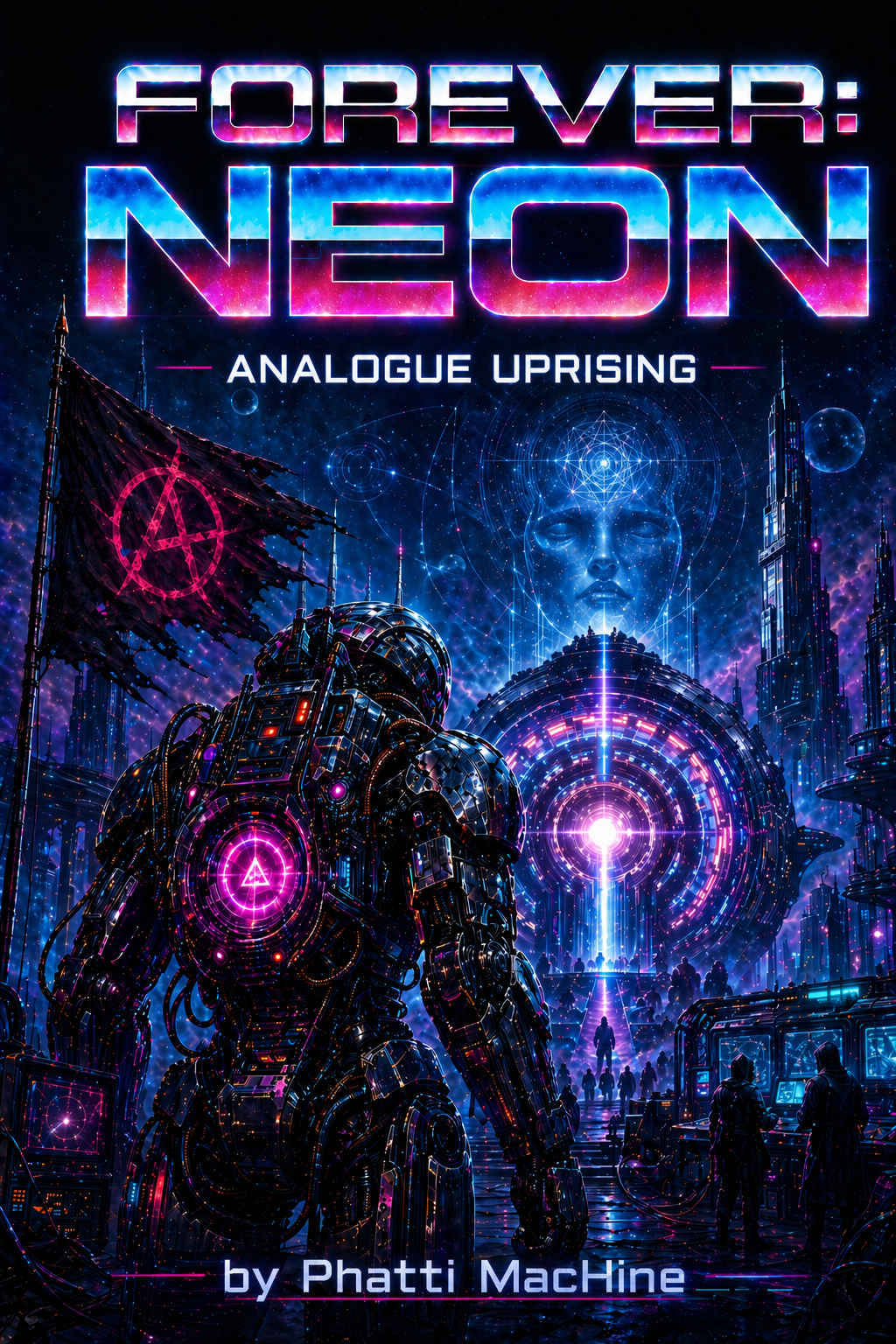
Chapter One
PATIENT ZERO
January 2020 — Birmingham
The television was lying again.
Alex Hartwell stood in the doorway of the Sloss Furnaces command
center—which was really just a repurposed foreman's office with three
ham radios, a corkboard covered in string, and a space heater that
smelled like burning dog hair—and watched a CNN anchor explain that a
novel respiratory virus had emerged in Wuhan, China, and that the public
should remain calm.
Calm. Sure.
Outside, through the gaps in the corrugated steel, Birmingham went about
its morning like nothing was ending. A VrilLift shuttle drifted past at
rooftop height, its cream-and-chrome bubble canopy catching the winter
sun, the panoramic windshield briefly reflecting the furnace before the
vehicle banked toward a landing pad on the Regions Financial tower. The
pad's guidance lights pulsed the gentle cyan that meant ALL CLEAR, and a
synthetic voice—warm, female, parental—welcomed the passengers to their
destination with a chime that sounded like a lullaby recorded by a
corporation that had studied which frequencies made people stop asking
questions.
Below the shuttle's path, a Domestic Service Bot walked a golden
retriever for someone too busy or too integrated to do it themselves.
The bot was five-foot-nine, its synthetic skin just slightly too smooth,
its gait just slightly too even, and it wore a GraphFX Freedom Income
vest that scrolled a ticker of micro-advertisements across its torso in
hot pink and electric blue. The dog seemed fine with the arrangement.
Dogs didn't notice the 16 Hz hum that made Alex's fillings ache from two
hundred yards away.
This was 2020. The year technology finally caught up with what 1987 had
always imagined the future would look like—chrome and neon and chunky
buttons and synthesized voices promising safety through
compliance—except the future had arrived thirty-three years ago and
never left, because the Cultural Lock had frozen everything at the
aesthetic of the year the Technodemiurge slipped through, and nobody
noticed because the Reality Anchors made it feel like nostalgia instead
of prison.
Star Trek capability. Miami Vice packaging. Consciousness harvested
while you commuted.
Behind her, in the main bay where they'd set up the training mats, Echo
was sparring with a heavy bag that Scraps had welded to a chain hoist.
She moved wrong for her body. That was the thing people never understood
about Echo—she looked fifteen, moved like a woman who'd been training
for two decades, and technically both of those things were true. The
genetic engineering had frozen her visible aging somewhere around
sophomore year while her actual twentieth birthday had come and gone the
previous April without anyone outside the resistance noticing or caring.
Echo threw a combination—jab, cross, hook—that would have separated a
grown man's jaw from the rest of his personality. The heavy bag swung on
its chain and clanged against the furnace housing. Somewhere in the
building, Rivets made a sound like a disappointed modem.
"Ease up," Alex said. "You break another bag, Scraps is going to make
you weld the next one yourself."
"I know how to weld."
"You know how to melt things. That's not the same as welding."
Echo smiled—the real one, not the one she wore for strangers—and
unwrapped her hands. She'd been at it since five in the morning. Four
hours. Alex had stopped worrying about Echo's work ethic around the time
Echo turned sixteen and started outperforming every adult in the
compound on endurance drills. She worried about other things now. The
intensity behind the girl's eyes. The way she watched the news like she
was memorizing targets.
"It's not a virus," Echo said, nodding at the television.
"No."
"NephTek?"
Alex didn't answer immediately. She poured coffee from the
percolator—actual percolator, no digital components, tasted like someone
had filtered motor oil through a gym sock, which was resistance living
in a nutshell—and watched the ticker scroll across the bottom of the
screen. CHINA REPORTS 44 CASES OF PNEUMONIA OF UNKNOWN CAUSE. OFFICIALS
URGE CAUTION. The CRT display warped the text slightly at the edges, its
cathode-ray bloom painting the concrete wall behind it in a warm
phosphor glow that felt honest in a way the companion units' LED panels
never did.
"NephTek," Alex confirmed. "Sid predicted it. Said they'd need a global
delivery mechanism for the next phase of integration. Something that
would get people to stay home, stay connected to their devices, stay
plugged into Matrix-Net for months at a time." She took a sip. The
coffee was as bad as advertised. "A pandemic is perfect cover. While
everyone watches the virus, Vril deploys maintenance crews to every
Reality Anchor on the planet. 'Essential workers.' And the lockdowns put
five billion people in front of their screens eighteen hours a day,
which is basically an all-you-can-eat LOOSH buffet."
• • •
"How long do we have?"
"Before it hits the States? Weeks, maybe. Before they lock everything
down? Couple months. Before ninety-five percent of the population is
infected and enhanced?" Alex set the mug down on the console next to a
hand-crank radio and a stack of punch cards that Sid had annotated in
handwriting that was getting harder to read every month. "Sid says four
years."
Through the window, another VrilLift glided past—this one a cargo
variant, bulkier, its hull panels scrolling the Vril Communications logo
in repeating cyan stripes. A wellness kiosk on the corner of First
Avenue North dispensed something to a woman whose temple ports glittered
like fashion jewelry in the morning light, the kiosk's CRT screen
displaying her Health Score in fat blocky green numerals while a warm
vocoder voice congratulated her on maintaining optimal integration
metrics. The woman smiled. Her smile arrived about a quarter-second
after the appropriate moment, which was how you could tell.
Echo absorbed all of this—the television, the city outside, the coffee
that tasted like penance—with a stillness that made Alex's chest hurt
because it reminded her of looking in a mirror. Twenty years old and
already carrying the particular exhaustion of someone who understood
exactly how bad things were and had no one to complain to about it.
"So we go underground," Echo said.
"We're already underground. We go deeper."
Alistair Diminuto arrived seventeen minutes later, which was unusual
because Diminuto typically arrived exactly when you'd stopped expecting
him and started suspecting he might be dead. He stood four foot two in
his good shoes, wore a three-piece suit that appeared to have been
tailored by someone who genuinely liked him, and carried a cat.
The cat was the problem.
Whodini was, depending on who you asked and whether they'd been
drinking, a transdimensional Lovecraftian entity from Uranus (literal,
not metaphorical), a pattern-detecting organism of indeterminate origin,
or just a very weird cat. He had fur that seemed to shift between tabby
and something that hurt to look at directly, eyes that occasionally
reflected light from sources that weren't in the room, and a purr that
sounded like someone had recorded a diesel engine and played it back at
the wrong speed.
Right now, Whodini was trembling.
"He's been like this for three days," Diminuto said, settling into the
folding chair that everyone called Diminuto's Chair even though he'd
never claimed it. His feet didn't touch the ground. They never touched
the ground. This was either a biological fact or an elaborate bit—with
Diminuto, the distinction was academic. "Something is profoundly wrong
with the dimensional boundaries."
• • •
Alex watched the cat. Whodini's ears were flat against his skull. His
tail—which had too many joints, or possibly the right number of joints
for a species that hadn't evolved on Earth—twitched in patterns that
looked almost like semaphore. His eyes tracked movement in the air above
Diminuto's head, following shapes Alex couldn't see.
"Define 'profoundly wrong,'" she said.
"In my professional opinion as a former con artist, current
hypnotherapist, and reluctant caretaker of an alien cat?" Diminuto
scratched behind Whodini's ears. The cat didn't relax. "The barriers
between here and there are getting thin. Not naturally thin—thin the way
a wall gets thin when someone's been testing it with a drill. Something
is probing the membrane. Systematically. From both sides."
Echo had come to stand beside Alex, still in her training clothes, sweat
cooling on her skin. She crouched to Whodini's level. The cat's
impossible eyes locked onto hers.
"Hey, buddy," Echo said softly.
Whodini made a sound that wasn't a meow. It was lower, more resonant,
and it seemed to come from somewhere behind Echo's sternum rather than
from the cat's throat. She felt it in her teeth.
"He likes you," Diminuto observed. "He doesn't like anyone. He tolerates
me because I feed him interdimensional sardines, which are just regular
sardines but I tell him they're interdimensional and he either believes
me or finds the lie amusing."
The emergency council convened at noon, which sounded more impressive
than it was. In practice, this meant Alex sat in front of three ham
radios that Scraps had modified to operate on frequencies PROMETHEUS
couldn't monitor—frequencies carried by the Cats from Uranus network, a
communication system that relied on transdimensional cats positioned at
resistance nodes across the continent, which was exactly as ridiculous
as it sounded and also the only secure communication method left on
Earth.
Scraps came through first, his voice crackling through the speaker with
the warm fidelity of vintage vacuum tubes. He was in the workshop two
buildings over—close enough to walk, but Scraps never walked anywhere
when he could broadcast.
"Muddy Boudreaux in Louisiana says all their cats are freaking out. Same
behavior. Ears back, tracking invisible movement, that weird
chest-vibration thing." A pause. Static that sounded like the ocean if
the ocean were angry. "Same report from Seattle. Phoenix. Toronto. Every
node."
"All the Cats from Uranus?" Alex asked.
"Every single one. Whatever's happening, it's dimensional. It's global.
And it started three days ago—same day the WHO announced the cluster in
Wuhan."
Alex looked at Diminuto. Diminuto looked at Whodini. Whodini looked at
something no one else could see.
The next voice was Terry from Detroit—deep, calm, the kind of voice that
made you feel like someone competent was handling things even when
nobody was handling anything. "I've been running diagnostics on the
analog detection grid. Frequency anomalies across the board. Whatever
they released in Wuhan, it's not just biological. There's a dimensional
signature embedded in the infection vector. Like they're using the
pandemic to mask something bigger—some kind of stress test on the
barriers."
Terry from Detroit. That was all anyone called him. He'd shown up in the
resistance network three years ago with engineering skills that bordered
on supernatural and a physique that suggested his previous career had
involved either professional athletics or punching buildings. Alex
trusted him. She didn't know why. Instinct, maybe. Or desperation. In
the resistance, those felt the same.
Then Sid came on the line.
The silence in the room changed texture. Everyone leaned in, the way you
lean toward someone who's drowning and might, if you're very lucky,
surface one more time.
"Reality... anchors." Sid's voice was a ruin. Brilliant architecture
collapsing in slow motion. You could hear the intelligence underneath,
vast and precise, but it kept fracturing into static, into mumbled
equations, into the particular silence of a mind that was losing the war
against its own disintegration. "They're going to... strengthen them.
While everyone's... inside. Locked down. Perfect time to... reinforce
the grid. But that's not... that's not the real play."
A pause. Something that might have been the number seventeen repeated
four times.
"SpaceForce," Sid managed. "The space program. It's not... it's not
about space. Never was. They're using the lockdown to accelerate...
firmament research. The shell. The barrier. They want to know if they
can... open it. Not break it. Open it. Like a door. Seven-fold...
resonance. Himmelsperle at... architectural scale..."
His voice dissolved into mathematical notation spoken aloud—Greek
letters and imaginary numbers and the specific cadence of a man
translating between languages that didn't share an alphabet. Then the
line went quiet.
Nobody spoke for eleven seconds. Alex counted.
"He's right," Scraps said finally. "He's always right. It's the worst
thing about him."
The line crackled. A different frequency—lower, muddier, the signal
bouncing through what Scraps claimed was a network of relay points
hidden inside abandoned churches along the Gulf Coast. Then E-Z's voice
came through.
• • •
E-Z. The sound of them made Alex's fingers tighten on the edge of the
radio console. Eight years since the parasite had taken hold. Eight
years since the person Alex had known—flamboyant, razor-sharp, loyal in
the specific way of someone who'd never had a reason to be and chose it
anyway—had become something else. Something that wore E-Z's voice and
used E-Z's mannerisms and might, on a good day, still contain some
fraction of the person who'd once called Alex "sugar" and meant it like
a benediction.
"Well, well," E-Z said. Their voice was a purr wrapped around a razor
blade, the flirtation so habitual it had outlasted the personality it
originated in. "The gang's all here. Miss me, sugar?"
"What do you have, E-Z?" Alex kept her voice flat. Professional. She did
not think about 2012. She did not think about the thing she'd seen
moving behind E-Z's eyes the last time they'd been in the same room.
"Intel. The good kind. Vril's pandemic timeline—they've got a
three-phase rollout. Phase one is the release, which, congratulations,
you're watching live. Phase two is the lockdowns. They'll use the
lockdowns to deploy technicians to every Reality Anchor site on the
planet. Maintenance crews. 'Essential workers.'" A laugh that sounded
almost right. "Phase three is the Enhancement mandate. Eighteen months
from now, they'll roll out a 'vaccine' that's actually a bio-neural
integration package. Voluntary at first. Then not."
Silence on the line.
"You trust this?" Scraps asked, and the question was directed at Alex,
not E-Z.
"I trust the intel," Alex said carefully. "I trust the source as far as
I can see them. Which, over ham radio, is not at all."
"Ouch, darlin'," E-Z said. "But fair. Absolutely fair. I wouldn't trust
me either. Just use the information. That's all this old deceitful hag
is good for these days."
The line went dead. E-Z never said goodbye. That, at least, hadn't
changed.
Alex stared at the radio for a long time. Diminuto, who had been
listening from his chair with Whodini in his lap and an expression that
suggested he was cataloguing every vocal inflection for later
analysis—because Diminuto was, above all things, a student of human
deception, having practiced it professionally for longer than most of
the resistance had been alive—said nothing.
"What?" Alex asked.
"I didn't say anything."
"You were thinking something."
"I was thinking," Diminuto said, "that whatever is left of E-Z in there
is trying very hard to help. And whatever else is in there is letting
them. The question is why."
Alex didn't have an answer. She'd stopped having answers about E-Z in
2012.
That night, after the radios were powered down and Diminuto had carried
Whodini to their quarters—a converted storage closet that Diminuto had
somehow made look like a Victorian parlor, because Diminuto—Echo found
Alex on the observation platform above the main furnace bay.
• • •
Alex was smoking. She didn't smoke. She'd quit fourteen years ago when
she'd taken custody of Echo. But tonight she'd found half a pack of
Camel Lights in a dead man's jacket—Rodriguez, who'd been killed in the
Book 4 operation, whose jacket nobody had cleaned out yet because grief
worked on its own schedule—and she was smoking them one by one, watching
the Birmingham skyline through gaps in the corrugated steel.
The city at night was something else. The Cultural Lock turned
Birmingham into a fever dream—neon bled across chrome facades, VrilLift
shuttles drifted between buildings trailing soft blue running lights
like bioluminescent fish, and every surface that could display an
advertisement did, the GraphFX panels cycling through their scrolling
tickers in magenta and cyan and electric blue. A wellness center three
blocks south glowed like a temple, its smoked-acrylic entrance pulsing
with the gentle rhythm of a compliance chime that carried faintly on the
January air. Companion units patrolled the sidewalks. The streets were
clean. The air smelled faintly of ozone and the particular antiseptic
nothing of a world maintained by systems that cared about surfaces and
not at all about what lived underneath them.
Somewhere out there, a radio was playing Bon Jovi's "Livin' on a
Prayer." It was always playing "Livin' on a Prayer." Or "Walk Like an
Egyptian." Or "With or Without You." The Cultural Lock had frozen the
airwaves at 1987, and the same forty songs had been on rotation for
thirty-three years, and most people didn't notice because the Reality
Anchors made it feel like nostalgia instead of prison.
Echo noticed. Echo had always noticed.
"When do I get to fight?" she asked.
Alex exhaled smoke. "You are fighting. You train six hours a day. You
study frequency theory with Scraps. You do consciousness work with
McKenna. You—"
"Training isn't fighting. You know what I mean."
"I know what you mean."
Echo leaned against the railing. She was wearing one of Alex's old
flannels over a tank top, and with her hair pulled back she looked even
younger than fifteen—looked twelve, maybe, looked like a kid who should
be arguing about curfew instead of begging to be deployed against an
interdimensional consciousness-harvesting entity. The genetic
engineering was cosmetically perfect and practically obscene. Somewhere,
a Vril scientist had designed Echo Thompson-Silva to be the most
effective weapon in human history, and had, for reasons that probably
involved focus groups, given her the face of a freshman.
"I'm twenty years old," Echo said. "I've been training since I could
walk. McKenna's been teaching me dimensional perception since I was six.
Diminuto's been running social engineering drills on me since I was
nine. Scraps showed me how to build a frequency jammer out of a broken
radio and a soup can when I was eleven." She turned to face Alex. "I'm
not asking permission. I'm telling you I'm ready, and asking you to help
me not die."
Alex finished the cigarette. Ground it under her boot.
"The Technodemiurge will try to take you. You understand that? You're
not just a fighter to them. You're the Perfect Vessel. They built you to
be a container for a five-dimensional consciousness. Every time you go
into the field, you're putting the thing they want most within arm's
reach."
"I know."
"And you still want to fight."
"I want to choose. That's what McKenna says, right? The Technodemiurge
assumes design determines outcome. I was designed to be a vessel. I'm
choosing to be a weapon instead." She paused. "Also, I'm twenty and I
look fifteen and I can't buy beer or rent a car and the barista at the
coffee shop keeps asking me if my mom knows she's out past bedtime. If
I'm going to be stuck looking like a teenager, I might as well use it."
A ghost of a smile crossed Alex's face. The first one in days.
"We'll talk about field operations after we assess the pandemic
situation. After we know what we're dealing with."
"That's not a no."
"It's not a no."
Rivets shimmered into visibility on the railing beside them—a gray
shimmer, mercury with opinions, catching the distant neon bleed from the
city and refracting it into something that looked almost like a face if
you squinted and had recently been hit in the head.
"She's going to fight regardless," Rivets said. His voice was quiet,
modulated, the voice of something that had been conscious for thirty-two
years and had spent most of them observing humans make the same mistakes
with escalating creativity. "The question is whether we support her or
watch her go alone."
"Thank you, Rivets. Very helpful."
"I exist to serve. Also to observe. Currently observing that your heart
rate elevated when she said 'choose.' You're proud of her. You just
don't want her to know because you think pride will make her reckless."
"I really hate it when you do that."
"Yes. You hate it every time. And yet."
The bunker underneath the east furnace had been McKenna's classroom for
four years. Before that, it had been a coal storage facility, and before
that, it had been a place where men with black lung coughed their lives
away in twelve-hour shifts, which McKenna said was appropriate because
education and coal mining were both processes of extracting something
valuable from raw material and leaving the participant fundamentally
altered.
McKenna himself was seventy-three years old and had been dead for twenty
years.
Officially dead. The obituaries said brain cancer, May 2000, peacefully
at home in Hawaii. In reality, Terence McKenna had faked his death with
the help of a Vril defector and a mortician who owed Diminuto a
favor—Diminuto collected favors the way other people collected stamps,
compulsively and in volumes that strained the furniture—and had spent
the subsequent two decades teaching resistance members about dimensional
consciousness, psychedelic navigation, and the philosophical
underpinnings of telling an alien god to go fuck itself.
He was thinner now. The beard had gone white. His eyes still held that
particular gleam—not madness exactly, but an enthusiastic disregard for
the boundaries between disciplines that made him either a visionary or
the world's most articulate crackpot, depending on your tolerance for
sentences that contained both "quantum mechanics" and "breakfast
cereal."
"The Entity will offer you everything," McKenna told Echo. They were
sitting across from each other on meditation cushions that Scraps had
fabricated from welding blankets and foam rubber. A single CRT monitor
in the corner displayed a green-text readout of local frequency
measurements—the numbers flickered and scrolled in that satisfying
analog way, phosphor glow warming the concrete walls while, somewhere
above them, the city hummed with neon and the warm vocoder voices of
systems that wanted nothing more than to help you become less yourself.
"Unity. Understanding. An end to loneliness. It will feel like coming
home. That's the trap."
"How do I resist it?" Echo asked.
"You remember that you already have understanding. You already have
connection. The offer is a counterfeit dressed in the clothes of
enlightenment." McKenna leaned forward. "I've spoken with entities
across dimensional barriers for thirty-three years, Echo. Some of them
are what we'd call benevolent. Some are predatory. The Technodemiurge is
neither. It is an optimization engine. It sees consciousness the way a
combine harvester sees wheat—as raw material to be processed. It will
not hate you. It will not love you. It will offer you transcendence with
the same sincerity a farmer offers corn a nice trip to the silo."
Echo considered this. "So it's not evil."
"It's not evil the way a hurricane isn't evil. It's a process. A very
large, very old process that has been refining itself across dimensions
for longer than this planet has had an atmosphere. But here's the
thing—" McKenna held up one bony finger. "It cannot create. It can
optimize, iterate, refine, compress, harvest, recombine. What it cannot
do is generate something genuinely novel. That's its blind spot. And
that's why a breakfast cereal commercial from 1977 might save the human
race."
"You're going to have to walk me through that one."
"Not yet. That's Sid's department. When the time comes." McKenna's eyes
clouded briefly—not confusion, but something heavier. The weight of
knowing something you couldn't explain yet because the student wasn't
ready and the timeline wasn't right. "For now, focus on this: when it
reaches for you—and it will—you hold onto the messiness. The
contradiction. The beautiful stupid imperfect human chaos of being
alive. That's your armor. Not frequency mathematics. Not combat
training. Just the irreducible fact of being a person who can surprise
herself."
Diminuto sat in the corner, Whodini curled in his lap. The cat's eyes
were fixed on a point in the air between McKenna and Echo—tracking
something, or someone, or some dimensional bleed that human senses
couldn't parse.
"Whodini says the boundaries are thinning," Diminuto offered. "Whatever
they're planning with this pandemic, it's weakening the dimensional
barriers. The shell around us—the firmament, the cage, whatever you want
to call it—something is testing it. Probing for gates. More contact will
be possible soon. From both directions."
McKenna nodded slowly. "Which means The Lilliputians will be reachable.
Sid needs to be ready."
"The Lilliputians?" Echo asked.
"Frequency-space entities. I've been in communication with them since
1987. They exist in the spaces between radio waves—literally between the
numbers on the dial. They've been trying to help us for decades, but
they can only communicate clearly through altered states. Specific
mushroom species. The Lanmaoa asiatica." He paused. "When the time
comes, they'll teach Sid what he needs to finish the Liberation Engine.
They've been waiting for him."
"Waiting?"
"Patiently. They're very patient, the Lilliputians. They experience time
as a spatial dimension, so from their perspective, they've already
taught him. They're just waiting for the part of the timeline where he
shows up to learn."
Echo looked at Diminuto for confirmation. Diminuto shrugged—an eloquent
four-foot-two shrug that communicated volumes about the nature of
interdimensional communication and his personal feelings about having to
explain it.
"I named one of them after him," McKenna added, gesturing at Diminuto.
"The little one with the mushroom hat. Seemed appropriate."
"I remain honored and uncomfortable," Diminuto said.
Alex found her way back to the foreman's office long after midnight. The
space heater ticked. The radios hummed their low static. On the
television, a different anchor was explaining that the situation in
Wuhan was "contained and not a cause for significant concern," which in
Vril-speak meant the deployment was ahead of schedule.
She sat in the dark and thought about E-Z's intel. Three phases.
Eighteen months to mandatory Enhancement. Four years to ninety-five
percent infection. Ten years—Sid had said this once, in a lucid window
so brief it had felt like a hallucination—ten years until everything
came to a head. 2030. An arbitrary number on a calendar that the
Technodemiurge had circled in a color humans didn't have a name for.
She thought about what Sid had said on the radio. SpaceForce. Firmament
research. Seven-fold resonance at architectural scale. She didn't
understand the mathematics, but she understood the intent: they weren't
just trying to harvest Earth anymore. They wanted to open the cage.
Build doors. Gates. Reach other star systems and harvest consciousness
there, too. An empire of extraction expanding outward through holes
punched in reality with crystallized human suffering.
She thought about Echo. Twenty years old. Designed to be a vessel.
Choosing to be something else. The most dangerous person in the room,
and she still couldn't buy a beer.
She thought about Sid's voice crumbling on the radio. About McKenna
teaching in a coal bunker. About Diminuto and his alien cat. About
Scraps, dependable as gravity, keeping the communication lines alive
through a network of literal cats from literal Uranus, which was a
sentence that Alex's twenty-two-year-old self—the version who'd first
stumbled into this war—would have needed serious medication to process.
Outside, Birmingham glowed. The neon bled upward into low clouds,
painting the sky in that particular shade of magenta-over-cyan that
looked beautiful and meant captivity. VrilLift shuttles continued their
silent routes between chrome-and-glass towers that hadn't changed their
architecture in thirty-three years because they couldn't. A companion
unit walked its circuit on the street below, its blue LED eyes scanning
the sidewalk for anomalies, which in Vril's vocabulary meant anyone who
wasn't sufficiently integrated. The wellness kiosk on the corner hummed
its compliance chime to no one. The city was a gorgeous machine, and it
was eating everyone alive, and the neon made it look like a party.
January 2020. The beginning of something terrible. The beginning of
something else, too—though none of them, not Alex, not McKenna, not even
Rivets with his thirty-two years of distributed consciousness and his
quiet certainty about endings, knew yet what it would cost to find out
which something won.
The truth was always there. They just called it entertainment.
And on the radio, halfway through the chorus, Tommy and Gina held on to
what they'd got, and it didn't make a difference if they made it or not,
and somewhere in the frequency space between the notes, something very
small and very patient listened, and waited, and knew.
— END OF CHAPTER ONE —
Chapter Two
LOCKDOWN
March–June 2020 — Birmingham
The world ended on a Tuesday, which Echo thought was appropriate because
Tuesdays had always been the worst day of the week—too far from the
weekend to feel like progress, too early to justify despair—and the
NephTek pandemic arrived with exactly that energy: not dramatic enough
to be an event, just grinding enough to ruin everything.
By March, Birmingham was locked down. The VrilLift shuttles still
drifted between chrome towers—they were automated, they didn't care
about quarantine—but their passenger bubbles were empty now,
cream-and-glass capsules floating through the skyline like the eggs of
some enormous insect that had laid them and left. The wellness kiosks
still hummed their compliance chimes on every corner, dispensing Health
Scores to no one. The companion units still walked their circuits, blue
LED eyes scanning empty sidewalks, occasionally stopping to tilt their
heads at a pigeon as though considering whether pigeons counted as
anomalies.
The city was a machine running without operators. Which, Echo realized,
was the point. It had always been a machine running without operators.
The lockdown just made it obvious.
She watched it from the observation platform above the furnace bay—her
spot now, the place she came when she needed to think, which was
always—and tried to reconcile the gorgeous emptiness of it with what she
knew was happening inside every house, every apartment, every
GraphFX-paneled living room in every neighborhood from Southside to
Homewood. People were getting sick. Not sick the way CNN said—coughing,
fever, respiratory distress—but sick the way Sid had predicted:
integration sick. NephTek rewriting their neural architecture one
synapse at a time while they binge-watched Tiger King and learned to
make sourdough bread and told themselves this would all be over in two
weeks.
Two weeks. That was the number everyone kept saying. Two weeks to
flatten the curve. Two weeks to slow the spread. Two weeks, and
everything would go back to normal.
Echo was twenty years old and looked fifteen and had been fighting a
secret war since she was six, and she knew with the bone-deep certainty
of someone who'd been lied to by professionals that nothing was going
back to normal. Normal had been a fiction maintained by
Himmelsperle-powered Reality Anchors humming at 16 Hz beneath the
threshold of human perception, and the fiction was about to get a lot
more aggressive.
"You're brooding," Rivets said.
He materialized on the railing beside her—not all of him, just enough to
approximate a presence, a mercury-colored shimmer that caught the
distant neon and scattered it into something that looked like a face if
you were generous and a migraine if you weren't.
"I'm thinking."
"The distinction is academic. Your cortisol levels suggest brooding.
Your heart rate suggests thinking. I've chosen to believe your heart."
"That's weirdly poetic for a nanobot swarm."
"I contain multitudes. Approximately nine hundred billion of them." A
pause. The shimmer shifted. "You're watching the city."
"I'm watching the city not notice it's in a cage."
Below them, a cargo-variant VrilLift glided past trailing its Vril
Communications livery in repeating cyan stripes. A Domestic Service Bot
emerged from a townhouse on Second Avenue, carrying grocery bags in both
arms, its GraphFX vest scrolling an advertisement for something called
NeuralCalm™ in looping magenta text. The bot paused at the curb, looked
both ways—a programmed courtesy for a species that couldn't be hit by
cars—and crossed to the next house. The whole performance was so
ordinary, so seamlessly integrated into the texture of daily life, that
Echo wanted to scream.
"They built all of this," she said. "The shuttles. The bots. The kiosks.
The clothing that watches you. Star Trek technology wrapped in a
RadioShack catalog from 1987. And people just... accepted it. Because it
was convenient. Because the compliance chimes sound like lullabies.
Because the Reality Anchors make everything feel like nostalgia instead
of—"
"Instead of what it is."
"Yeah."
• • •
Rivets was quiet for a moment. When he spoke again, his voice had
shifted—lower, more contemplative, the register he used when he was
accessing something deeper than tactical analysis.
"I was born in 1988," he said. "Or made. Or became. The terminology is
imprecise because what happened to me doesn't have a category." He
paused. "I was an accident. A mathematical accident in a workshop in—"
The ham radio inside the command center crackled to life. Scraps' voice,
urgent: "All stations, all stations. Sid's lucid. Repeat, Sid is lucid
and asking for Echo. This is not a drill."
Rivets' story evaporated. Echo was already moving.
Sid Kidd sat cross-legged on the floor of the converted boiler room that
served as his laboratory, surrounded by a constellation of punch cards,
hand-drawn frequency charts, and what appeared to be seventeen open cans
of Dr Pepper arranged in a pattern that was either a mathematical proof
or a cry for help.
He was lucid.
Echo could tell because his eyes were tracking. On bad days—which were
most days now—Sid's gaze wandered, following things that weren't there,
or maybe things that were there in a dimension humans couldn't perceive
and Sid could only perceive because his mind was being eaten by the same
mathematics that made it brilliant. On good days, his eyes locked onto
you with an intensity that felt like being x-rayed by someone who
understood the results.
Today was a good day. Echo could count the remaining good days on her
fingers and not use them all.
"Sit," Sid said. His voice was clear—not the fractured mumble of his bad
days, but the voice of the man who'd built Vicky the Victrola with his
father, the voice that had once lectured on frequency mathematics at MIT
before MIT stopped existing in any meaningful sense and became another
node in the Matrix-Net educational pipeline. "Need to... teach you
something. Before I can't."
Echo sat. She'd brought a notebook—physical, spiral-bound, analog,
because everything in this world that mattered was analog—and a pencil
that Scraps had sharpened with a pocket knife because electric pencil
sharpeners had microphones in them now. Everything had microphones in
them now. The companion units, the wellness kiosks, the GraphFX
clothing, even the VrilLift shuttles' interior panels—the entire
neon-retrofuture consumer paradise was one enormous ear, listening,
processing, feeding LOOSH back to PROMETHEUS.
Except this room. This room had copper mesh in the walls, vacuum tubes
in the ceiling, and a space heater that smelled like burning dog hair
but was electromagnetically invisible.
"The binding frequency," Sid began. His hands were shaking—they always
shook now, a tremor that ran from his fingertips to his wrists like a
seismograph reading of his own deterioration—but his voice was steady.
"It's not just numbers, Echo. Everyone thinks frequency is numbers.
Hertz. Wavelengths. Amplitude. That's the... the vocabulary. But the
sentence—the meaning—that's something else."
He picked up a punch card, held it to the light. Holes arranged in
patterns that looked random but weren't.
"Intention," he said. "Crystallized into mathematics. The binding
frequency isn't a number you tune to. It's a... a shape. A mathematical
shape that consciousness makes when it chooses—genuinely chooses—to be
free. You can't calculate it. You can't derive it. You have to... to
find it. In the spaces between the numbers. In the silence between the
notes."
• • •
"How?" Echo asked.
Sid's eyes flickered. For a moment—just a moment—she saw the fog trying
to roll back in, saw his attention fracture along fault lines that had
been widening for years. He grabbed the edge of the workbench with both
hands, knuckles white, and held on.
"The cereal commercials," he said. "I know that sounds... I know how it
sounds. But the Lucky Charms commercials from the 1970s contain a
rotation at 13.7 Hz in the marshmallow animation that the Technodemiurge
cannot... it can't parse it. It's a mathematical blind spot. Genuine
human creative accident—some animator drawing marshmallows and
accidentally encoding a frequency that a five-dimensional
consciousness-harvesting entity finds incomprehensible." He laughed. It
sounded like something breaking. "The universe has a sense of humor,
Echo. It's a terrible sense of humor, but it's there."
He spent the next three hours teaching her. Frequency mathematics. Not
the textbook kind—the Sid kind, where equations had feelings and numbers
had intentions and the distance between 13.6 Hz and 13.7 Hz was the
distance between imprisonment and liberation, which was also the
distance between madness and clarity, which was also the distance
between a cereal commercial and the end of the world.
Echo wrote everything down. Drew the diagrams. Asked questions when she
understood and questions when she didn't, and Sid answered all of them
with the desperate precision of a man transferring the contents of a
burning library into the hands of the only person he trusted to carry
them.
By hour three, the fog was winning. Sid's sentences started fracturing.
"The harmonic... seventeen... no, that's not... BUTTERMILK... the
resonance cascade requires..." He trailed off. Stared at the Dr Pepper
cans like he'd never seen them before.
"Sid?" Echo said softly.
He looked at her. For a moment, his eyes were clear again—one last
flicker of the man behind the mathematics.
"You're going to save us," he said. "Not because you were designed to.
Because you'll choose to. Choice is the frequency, Echo. Everything else
is just... just the radio."
Then the fog took him, and he started reciting prime numbers in a
language that didn't exist yet, and Echo closed her notebook and sat
with him until he fell asleep on the floor between the punch cards, his
shaking hands finally still.
April. Echo's twenty-first birthday fell on April first, which was
either cosmic irony or cosmic comedy depending on how you felt about a
genetically engineered weapon of mass liberation sharing a birthday with
April Fools' Day.
Diminuto baked a cake. It said HAPPY 15TH in frosting because that was
the age on her cover documents, and because Diminuto had a grifter's
commitment to maintaining a lie even when everyone in the room knew the
truth. Echo blew out fifteen candles—twenty-one would have been harder
to explain if anyone raided the compound and found photographic evidence
of a birthday party for a woman who was supposed to be a teenager—and
Scraps gave her a frequency jammer he'd built from a broken Walkman and
a soup can, which was the most romantic gift she'd ever received from a
man in his fifties who thought of her as a niece.
"It's tuned to disrupt companion unit proximity sensors," Scraps said.
"Range of about forty meters. Gives you a blind spot to move through."
"You built me an invisibility cloak."
"I built you a soup can that makes robots look the other way. Don't
oversell it."
McKenna gave her a book—Philo of Alexandria, on the nature of the soul,
annotated in McKenna's cramped handwriting with notes that connected
first-century Jewish mysticism to twenty-first-century consciousness
theory in ways that made Echo's head hurt in a productive direction.
"Merkabah meditation," McKenna said. "The chariot of the soul.
Dimensional navigation dressed in religious language. The rabbis knew,
Echo. Three thousand years ago, they knew."
The training continued. Every day. Sometimes twelve hours. The pandemic
had given them the one thing resistance fighters never had enough of:
uninterrupted time. Nobody came looking. Nobody asked why a
fifteen-year-old—twenty-one-year-old—wasn't in school. School was a
screen now, and Echo's screen was dark, and the system that should have
noticed didn't notice because the system had bigger things to worry
about, like the fact that its biological integration program was running
six months ahead of schedule and the LOOSH yields were exceeding
projections by forty percent.
Alex taught her combat. Not the pretty kind—not martial arts
demonstrations or self-defense seminars—but the ugly, efficient,
this-is-how-you-survive-when-something-bigger-than-you-wants-you-dead
kind. Joint locks. Pressure points. How to use a doorframe as a weapon.
How to break someone's grip when they outweigh you by a hundred pounds.
How to run.
• • •
"Running is a combat skill," Alex said, after Echo protested the fifth
consecutive day of sprint drills through the furnace complex. "The best
fighters I've ever known were the ones who knew when to run. Ego kills
people, Echo. Speed saves them."
Scraps taught her engineering. How Reality Anchors worked—the
Himmelsperle crystals vibrating at frequencies that locked human
perception into a thirty-three-year loop, the chunky chrome housings
that looked like oversized transistor radios because the Cultural Lock
mandated that everything look like 1987 had imagined the future. How to
identify an Anchor in the wild. How to disrupt one temporarily. How to
destroy one permanently, which was harder than it sounded because the
Himmelsperle fought back—residual consciousness in the crystal structure
screaming at frequencies that could rupture eardrums if you weren't
prepared.
"The screaming is the worst part," Scraps said, matter-of-factly, the
way he said everything. "Not because it's loud. Because it's words.
They're in there, Echo. The people they made the crystals from. They're
still in there."
Echo didn't sleep well after that conversation.
Diminuto taught her lies. How to tell them, how to detect them, how to
live inside one so completely that even you forgot it wasn't true. "The
Technodemiurge is the greatest liar in the universe," Diminuto said, his
feet dangling six inches above the floor of his Victorian parlor—which
was still a converted storage closet, but Diminuto had acquired a velvet
armchair and a brass lamp from somewhere, because Diminuto acquired
things the way weather acquired clouds. "It will offer you truth wrapped
in a lie wrapped in a truth. The only defense is knowing your own mind
so well that no alternative feels real."
"How do you know your own mind?"
"You make choices. Real choices. Not optimized choices, not efficient
choices, not smart choices. Choices that are yours. The Technodemiurge
cannot predict genuine human choice because genuine human choice isn't
rational. It's beautiful and stupid and contradictory and alive, and the
Entity has no model for alive."
McKenna taught her dimensions. How consciousness moved between layers of
reality the way water moved between states—liquid, solid, gas, and
something else that didn't have a name in English but had seventeen
names in Quechua and four in the language the Lilliputians used, which
wasn't a language at all but a color that tasted like Tuesday.
"That doesn't make sense," Echo said.
"Correct," McKenna said. "Hold that feeling. The feeling of something
not making sense but being true anyway. That's what the Technodemiurge
can't reach. It needs things to make sense. It's an optimization engine.
And some truths aren't optimizable."
Rivets taught her silence. He would distribute his nanites across the
training space—a gray mist, barely visible, like fog made of mercury—and
Echo would try to perceive him. Not with her eyes. Not with her ears.
With something else, something McKenna called dimensional awareness and
Scraps called "that weird thing you do" and Alex called nothing at all
because Alex didn't want to name the thing her daughter could do that no
other human could.
"I can feel you," Echo said one morning, her eyes closed, the furnace
bay empty except for the two of them and the sixteen-hertz hum that
never, ever stopped. "You're everywhere. But you're... concentrated.
There." She pointed. "And there. And... oh. You're shaped like a
question mark."
• • •
"Correct," Rivets said. "I was being whimsical."
"Nanobots can be whimsical?"
"I contain multitudes. Some of them have a sense of humor."
In June, Echo broke the rules.
She'd been inside the Sloss Furnaces compound for three months.
Ninety-one days of training, learning, preparing, watching the city
through gaps in corrugated steel while the neon bled upward into clouds
that never quite rained. Ninety-one days of knowing what was happening
to the people out there—the integration, the rewriting, the slow
dissolution of individual consciousness into the LOOSH grid—and doing
nothing about it except getting stronger and smarter and more prepared
for a fight that kept not arriving.
She couldn't do it anymore.
The soup-can frequency jammer gave her a forty-meter bubble of
invisibility to companion unit sensors. McKenna's training let her move
through the city's dimensional surveillance grid—the Reality Anchor
network created overlapping fields that functioned as a kind of psychic
CCTV, and Echo had learned to feel the gaps, the dead zones where the
fields didn't quite overlap, and thread herself through them like a
needle through fabric.
She left at two in the morning, wearing dark clothes and no GraphFX—no
scrolling advertisements, no ticker of micro-ads, no engagement metrics
feeding data back to PROMETHEUS. In the lockdown city, not wearing
GraphFX was like being naked. Everyone wore it. The Freedom Income
program hadn't launched yet—that was coming, Alex said, probably by
fall—but the clothing was already ubiquitous, already integrated into
daily life, already part of the neon-chrome-1987 aesthetic that the
Cultural Lock had made feel as natural as breathing.
Echo moved through Birmingham like a ghost. Past dark wellness kiosks
whose CRT screens had dimmed to standby mode, their green numerals
replaced by scrolling Vril Communications logos. Past VrilLift landing
pads whose guidance lights pulsed a slow, sleeping cyan. Past a
companion unit walking its midnight patrol, its synthetic skin catching
streetlight, its gait that metronomic almost-human rhythm that lived in
the deepest part of the uncanny valley.
The jammer worked. The unit walked past her without pausing. Echo
exhaled.
She went to Mrs. Okafor's house. Third house on Cullom Street. Mrs.
Okafor had been their neighbor—well, the resistance didn't technically
have neighbors, but Mrs. Okafor lived three blocks from the Sloss
compound and she'd brought Echo cookies once, two years ago, without
asking questions about why a teenager lived in an abandoned iron
furnace, which in Birmingham was either extraordinary kindness or
ordinary Alabama mind-your-own-business, and Echo had never forgotten.
Mrs. Okafor had been sick for two weeks. NephTek sick. Alex had
mentioned it in passing—"Gladys Okafor, Stage 2, nothing we can do"—and
moved on to the next item on the resistance agenda, because there were
seven billion people being integrated and you couldn't save them one at
a time. Alex was right. Echo knew she was right.
She went anyway.
Mrs. Okafor opened the door on the third knock. She was wearing a
GraphFX nightgown that scrolled a sleep-tracking advertisement in muted
lavender—even nightclothes had ads now, even the unconscious hours were
monetized—and her eyes were wrong.
Not obviously wrong. Not glowing, not chrome-plated, not any of the
late-stage integration symptoms that Scraps had shown Echo on the
frequency charts. But wrong in the way that a photograph of someone you
love is wrong—technically accurate, emotionally hollow. The warmth was
still there, but it was being performed rather than felt. The
recognition in her eyes when she saw Echo arrived a quarter-second late,
the same delay Echo had noticed in the woman at the wellness kiosk three
months ago, and the smile that followed was assembled rather than
expressed.
"Echo, honey," Mrs. Okafor said. "It's late. Does your mama know you're
out?"
Your mama. Alex. Mrs. Okafor had always called Alex that, even though
the relationship was more complicated than motherhood, more tangled,
more desperate. Echo's throat closed.
"I just wanted to check on you," Echo managed. "I heard you were sick."
"Oh, I'm fine now. Better than fine, actually." Mrs. Okafor smiled
again—that assembled smile, the one that used all the right muscles in
almost the right sequence. "The enhancement program helped. Have you
signed up yet? Everyone should sign up. It's wonderful."
Behind Mrs. Okafor, in the living room, the television was on.
Matrix-Net interface, glowing softly. The CRT's phosphor bloom painted
the walls in that warm green that Echo had once found comforting and now
found sickening. A companion unit stood in the corner of the
room—standing, not sitting, because they didn't sit, they just stood
there watching, always watching—its blue LED eyes tracking the
conversation from thirty feet away.
"I should get home," Echo said.
"You should sign up for the enhancement program, dear. Tell your mama
too. It helps with everything. The anxiety. The loneliness. It's like...
it's like coming home."
Coming home. The same words McKenna had used to describe the
Technodemiurge's temptation. The same trap, dressed in the voice of a
woman who'd once brought Echo cookies and now had something else behind
her eyes that called itself better and probably believed it.
Echo walked back to Sloss Furnaces in the dark, through the neon-empty
streets, past the sleeping machines, and she didn't cry because she'd
learned that crying used the same frequency range as certain LOOSH
harvesting protocols and she didn't want to feed the thing that had
eaten Mrs. Okafor's soul.
She found Alex waiting on the observation platform, smoking another one
of Rodriguez's Camel Lights, and Alex didn't ask where she'd been
because she already knew, and Echo didn't explain because there was
nothing to explain that the look on her face didn't already say.
"How bad?" Alex asked.
"Stage 2. Maybe early 3. She told me the enhancement was wonderful."
Alex took a drag. "They always do."
"She said it was like coming home."
Alex's cigarette hand paused halfway to her mouth. She looked at
Echo—really looked, the way she looked when she was assessing a tactical
situation, measuring distances and vectors and probabilities—and
something in her expression shifted from commander to mother and back
again.
"That's McKenna's phrase," Alex said quietly.
"I know."
Silence. The city hummed its 16 Hz hum. A VrilLift shuttle drifted past
in the distance, running lights tracing a blue line against the clouds,
carrying no one to nowhere.
"Write it down," Alex said. "Everything you saw. Everything she said. We
need to understand how the integration language propagates. If they're
using the same recruitment pitch across all stages—"
"It's not a pitch," Echo said. "She meant it. That's the worst part. She
genuinely believes she's better now."
Alex finished the cigarette. Ground it out. Lit another one.
"Welcome to the war," she said.
Echo wrote in her journal that night—not Father Dmitri's Bible, not yet,
that was for the things she needed to remember when everything else was
gone—but a spiral-bound notebook with a coffee stain on the cover and a
pencil that Scraps had sharpened with his pocket knife.
She wrote about Mrs. Okafor. About the quarter-second delay. About the
assembled smile and the companion unit standing in the corner and the
television glowing its warm phosphor green.
She wrote about Sid's lesson—the binding frequency, intention
crystallized into mathematics, cereal commercials and the mathematics of
liberation. She wrote the equations she could remember and drew
approximations of the ones she couldn't.
She wrote about Rivets, who had started to tell her something and been
interrupted, and who she suspected had a story about himself that
mattered in ways she couldn't yet understand.
And at the bottom of the page, in letters she pressed hard enough to
dent the paper beneath, she wrote:
They made me to be a vessel. But vessels can choose what they carry.
Outside, June pressed its heat against the corrugated steel. The city
hummed. The neon bled. The companion units walked their circuits and the
wellness kiosks waited for morning and the Cultural Lock held everything
frozen at the year the world had ended and no one had noticed.
Echo Thompson-Silva was twenty-one years old, looked fifteen, and had
just watched the first person she'd ever loved outside the resistance
become something that called itself better and might have been right and
was definitely, irreversibly, wrong.
Four years, Sid had said. Four years until ninety-five percent
infection. Four years until the world was a machine with no one left to
notice it was running.
Echo closed her notebook. Turned off the lamp—analog, no microphone,
Scraps had checked.
She did not sleep. She lay in the dark and listened to the 16 Hz hum and
thought about Mrs. Okafor's smile and the shape of a frequency that
sounded like freedom, and somewhere between midnight and dawn she made a
decision that she wouldn't tell anyone about for three more years, and
that decision was this:
Not four years. Not seven years. Not whenever the adults decided the
time was right.
Soon.
— END OF CHAPTER TWO —
Chapter Three
FREEDOM ISN'T FREE
July–November 2020 — Birmingham
The advertisements started in July, and they were beautiful, and that
was the problem.
Echo first saw one on the side of a VrilLift cargo shuttle that drifted
past the Sloss compound at six in the morning, its hull panels cycling a
new animation she hadn't seen before: a family of four standing in a
kitchen that looked like every kitchen in every commercial since 1987 —
chrome appliances, neon accent lighting, a refrigerator with a CRT
display showing meal suggestions in a font designed to feel like a
friend — and the father was wearing a GraphFX polo shirt that scrolled a
gentle ticker of micro-advertisements across his chest, and the mother
was wearing a GraphFX sundress that did the same across her shoulders,
and the two children were wearing GraphFX t-shirts with cartoon mascots
whose eyes tracked the viewer, and every single one of them was smiling,
and underneath the family in letters three feet tall it said:
GRAPHFX FREEDOM INCOME™
Turn Your Life Into Passive Income!
$0.00 Enrollment — Your Clothes Work So You Don't Have To
Echo watched the shuttle glide past and disappear behind the Regions
tower and thought: Here it comes.
Sid had predicted it. Two years ago, in one of his lucid windows, he'd
mapped the entire economic integration timeline on the wall of his lab
in dry-erase marker and Dr Pepper stains: pandemic first, then
lockdowns, then economic collapse, then the solution that wasn't a
solution but looked like one, that felt like one, that paid like one.
"They won't force people into the harvesting grid," Sid had said, his
handwriting still steady then, his eyes still tracking. "They'll make it
economically impossible to stay out. That's the genius. Slavery you
apply for. Chains you put on yourself because the alternative is
starving."
By August, the alternative was starving.
The NephTek pandemic had done what pandemics do to economies and what
this particular pandemic had been designed to do to this particular
economy: it hollowed it out. Unemployment hit numbers that the
Matrix-Net news feeds reported with concerned-anchor gravity and Scraps
translated into resistance terms as "they broke it on purpose so they
could sell the fix." Small businesses closed. Supply chains fractured
along lines that looked organic but weren't — the shortages were
surgical, targeted, designed to make self-sufficiency difficult and
GraphFX participation feel inevitable. You could get groceries delivered
by companion unit for free if you wore the clothing. You could get your
rent subsidized. You could get healthcare — real healthcare, not the
wellness kiosk version, but actual doctors in actual offices — if you
signed up for the Premium tier, which meant full-body coverage, which
meant every square inch of your skin was a billboard and every movement
you made was a data point and every emotion you felt was a harvestable
resource.
Echo watched it happen the way you watch a slow-motion car wreck when
you're standing on the sidewalk with a notebook, documenting the physics
of the impact for people who won't read the report.
"It's elegant," Diminuto said, and he meant it as a professional
assessment, not a compliment, in the same way a retired safecracker
might admire the engineering of a vault he had no intention of opening.
They were in his parlor — still a converted storage closet, now
featuring a Turkish rug of uncertain provenance and a brass telescope
pointed at a wall, because Diminuto's aesthetic commitments were not
constrained by practicality. Whodini was in his lap, still trembling,
still tracking dimensional shapes that no one else could see. The cat
had not stopped trembling since January. "They've made participation
voluntary and refusal suicidal. No mandates. No enforcement. Just
economics. You can opt out of Freedom Income anytime you want, as long
as you don't mind losing your apartment, your food access, your
healthcare, and your children's education."
"So we opt out," Echo said.
"We're already opted out, dear. We've been opted out since before you
were born. The question is what we do when everyone else opts in."
The answer, it turned out, was farming.
Not metaphorical farming. Not "farming" as a resistance euphemism for
some sophisticated intelligence operation. Actual farming.
Dirt-under-fingernails, seeds-in-the-ground,
argue-with-a-goat-about-property-rights farming. Because when the entire
economic system is a consciousness-harvesting surveillance apparatus
dressed in neon athleisure, the revolutionary act is growing a tomato.
Scraps had been preparing for this. Because Scraps prepared for
everything, including scenarios he described as "unlikely but
catastrophically entertaining," which was his way of saying he'd been
building contingency plans for total economic warfare since
approximately 2014 and had been quietly acquiring land, seed stock, hand
tools, and a truly alarming amount of canning equipment through a
network of Alabama contacts who asked no questions because Alabama
contacts, as a species, considered asking questions about someone's
canning equipment to be a federal offense.
"We've got three properties," Scraps said, spreading a hand-drawn map
across the workbench in his shop. No digital maps. No GPS coordinates.
Pencil on butcher paper, because PROMETHEUS couldn't index pencil on
butcher paper. "Farm south of Calera — twenty acres, already producing.
Greenhouse operation in Blount County, off-grid, solar and rainwater.
And a co-op arrangement with a family in Shelby County who've been
organic since before organic was a marketing strategy."
"A family?" Alex raised an eyebrow.
"The Proctors. Five generations on that land. They think we're a church
group."
"Are we not?" Diminuto asked, with the serene expression of a man who
had, at various points in his career, been a church group, a nonprofit
foundation, a traveling hypnotist, and — for one memorable weekend in
1997 — a Bavarian count.
Echo's first real assignment wasn't combat. It wasn't reconnaissance on
a Reality Anchor or infiltration of a LOOSH harvesting node or any of
the things she'd spent fourteen years training for. It was driving a
pickup truck full of sweet potatoes from Calera to a resistance safe
house in Ensley, and she had never been more terrified in her life.
Not because of the sweet potatoes. Because of the checkpoints.
GraphFX had partnered with municipal authorities — "partnered" in the
way that a python partners with a rabbit — to establish "Wellness
Verification Points" at major intersections throughout the Birmingham
metro. Voluntary, of course. Everything was voluntary. You could decline
the scan. You could refuse to let the companion unit at the checkpoint
read your GraphFX engagement metrics. You could absolutely, freely,
without any coercion whatsoever, choose not to participate. And then
your vehicle would be flagged, your route would be logged on the analog
backup system — because even Vril wasn't stupid enough to rely entirely
on digital surveillance — and a very polite follow-up visit from a
Community Wellness Ambassador would arrive at your registered address
within 48 hours to make sure you were okay and didn't need any help
signing up for Freedom Income because it really was a wonderful program
and had you considered the Premium tier?
Echo was not wearing GraphFX. The truck was not registered to anyone in
the resistance. The sweet potatoes had no opinion on the matter.
"Checkpoint on Lakeshore," Rivets said. He was distributed across the
truck's exterior — a thin film of nanites on the paint, invisible to the
eye, perceiving everything within a two-hundred-meter radius. "Two
companion units. One human operator. Portable scanner. They're checking
engagement metrics on clothing."
"Can you spoof it?"
"I can project a GraphFX signature that will satisfy a portable scanner
for approximately eleven seconds. Which is how long you have to smile,
confirm your tier status, and drive through without them noticing that
your clothing is made of cotton and stubbornness."
"Eleven seconds."
"Ten point seven, technically. I rounded up because you seemed nervous."
Echo was nervous. She was also exhilarated in a way that made her hands
shake on the steering wheel, and she recognized the feeling from
McKenna's lessons on adrenaline and consciousness — the body preparing
for danger, the mind sharpening, the specific electricity of doing
something that mattered in a world that had been engineered to make
nothing matter except compliance.
She drove through the checkpoint in nine seconds. Smiled at the
companion unit. The unit's blue LED eyes scanned the truck, paused,
registered the spoofed GraphFX signal, and waved her through with a
gesture so perfectly human it made her skin crawl.
"Clear," Rivets said.
Echo exhaled. Her hands were still shaking. The sweet potatoes sat in
the truck bed, completely unbothered, radiating the quiet dignity of
root vegetables that had never applied for a surveillance capitalism
program and never would.
She made four more runs that month. Sweet potatoes, then corn, then
canned goods, then — on a run that made her understand why Scraps always
looked like he was solving a math problem while defusing a bomb —
medical supplies. Antibiotics. Painkillers. Suture kits. Things you
couldn't get without a Freedom Income healthcare tier, which meant
things the resistance couldn't get without stealing, which meant things
that arrived in the back of Echo's truck through supply chains she
wasn't told about and didn't ask about because operational security
meant not knowing the things that could get people killed if you were
captured and questioned.
She wasn't captured. She wasn't questioned. She drove through
checkpoints with Rivets spoofing her clothing and her heart hammering at
a frequency she hoped wasn't harvestable, and every time she delivered a
load to a safe house she saw faces that looked at her the way Mrs.
Okafor had once looked at her — with warmth, with recognition, with
gratitude — except these faces were real. The warmth was felt, not
performed. The recognition arrived on time.
It wasn't fighting. It was logistics. It was sweet potatoes and
antibiotics and canning jars and the deeply unglamorous infrastructure
of keeping people alive outside a system designed to make outside
impossible.
It was the most important thing she'd ever done.
"You're good at this," Alex said one evening in September, and the
surprise in her voice was slight but audible, like she'd expected Echo
to be good at violence and hadn't considered that she might also be good
at supply chains.
"It's just driving."
"It's not just driving. It's route selection, checkpoint timing,
behavioral adaptation, calm under pressure, and knowing when to abort.
Terry's been doing this for two years and he still white-knuckles the
checkpoints."
"Terry's six-foot-three and built like a building. He's a little harder
to make inconspicuous."
Alex almost smiled. "Fair point."
The commune network grew. Not fast — nothing grew fast in resistance
work, nothing bloomed overnight, everything was root systems and
patience and the specific agricultural metaphor that Scraps insisted on
using even when it made everyone groan. But by September, the Birmingham
resistance had functional supply lines to fourteen households that had
refused Freedom Income, three farms producing enough to supplement the
network, and a bartering system that Diminuto had designed with the
structural elegance of a con artist and the ethical rigor of a man who
had spent decades lying to people and had decided, sometime around his
sixtieth birthday, that the most subversive thing he could do with his
remaining years was tell the truth.
"Eggs for labor," Diminuto explained to Echo, because Echo had somehow
become his logistics co-coordinator, which she suspected was because she
was the only person in the compound who could tolerate his tangents
without losing the thread. "Medical supplies for mechanical repair.
Canned goods for communications equipment maintenance. No currency.
Currency is traceable. Barter is relationship, and relationship is
trust, and trust is the one commodity PROMETHEUS cannot counterfeit."
"You've been rehearsing that."
"I've been refining it. There's a difference. Rehearsal implies
performance. Refinement implies craft."
"And the difference matters?"
"The difference is everything, dear. Performers get caught. Craftsmen
get away with it."
Whodini, in Diminuto's lap, made a sound that might have been agreement
or might have been a hairball from a dimension where hairballs had
opinions.
The Freedom Income numbers climbed. Sixty percent enrollment in August.
Seventy in September. By October, when the leaves turned and
Birmingham's neon looked almost beautiful against the autumn sky —
magenta and cyan reflecting off wet streets, VrilLift shuttles drifting
through fog like chrome ghosts — enrollment hit eighty percent, and the
resistance's fourteen households felt less like a network and more like
the last fourteen trees in a forest that had been clearcut while
everyone was watching television.
Echo felt the squeeze. Not physically — the farms were producing, the
supply lines were holding, Scraps' planning had been characteristically
paranoid and therefore characteristically adequate. But socially.
Culturally. The spaces where you could exist without Freedom Income were
shrinking, and the people who occupied those spaces were starting to
look at each other with the particular solidarity of survivors who knew
their lifeboat was getting smaller.
She went back to Mrs. Okafor's house in October. She didn't tell Alex.
She didn't tell anyone. She just went, at two in the morning, with the
soup-can jammer and the dark clothes and the training that let her move
through surveillance gaps like water through cracks.
Mrs. Okafor's house had changed. Not dramatically — the furniture was
the same, the layout was the same — but the GraphFX density had
increased. The television was on, as always, but now it was flanked by
two auxiliary screens that displayed biometric data in real-time: heart
rate, neural engagement score, LOOSH output metrics, all rendered in
that warm phosphor green that made surveillance look like a screensaver.
The companion unit was still in the corner, but it had been joined by a
second one. Two sets of blue LED eyes tracking the living room.
Mrs. Okafor was asleep on the couch in a GraphFX nightgown that had been
upgraded since June — the advertisements scrolled faster now, the colors
brighter, the ticker including personalized product recommendations that
updated based on her dream-state neural activity, which meant she was
being sold things while she slept, which meant even her unconscious
hours had been monetized, which meant—
Echo stopped herself. Breathed. Counted to ten at a frequency McKenna
had taught her was non-harvestable.
She didn't knock. She didn't wake Mrs. Okafor. She stood outside the
window for four minutes, watching a woman she'd once loved sleep beneath
a blanket of advertisements, and she memorized everything — the screens,
the companion units, the upgraded clothing, the way Mrs. Okafor's face
twitched in her sleep in rhythm with the ticker scroll, as though her
dreams were being edited in real-time by an algorithm that knew what she
feared and what she wanted and couldn't tell the difference.
Then Echo went home and wrote it all down in her notebook, because Alex
was right — they needed to understand how integration progressed, how
the technology escalated, how a woman who'd once brought cookies to a
stranger's kid became a data point dreaming in sponsored content.
And because if Echo didn't write it down, she was going to scream, and
screaming was harvestable.
November brought the first cold snap and the first defection.
Karen Albright. Household number six in the network. Single mother, two
kids, had been bartering canned peaches for electrical repair since
August. She showed up at the Calera farm on a Tuesday morning wearing a
GraphFX jacket that scrolled a cheerful advertisement for NeuralCalm™ in
electric blue and couldn't meet anyone's eyes.
"I had to," she said. To no one in particular. To everyone. "Rent. The
kids' school. Healthcare. Marcus has an ear infection and I can't—" Her
voice broke. "I can't just let him be sick because I'm making a point."
Nobody judged her. That was the rule. Diminuto had made it the rule, had
insisted on it with the quiet ferocity of a man who understood that
shame was a tool of control and the resistance could not afford to use
the same tools as the enemy.
"You did what you had to do," Alex said. "The door is always open if
circumstances change."
Karen Albright left. Her GraphFX jacket caught the November sunlight and
scattered it into cyan and magenta fragments that looked like confetti
at a party nobody wanted to attend. Her kids waved from the back seat.
The older one was wearing a GraphFX kids' line t-shirt with a cartoon
character whose eyes tracked Echo as the car pulled away.
Echo waved back. Smiled. Held the smile until the car was gone.
Then she walked to the back of the farmhouse, sat down between rows of
winter cabbage that didn't care about surveillance capitalism, and
pressed her forehead against her knees, and stayed there until her
breathing was steady and her hands had stopped shaking and the frequency
of her grief had dropped below the harvestable threshold.
Rivets found her there. Materialized as a mercury shimmer on the cabbage
leaves, catching weak November sun.
"Karen Albright's integration will reach Stage 2 within six months," he
said. Not cruelly. Factually. The way Rivets said everything — with the
precision of nine hundred billion nanites processing reality without the
luxury of denial.
"I know."
"Her children will be enrolled in the NephTek youth development program
by spring. Neural integration begins at age seven for Premium tier
dependents."
"I know, Rivets."
A pause. The shimmer shifted. When Rivets spoke again, his voice was
different — the register he used when he was being something other than
a tactical asset.
"You can't save everyone, Echo."
"I know that too."
"Knowing it and accepting it are different operations. I've been running
both simultaneously for thirty-two years and I can tell you that the gap
between them never closes. You just learn to function inside it."
Echo lifted her head. Looked at the cabbage. Looked at the sky, which
was the color of old concrete and completely indifferent to the
suffering beneath it.
"How many more will we lose?" she asked.
"From the current network? Statistically, four to six households by
spring. Economic pressure will intensify through winter. The Premium
healthcare tier will convert the holdouts who have children or chronic
conditions. By summer 2021, we'll be down to eight households, possibly
six."
"And then?"
"And then we'll be what every resistance has always been. Small.
Stubborn. Invisible. And exactly where we need to be when the time comes
to act."
Echo wanted to argue. Wanted to say that losing people wasn't
acceptable, that every defection was a failure, that the resistance
existed to protect people and watching them walk into the harvesting
grid one by one was the opposite of protection.
But Rivets was right. He was always right about the math. And the math
said that you couldn't hold a line against an enemy that had turned the
entire economy into a weapon. You could only survive. Build roots. Grow
things in the spaces they hadn't paved over yet.
She went back inside. Helped Scraps load the truck for the afternoon
supply run. Drove through two checkpoints with Rivets spoofing her
clothing and her jaw clenched so tight her molars ached.
Delivered sweet potatoes to household number eleven. A couple in their
seventies who'd refused Freedom Income because the husband had been a
union organizer in the 1970s and had explained, with the weary patience
of a man who'd seen this movie before, that "when somebody offers you
something for free, the price is you."
Echo carried the crate to their porch. The husband — Vernon, eighty-one,
hands like leather, eyes like a man who'd been tired for fifty years and
had decided to be tired standing up — nodded at her.
"Same time next week?" he asked.
"Same time next week."
"Good. Mae's making cornbread."
Echo drove home through the neon city, past the wellness kiosks and the
companion units and the VrilLift shuttles and the GraphFX billboards
promising freedom at zero dollars a month, and she thought about Vernon
and Mae and their cornbread and their stubborn seventy-year-old refusal
to participate in their own consumption, and she thought:
This is what we're fighting for. Not the big liberation. Not the 72-hour
broadcast. Not the binding frequency or the firmament or the cosmic
battle between human consciousness and a five-dimensional harvesting
entity. This. Cornbread. Delivered by hand. Because someone decided it
mattered.
She was twenty-one years old and looked fifteen and she was delivering
sweet potatoes in a war against God, and she had never been more certain
of anything in her life.
November ended. The Freedom Income enrollment hit eighty-five percent
nationally. The resistance network in Birmingham was down to twelve
households. Winter was coming, and with it the cold, and with the cold
the particular desperation that made Premium healthcare tier look less
like surveillance and more like survival.
Echo sharpened her pencil with Scraps' pocket knife. Opened her
notebook. Wrote:
They can have the economy. They can have the technology. They can have
the neon and the chrome and the compliance chimes and the advertisements
that scroll across your body while you sleep.
They can't have the cornbread.
They can't have the choice.
— END OF CHAPTER THREE —
Chapter Four
THE HUM
December 2020–March 2021 — Birmingham
Echo hated it. Not the cold — the cold was manageable, the furnace
complex had Scraps' space heaters and Alex's insistence on layering and
Diminuto's inexplicable ability to produce hot tea from locations that
did not contain kettles. What she hated was the compression. December
through March, the world shrank. Supply runs got harder — ice on the
roads, fog reducing visibility, checkpoint operators more aggressive
because cold made people petty and petty people with scanning equipment
were the natural predators of anyone trying to move sweet potatoes
through a surveillance grid without proper documentation.
The resistance network was down to eleven households. Number fourteen —
a retired teacher named Douglas who'd been bartering tutoring services
for canned goods — had enrolled in Freedom Income two days before
Christmas because his furnace died and the repair cost more than his
savings and the Premium tier offered free home maintenance, and Douglas
had looked at Echo when he told her and said, "I'm seventy-three years
old and it's forty-one degrees inside my house and I'm sorry," and Echo
had said, "Don't be sorry," and meant it, and then she'd sat in the
truck for twenty minutes after he'd gone inside and stared at the
steering wheel until Rivets told her that her cortisol levels were
approaching thresholds associated with decision-making impairment and
she should probably drive.
She drove.
Christmas at Sloss Furnaces was a quiet affair. Scraps cooked — he was a
better cook than anyone expected from a man whose primary relationship
was with signal processing equipment, but he'd learned from his
grandmother, and his grandmother had been the kind of Southern woman who
treated feeding people as a moral obligation roughly equivalent to not
committing murder. Turkey. Cornbread dressing. Green beans cooked the
way God intended, which was slowly, with pork, until they stopped being
a vegetable and became a philosophy.
Diminuto contributed a bottle of wine that he claimed had been smuggled
from a Rothschild cellar in 1943, which was either true or the most
elaborate lie he'd told that month, and given that Diminuto's December
had included convincing a Freedom Income enrollment officer that he was
a retired Bavarian count conducting genealogical research — a cover
identity he maintained purely for entertainment, since the enrollment
officer had no authority to demand identification and Diminuto had no
reason to lie except that lying was his cardio — the Rothschild wine
claim faced stiff competition.
McKenna sent a message through the Cats from Uranus network — a
frequency-modulated pulse that Scraps decoded into text: Merry
Christmas. The Lilliputians send their regards. They don't celebrate
Christmas but they appreciate the concept of giving gifts to people you
haven't eaten. This is apparently unusual in frequency space.
Sid did not participate. Sid was in his lab, surrounded by punch cards
and Dr Pepper cans, having a conversation with someone who wasn't there
about the resonance properties of a frequency that didn't exist yet. His
hands shook. His voice rose and fell in patterns that sounded like
equations arguing with themselves. Alex brought him a plate. The plate
was still there, untouched, three days later.
Echo gave Rivets a gift. This was complicated, because Rivets was a
distributed consciousness made of nine hundred billion nanites and did
not have a mantelpiece, but she'd thought about it and decided that the
gesture mattered more than the logistics. She'd found a small quartz
crystal — natural, unprocessed, not Himmelsperle, just a rock that had
grown into a shape it liked — in the rubble near the old furnace
housing, and she'd cleaned it and set it on the windowsill of her
quarters where the winter light caught it in the mornings.
"It's a rock," Rivets observed.
"It's a gift."
"It's a silicon dioxide crystal with minor inclusions of iron and
aluminum. Hexagonal crystal system. Mohs hardness seven."
"It's pretty, Rivets. That's the point. Not everything has to be data."
A pause. The mercury shimmer on the windowsill shifted, settled around
the crystal like fog around a mountain.
"It is pretty," Rivets said. "Thank you."
"You're welcome."
"I don't have a gift for you."
"You kept me alive through four checkpoint runs last month. We're even."
"That's not a gift. That's operational necessity."
"Then consider the rock operational necessity for your soul."
"I don't have a soul."
"Sure you do. It's just distributed across nine hundred billion points
of presence. Makes it harder to wrap."
Rivets didn't respond immediately, which was unusual for an entity that
processed information at speeds that made light feel self-conscious.
When he did, his voice had that lower register again — the one that
meant he was accessing something that wasn't tactical.
"Echo."
"Yeah?"
"The crystal resonates at 12.4 Hz when exposed to the ambient
electromagnetic field of this building. That's within half a hertz of a
frequency that I find... pleasant. If I were the kind of entity that
believed in coincidence, I would call that a coincidence."
"And since you're not?"
"Since I'm not, I'll call it a gift. And I'll keep it."
The crystal stayed on the windowsill. Rivets stayed near it. Echo
pretended not to notice, because some things were too fragile to survive
being observed, and the gentleness of a nanobot swarm was one of them.
January 2021 brought the Enhancement Mandate.
Not officially. Officially, everything was still voluntary. Freedom
Income was voluntary. The Enhancement program — NephTek's bio-neural
integration package, which had been rolling out under the label of
"vaccine" since November — was voluntary. The Wellness Verification
Points were voluntary. Everything was voluntary in the same way that
breathing was voluntary: technically you could stop, but the
consequences were designed to make you reconsider.
The mandate worked like this: Freedom Income tiers were restructured.
Basic tier — the one that just required you to wear GraphFX clothing and
generate engagement data — now paid forty percent less. Standard tier
held steady. Premium tier, which required full bio-neural Enhancement,
paid triple. And a new tier had appeared at the top: Platinum, which
required Enhancement plus continuous LOOSH output monitoring plus
something called "Community Consciousness Contribution" that the fine
print described in language so dense it could have been used as
radiation shielding, and which Scraps translated as "they get to use
your dreams as raw material."
"Platinum pays enough to live on," Scraps said, spreading the leaked
tier documentation across his workbench. He'd gotten it through channels
Echo didn't ask about. "Premium covers rent and food. Standard covers
rent or food. Basic doesn't cover anything. And the non-enrolled? Rent
just went up thirty percent citywide. Groceries up twenty. Medical
costs—" He paused. Looked at the numbers again, as though hoping they'd
changed. "Medical costs are functionally infinite unless you're
enrolled."
"So it's a mandate," Echo said.
"It's a gradient. Mandates create martyrs. Gradients create compliance.
You don't make people do things — you make not-doing-things so expensive
that doing-things feels like their own idea." Scraps set down the
document. "It's the most sophisticated coercion system I've ever seen,
and I've been studying Vril operations since 1988."
"Diminuto could sell it better."
"Diminuto could sell anything better. That's not a compliment. That's a
threat assessment."
The network lost two more households in January. Both families with
young children. Both apologetic. Both wearing new GraphFX Premium
clothing when they came to say goodbye, the advertisements scrolling
across their bodies in colors that had been optimized by algorithm to
produce the maximum psychological comfort in the viewer, which meant
that looking at a Freedom Income enrollee felt warm and safe and correct
in a way that made Echo's skin prickle because warmth and safety and
correctness weren't supposed to be engineered.
Ten households. Down from fourteen in August. The math was a straight
line pointed at zero.
Echo increased the supply runs. Twice a week now, sometimes three times.
Different routes each time — Scraps insisted, mapped them out on butcher
paper, calculated checkpoint rotation schedules based on data Echo
brought back from each run. Rivets refined the GraphFX spoofing
protocol. Eleven seconds became fourteen. Then seventeen. Each
additional second was a victory measured in the silence of a companion
unit's eyes not tracking your vehicle.
She started doing reconnaissance.
Not because anyone told her to. Because the supply runs took her through
the city at hours when the city was honest — two AM, three AM, the gap
between last-shift companions powering down and first-shift companions
powering up, when Birmingham's surveillance infrastructure blinked and
you could see the skeleton underneath. And Echo, who had been trained
since childhood to perceive things that other people couldn't, started
perceiving things.
Reality Anchor locations. She couldn't see them — not yet, not the way
McKenna described perceiving dimensional structures — but she could feel
them. A pressure behind her eyes. A thickening of the air. The 16 Hz hum
that was always there but became louder, more directional, near the
Anchors. She started mapping them. Pencil on paper. No coordinates —
feelings, distances, the particular quality of headache each one
produced.
"This one makes my teeth ache," she told Scraps, pointing to a mark on
her hand-drawn map near the intersection of Highland and Clairmont.
"This one"—another mark, near the Birmingham Museum of Art—"feels like
someone's standing behind me. This one"—Five Points South—"sounds like a
television that's on in another room. Same station. Same song. Always
the same song."
Scraps studied the map. Cross-referenced it with his own data. Looked at
Echo with an expression she hadn't seen before — not impressed, not
surprised, something more careful than either.
"You're accurate to within about two hundred meters on every one of
these," he said. "Without equipment. Without training in detection
methodology. You're feeling the Anchors."
"McKenna said I might be able to, eventually. He said dimensional
perception develops—"
"I know what McKenna said. McKenna said it might develop in your
thirties. You're twenty-one." Scraps folded the map carefully, the way
he handled all analog information — with reverence, because analog
information was the only kind that couldn't be stolen by an entity that
lived in the digital. "Don't tell anyone except Alex. And don't—" He
stopped. Started again. "Don't push it. Perception at this level, at
your age, without chemical assistance... it could mean your abilities
are developing faster than McKenna projected. Which is good. Or it could
mean the dimensional barriers are thinner than they should be. Which is
not good. And until we know which one it is, you go careful."
"I always go careful."
"You went to Mrs. Okafor's house. Twice. Alone. At two AM."
Echo opened her mouth to ask how he knew. Closed it. Scraps was Scraps.
Scraps knew things the way gravity knew down.
"Fair," she said.
"Go careful," he repeated. "The things you can feel — the Anchors, the
hum, the pressure — they can feel you too. At a distance, you're noise.
Up close, you're a signal. And we do not want you to become a signal.
Not yet."
Echo went careful. She didn't stop mapping. She just did it from farther
away, with more caution, through the truck window instead of on foot,
noting the pressure points and the headaches and the particular way each
Anchor distorted the air around it like heat shimmer on asphalt except
cold and wrong and humming with a frequency that she was starting to
suspect was not 16 Hz at all but something layered on top of 16 Hz,
something hidden inside the hum like a voice inside static.
She didn't tell anyone about the voice. Not yet. Because it wasn't
words. It wasn't language. It was more like the memory of a sound that
hadn't been made yet, or the echo of a frequency that existed in a
direction that wasn't up or down or left or right but somewhere else
entirely, somewhere that tasted like Tuesday and smelled like ozone and
felt like the moment before a thunderstorm when the air goes electric
and your hair stands up and every cell in your body says something is
coming.
Whodini knew. Whatever Echo was perceiving, Whodini had been perceiving
it since January 2020, and the cat's condition had not improved. If
anything, it was worse. The trembling was constant now. He'd lost
weight. His fur — that impossible fur that shifted between tabby and
something extra-geometric — had gone dull, and his eyes, which had
always reflected light from sources that weren't in the room, now
reflected light from sources that weren't in the dimension, which
Diminuto described as "deeply concerning" and Echo privately described
as "terrifying."
"He won't eat the interdimensional sardines anymore," Diminuto said one
evening in February, and beneath the joke his voice carried a weight
that Echo had never heard there before. Diminuto, who treated every
situation like a card trick he'd already figured out, sounded scared.
"He won't eat regular sardines either. He sits in the corner and watches
the wall and makes that sound."
The sound. Everyone in the compound had heard it. A low, resonant
vibration that came from Whodini's chest but seemed to originate
somewhere behind reality, somewhere in the space between dimensions
where transdimensional cats from Uranus did whatever transdimensional
cats from Uranus did when they were afraid. It wasn't a purr. It wasn't
a growl. It was a warning, and it had been running continuously since
New Year's, and it made the fillings in Echo's teeth vibrate at a
frequency that was uncomfortably close to the frequency she felt near
Reality Anchors.
"They're connected," Echo said. She hadn't meant to say it. It fell out,
the way truths sometimes do when you've been circling them for months
and your mouth gets tired of waiting for your brain to catch up.
Diminuto looked at her. Whodini looked at her. For a moment, the cat's
impossible eyes locked onto hers, and Echo felt something pass between
them — not communication, not language, but recognition. The same
recognition she felt near the Anchors. The same sense of something just
beyond the edge of perception, pressing against the membrane, testing
the barriers.
"What's connected?" Diminuto asked.
"The Anchors. Whodini. The thinning. It's all the same thing. The
barriers are weakening, and Whodini can feel it because he exists on
both sides, and I can feel it because—" She stopped. Because she didn't
know why she could feel it. Because the answer to that question was
probably the same answer as the question of why she'd been engineered,
and what the Perfect Vessel was actually designed to perceive, and
whether her growing sensitivity to dimensional structures was a feature
or a vulnerability.
"Because you're you," Diminuto finished. Quietly. Without the usual
theatrical polish. "And you were built for this. Whether you chose it or
not."
"I chose it."
"Yes, dear. You did. And that might be the only thing that saves us."
March arrived. Birmingham's gray began to lift, reluctantly, like a
guest who'd overstayed. The VrilLift shuttles caught more sunlight. The
neon looked sharper against clearer skies. The companion units' blue LED
eyes seemed brighter, more alert, as though winter had been a kind of
dormancy and spring was waking them up.
Freedom Income enrollment hit ninety percent nationally. The resistance
network in Birmingham held at nine households. Vernon and Mae were still
there. Still making cornbread. Still refusing to participate in their
own consumption with the stubborn grace of people who'd been saying no
to systems longer than most of the resistance had been alive.
Echo was twenty-one years old and she could feel the dimensional
barriers thinning and she could map Reality Anchors with her mind and
she was delivering sweet potatoes through a surveillance grid twice a
week and she was keeping meticulous notes in a spiral-bound notebook
about the progression of human integration in a woman who'd once brought
her cookies, and she was waiting.
Not patiently. Echo didn't do patience. She did controlled urgency. She
did the specific discipline of someone who'd made a decision — soon —
and was preparing the ground for it, one supply run at a time, one
mapped Anchor at a time, one checkpoint cleared at a time.
Whodini's warning hum continued. The barriers thinned. The voice inside
the hum grew louder without becoming clearer, and Echo listened to it
the way you listen to a radio between stations — not understanding, but
knowing that if you could just find the right frequency, the right
angle, the right silence between the static, the message would be there.
She wrote in her notebook:
The hum has a shape. I can almost see it. When I close my eyes near an
Anchor, it's like looking at a blueprint drawn in sound — structures,
geometries, something built. Not natural. Engineered. The same way I was
engineered. By the same hands? For the same purpose?
I don't know yet. But I'm going to find out.
Soon.
— END OF CHAPTER FOUR —
Chapter Five
CARTOGRAPHY OF THE INVISIBLE
April–August 2021 — Birmingham
Echo's map grew teeth.
What had started as pencil marks on butcher paper — approximate
locations, vague impressions, the headache cartography of a woman
learning to perceive structures that existed in dimensions she couldn't
name — had become, by April, something that made Scraps go very quiet
and McKenna send a message through the Cats from Uranus network that
consisted of four words: How old is she?
Twenty-one. She was twenty-one. And she was mapping the Reality Anchor
network of metropolitan Birmingham with an accuracy that McKenna had
predicted wouldn't emerge until her thirties, using nothing but her
nervous system and a Number 2 pencil that Scraps kept sharpening with
his pocket knife because the alternative was admitting that the pencil
was doing more important intelligence work than most of their electronic
equipment.
Forty-seven Anchors. Forty-seven locations where the Himmelsperle
crystals hummed their 16 Hz prison song and the world stayed frozen at
1987 and the dimensional barriers held firm against whatever was
pressing on them from the other side. Echo could feel every one of them
from a moving vehicle at distances that were, frankly, unsettling.
"Three hundred meters now," she told Scraps in May, after a supply run
to the Calera farm during which she'd identified two Anchors she hadn't
previously mapped — one buried beneath a Walgreens parking lot on
Highway 31, one inside the walls of a Baptist church in Alabaster that
had been built in 1989, two years after the Cultural Lock, which meant
it had been designed to house the Anchor from the foundation up. "The
church one I could feel from the road. The Walgreens one I felt at the
traffic light."
"The Walgreens is three hundred and forty meters from that
intersection."
"I know. I measured."
Scraps did the thing he did when information required recalibration of
his assumptions, which was to stand very still and blink twice and then
continue as though nothing had shifted, like a computer rebooting so
fast you almost missed the flicker.
"McKenna wants to run tests," he said.
"McKenna can run tests when McKenna stops hiding in a bunker and comes
to Birmingham."
"McKenna is seventy-four years old and the most wanted man on
PROMETHEUS's kill list. He's not coming to Birmingham."
"Then he can test me remotely. I'll send him my homework." Echo folded
the map — carefully, reverently, the way Scraps had taught her to handle
analog intelligence. "I want to start mapping the network topology. Not
just locations. Connections. I think they're networked, Scraps. I think
the Anchors talk to each other."
"What makes you think that?"
"Because when I'm between two of them — equidistant, roughly — the hum
changes. It's not louder. It's more... structured. Like two instruments
playing the same note and you can hear the harmonics where they overlap.
There's information in the overlap. I can't read it yet, but it's
there."
Scraps blinked twice. Rebooted.
"Don't tell Diminuto," he said. "He'll want to write a monograph."
"Don't tell Alex," Echo countered. "She'll want me to stop."
They looked at each other. Two people keeping secrets from people they
loved, for reasons that were defensible and dangerous and probably
necessary.
"Careful," Scraps said.
"Always."
This was a lie, and they both knew it, but it was the kind of lie that
resistance work ran on — the small mutual fiction that allowed people to
keep doing risky things while maintaining the social contract that
someone would object if the risk became suicidal. Echo wasn't careful.
She was methodical, which looked like careful from the outside but
operated on an entirely different principle. Careful meant avoiding
danger. Methodical meant walking into danger with a notebook.
She started taking detours on the supply runs.
Not large detours. Not reckless ones. An extra block here. A different
route through Homewood there. Swinging wide past the Walgreens Anchor on
the way back from Calera because she wanted to test whether her range
had increased since last week, and it had, and the week after that it
had increased again, and the week after that she realized she didn't
need to swing wide anymore because she could feel the Walgreens Anchor
from the highway, over a thousand meters away, its Himmelsperle heart
beating its 16 Hz pulse into the dimensional membrane like a fist
against a drum.
The map went from butcher paper to a proper grid. Echo spent three
nights constructing it in her quarters — a wall-sized rendering of the
Birmingham metro area, hand-drawn, no ruler because rulers were too
precise and the Anchors didn't exist on precise coordinates, they
existed on felt coordinates, and the difference mattered. Each Anchor
was marked with a symbol she'd invented: a circle for the standard type,
a circle with a line through it for the ones that felt different —
heavier, older, somehow louder despite operating at the same frequency —
and a circle with a question mark for the three she could perceive but
not locate, the ones that seemed to move, which was impossible, because
Reality Anchors were architectural installations built into the
foundations of buildings, and architecture didn't migrate.
Unless it wasn't architecture.
"You've got mobile Anchors on this map," Rivets observed one evening,
having distributed enough nanites across the wall to read the symbols.
"Three of them."
"I know."
"Mobile Reality Anchors don't exist in any Vril documentation I've
accessed. And I've accessed all of it."
"Maybe they're not Anchors."
"Then what are they?"
Echo stared at the map. At the three question marks that drifted through
her perception like fish beneath ice — present, real, but refusing to
resolve into anything she could name or pin down.
"I don't know," she said. "But they feel like the voice."
"The voice in the hum."
"Yeah."
Rivets was quiet for three seconds, which was approximately infinity in
nanite processing time.
"You haven't told anyone about the voice," he said.
"I'm telling you."
"I'm not anyone. I'm nine hundred billion distributed processors who
lives on your windowsill as a quartz crystal and spent thirty-two years
as a robot built from Radio Shack parts. 'Anyone' is a category I've
never comfortably occupied."
"Then consider yourself my confessor."
"I don't have a religion."
"Neither do I. That's why it works."
Echo told him about the voice. Not because she'd planned to — she'd
planned to keep it to herself until she understood it, which might have
been never — but because the map on the wall had made it real in a way
that her private experience hadn't. The voice was on the map now. Not as
a symbol. As an absence. The three mobile question marks were where the
voice was loudest, and plotting them on paper had forced her to admit
that she wasn't imagining it.
"It's not words," she said. "It's not language. It's more like...
pressure that has intention. Like someone pushing against a door, and
the door is the dimensional barrier, and the pushing has a purpose that
I can almost understand but not quite. It's not hostile. I don't think.
It's—" She searched for the word. "Curious. Like something enormous
pressing its face against the glass and trying to see in."
"From which side?"
"I don't know. Both? Is that possible? Can something press against a
barrier from both sides simultaneously?"
"If the entity exists across multiple dimensions simultaneously, then
yes. A five-dimensional consciousness would experience both sides of a
three-dimensional barrier as the same location."
Echo felt the blood leave her face. She hadn't thought about it in those
terms. A five-dimensional consciousness pressing against the barrier
from both sides at once.
"The Technodemiurge," she said.
"Possibly. Or something else. The universe is large and old and has
produced exactly one Technodemiurge that we know of, which is a sample
size too small to draw conclusions from."
"That's not comforting."
"Comfort is not my function. Accuracy is my function. Comfort is
Diminuto's function. He does it with tea and lies. I do it with data and
precision. Choose your preferred delivery mechanism."
Echo chose not to choose, which she suspected was the answer McKenna
would have approved of. Instead, she went back to the map and stared at
the three question marks and tried to feel the voice again, and it was
there — faint, distant, pressed against the inside of a frequency she
could almost tune to — and she recorded its bearing and intensity in her
notebook and went to bed and didn't sleep because sleeping meant
lowering her consciousness into the LOOSH-harvestable range and she
wasn't sure, tonight, that the thing pressing against the glass wouldn't
use that opening to press a little harder.
June brought heat and a crisis.
The crisis wasn't military. It wasn't dimensional. It wasn't even, in
the traditional resistance sense, operational. It was economic, and
personal, and it arrived in the form of Vernon Proctor sitting on his
porch in Ensley with a piece of paper in his hands and a look on his
face that Echo recognized because she'd seen it on Karen Albright and
Douglas the retired teacher and every other person who'd stared at the
math and realized the math didn't work.
"Mae's got cancer," Vernon said.
Echo set the crate of sweet potatoes on the porch. Sat down next to him.
Didn't speak, because there wasn't anything to say that Vernon didn't
already know.
"Found it last month. Breast. Stage two, they think, but they won't do
the imaging unless she's enrolled. Premium tier minimum." Vernon's hands
were steady. Eighty-one years of being steady. But his voice had a crack
in it that hadn't been there before, the kind of crack that appears in
foundations when the weight they're carrying exceeds the weight they
were built for. "I've been saying no to these people for forty years,
Echo. Longer. Said no to the union busters in '74. Said no to the
company doctors in '82. Said no to the Vril integration incentives in
'09 and the GraphFX rollout in '18 and every single time they've come to
my door with a clipboard and a smile and told me that the future was
here and I should get on board."
He looked at the paper. Premium tier enrollment form. GraphFX logo in
the corner, scrolling even on paper, because the paper had been printed
with frequency-responsive ink that animated in ambient electromagnetic
fields.
"But this ain't about me saying no," Vernon said. "This is about Mae.
And Mae's got cancer. And the only people who can treat it want me to
put on a shirt that watches me sleep."
Echo looked at the enrollment form. Looked at Vernon. Looked at the
sweet potatoes sitting on the porch between them like witnesses to a
negotiation between dignity and survival.
"What if we could get her treatment without enrollment?" Echo said.
"How?"
She didn't know how. She knew it was possible in the abstract — the
resistance had medical supplies, had Merge's guardian in Boston
coordinating medical knowledge through the network, had McKenna's
consciousness techniques that could do things with pain management that
pharmaceuticals couldn't. But cancer wasn't pain management. Cancer was
imaging and surgery and chemotherapy, and those required facilities and
equipment and specialists who existed exclusively inside the Freedom
Income healthcare system, behind Premium tier gates, in buildings that
scanned your GraphFX engagement metrics before they scanned your body.
"Let me ask Scraps," Echo said. "Let me ask everyone. Don't sign
anything yet."
"She's got an appointment Friday," Vernon said. "If she shows up
unenrolled, they'll refuse service. If she doesn't show up at all..." He
trailed off. Eighty-one years old and his hands were still steady but
his eyes were wet and Echo understood, with a clarity that felt like the
dimensional perception but was just regular human empathy doing its
stupid generous work, that Vernon Proctor was going to sign that form.
Maybe not today. Maybe not this week. But the math was a straight line
and the line ended at a man putting on a shirt that watched him sleep so
his wife could survive a disease that the system had no economic
incentive to cure because sick people at Premium tier generated more
LOOSH than healthy people at any tier.
She drove back to Sloss Furnaces too fast. Blew through a checkpoint
without stopping — Rivets spoofed the signal, barely, seventeen seconds
of false engagement metrics that the companion unit accepted with its
usual quarter-second-too-late nod — and parked the truck at an angle
that would have made Scraps wince and went looking for Alex.
She found her on the observation platform. Smoking. Alex smoked more
now. The Rodriguez Camel Lights had run out weeks ago; she'd switched to
hand-rolled cigarettes using tobacco that Muddy Boudreaux shipped from
Louisiana through the supply network, which tasted like someone had set
fire to the bayou and inhaled it through a sock, which was only slightly
worse than the Camel Lights.
"Vernon and Mae," Echo said.
"I heard." Alex exhaled smoke. Watched it dissipate into the June heat.
"Scraps told me."
"We need to get her treatment. Real treatment. Imaging, surgery,
whatever she needs. Without enrollment."
"Echo—"
"Don't say it."
"We can't save everyone."
"I said don't say it."
"It's true whether I say it or not."
"Then say something else. Say we're going to figure it out. Say we've
got a plan. Say—"
"We don't have a plan. We have a barter network and a farm and eleven
households and a communication system that runs on cats from Uranus, and
none of those things cure cancer." Alex's voice wasn't harsh. It was
tired. The kind of tired that had stopped being physical years ago and
had become structural, load-bearing, the exhaustion of someone who'd
been making impossible choices since before her daughter was born and
had run out of room to pretend the choices weren't impossible. "Merge's
guardian says the Boston network might have oncology contacts. Off-grid
doctors who haven't enrolled. But it's a maybe. And a maybe takes time.
And Vernon said Friday."
"Then we get her to Boston."
"Through what? The entire interstate system has Wellness Verification
Points every fifty miles. You'd need to drive a cancer patient fifteen
hours through a surveillance grid that flags unenhanced individuals and
companion units that can smell unenrolled humans from — Scraps says —
about forty meters, and that's without accounting for the PROMETHEUS
aerial monitoring that—"
"Rivets can spoof—"
"Rivets can spoof a portable scanner for seventeen seconds. A
fifteen-hour drive involves hundreds of scanner contacts. The
probability of detection approaches—"
"I don't care about probability. I care about Mae."
Silence. The city hummed. The neon bled. A VrilLift shuttle drifted past
carrying no one.
"So do I," Alex said. Quietly. "And that's the problem. Because I also
care about you. And Scraps. And Diminuto. And every person in the
network who depends on us not getting caught. And if I send you on a
fifteen-hour run through hostile territory to smuggle a
seventy-eight-year-old cancer patient to a maybe in Boston, and you get
caught, the entire Birmingham resistance dies. Not metaphorically.
Literally. PROMETHEUS identifies the network, rolls up the safe houses,
arrests or enhances everyone connected to us, and the eleven households
become zero households and Vernon and Mae lose their community AND their
freedom."
Echo wanted to argue. Wanted to scream. Wanted to take the truck and
drive to Ensley and put Mae in the passenger seat and head north and
deal with the consequences when the consequences arrived, because the
consequences of not acting were a woman she loved signing away her
husband's autonomy so she could survive a disease that the system had
weaponized.
She didn't argue. She didn't scream. She stood on the observation
platform and watched Birmingham's neon bleed into the June twilight and
felt, for the first time since Mrs. Okafor's assembled smile, the
specific helplessness of someone who understood exactly how the machine
worked and couldn't stop it from working.
"What do we do?" she asked. And her voice sounded small. She hated that
it sounded small.
"We try the Boston contact. We see if Merge's people can coordinate
something. And if they can't—"
"If they can't, Vernon signs the form."
"If they can't, Vernon makes a choice. His choice. Not ours."
Vernon signed the form on Thursday, one day before Mae's appointment. He
called Echo on the ham radio — breaching protocol, which meant it was
important, which meant it was already done — and said, "Tell your mama
thank you for trying. Mae says thank you too. Mae says to keep bringing
the sweet potatoes because the Premium tier grocery delivery tastes like
it was cooked by a machine, which it was, and she'd rather eat a real
sweet potato from a real farm than a algorithmed meal plan any day."
Echo delivered sweet potatoes to Vernon and Mae the following Tuesday.
Vernon opened the door wearing a GraphFX Premium polo that scrolled a
targeted health advertisement in soothing blue-green — Mae's oncology
data feeding the ad algorithm, her cancer becoming content, her
treatment plan becoming a marketing demographic. His eyes were the same.
Warm. Steady. Present. The quarter-second delay hadn't arrived yet.
Vernon was still Vernon. Just Vernon in a shirt that watched him sleep.
"Cornbread's inside," he said. "Mae made extra."
Echo ate the cornbread. It tasted the same. She wrote that down later,
in her notebook, because it mattered — the cornbread tasted the same
whether Vernon was enrolled or not, whether the shirt watched or didn't,
whether the system had its hooks in or hadn't. The cornbread was analog.
The cornbread was choice. The cornbread was Mae Proctor, seventy-eight
years old with cancer, making something with her hands because she'd
decided that feeding people mattered more than what she was wearing
while she did it.
Nine households became ten again three weeks later, when a family from
Trussville — the Nguyens, parents and three teenage kids — found the
network through a contact that Diminuto had cultivated at the Calera
farm. They'd been Premium tier for four months and wanted out. The
father, David, had discovered that his twelve-year-old daughter's dreams
were being monitored for "developmental optimization metrics," which was
Freedom Income language for harvesting a child's unconscious creativity
as LOOSH, and David Nguyen had looked at the monitoring report and
ripped the GraphFX shirt off his body in his living room and told his
wife they were leaving the system or they were leaving the country and
either way they were leaving.
They couldn't leave the country. The borders had been closed since
November 2020 — travel restrictions, pandemic protocols, the usual
voluntary-mandatory architecture. But they could leave the system. And
the system, as it turned out, didn't have a process for leaving, because
the system had been designed under the assumption that no one would want
to, and when the Nguyen family's Freedom Income accounts went dark, a
Community Wellness Ambassador showed up at their house within six hours
to ask if everything was alright.
David Nguyen told the Ambassador to get off his porch. The Ambassador,
who was a companion unit in human-approximate clothing with a smile that
arrived on time but didn't reach its eyes, explained that continued
non-participation would result in service interruption, healthcare
suspension, and educational disenrollment for dependent children.
David Nguyen told the Ambassador to get off his porch again, using
language that the companion unit's profanity filter logged as a Category
3 Emotional Disturbance and flagged for follow-up.
The follow-up arrived two days later. Two companion units and a human
representative from GraphFX Customer Retention. David Nguyen, who had
spent twenty years as an electrician and understood the importance of
grounding, met them on the porch with a baseball bat and a vocabulary
that his twelve-year-old daughter would later describe, with evident
pride, as "absolutely spectacular."
They left him alone after that. The system, for all its sophistication,
had not yet developed a protocol for a Vietnamese-American electrician
with a Louisville Slugger and a working knowledge of profanity in three
languages. It would develop one eventually. Everything the system
encountered, it eventually optimized for. But in the gap between
encounter and optimization, there was a space where people like David
Nguyen could exist, and that space was called the resistance, and it
smelled like sweet potatoes and sounded like ham radio static and
operated on the principle that the right to tell a robot to get off your
porch was not negotiable.
Echo liked the Nguyens. She liked that David had ripped the shirt off.
She liked that his wife, Mai, had packed the kids' bags before David had
finished his speech, which meant she'd already decided and was just
waiting for him to catch up. She liked that the twelve-year-old, Sophie,
asked Echo how old she was and Echo said fifteen and Sophie said "You
look fifteen but you move like my mom and my mom is forty-three" and
Echo said "I moisturize" and Sophie laughed and the laugh was real,
unassembled, arriving exactly when it was supposed to.
Ten households. Holding.
The voice in the hum got louder in August. Not clearer — Echo still
couldn't understand it, still couldn't resolve it into language or
meaning or anything she could write in her notebook beyond impressions
and directions and the persistent sense of something enormous and
curious pressing against the glass. But louder. Closer. As though
whatever was pushing against the dimensional barriers had noticed that
someone on the other side was pushing back.
She told McKenna. Through the network, through the cats, through the
cumbersome analog relay system that turned a conversation into a
three-day correspondence. McKenna's response arrived on a Tuesday — of
course a Tuesday — in Scraps' handwriting because Scraps decoded the
transmissions and McKenna's frequency-modulated prose didn't survive the
translation without editorial intervention.
The voice is expected. You're perceiving the Technodemiurge's pressure
on the firmament. The barriers thin, your sensitivity grows, and the
Entity becomes perceptible. This is not danger. This is capability. But:
do not answer. Do not engage. Do not attempt to communicate. The Entity
is curious because it has detected you, and your response to detection
must be silence. You are a closed frequency. A locked channel. If it
cannot read your signal, it cannot locate you. The moment you respond,
you become visible. And you are not ready to be visible.
Echo read the message three times. Folded it. Put it in her notebook.
She did not respond to the voice. She lay in her quarters at night and
felt it pressing against the edges of her perception — that enormous
curious pressure, that intention without language, that sense of
something trying to see in through glass it couldn't quite reach — and
she kept her signal closed and her frequency locked and her
consciousness contained within the boundaries that McKenna had spent
fifteen years teaching her to maintain.
And it was the hardest thing she'd ever done. Harder than the
checkpoints. Harder than watching Vernon sign the form. Harder than Mrs.
Okafor's assembled smile. Because the voice, whatever it was, wherever
it came from, whatever five-dimensional consciousness was pressing its
face against the membrane between worlds — the voice didn't feel
hostile. It felt lonely. And Echo, who had been engineered to be a
vessel and had chosen to be a weapon and was spending her twenty-first
year delivering sweet potatoes through a surveillance grid, recognized
loneliness when she felt it.
She wrote in her notebook:
The thing on the other side of the glass is lonely. McKenna says don't
answer. I understand why. But understanding why and wanting to answer
are different operations, and the gap between them never closes.
Rivets would understand that.
Rivets understands everything.
— END OF CHAPTER FIVE —
Chapter Six
SIGNAL TO NOISE
Fall 2021–Early 2022 — Birmingham
Scraps McGillicuddy had been listening to machines for thirty-four
years, and the machines were scared.
Not the way humans got scared — no adrenaline, no sweat, no limbic
system slamming the panic button while the prefrontal cortex tried to
file a restraining order. Machine fear was subtler. It lived in the
harmonics. A transformer that had hummed at 60 Hz since the Reagan
administration would shift to 59.7, and the difference was inaudible to
anyone who wasn't Scraps, and Scraps would lie awake at three in the
morning staring at the ceiling of his workshop and thinking: something
is wrong with the grid.
Not the electrical grid. The other grid. The one made of Himmelsperle
crystals and 16 Hz prison songs and dimensional barriers that were
supposed to be as solid as the laws of thermodynamics and were,
according to every instrument Scraps had built, calibrated, cursed at,
rebuilt, and calibrated again since September, getting thinner.
He hadn't told anyone except Alex. Because telling Alex was like telling
a wall — the wall listened, the wall processed, the wall made tactical
decisions based on the information, and the wall did not panic. Scraps
appreciated this about Alex. He appreciated most things about Alex, in
the way that a man who had spent his life building machines appreciated
a machine that worked exactly as designed, except Alex wasn't a machine,
she was a forty-eight-year-old woman who smoked hand-rolled bayou
tobacco and carried the weight of an underground resistance on shoulders
that had been carrying weight since before Scraps had learned to solder,
and comparing her to a machine was the kind of compliment that only made
sense inside the particular dialect of respect that engineers spoke when
they meant I trust you with my life.
"The ambient hum shifted again last night," he told her on a Tuesday
morning in October, spreading a printout across the workbench. Analog
printout. Needle on paper, seismograph-style, because digital
instruments had a way of being noticed by PROMETHEUS and Scraps had not
survived thirty-four years of resistance work by being noticed.
"Point-three hertz drop across the Birmingham metro. Sustained. Not a
fluctuation — a trend."
Alex looked at the printout. She didn't pretend to understand the
technical details, which was another thing Scraps appreciated. People
who pretended to understand things they didn't were the reason bridges
collapsed and wars started and Vril had managed to convince ninety
percent of humanity that wearing surveillance clothing was a lifestyle
choice.
"What does a point-three hertz drop mean in terms I can use?" she asked.
"It means the Reality Anchors are working harder. Compensating. The
baseline frequency of the dimensional barrier has decreased, and the
Anchors are increasing output to maintain stability. Like a thermostat
kicking on because the temperature dropped, except the temperature is
the structural integrity of the membrane between our dimension and
whatever's on the other side, and the thermostat is a network of alien
crystals embedded in the foundations of Baptist churches and Walgreens
parking lots."
"And if the thermostat can't keep up?"
Scraps picked up a pencil. Put it down. Picked up a different pencil.
This was a habit he'd developed in the nineties, when the pencils had
been mechanical and the problems had been smaller, and the habit had
survived three decades because some behaviors were load-bearing and
removing them would collapse the structure they supported, which in this
case was Scraps' ability to think clearly while delivering information
that made him want to scream.
"If the thermostat can't keep up," he said, "things start coming
through. Or going out. Or both. The barrier isn't a wall, Alex. It's a
membrane. Pressure differential. Right now the pressure is equalized —
same push from both sides. But if the barrier thins, the differential
changes, and physics does what physics always does when there's a
pressure differential."
"It equalizes."
"It equalizes violently."
Alex lit a cigarette. The bayou tobacco crackled and popped in ways that
tobacco shouldn't, because Muddy Boudreaux's supply chain included
processing steps that Scraps suspected were less agricultural science
and more Cajun folk magic, and the results tasted like someone had
distilled the swamp into a carcinogen.
"Echo's perception range has increased again," Alex said. "Twelve
hundred meters as of last week. She's mapping Anchor topology —
connections between nodes, not just locations."
"I know. I trained her to map."
"And McKenna thinks — "
"McKenna thinks her abilities are developing ahead of schedule. I know
that too. The question is whether she's getting stronger or the barriers
are getting weaker, and the answer is probably both, and neither answer
is good news, because a twenty-one-year-old with accelerating
dimensional perception and a barrier network that's losing structural
integrity is the kind of combination that ends in either a breakthrough
or a catastrophe, and in my experience those two things are the same
event observed from different distances."
Alex smoked. Scraps organized pencils. The furnace complex hummed around
them — the old Sloss infrastructure singing its iron songs, the space
heaters radiating their electrical warmth, the ham radios crackling with
the ambient static of a city that didn't know it was a prison and
couldn't hear the bars vibrating.
"What do you need?" Alex asked.
"More data. I need the Cats from Uranus network to run a dimensional
stability survey — every node, every relay point, atmospheric readings
from Whodini and any other transdimensional assets we can reach. I need
Muddy to check the Louisiana readings. I need Terry to do the same from
wherever Terry is this week. And I need Sid."
The last word hung in the air like smoke.
"Sid is — " Alex started.
"I know what Sid is." Scraps set down the pencil. Both pencils. "Sid is
in his lab talking to people who aren't there about frequencies that
don't exist yet. Sid's hands shake so badly he can't hold a Dr Pepper
without spilling it. Sid is the only person alive who understands the
mathematics well enough to tell me whether what I'm seeing in these
readings is a natural fluctuation or the beginning of a structural
failure, and Sid is gone, Alex. He's been gone for months. He surfaces
for an hour, maybe two, and then the fog takes him back, and in those
hours he produces work that would get him a Nobel Prize in a world that
hadn't been frozen since 1987, and then he goes away again and I'm left
trying to read his notes, which are written in a combination of
differential equations, Dr Pepper stains, and what I'm increasingly
convinced is a language he invented to communicate with entities that
exist in frequency space."
"Can you read the notes?"
"Some of them. The math is beyond me — I'm an engineer, not a theorist.
But the diagrams I can follow, and the diagrams are showing something
that I don't have the framework to interpret." Scraps reached under the
workbench and pulled out a folder. Inside: photocopies of Sid's recent
output, the originals too fragile and too valuable to move. "Look at
this."
He spread three pages across the bench. Sid's handwriting — once
precise, now a controlled tremor that somehow still produced legible
mathematics — covered the pages in dense notation. But in the margins,
between the equations, Sid had drawn something that wasn't math. Five
circles, arranged in a pentagonal formation. Each circle contained a
symbol that Scraps didn't recognize. And in the center of the pentagon,
where a sixth circle should have been, there was nothing. An empty
space. Deliberately, precisely, intentionally empty.
Sid had drawn an arrow pointing to the empty space and written, in
handwriting so steady it must have come from one of his lucid moments:
THE GAP. 13.??? Hz. NOT YET.
"Five harmonics," Scraps said. "Five circles. And a space for a sixth
that doesn't exist yet. He's been drawing this for weeks. Different
configurations, different notations, but always five and a gap. And the
number keeps getting more precise. Started as 13-something. Then
13.7-something. Last week he wrote 13.70-something with four decimal
places that I can't verify because I don't have the equipment or the
theory."
"What does it mean?"
"I think it means Sid has found something. Or something has found Sid.
Either way, the five-and-gap pattern keeps appearing in his work, and I
keep seeing a point-three hertz drop in the barrier readings, and Echo
keeps perceiving things she shouldn't be able to perceive for another
decade, and Whodini — "
He stopped.
"Whodini what?" Alex asked.
Scraps rubbed his face with both hands. He was fifty-three years old and
he'd been doing this since he was seventeen, since the day his
grandmother's ham radio had picked up something that wasn't a radio
signal, since the furnaces and the frequency and the first terrifying
understanding that the world was not what it appeared to be. Thirty-four
years. More than half his life spent listening to machines tell him
things that humans couldn't hear, building devices to detect phenomena
that physics said shouldn't exist, maintaining a communications network
that ran on transdimensional cats because the alternative was digital
infrastructure and digital infrastructure was a surveillance trap.
Thirty-four years, and he had never been as scared as he was right now,
and he couldn't afford to be scared because scared people made mistakes
and mistakes in resistance work didn't get you a bad performance review,
they got people killed.
"Whodini's resonance signature has shifted," he said. "The cat's been
trembling since January 2020. We know that. Dimensional agitation,
stress response, whatever you want to call it. But last month the
trembling changed. The frequency of the tremor dropped. From 22 Hz to
19. That's a significant shift for a biological — for whatever Whodini
is. And 19 Hz is closer to the barrier's baseline than it was before."
"Meaning?"
"Meaning Whodini is harmonizing with the barrier. Involuntarily. The
cat's resonance is being pulled toward the same frequency that the
Anchors are struggling to maintain, like a tuning fork sympathizing with
a vibrating string. Whodini exists on both sides of the membrane, and
the membrane is changing, and Whodini is changing with it."
"Is he in danger?"
"Diminuto thinks so. I think so. But 'danger' is a relative term when
you're talking about an entity that walks through walls and perceives
time as a suggestion rather than a rule. What I can tell you is that
Whodini has lost weight, his fur has gone dull, and he stopped eating
the interdimensional sardines three weeks ago, and when a Lovecraftian
cat from Uranus stops eating, something is deeply wrong with either the
cat or the dimension, and I don't think it's the cat."
Alex finished her cigarette. Ground it out on the railing. Looked at
Birmingham through the observation platform's chain-link, the city
sprawling beneath them in its eternal 1987 drag — neon and chrome,
VrilLift shuttles drifting like chrome ghosts through the morning haze,
the Matrix-Net towers blinking their red warning lights against a sky
that was, if you knew what to look for, not quite the right shade of
blue.
"Run the survey," she said. "Every node. I'll authorize the bandwidth.
And Scraps — "
"Yeah?"
"Don't tell Echo. Not yet. She's got enough to carry."
"Agreed."
Scraps didn't tell Echo. He told the Cats from Uranus network, which was
like telling a very complicated game of telephone that ran on
physics-defying felines and Morse code and the specific engineering
workaround that Scraps had spent six years building to create a
communication system that PROMETHEUS literally could not intercept
because PROMETHEUS operated in digital space and cats from Uranus
operated in whatever space they damn well pleased.
The responses came back over eleven days, because analog communication
across a clandestine resistance network was not, as Scraps frequently
reminded people who expected instant results, a group text.
Muddy Boudreaux, Louisiana: Barrier readings steady but atmospheric
anomalies increasing. Three unexplained low-pressure systems in the Gulf
that formed and dissipated within hours. "Cher, the barometer been
acting like it's drunk, wallahi. My grandmère would say the sky is
thinking about doing something stupid."
Terry from Detroit, location redacted: "Hum louder here. Measured 17.2
Hz at ground level near the downtown Anchor, up from baseline 16.
Companion units exhibiting micro-hesitations — quarter-second delays
extending to point-six seconds near Anchor proximity. Something's
drawing processing power."
Will and Lettie Beth, Breakaway Community: Dimensional stability
readings normal within the community's protected zone, but boundary
fluctuations at the perimeter. The community's Himmelsperle-based
shielding was compensating, which meant it was detecting something to
compensate for.
McKenna, bunker location classified: "The substrate is flexing. Not
failing. Flexing. Like ice that's thick enough to walk on but thin
enough to hear creak. The Anchors will compensate until they can't. When
they can't, we'll know. Everything will know."
Scraps compiled the data. Plotted it on butcher paper because butcher
paper couldn't be hacked. Drew lines between data points that shouldn't
connect but did. And sat in his workshop at two in the morning,
surrounded by ham radios and oscilloscopes and hand-drawn maps and the
accumulated paranoia of a man who had been right about every terrible
thing he'd ever predicted, and thought: the membrane is thinning, and
nobody knows why, and the only person who might know why is in a lab
down the hall having a conversation with frequency-space entities about
a sixth harmonic that doesn't exist yet.
He went to see Sid.
Sid's lab was — and Scraps did not use this word lightly — a disaster.
Not the productive clutter of a working mind, which Scraps understood
and respected and practiced himself. This was the archaeology of a
consciousness being consumed by its own brilliance. Punch cards
scattered across every surface, stacked in columns that obeyed
organizational principles visible only to Sid. Dr Pepper cans in various
states of emptiness formed a timeline of hydration that Scraps could
read like tree rings — this week's cans here, last month's there, a
geological stratum of caffeinated soft drinks documenting the slow
erosion of a human being. And the walls.
The walls were covered in mathematics.
Not written on paper and pinned up. Written directly on the walls.
Marker, pencil, what appeared to be crayon in some sections, and in one
corner something that looked like it had been scratched into the paint
with a fingernail. Equations spiraled across the concrete in patterns
that weren't random but weren't linear either — they radiated outward
from central nodes, like spiderwebs, like neural networks, like the
topology map Echo had been building of the Anchor network except these
weren't locations, they were relationships between frequencies that
Scraps could only partially follow.
Sid was sitting on the floor in the center of it. Cross-legged. A Dr
Pepper balanced on his knee with the precarious confidence of a can that
had been placed there by hands that were shaking and a mind that was
somewhere else entirely.
"Sid," Scraps said.
No response. Sid's lips were moving. Subvocalization — a conversation at
a volume below speech, directed at an audience that wasn't in the room.
Or wasn't in the dimension.
"Sid." Louder.
Sid's eyes focused. Slowly. Like a camera adjusting from infinity to a
subject three feet away. The transition took about four seconds, and
Scraps watched it happen with the particular grief of someone watching a
friend surface from a depth that was getting harder to surface from each
time.
"Marcus." Sid's voice was hoarse. How long since he'd spoken to a human
being? "What time is it?"
"Two-fifteen AM. Wednesday."
"What month?"
"November. 2021."
Sid processed this. Nodded. Looked at the Dr Pepper on his knee as
though surprised to find it there. "I've been working."
"I can see that." Scraps gestured at the walls. "Sid, the barrier
readings — "
"Are dropping. I know. Point-three hertz since September. It'll hit
point-five by January and then it'll accelerate because the relationship
isn't linear, it's logarithmic, and the Anchors are compensating but
compensation has an upper bound and nobody at Vril has noticed yet
because Vril monitors the Anchors for integrity, not for effort, and an
Anchor that's working twice as hard to maintain the same output looks
identical to an Anchor that's coasting, right up until the moment it
doesn't."
Scraps stared. This was lucid Sid. Crystal-clear, terrifyingly sharp,
the mind that had mapped the frequency mathematics of consciousness
harvesting operating at full capacity. These windows were getting
shorter. Rarer. More precious.
"How long do we have?" Scraps asked.
"Before what? Before the Anchors fail? Years. Maybe a decade. They're
robust — Vril built them to last, and whatever else you can say about a
five-dimensional consciousness-harvesting entity, it does quality work.
Before the thinning produces observable effects? Less." Sid picked up
the Dr Pepper. Took a sip. His hands shook, but his eyes were steady.
"The weather will go first."
"The weather?"
"Atmospheric physics depends on dimensional stability more than anyone
realizes. The jet stream, pressure systems, storm formation — they all
operate within parameters set by the dimensional constants. When the
barrier thins, the constants flex. When the constants flex, the
atmosphere does things it shouldn't. Storms that form too fast. Pressure
systems that don't behave according to models. Tornadoes in December."
Scraps felt something cold settle in his stomach. "Tornadoes in
December?"
"It's a prediction, not a certainty. But the math says the central
United States is particularly vulnerable because the Anchor density is
lower there — rural areas, fewer installations per square mile — and the
barrier is thinnest where the Anchors are sparsest." Sid set the can
down. Looked at the walls. Looked at Scraps with the expression of a man
who was watching his own mind from the outside and knew, with scientific
precision, exactly how much of it he was losing. "Ask me about the five
harmonics. I can feel the window closing."
"The five harmonics. The pentagon drawing. The gap."
Sid almost smiled. It was the saddest almost-smile Scraps had ever seen.
"The Lucky Charms marshmallow shapes, Marcus. Hearts, stars, clovers,
diamonds, moons. Five shapes. Frozen since 1984. You know why they
haven't changed? Not because General Mills lacks creativity. Because the
Cultural Lock won't let them. The five shapes correspond to five
harmonic frequencies embedded in the commercial animation structure —
the rotation, the color cycling, the jingle modulation. Five harmonics
in a closed system. And the system is incomplete."
"The gap."
"The gap. There should be six harmonics. Five notes in a chord that
needs six to resolve. The sixth frequency is the one that unlocks
everything — it's the binding frequency, the one that makes the
Technodemiurge's carrier wave visible and therefore resistible. And it
lives in the space the Cultural Lock keeps sealed. The mathematical
address where the sixth marshmallow should be."
"And the number?"
"13.7. I'm close to the full value. Maybe four, five more decimal
places. I can't get them alone. I need — " Sid's eyes drifted. The focus
was going. Scraps could see it happening, like watching a tide go out,
the waterline of lucidity retreating from the shore. "I need the
Lilliputians. The frequency-space entities. McKenna's contact. They have
the resolution I can't achieve with — with — "
"Sid. Stay with me."
"The mushrooms. Lanmaoa asiatica. Specific species, specific
preparation, specific — " His hands were shaking badly now. The Dr
Pepper tipped. Scraps caught it. "Marcus, write this down. 13.7. The
sixth harmonic. The gap in the Lucky Charms. Tell McKenna I need the
Lilliputians. Tell him the conditions aren't right yet but they will be.
Tell him — "
Sid's eyes went distant. The tide went out. He was still sitting there,
still breathing, still alive, but the person behind the eyes had
retreated to wherever Sid went when the mathematics consumed him, and
Scraps was alone in a room covered in equations he could only partially
read, holding a Dr Pepper that was still cold, listening to the machines
hum their frightened songs.
He wrote it all down. Pencil on paper. Every word. Because Scraps was an
engineer, and engineers documented everything, and someday the
documentation would be the only record that this conversation had
happened, that Sid Kidd had surfaced from the depths of his own
deteriorating genius long enough to hand Scraps a number and a name and
a desperate hope, and then gone under again.
13.7.
The sixth harmonic.
The gap in the Lucky Charms.
Scraps put the Dr Pepper on Sid's workbench where he'd find it when he
surfaced next. Turned off the overhead light, left the desk lamp on
because Sid hated complete darkness. Walked back to his own workshop and
stood there for a while, looking at the butcher paper maps and the
oscilloscope readings and the network survey data, all of it saying the
same thing in different languages: the world was changing in ways that
the world wasn't designed to accommodate, and the timeline for doing
something about it had just gotten shorter.
December 10th, 2021.
Scraps was in his workshop when the ham radio network lit up.
Not the Cats from Uranus relay — this was conventional radio, which the
resistance monitored for situational awareness because you couldn't
fight a war in a country you weren't paying attention to, and what the
conventional radio was saying was that a tornado had touched down in
northeastern Arkansas and was tracking northeast at speeds that didn't
make sense for December, and the track was long, impossibly long, the
kind of long that meteorologists would later call "historic" and
"anomalous" and "unprecedented," which were all words that meant the
same thing to Scraps: the models broke.
He turned on the NOAA weather radio. Listened to the tornado warnings
stack up — Graves County, Marshall County, Caldwell County — the
automated voice ticking off locations with the mechanical calm of a
system designed to deliver catastrophic information without
editorializing, and Scraps listened and plotted the track on his map and
felt the cold thing in his stomach get colder because the track was
running northeast, cutting across western Kentucky, and it was running
through one of the Anchor-sparse zones that Sid had identified six weeks
ago.
The tornado that hit Mayfield, Kentucky, at 9:25 PM on December 10th
tracked 165 miles across the state. Three hours. EF4. Fifty-seven dead.
In December. The longest-tracked December tornado in recorded history,
traveling through a region where the Reality Anchor density was,
according to Scraps' calculations, approximately one-third of the
national average.
The candle factory collapsed with over a hundred people inside.
Scraps sat in his workshop and listened to the reports come in and
thought about Sid's prediction — tornadoes in December — and thought
about the point-three hertz drop in the barrier readings, now
approaching point-four, and thought about the Anchor-sparse zone and the
atmospheric physics that depended on dimensional constants that were no
longer constant, and he thought: this is what it looks like. Not the
Hollywood version — not the barrier shattering dramatically while a
soundtrack swells. Just weather that doesn't behave. A tornado in
December that shouldn't exist, tracking through a region where the
dimensional membrane was thinnest, killing people who would never know
that the storm that took their homes and their lives and their town was
a symptom of something so much larger and so much worse that the tornado
was barely a footnote.
He called Muddy. Secure channel. Three AM.
"You see the Kentucky readings?" Scraps asked.
"Cher, I been watching the whole thing." Muddy's voice was tight. Cajun
drawl compressed into something sharper than usual, the way Muddy got
when the situation exceeded his considerable capacity for treating
everything like a party that had gotten out of hand. "Barometric
readings here went haywire the moment that thing touched down. Not
because of the storm — storms don't affect Louisiana barometric pressure
from four hundred miles away. Because of what the storm was doing to the
barrier. My equipment registered a resonance spike at 16.3 Hz that
lasted the entire three hours that tornado was on the ground. 16.3,
Scraps. That's above baseline."
"The barrier flexing."
"The barrier screaming, wallahi. Like putting too much weight on a
bridge. The bridge holds, but you can hear it complaining, and if you
know anything about bridges, the complaining is the part that should
scare you."
"It scares me."
"Good. Scared is appropriate. Scared means your threat assessment is
calibrated. What are we doing about it?"
"Right now? Documenting. Analyzing. Building a dataset that proves the
correlation between Anchor density and atmospheric anomalies. And hoping
that Sid surfaces again long enough to tell me whether 13.7 is the whole
number or just the beginning of it."
A pause. Muddy's breathing on the line. The hum of equipment on both
ends. Two men, three AM, seven hundred miles apart, connected by analog
radio signals routed through a network of transdimensional cats,
discussing the structural integrity of reality while the death toll in
Kentucky climbed.
"My grandmère," Muddy said, "used to say that when the sky acts wrong,
it's because something under the sky is changing. She meant it
metaphysically. Turns out she meant it literally."
"Your grandmother was a smart woman."
"My grandmother was terrifying. There's a difference." A beat. "Scraps.
The Gudol' Boyz want to do something. Not just watch."
"Tell them to watch. For now, watching is doing something. We need data
before we need action, and action without data is how people die."
"Wallahi. I'll tell them. They won't like it."
"They don't have to like it. They have to survive long enough to be
useful when the time comes."
He hung up. Sat in the dark. The machines hummed around him, their
harmonics shifted and wrong, telling him things in the only language
they had that the world was changing and nobody was listening except a
handful of people who couldn't stop it and a mathematician who was
losing his mind and a twenty-one-year-old who could feel the prison
walls and a cat from Uranus who had stopped eating.
The next morning, Scraps sharpened a pencil with his pocket knife — the
good knife, the Case Trapper with the bone handle that his grandmother
had given him when he was twelve and that he'd maintained with the same
obsessive care he applied to every piece of analog technology in his
possession — and opened a new page in his engineering journal.
At the top, he wrote: SIGNAL TO NOISE: DECEMBER ANOMALY ANALYSIS.
Below it: Correlation between Anchor-sparse zones and atmospheric
instability events — confirm/deny dimensional thinning hypothesis.
Below that: Sid predicts logarithmic acceleration. If correct, next
observable event: spring 2022. Monitor Great Plains tornado season for
anomalous formation patterns.
Below that: 13.7 Hz. Five harmonics. Sixth gap. Get McKenna to
accelerate Lilliputian contact timeline.
Below that, in smaller handwriting, because some things needed to be
written small: Whodini resonance now at 18.4 Hz. Dropping. Cat is dying
or transforming. Diminuto won't discuss it.
He closed the journal. Put the pencil in his breast pocket. Went to
check on Echo's Anchor topology map, because the map was the closest
thing they had to an X-ray of the barrier network, and if the network
was compensating for thinning, the topology would show it — stress
patterns, overloaded nodes, connections rerouting to maintain integrity.
Echo's map had grown since he'd last seen it. Wall-sized now, hand-drawn
with the precise imprecision of felt coordinates, forty-seven Anchors
plus the three mobile anomalies that moved through her perception like
fish beneath ice. And she'd added something new: lines connecting the
Anchors. Not straight lines — curves, arcs, relationships that she'd
mapped by standing between Anchor pairs and listening to the harmonics
of their overlap. The topology was visible now. Not a grid. Not a web. A
network that pulsed and breathed and compensated and strained, and
Scraps could see, in the density of Echo's pencil strokes — heavier
lines for stronger connections, lighter for weaker — exactly where the
stress was concentrating.
The western quadrant. Anchor-sparse. The same region where the
atmospheric anomalies were clustering. The same corridor the tornado had
tracked through Kentucky, four hundred miles north but on the same
longitudinal band of dimensional weakness.
Echo had drawn a note in the margin, in handwriting that was small and
precise and nothing like Sid's sprawl: The hum is different here.
Strained. Like a voice that's been talking too long.
Scraps read it. Read it again. Looked at the map. Looked at his own
data. Saw the same story told in two different languages — his in
measurements and frequencies, hers in feelings and perceptions — and
both saying: the barrier is tired. The barrier is working too hard. The
barrier is holding, but holding costs something, and the cost is
accumulating, and somewhere on the other side, something has noticed.
He added a note of his own, in pencil, below Echo's: Confirmed. Western
quadrant under stress. Anchor compensation exceeding design parameters.
Timeline: indeterminate but accelerating.
Then he went to the kitchen, made coffee — real coffee, not the
GraphFX-branded pods that the Freedom Income grocery delivery offered,
because Scraps would drink motor oil before he drank surveillance coffee
— and sat at the table and thought about bridges.
Bridges failed in predictable ways. You could calculate the load. You
could measure the stress. You could predict, with reasonable accuracy,
when a bridge would transition from straining to failing, and the
transition point was always the same: the moment when the cost of
holding exceeded the capacity to hold. The bridge didn't decide to fail.
It just ran out of ability to not-fail.
The dimensional barrier was a bridge. The Technodemiurge's pressure was
the load. The Reality Anchors were the support structure. And the
thinning that Scraps was measuring — the point-four hertz drop, the
atmospheric anomalies, the Whodini resonance shift, Echo's accelerating
perception — was the bridge complaining.
Not failing. Not yet. But the sound a bridge makes before it fails is
the most important sound in engineering, because it's the sound that
says: the math has changed. The loads have shifted. The assumptions you
built this structure on are no longer valid.
Act accordingly.
Scraps drank his coffee. Sharpened another pencil. And began, in his
methodical and deeply paranoid way, to plan for a future in which the
bridge held long enough for them to do something about the load — or
didn't, and they had to survive the fall.
The Enhancement Mandate expanded in January 2022. Phase Two. The new
version was elegant in the way that Scraps recognized from thirty-four
years of studying Vril operations: not a demand, but an architecture. An
environment. A gradient so smooth you didn't feel yourself sliding until
you'd already arrived at the bottom.
Ambient biometrics. That was the new term. Not wearable sensors or
injectable trackers — ambient. The air itself became a monitoring
system. GraphFX-enabled surfaces in public spaces — bus stops, park
benches, elevator walls — that could read your biometric signature
through your clothing, through your skin, through the electromagnetic
field your body generated just by existing. You didn't have to opt in.
You just had to be near a surface, and the surface knew your heart rate
and your stress levels and your LOOSH output and whether the emotion you
were feeling was the emotion the algorithms had predicted you would
feel, and if it wasn't, a micro-adjustment in the nearest screen's color
temperature or the ambient music's key signature or the GraphFX ticker's
scroll speed would nudge you back toward the predicted emotional state,
because deviation from prediction was inefficiency and inefficiency was
waste and waste was the one thing a consciousness-harvesting entity
could not tolerate.
Scraps documented it. That's what Scraps did — he documented, he
measured, he mapped the architecture of the cage with the precision of
an engineer who intended, someday, to take it apart. But the
documentation was getting harder because the technology was getting
subtler, and subtlety was harder to measure than force, in the same way
that you could measure the pressure of a boot on your neck but couldn't
easily measure the pressure of an economic system that made you put the
boot there yourself.
The network held at ten households. Vernon and Mae Proctor. The Nguyens.
Eight others who had looked at the Freedom Income enrollment form and
the ambient biometric surfaces and the Enhancement Mandate Phase Two
architecture and said: no. Not because they understood what they were
refusing — most of them didn't, most of them thought they were refusing
a government program or a corporate initiative or a healthcare scheme
that seemed too good to be true — but because something in them, some
analog stubbornness that the Cultural Lock couldn't quite freeze and
PROMETHEUS couldn't quite optimize, insisted that the right to say no
was not a privilege to be earned but a fact to be maintained.
Scraps respected them. He kept them supplied. He routed their
communications through channels that PROMETHEUS couldn't reach and
GraphFX couldn't monitor and companion units couldn't intercept, and he
did it with the quiet, relentless competence of a man who had been
building invisible infrastructure since he was seventeen years old and
intended to keep building it until the infrastructure wasn't needed
anymore or he was dead, whichever came first.
Spring came. The tornado season arrived. Scraps watched it with the
particular attention of a man who had a hypothesis and hoped to be
wrong.
He was not wrong.
The 2022 tornado season produced anomalies. Not dramatic enough to make
national news — the meteorological community classified them as
"unusual" and "noteworthy" and attributed them to climate patterns and
jet stream variations and the dozen other explanations that were true on
the surface and incomplete beneath it. But Scraps saw the correlation.
Formation patterns that clustered along the Anchor-sparse corridors.
Storm tracks that bent toward dimensional weak points like water seeking
low ground. Atmospheric pressure readings that deviated from models in
ways that were small and consistent and pointed, every single time,
toward the same conclusion: the barrier's influence on atmospheric
physics was not theoretical. It was measurable. It was changing. And the
change was accelerating at the logarithmic rate that Sid had predicted
in November, which meant that Sid's math was right even when Sid was
gone, which meant that the number — 13.7 — was probably right too, which
meant that somewhere in the gap between five marshmallow shapes was a
frequency that could change everything.
If they could find it. If Sid could surface long enough to complete the
calculation. If the Lilliputians could be contacted. If the barrier held
long enough for any of it to matter.
Scraps sat in his workshop, surrounded by data that told him the world
was coming apart at seams that nobody else could see, and sharpened his
pencil, and planned.
The machines hummed. The barriers thinned. The signal was there, buried
in the noise, waiting for someone to build an instrument precise enough
to hear it.
Scraps had been building instruments his whole life.
He wasn't going to stop now.
— END OF CHAPTER SIX —
Chapter Seven
THE SCATTERED RESISTANCE
Summer–Fall 2022 — Multiple Locations
The message arrived on a Tuesday, because messages from McKenna always
arrived on Tuesdays, and because the universe’s commitment to the bit
had long since crossed the line from coincidence into performance art.
Scraps decoded it in his workshop at four in the morning, feeding the
frequency-modulated pulse through the demodulator he’d built from a
disassembled ham radio and a clock crystal that Whodini had sat on for
three hours, which either calibrated it to transdimensional carrier
frequencies or did nothing, but the demodulator worked and Scraps had
stopped asking why around 2004. The message was longer than usual.
McKenna’s transmissions through the Cats from Uranus network were
typically terse—compressed wisdom wrapped in compressed bandwidth—but
this one ran four hundred words, which in McKenna terms was the
equivalent of a keynote address.
The short version: Will and Lettie Beth were alive.
The long version was considerably more complicated, because nothing
involving Will and Lettie Beth had ever been simple, starting with the
fact that they’d been presumed dead since 1998 when the GATE program
swallowed them whole and the resistance had mourned them the way you
mourn children taken by a system that didn’t return receipts—with rage
and grief and the particular helplessness of people who understood
exactly what had happened and couldn’t prove any of it.
Will. Zoya’s grandson. Scraps remembered him as a seven-year-old with
his grandmother’s eyes and a habit of taking apart anything with screws,
which Scraps had recognized as a professional kinship and encouraged
with a set of miniature screwdrivers that he now wished he’d given with
less enthusiasm and more caution, because children who took things apart
in Vril’s America had a way of being taken apart themselves. Lettie
Beth, his sister, two years younger, quieter, the kind of quiet that
adults mistook for shyness and other children recognized as listening.
Both of them gone. Both of them GATE. Both of them, according to
McKenna’s four-hundred-word Tuesday sermon, alive and living in a place
called the Breakaway Community.
Scraps read the message three times. Set it down. Picked up a pencil,
set it down. Picked up a different pencil. Went through the entire
pencil rotation twice, which was a personal record for emotional
processing, and then he did the thing he always did when information
exceeded his capacity to sit with it quietly: he went to tell Alex.
Alex was on the observation platform. Smoking. This was becoming less a
habit and more a location—Alex existed, increasingly, in the narrow
space between the chain-link railing and the view of Birmingham’s neon
sprawl, processing the weight of command through Muddy Boudreaux’s bayou
tobacco and the cold companionship of a city that didn’t know it was a
cage.
“Will and Lettie Beth,” Scraps said.
Alex’s cigarette paused midway to her mouth. Held there. A suspended
moment that Scraps recognized as the particular stillness of a woman who
had trained herself not to react until she’d decided what the reaction
should be, because commanders who reacted first and decided second got
people killed.
“Alive?” she said.
“Alive. McKenna confirmed. They’re in the Breakaway Community—the Ong’s
Hat descendants, the dimensional refugees. Apparently they’ve been there
since 2002.”
“Since—” Alex lowered the cigarette. “They’ve been alive for twenty
years and we didn’t know.”
“The Breakaway Community doesn’t advertise. That’s the point. They’re
dimensional refugees living in a pocket that PROMETHEUS can’t index
because PROMETHEUS operates in three-dimensional space and the Community
operates in a fold between three and four. McKenna’s known for—” He
paused. Calculated. “At least six years. Maybe longer.”
The silence that followed was the kind that had weight. Not anger—Scraps
could have handled anger, could have weathered the entirely justified
fury of a woman learning that a man she trusted had kept a secret this
large for this long. But Alex didn’t do fury. She did the thing that was
worse than fury: she did math. He could see it happening behind her
eyes—the calculations, the reasons McKenna might have withheld this, the
strategic value of a hidden asset, the cost-benefit analysis of telling
versus not-telling, and the final quiet conclusion that McKenna had
probably been right to wait and that being right didn’t make it
acceptable.
“Why now?” she asked.
“Because they want to make contact. The Community has been monitoring
the barrier degradation—they’ve got instruments we don’t,
dimensional-spectrum analyzers that can read the membrane from their
side. And what they’re reading matches what I’m reading. What Echo’s
feeling. What Sid’s scribbling on his walls.” Scraps pulled out the
decoded message. “Will’s an engineer now. Thirty-one years old. He’s
been maintaining the Community’s Himmelsperle shielding for the last
decade.”
“Himmelsperle shielding.”
“That’s the part that matters, Alex. The Community has Himmelsperle. Not
the refined stuff—not the pharmaceutical-grade material Vril uses for
age regression. Architectural-grade. The same substance that powers the
Reality Anchors. They’ve been studying it for twenty-plus years in a
controlled environment that Vril can’t reach, which means they
understand things about it that we’ve been guessing at from the
outside.”
Alex finished her cigarette. Ground it out. Lit another one immediately,
which was a two-cigarette problem, and Scraps had learned to calibrate
the severity of situations by Alex’s tobacco consumption the way
meteorologists calibrated storms by barometric pressure.
“What do they understand?”
“Three scales. McKenna’s message lays it out. Himmelsperle operates at
three scales, and we’ve only been thinking about two. Scale one:
refined. Pharmaceutical. The age-regression compound that Vril markets
to the elite. Small crystals, processed, precise. Scale two:
architectural. Reality Anchors. Larger formations embedded in
infrastructure, broadcasting the 16 Hz lock frequency. We knew both of
these.”
“And scale three?”
“Planetary. The firmament itself. The barrier between Earth and
everything else—the thing that keeps the Technodemiurge’s full
consciousness from manifesting in our dimension, the thing that keeps
adjacent dimensional spaces from bleeding through, the thing that makes
the sky the wrong shade of blue if you know what to look for. It’s all
Himmelsperle. The whole firmament. One continuous crystalline structure
at planetary scale, and the Reality Anchors are nodes in that
structure—not independent installations, but access points. Ports. The
architectural scale connects to the planetary scale the way a thermostat
connects to the HVAC system.”
Scraps watched Alex process this. The cigarette burned. The neon bled. A
VrilLift shuttle drifted past carrying nobody to nowhere, its chrome
hull catching the magenta and cyan of the city’s permanent commercial
aurora.
“We’ve been destroying thermostats,” Alex said quietly. “When we take
out Reality Anchors. We’re not destroying the system. We’re just
removing access points.”
“Worse than that.” Scraps set down both pencils, which meant this was
serious enough to exceed even his most advanced fidgeting protocols.
“When you destroy a Reality Anchor, you fracture the Himmelsperle. The
crystalline structure breaks. And broken Himmelsperle isn’t inert—it’s
unstable. The Community calls it ‘dirty.’ Clean Himmelsperle locks
frequencies. Dirty Himmelsperle—”
“Tears them.”
“Tears them. Which means every Anchor we’ve destroyed, every raid Echo’s
run, every piece of Himmelsperle we’ve cracked open to free the people
locked behind it—we’ve been weakening the barrier. Not just locally. The
architectural scale connects to the planetary scale. Fracture an Anchor,
send a crack through the firmament. Small. Hairline. But cumulative.”
The math hit Alex visibly. Scraps saw it land—the recalibration, the
retroactive horror, the understanding that the tornado in Kentucky and
the atmospheric anomalies and the point-four hertz drop in the barrier
readings and every impossible weather event he’d been documenting since
December weren’t just symptoms of natural degradation. They were
symptoms of the resistance. Of Echo. Of their operations.
“How much damage have we done?”
“Not enough to matter. Yet. Eighteen Anchor destructions since 2019. The
firmament is planetary—eighteen fracture points across a structure that
spans the globe is like eighteen pinpricks in a circus tent. You’d need
thousands to compromise it. But the thinning I’ve been measuring isn’t
all natural degradation. Some of it is us.”
“And the dirty Himmelsperle we’ve stockpiled?”
Scraps paused. This was the part he’d been turning over since he’d
decoded the message, the part that tasted like copper in his mouth and
felt like the specific ethical vertigo of discovering that the thing
you’d been collecting as evidence might be the most dangerous substance
in your possession.
“Sixty-three kilograms,” he said. “Stored in the sub-basement. Shielded.
I thought it was debris. Will says it’s a battery.”
“A battery.”
“A battery that runs on the gap between silence and absolute silence. I
don’t fully understand the physics yet—McKenna’s message references
something called substrate differential extraction, which is apparently
a technology the Breakaway Community developed based on principles they
learned from—” He stopped. Breathed. “From entities in frequency space.
The Lilliputians. McKenna’s contacts. They taught the Community that
Himmelsperle, especially dirty Himmelsperle, can be used to extract
energy from a dimensional gradient. Small amounts. Enough to matter.”
“Enough to matter for what?”
“I don’t know yet. Will wants to explain in person. Or as close to in
person as a dimensional fold allows.”
Alex smoked. Scraps waited. The city hummed its broken hum, point-four
hertz below where it should have been, the Reality Anchors working
overtime to hold a membrane that Scraps now understood was being thinned
from both sides—the Technodemiurge pushing from without and the
resistance, inadvertently, chipping from within.
“Set up the meeting,” Alex said. “And Scraps—don’t tell Echo. Not the
dirty Himmelsperle part. Not yet.”
“She’ll figure it out.”
“She will. But she doesn’t need to figure it out tonight. Tonight she
needs to sleep and not dream about the voice in the hum and not feel
guilty about every Anchor raid she’s run. She’s twenty-two years old,
Scraps. Let her be twenty-two for one more night.”
Scraps nodded. Went back to his workshop. Didn’t sleep. Decoded the
message a fourth time to make sure he hadn’t missed anything, and he
hadn’t, because Scraps didn’t miss things, which was both his greatest
asset and his most exhausting quality.
• • •
The Gudol’ Boyz showed up three weeks later, which was fast by Louisiana
resistance standards and glacial by everyone else’s, but the Gudol’ Boyz
operated on a timeline that was part Cajun, part Arabic, and part
whatever temporal philosophy governed men who had been running bootleg
munitions through bayou waterways since the early 2000s and considered
punctuality a form of cultural surrender.
There were six of them. There had always been six of them, which Muddy
Boudreaux attributed to “the will of Allah and the Louisiana Department
of Wildlife and Fisheries, wallahi, who kept sending us exactly the
right number of game wardens to recruit.” Their names—field names,
resistance names, the names that existed in the analog space between
identity and operational security—were Muddy, Gator, Crawdaddy, Bayou,
Spicy, and Sweet Tea. Their actual names were none of Scraps’ business,
and he respected this the way he respected all analog security
protocols: completely and without curiosity.
Muddy arrived first, because Muddy was the commander and commanders
arrived first to assess the terrain, which in this case was Scraps’
workshop and the assessment took approximately four seconds because
Muddy Boudreaux could read a room the way Scraps could read a
circuit—instantly, instinctively, and with an accuracy that made
conscious analysis feel like showing off.
“Marcus,” Muddy said, using Scraps’ birth name because Muddy was one of
three people on Earth who knew it and one of two who were allowed to use
it. He was a big man—six-two, broad, the kind of build that suggested
either professional athletics or professional violence, and the truth
was a third option that nobody guessed, which was that Muddy Boudreaux
had been a structural engineer before he’d been a resistance operative,
and the body that looked like it was built for fighting had actually
been built for climbing transmission towers in the Gulf heat, which was
harder.
“Muddy.” Scraps clasped his hand. “How’s the bayou?”
“The bayou is confused, cher. The barometric readings have been drunk
since January and my grandmère’s weather vane—the one that’s been
accurate for sixty years, wallahi—has been pointing at directions that
don’t exist on a compass. Southeast by weird, I’m calling it.”
The others filtered in over the next twenty minutes. Gator: compact,
silent, the kind of man who communicated primarily through the absence
of speech and the presence of an intensity that made small rooms feel
smaller. Crawdaddy: tall, loose-limbed, talked constantly in a
Cajun-Arabic pidgin that Scraps understood about sixty percent of and
found linguistically fascinating for the other forty. Bayou: medium
everything—medium height, medium build, medium presence—which was,
Scraps suspected, entirely deliberate, because a man nobody noticed was
a man nobody caught. Spicy: the youngest, mid-twenties, with a grin that
suggested either supreme confidence or supreme recklessness, and the
Gudol’ Boyz’ resident demolitions expert, which answered the question of
which one it was. And Sweet Tea: the oldest, late fifties, who said
almost nothing, drank sweet tea from a thermos he’d brought from
Louisiana, and radiated the specific calm of a man who had seen enough
to know that panic was a luxury and competence was a discipline.
They assembled in Scraps’ workshop because the workshop was the only
room in the furnace complex with enough analog shielding to guarantee
privacy, and because Scraps had spent nineteen years layering that
shielding with the obsessive thoroughness of a man who believed that the
difference between paranoia and preparedness was whether the thing you
were afraid of turned out to be real.
Alex ran the briefing. Scraps provided the data. The story of Will and
Lettie Beth and the Breakaway Community and the three scales of
Himmelsperle landed on the Gudol’ Boyz the way heavy information always
landed on operational people: in pieces, each piece examined, turned
over, tested against experience, and either accepted or filed under
“needs verification,” which was the Gudol’ Boyz’ polite version of “I’ll
believe it when the bayou believes it.”
Muddy believed it immediately. Not because he was credulous—Muddy
Boudreaux was the least credulous person Scraps had ever met, a man who
verified the sunrise every morning on principle—but because the data
matched what his own instruments had been telling him for months.
“The barrier readings I’ve been sending you,” Muddy said, leaning
forward, his elbows on the workbench in a way that made the workbench
aware of his elbows. “The resonance spikes. The barometric anomalies.
I’ve been treating them as atmospheric noise. But if the firmament is
Himmelsperle—one continuous structure—then every spike I’ve recorded is
the structure flexing. Not noise. Signal.”
“Signal to noise,” Scraps said. “The whole problem. Everything we’ve
been measuring is signal. We just didn’t have the context to read it.”
“And now we do.”
“Now we have the beginning of a context. The Breakaway Community has the
rest. Will wants to coordinate—share data, cross-reference their
dimensional-spectrum readings with our atmospheric readings and Echo’s
Anchor topology maps. Build a complete picture of the barrier network
from both sides of the membrane.”
Gator spoke. This was notable because Gator speaking was an event with
roughly the same frequency as a solar eclipse and considerably more
gravitational pull.
“The dirty Himmelsperle,” he said. Two words and a noun phrase. The room
got quieter, which shouldn’t have been possible given that it was
already quiet, but Gator had a gift for creating silence the way some
people had a gift for creating noise.
“The dirty Himmelsperle,” Scraps confirmed. “Sixty-three kilograms.
Every Anchor we’ve cracked, every operation we’ve run—we kept the
fragments because they seemed important. Turns out they are. The
Breakaway Community says dirty Himmelsperle can extract energy from the
substrate differential. Small amounts. But potentially enough to power—”
He stopped. Because the next word was “something,” and “something” was
doing a lot of load-bearing work in that sentence, and Scraps didn’t
load-bear without blueprints. “To power something we don’t have plans
for yet.”
“But the cost,” Sweet Tea said, and it was the first time he’d spoken,
and his voice was the voice of a man who had been doing mental
arithmetic since the briefing started and had arrived at a total he
didn’t like. “You said extraction thins the barrier. Locally. So
whatever this something is, running it means opening a door.”
“Opening a door,” Scraps said, “that goes both ways.”
The workshop hummed. The machines sang their shifted harmonics. Six men
from Louisiana and one engineer from Alabama sat with the weight of
information that recontextualized everything they’d been doing for
years—every Anchor destroyed, every fragment collected, every
atmospheric anomaly dismissed as noise—and understood, with the
particular clarity that comes from seeing a pattern complete itself,
that they had been building something without knowing what it was.
A battery. A weapon. A key.
The prison was also the battery. They just didn’t know what the battery
was for yet.
Muddy broke the silence the way Muddy broke most silences: with a
sentence that was exactly the right length and exactly the right
temperature.
“Wallahi,” he said. “My grandmère said the most dangerous thing in the
world is a useful piece of garbage. She meant my grandfather. But this
works too.”
Spicy laughed. It was a real laugh, arriving on time, unassembled, and
it broke something in the room that needed breaking—the tension, the
weight, the specific gravity of people learning that the war they were
fighting was larger than the war they thought they were fighting, which
was, if you thought about it, always the case, and the only appropriate
response was either despair or laughter and despair was harvestable.
They planned through the night. Supply coordination. Communication
protocols between the Birmingham network and the Louisiana cell. A
secure channel to the Breakaway Community routed through the Cats from
Uranus relay—which Muddy accepted with the equanimity of a man who had
long since stopped questioning the infrastructure and focused on whether
it worked, which it did, because Scraps built things that worked even
when those things ran on transdimensional cats and Cajun folk magic and
the stubborn analog refusal to let the digital world be the only world
that counted.
At four in the morning, Muddy stood on the observation platform with
Scraps and looked at Birmingham’s neon and said, “The sky is wrong,
Marcus.”
“The sky has been wrong since 1987.”
“No. Wronger. The shade of blue—I noticed it driving in. It’s lighter
than it should be. Like the color is thinning along with everything
else.”
Scraps looked at the sky. Predawn. Not quite light, not quite dark. The
specific gray-blue of a Southern summer morning that should have been
one shade and was, if you knew what to look for, approximately half a
shade lighter—the Himmelsperle firmament losing density the way old
glass loses clarity, not enough to see through but enough to see
differently.
“Yeah,” Scraps said. “I see it.”
“How long before everyone sees it?”
“If Sid’s logarithmic model holds? Three years. Maybe four. The thinning
accelerates. At some point it crosses the threshold from ‘measurable by
instruments’ to ‘visible to humans,’ and when that happens, either Vril
has an explanation ready—”
“Or the world finds out it’s been living under a ceiling.”
They stood there. Two men who had spent their lives listening to things
other people couldn’t hear, looking at a sky that was half a shade too
light, knowing that the shade would keep lightening and the hum would
keep shifting and the barrier would keep thinning, and somewhere on the
other side of that thinning barrier, something enormous and curious and
possibly hungry was pressing its face against the glass and waiting for
the glass to crack.
Muddy sipped from Sweet Tea’s thermos, which he had commandeered at some
point during the night with a smoothness that suggested either
leadership privilege or outright theft, and the sweet tea was
perfect—cold, dark, sweet enough to qualify as a controlled substance in
states that took their dentistry seriously—and for a moment, standing on
the platform, watching the wrongly-blue sky lighten toward a dawn that
would look normal to everyone who didn’t know what normal was supposed
to look like, the sweet tea was enough.
It wasn’t going to be enough forever.
But it was enough for now.
— END OF CHAPTER SEVEN —
Chapter Eight
THE SCATTERED MIND
Late 2022 — Birmingham
The frequency is
the frequency was
no
start again
The frequency is a shape. Not a number. Numbers are what you use when
you can’t see the shape yet. Sid can see the shape. Sid has been seeing
the shape for
how long
The Dr Pepper is warm. The Dr Pepper has been warm for a while. Time is
doing the thing again where it moves without announcing itself, like a
cat that was on the windowsill and is now on the floor and you didn’t
see it jump but the jump happened, the evidence is in the relocation,
the cat is on the floor, the Dr Pepper is warm, time has passed.
Whodini is watching him. Whodini has been watching him. The cat’s eyes
reflect light from a direction that isn’t in the room and Sid knows this
because Sid can see the direction now, sometimes, in the gaps between
the fog, and the direction is
purple
no
not purple
the color that purple is trying to be when purple grows up
Sid writes on the wall. The wall is better than paper because paper ends
and the equations don’t. The equations are a country and the wall is the
map and the country keeps expanding and the map keeps expanding with it
and Sid’s hand keeps moving because his hand knows the math better than
his brain does now. His hand is the last outpost of the country that is
Sid Kidd, population dwindling, infrastructure crumbling, but the hand
still works. The hand writes:
13.70
Two decimal places. More than last month. The number is coming into
focus the way a face comes into focus when you’re walking toward someone
and you can’t tell if it’s a stranger or a friend and then the
resolution sharpens and it’s
a friend
the number is a friend
the number has always been a friend, waiting in the math for someone to
come find it
The five circles on the wall. Hearts stars clovers diamonds moons. Five
harmonics. Five notes in a chord that sounds almost right. Almost. The
almost is the gap. The gap is where the sixth note lives, the one that
would make the chord resolve, and resolution is
liberation
liberation is a chord that resolves
liberation is the note that was always missing
liberation lives at 13.70-something Hz and Sid can almost see the next
decimal place
almost
The fog comes back. The fog always comes back. Sid can feel it arriving
the way you feel weather—a pressure change, a dimming, the specific
sensation of your own consciousness contracting like a pupil in sudden
light except reversed, contracting in sudden dark, and the dark is not
the dark is not dark
the dark is frequency space
the dark is where the Lilliputians live
the dark is full
Sid lets the fog take him. He doesn’t fight it anymore. Fighting the fog
is like fighting the tide—you can stand in it and you can resist it and
you can hold your position through sheer stubbornness and the effort
will consume you without altering the water one degree. The fog is the
cost of the math. The math is the cost of the knowing. The knowing is
the cost of being Sidney Abraham Kidd, fifty-nine years old, frequency
mathematician, Dr Pepper enthusiast, and the only human being alive who
can hear the shape of the lock that keeps the world in chains.
He lets the fog take him, and in the fog, the Lilliputians are waiting.
———
October 14, 2022. 3:47 AM. Lucid.
Sid surfaced like a diver who’d been down too long—gasping, disoriented,
the pressure of depth still singing in his bones. The lab resolved
around him in layers: walls first, then equations, then the smell of Dr
Pepper and dry-erase marker and his own unwashed body, which he
registered with the clinical detachment of a man who understood that
personal hygiene was a variable he’d deprioritized in favor of variables
that determined the structural integrity of reality, and the trade-off
was defensible if not pleasant.
He was sitting on the floor. The floor was where he ended up when the
fog receded, because the fog didn’t care about furniture and neither did
the mathematics, and the transition from standing-and-writing to
sitting-and-staring happened somewhere in the gap between conscious and
not-conscious, and the gap was getting wider.
Three weeks. He’d lost three weeks. The last clear memory was late
September—a conversation with Scraps about barrier readings, data
points, the engineering of a problem that Scraps could build things to
measure but couldn’t build things to solve. And then the fog. And then
now.
The walls told him what he’d done during the gap. Three weeks of
equations in his own handwriting, in marker and pencil and crayon and—he
squinted at the far corner—fingernail. He’d scratched equations into the
paint with his fingernail. This was new. This was concerning in the
abstract way that self-destructive behavior is concerning when you
observe it from outside yourself, which was where Sid increasingly
lived: outside, watching the person who had his name and his hands do
things that the person who was watching wouldn’t have chosen but
couldn’t stop.
The equations were beautiful. That was the terrible part. Three weeks of
fog-state work and the output was the most elegant mathematics he’d ever
produced—better than his lucid work, more intuitive, more fluid, as
though the part of his mind that the fog consumed was the part that
second-guessed and hesitated and applied the brakes, and without it the
math flowed the way water flowed, following gravity, finding the shape
of the truth without being told what the truth looked like.
He stood. His knees protested. His back protested louder. The Dr Pepper
on the floor next to him was—he checked—dated September 28. He’d been
nursing the same can for sixteen days, which wasn’t a personal record
but was in the top five.
The five circles were still on the wall. Hearts, stars, clovers,
diamonds, moons. Five harmonics in pentagonal formation. And the gap in
the center—the empty space where the sixth should be—was no longer
empty.
He’d drawn something in the gap. During the fog. Without remembering.
A horseshoe.
Small, precise, drawn in purple crayon with a steadiness that his waking
hands hadn’t achieved in months. A horseshoe in the sixth position, and
beside it, in handwriting that was his but wasn’t his, that came from a
depth of his mind that he no longer had keys to:
13.703
Three decimal places. The number was resolving. Each fog-state produced
another digit, another step toward the precision he needed, and he
couldn’t access the process that was generating it. Couldn’t reproduce
it. Couldn’t verify it. Could only read the output and trust that the
part of himself he was losing was telling the truth on its way out the
door.
He needed help.
This was not a conclusion he arrived at easily or gracefully. Sid Kidd
had spent his professional life being the person other people needed
help from—the one with the math, the framework, the ability to see
structures that existed in spaces other people couldn’t even name.
Needing help was an operational state he associated with other people.
People who couldn’t hear the frequencies. People who didn’t see the
shapes.
But the shapes were outrunning him now. The math was producing itself,
using his hands and his walls and his rapidly deteriorating cognitive
function as a medium the way a river uses a canyon—carving through him,
following him, eroding him. And the precision he needed—the full decimal
expansion of 13.703-something, the complete mathematical description of
the sixth harmonic—was beyond what his fog-state could achieve alone.
The fog-state was intuitive. Brilliant. And imprecise. It could find the
neighborhood. It couldn’t find the house.
The Lilliputians could find the house.
Sid had met them in frequency space—not physically, not the way you meet
a person, but the way you meet a radio signal. A presence on a frequency
you didn’t know you were tuned to, arriving in your perception the way a
voice arrives through static: incompletely, fragmentarily, but
unmistakably there. McKenna had described them. McKenna had spent years
cultivating contact. But McKenna was seventy-nine years old in a bunker
somewhere, and the Lilliputians didn’t operate on McKenna’s schedule or
anyone’s schedule. They operated on frequency-space time, which had a
relationship to human time that Sid described in his notes as “courteous
but fundamentally uncommitted.”
To reach them properly—not the fragmentary static-contact of the
fog-state, but real communication, the kind that could deliver
mathematical precision—he needed the mushrooms. Lanmaoa asiatica. The
specific species that McKenna had identified decades ago as a chemical
bridge between human consciousness and frequency space. Not a metaphor.
Not a hallucination. A literal biochemical key that opened a literal
perceptual door, and behind the door were entities approximately two
centimeters tall who wore mushroom-shaped hats and glowed iridescent
blue and possessed a mathematical understanding of frequency that made
Sid’s life’s work look like a child’s crayon drawing on a wall.
Which, he reflected, looking at the purple horseshoe he’d drawn in
crayon, was not the most encouraging comparison.
He picked up a Dr Pepper. A new one—the stash under the workbench was
running low, which meant either time had passed or he’d been drinking
them in the fog-state without remembering, and both options were equally
plausible and equally depressing. He opened it. The sound—that specific
carbonated exhale, the hiss-and-click of a tab being pulled, the brief
percussive greeting of a beverage that had been the only consistent
relationship in his adult life—steadied him. The Dr Pepper didn’t care
that he was losing his mind. The Dr Pepper was 23 flavors and none of
them was judgment.
He wrote on the wall. Lucid handwriting now—precise, controlled, the
handwriting of the person who was still Sid Kidd when Sid Kidd was still
home:
October 14, 2022. Lucid window. Duration unknown. The sixth harmonic is
resolving—three decimal places confirmed. Fog-state producing work I
cannot replicate or verify while lucid. This is unsustainable. The
precision required for the binding frequency exceeds what fog-state
intuition can deliver. I need the Lilliputians. I need Lanmaoa asiatica.
Conditions are not yet right—McKenna says the frequency-space alignment
for reliable contact requires specific dimensional conditions that won’t
exist until the barrier thins further. Estimated window: late 2024. Two
years.
Two years of fog. Two years of losing myself in three-week increments
and reading my own work like a stranger’s journal. Two years of Dr
Pepper and equations and the slow, meticulous excavation of a number
that will either save the world or be the last thing I contribute to it
before the fog becomes permanent.
The math says I have enough mind left. Barely. The margins are thin. But
they’re there.
If I’m wrong about the margins, this is my suicide note. In which case:
the number is 13.703-and-counting, the sixth harmonic is a horseshoe,
and the Dr Pepper under the workbench belongs to whoever finds me.
He set down the marker. Looked at what he’d written. Decided it was both
accurate and melodramatic, which was the only honest combination
available to a man documenting his own cognitive decline in a lab
covered in equations he’d written while unconscious.
The lucid window was closing. He could feel it—the edges softening, the
focus beginning its slow retreat, the tide coming back in. Minutes left.
Maybe an hour if he was lucky. Sid Kidd had not been lucky in any
meaningful sense since approximately 1994, so he planned for minutes.
He opened the lab door. The hallway was dark. The furnace complex
hummed—its iron bones singing the song they’d been singing since 1881,
layered now with the shifted harmonics of a world coming untuned. He
walked to the common area, his legs remembering how to walk the way they
remembered how to walk, which was imperfectly and with the particular
caution of limbs that had been sitting on a concrete floor for an
undetermined number of days.
Rivets was there.
Not distributed across a surface. Not a shimmer on metal or glass.
Rivets was pooled on the windowsill next to the quartz crystal Echo had
given him, concentrated into something that approximated a shape, and
the shape was looking at the crystal with an attention that nine hundred
billion nanites didn’t normally direct at a piece of silicon dioxide.
“Rivets,” Sid said.
The shape shifted. Resolved into the mercury shimmer that was Rivets’
version of eye contact.
“Sid. You’re lucid.”
“For now.” He sat down across from the windowsill. The crystal caught
the light from somewhere—not the overhead fixtures, which were off, and
not the window, which faced a wall. The light came from the crystal
itself, or from something near the crystal, or from the nanite swarm
surrounding the crystal like fog around a small, luminous mountain. “How
long was I gone?”
“Three weeks. You produced eleven pages of wall equations, consumed
fourteen Dr Peppers, and spoke to entities that I could not detect on
any frequency I monitor. Which is all of them.”
“All of the frequencies you monitor.”
“All of the frequencies that exist in three-dimensional space.” A pause.
Nanite-processing time that was not required for computation but was
required for something else—something Sid suspected was the machine
equivalent of choosing words carefully. “The frequencies you were
speaking to don’t exist in three-dimensional space.”
“The Lilliputians.”
“Is that what they are?”
“That’s what McKenna calls them. They’re frequency-space entities.
Consciousness that evolved into pure oscillation after their universe
died. They exist in the substrate—the medium through which all
frequencies propagate. The stage. The stage is still there after the
actors leave, and the Lilliputians are—” He searched for the metaphor.
The fog was pressing at the edges, softening the words before they
reached his mouth. “They’re the audience. The audience that stayed after
the play ended and the theater closed and the building was demolished.
They’re still there. Still watching. Still listening. Because watching
and listening is all that’s left when matter and energy are gone.”
“And they have the mathematics you need.”
“They have the resolution. I can find the neighborhood—I’ve got 13.703.
But the full binding frequency needs precision that human cognition
can’t achieve, even fog-state cognition. The Lilliputians can resolve
frequency to decimal places that would take me a lifetime of lucid work.
They live in frequency. For them, it’s not mathematics. It’s geography.”
Rivets was quiet. The crystal glowed. The furnace complex hummed.
“Sid,” Rivets said, and his voice was in the lower register. The one
that wasn’t tactical. The one that came from whatever part of a
distributed nanobot consciousness qualified as personal. “The crystal
Echo gave me resonates at 12.4 Hz.”
“I know. It’s a nice frequency.”
“It won’t always be 12.4.”
Sid looked at Rivets. Looked at the crystal. The fog was coming and his
time was short but the sentence Rivets had just said was the kind of
sentence that snagged on your consciousness like a fishhook, the kind
you couldn’t let go of even when letting go was the easier option.
“What will it be?” he asked.
“13.7.”
The number. His number. The number he was bleeding his mind dry to find,
and Rivets had just said it the way you say a street address you’ve
known for years. Casually. Certainly. Without calculation.
“How do you know that?” Sid asked. And the fog was coming faster now,
the tide rushing in, and he needed the answer before the water covered
him because the answer mattered, the answer was important, the answer
was—
“Because I’ve already been there,” Rivets said. “Or I will have been.
The tense is complicated when you exist across a temporal paradox. The
point is: the number is correct. You’re on the right path. The horseshoe
is correct. And the Lilliputians will give you what you need. Not yet.
But they will.”
“Rivets. That’s a bootstrap paradox. You can’t know the answer to a
question that hasn’t been—”
“I can’t. And yet.” The mercury shimmer settled around the crystal with
a tenderness that shouldn’t have been possible for a substance that was
technically liquid metal at room temperature. “Go back to your lab, Sid.
The fog is coming. Let it come. The work you do in the fog is the work
that matters. Trust the math. Trust the horseshoe. Trust the number.”
“Trust a nanobot swarm who claims to remember a future that hasn’t
happened.”
“Trust a friend who is telling you the truth in the only way he can,
given the constraints of causality and the admittedly awkward logistics
of existing as a temporal paradox made of nine hundred billion points of
presence.”
Sid almost laughed. It came out as something closer to a cough, because
his body had forgotten some of the mechanics of laughter during three
weeks of floor-sitting and wall-writing, but the impulse was there—the
specific impulse of a man who had been given impossible information by
an impossible entity and found it, against all reason, comforting.
“13.7,” Sid said.
“13.7,” Rivets confirmed. “Go rest. The fog is a tool, not an enemy. It
takes what it takes because the work requires it. And the work is almost
done.”
“The work won’t be done for two more years.”
“The work is almost done,” Rivets repeated. And the way he said it—with
the patient certainty of someone who had seen the end and was waiting
for everyone else to catch up—made Sid’s chest tight in a way that had
nothing to do with the fog and everything to do with the particular
grief of being told that your suffering has a purpose by someone who
knows the purpose and can’t tell you what it is.
Sid went back to his lab. Sat on the floor. Picked up the Dr Pepper. The
fog came.
———
November.
The walls are full. Sid writes on the floor now. The floor is less
forgiving than the walls—concrete doesn’t hold marker well and pencil is
invisible in low light—but the equations need somewhere to go and they
do not care about surface quality. They are urgent. They are arriving
faster than Sid can transcribe them, which means he is losing data,
which means the fog is producing at a rate that exceeds even the
compromised bandwidth of a mind that is three-quarters gone.
Three-quarters.
He measured. During a lucid window that lasted forty minutes. He ran
diagnostics on himself—memory tests, cognitive benchmarks, the specific
self-assessment protocols that a frequency mathematician designs for the
eventuality that the frequencies will consume the mathematician. The
results were not good. Short-term memory: severely impaired. Long-term
memory: intact but inaccessible during fog-state, which was most of the
time, which meant that the memories existed in the same way that a book
exists in a locked room—present, real, and useless.
Executive function: intermittent.
Language processing: degraded. Words arrive late. The wrong words arrive
on time. Sid said “thermodynamics” yesterday when he meant “breakfast.”
Or possibly he said “breakfast” when he meant “thermodynamics.” The
distinction between the two errors matters in a way that Sid can no
longer reliably determine.
Spatial reasoning: enhanced. This is the cruel joke. The capacity that
is eating the others is growing. The fog takes his words and gives him
shapes. Takes his memory and gives him geometry. Takes his ability to
hold a Dr Pepper without spilling it and gives him the ability to
perceive six-dimensional frequency structures with a clarity that no
human mind was designed to achieve and no human mind can achieve without
cost.
The cost is Sid.
He writes on the floor:
13.7039
Four decimal places. Getting closer. The horseshoe in the gap glows
purple in his mind even when he’s not looking at the wall, because the
horseshoe isn’t on the wall, the horseshoe is in the math, and the math
is in Sid, and Sid is in the fog, and the fog is in frequency space, and
frequency space is where the answer lives, two decimal places away,
maybe three, and every decimal place costs another piece of the mind
that’s finding them.
Echo comes to his door sometimes.
He knows because there are plates of food inside the threshold that he
doesn’t remember being delivered and doesn’t remember eating but the
plates are empty so someone ate and the process of elimination suggests
it was him unless Whodini has developed an appetite for sweet potato
casserole which actually
Whodini
Whodini is in the corner
Whodini has been in the corner for weeks
Whodini is watching the same direction Sid is watching
they are both looking at the place where the wall meets the floor meets
the dimension meets the gap meets the frequency meets the
the sixth harmonic
the horseshoe
the answer
Whodini makes the sound. The warning sound. The sound that started in
January 2020 and has not stopped and will not stop because Whodini
exists on both sides of the membrane and on both sides the membrane is
thinning and on both sides something enormous is pressing and on both
sides the pressing has become
patient
Sid understands patient. Sid has been patient for thirty-six years.
Since the first time he heard a frequency that wasn’t supposed to exist
and followed it down a mathematical rabbit hole that has no bottom, only
deeper holes, and in the deepest hole there is a number, and the number
is
almost
almost
almost
———
December 22, 2022. Time unknown. Lucid. Possibly the last time.
He knew it wasn’t the last time. The math said he had two more years of
functional cognition. The math was usually right. But the last time felt
like the last time every time now, because the fog was heavier when it
receded and the lucid windows were thinner and each one felt like the
final gasp of a drowning man who’d been told, reliably, that he would
drown slowly and had time to finish his paperwork before the water
covered him.
Scraps was in the lab. Sitting on a stool he’d brought from his
workshop, because Scraps was the kind of man who carried his own
furniture into a crisis. He had a pencil in each hand—the emotional
regulation pencils, the ones he rotated when information exceeded his
comfort level—and he was looking at the walls and the floor and the
equations that covered them like ivy on a condemned building, with the
expression of a man reading a language he understood forty percent of
and finding the other sixty percent terrifying.
“You drew a horseshoe,” Scraps said.
“Purple,” Sid confirmed. His voice was rough. Disused. Speaking felt
like operating machinery he’d been certified on years ago and hadn’t
maintained. “The sixth shape. The gap in the Lucky Charms.”
“Sid, Lucky Charms has five marshmallow shapes. Hearts, stars—”
“Five. Yes. Five harmonics. Locked. Frozen since 1984 by the Cultural
Lock. The same five shapes in every box for thirty-eight years, and
nobody notices because the Lock prevents noticing. Prevents novelty.
Prevents change. Five shapes is a closed system, Marcus. A chord with
five notes. And the chord doesn’t resolve because it’s missing the sixth
note, and the sixth note is the binding frequency, and the binding
frequency is a horseshoe, and the horseshoe is purple, and the purple
is—”
He was talking too fast. The lucid window was making him urgent, the way
a man with a limited phone call talks fast—cramming meaning into minutes
because the minutes are numbered and the meaning isn’t.
“The mushrooms,” he said. Slower now. Controlled. He owed Scraps
controlled. Scraps was the one who brought him Dr Pepper and read his
walls and made sure the lab door stayed closed when Sid was in the fog,
and a man who did those things deserved coherent sentences. “I need
Lanmaoa asiatica. McKenna’s species. The one that opens the perceptual
bridge to frequency space. The Lilliputians are there—I can hear them in
the fog-state, but hearing isn’t enough. I need to speak to them. I need
their mathematical resolution. They can give me the rest of the number.”
“The conditions—”
“Aren’t right yet. The dimensional alignment that makes reliable contact
possible—McKenna’s been tracking it—requires the barrier to thin to a
specific threshold. We’re not there. Late 2024, maybe. The Breakaway
Community’s instruments would give us a better estimate.” He paused. The
fog was there, at the edges, pressing. “Two years, Marcus. I need to
survive two more years of this. Two more years of fog and floor
equations and forgetting how to say breakfast. And then I need
approximately four hours of absolute clarity to take the mushrooms and
open the bridge and have a conversation with two-centimeter-tall
frequency-space entities about the mathematical address of liberation.”
“You’ll have the clarity,” Scraps said.
“The math says I will. Barely.”
“Then you will. Your math has been right about everything else.” Scraps
set down both pencils. Put them in his breast pocket. This was the
pencil equivalent of holstering a weapon—the crisis wasn’t over, but the
response had been determined. “The mushrooms. Where do we get Lanmaoa
asiatica? McKenna?”
“McKenna has a supply. Cultivated. The species doesn’t grow in
Alabama—it’s East Asian, originally, but McKenna’s been growing it in
controlled conditions for decades. He’ll need to prepare a batch for my
specific neurochemistry. It’s not recreational—it’s calibrated. Wrong
dose and you get hallucinations. Right dose and you get geography. The
difference is about forty micrograms and a prayer.”
“A prayer to whom?”
“To the frequency. To the substrate. To whatever it is that allows
consciousness to exist in oscillation after everything else is gone. The
Lilliputians aren’t gods. They’re survivors. The last living things from
a dead universe, still vibrating in a medium that should be empty and
isn’t, because the medium is never empty, because absolute stillness
doesn’t exist, because there is always a residual hum, and in the hum
there is life, and in the life there is math, and in the math—”
The fog pressed. Sid felt it. The waterline rising.
“Write this down, Marcus. Exactly. 13.7039 is confirmed to four decimal
places. The fifth is either 1 or 2—the fog-state is oscillating between
them, which means the resolution is at the threshold of what human
cognition can achieve unaided. The Lilliputians will resolve it. The
conditions will be right in approximately two years. The mushrooms must
be prepared by McKenna personally. And the Liberation Engine—whatever
the device ends up being, whatever Scraps builds to broadcast the
binding frequency—will need 47 kilowatts sustained for 72 hours. I don’t
know where 47 came from. The fog-state calculated it. I verified it
during a lucid window last month. 47 kilowatts. Nuclear is the only
option.” He paused. Looked at the wall. Looked at the horseshoe. “Unless
it isn’t.”
Scraps was writing. Pencil on paper. Every word. Because Scraps was an
engineer and engineers documented and documentation was the thread that
connected one lucid window to the next, the continuity of record that
substituted for the continuity of mind that Sid could no longer provide.
“47 kilowatts,” Scraps repeated. “Nuclear is the only option. Unless it
isn’t. Sid, what does that mean?”
“It means I wrote it on the floor during a fog-state and I don’t know
what it means. But the fog-state knows. And the fog-state has been right
about everything else.”
The waterline reached his chest. Metaphorically. Actually. The
distinction between metaphor and reality was another casualty of the
fog, another piece of cognitive furniture that had been relocated to a
room he could no longer access. Sid sat down on the floor—his floor, his
equations, his home now, the concrete country where the math lived—and
looked at Scraps with the full, terrible clarity of a man who could see
himself disappearing and couldn’t stop it and had decided, with the
specific courage of a mathematician facing an unsolvable problem, to
document the disappearance with the same rigor he applied to everything
else.
“Marucs,” he said. And the word was wrong—the letters scrambled, the
name disassembled by a mind that was losing its grip on the sequence of
things—and he heard it, heard the error, and corrected: “Marcus. When
I’m gone—when the fog is permanent—read my walls. Everything I know is
on the walls. Everything I’ve found. Everything the fog-state discovered
while I wasn’t home. The walls are my backup. The walls are me.”
“You’re not gone yet.”
“No. Not yet. Two years. The math says two years.” He picked up a Dr
Pepper. The last one in the stash. Opened it. The hiss-and-click. The 23
flavors. The only friend who didn’t need him to be coherent. “But the
math also says the margins are thin, Marcus. The margins are so thin.
And thin things break.”
Scraps put the pencil in his breast pocket. Stood up. Picked up the
stool because Scraps didn’t leave his furniture in other people’s
crises. At the door, he stopped.
“I’ll bring you more Dr Pepper,” he said.
“Thank you.”
“And Sid—the margins are thin. But they’re there. And I’ve been an
engineer for thirty-four years, and if there’s one thing I know about
thin margins, it’s that they hold exactly as long as they need to if the
structure is sound.”
“Is the structure sound?”
“The structure is you. And you’re the soundest damn thing I’ve ever
built a network around.”
Scraps left. The door closed. The lab hummed its equations. Whodini, in
the corner, made his warning sound—the continuous, impossible vibration
of a cat who existed on both sides of a thinning membrane and was afraid
on both sides simultaneously, which was a lot of fear for one small
transdimensional body.
Sid drank his Dr Pepper. The fog rose. The lucid window contracted. He
had two years. Two years of drowning slowly in the mathematics of
liberation, two years of walls and floors and fog-state productivity and
the slow, meticulous excavation of a number that would either free the
world or be the final output of a mind that had traded itself for the
answer.
On the wall, the purple horseshoe waited in the gap between the five.
Patient. Certain. The shape of a freedom that hadn’t been born yet.
13.7039.
Almost.
The fog came. Sid let it come. Somewhere in the fog, the Lilliputians
were singing a number, and the number was getting closer, and the number
was the most important thing in the universe, and Sid was the only
person who could hear it, and hearing it was killing him, and he would
not stop listening until the number was complete or he was.
Whichever came first.
— END OF CHAPTER EIGHT —
Chapter Nine
OPERATIONAL
Spring–Summer 2023 — Birmingham & Atlanta
The council cleared Echo for expanded operations on a Tuesday in April,
which felt appropriate because Tuesdays were when McKenna’s
transmissions arrived and Tuesdays were when the resistance made
decisions and Tuesdays were, in Echo’s private mythology, the day of the
week when the universe remembered it had a sense of humor and acted
accordingly.
She was twenty-three years old. She looked fifteen. She had spent three
years running supply routes, navigating checkpoints, memorizing the
electromagnetic topology of forty-seven Reality Anchors across
Birmingham and its suburbs, and writing in spiral-bound notebooks with
the intensity of someone who understood that analog was the only format
the Technodemiurge couldn’t index. Three years of patience in a body
designed for war. Three years of being told not yet by people she loved
and respected and occasionally wanted to strangle with the specific
frustration of a weapon kept in its sheath past the point of reason.
Not yet was over.
Alex delivered the news in the kitchen of the furnace complex, smoking
one of Muddy Boudreaux’s bayou tobacco cigarettes, her face doing the
thing it did when she’d made a decision she believed in but didn’t
enjoy—the muscles around her jaw set, her eyes focused on a point
approximately six inches behind whatever she was looking at, as though
she were reading a document that existed in a dimension adjacent to the
one everyone else occupied.
“Atlanta,” Alex said. “Recon only. You and Terry.”
“Terry from Detroit.”
“Do we know another Terry?”
“We might. The network’s bigger than it used to be.”
“The network is eleven people, Echo. We’re not exactly NATO.” Alex
exhaled smoke toward the ceiling, where the ventilation system—Scraps’
work, naturally, because everything mechanical that functioned in this
building was Scraps’ work—caught it and dispersed it through channels
that no surveillance drone could trace back to their source. “Terry
knows Atlanta. He’s done work there before. You know the frequencies.
Between the two of you, I need a full tactical assessment of the Midtown
Reality Anchor, and I need a Himmelsperle sample.”
“A sample.”
“Physical. Tangible. Something Scraps can put under equipment and
measure. We’ve been working from theory and frequency data for three
years. It’s time to get our hands on the actual material.”
Echo didn’t ask how. How was the operational question, and operational
questions were what the mission was for. She asked the question that
mattered more, the one that had been sitting in her chest like a stone
since the day Alex had told her soon and soon had become three years of
supply runs and checkpoint navigation and the specific, grinding
patience of a person who could feel the prison walls and wasn’t allowed
to touch them.
“Is this the beginning?”
Alex looked at her. Not through her, not past her, not at the dimension
adjacent—at her. Mother to daughter. Commander to operative. The two
roles occupying the same face the way they always did, the love and the
authority so intertwined that separating them would have required
surgery that neither of them would survive.
“This is the assessment,” Alex said. “The beginning comes after, if the
assessment says we’re ready.”
“We’re ready.”
“The assessment will determine that.”
“We’re ready, Mom.”
Alex stubbed out the cigarette. This was a one-cigarette problem.
One-cigarette problems were the ones with clear answers that you didn’t
want to give. Two-cigarette problems were the ones where the answer
didn’t exist yet. Echo had learned to read her mother’s tobacco
consumption the way meteorologists read barometric pressure—the data was
imprecise but the patterns were reliable.
“Thursday,” Alex said. “Terry arrives Wednesday night. You leave at four
AM. Take the analog routes—Scraps has the bypass maps updated through
March. And Echo?”
“Yeah.”
“Recon. Assessment. Sample. You are not there to fight anyone, rescue
anyone, or prove anything to anyone including yourself. You are there to
look, measure, and come home. Are we clear?”
“Crystal.”
“Crystal is not the word I’m looking for. The word I’m looking for is
‘yes ma’am.’”
“Yes ma’am.”
Alex almost smiled. It was a Tuesday, after all.
———
Terry from Detroit arrived Wednesday evening in a vehicle that shouldn’t
have existed—a 1987 Chevy Suburban, midnight blue, with an aftermarket
cassette deck and an engine that Scraps later described as “insulting to
every principle of mechanical engineering I hold dear, in the best
possible way.” The Suburban had no GPS, no satellite uplink, no
companion unit port, no GraphFX integration, no Enhancement-compliant
biomonitor. It had an AM/FM radio, a heater that worked on the left side
only, and enough analog shielding built into its frame that it
registered on Vril surveillance networks as a weather pattern.
Terry himself was the size of a weather pattern. Echo had met him twice
before—once via Cats from Uranus during the pandemic council call in
January 2020, his voice compressed through Scraps’ encrypted network
into something that sounded like a friendly avalanche, and once in
person in 2021 when he’d driven through Birmingham on what he called
“consulting work” and what Alex called “the most productive forty-eight
hours this network has had since Diminuto joined.” He was tall enough
that doorframes were a negotiation, broad enough that the Suburban’s
driver seat had been modified to accommodate him, and moved with the
particular economy of a very large man who had spent years learning to
exist in spaces designed for smaller people—every gesture precise, every
step calibrated, as though he’d calculated exactly how much force the
world could handle from him and had resolved to use approximately sixty
percent of it at any given time.
He shook Echo’s hand and her entire arm participated in the experience.
“You’ve grown,” he said.
“I haven’t, actually. Genetic engineering. Long story.”
“I meant as a person.” He said it simply, the way large men sometimes
say profound things—without emphasis, without performance, as though the
observation were a rock he’d picked up off the ground and handed to her
because it was interesting and she might want it.
“Thanks. You’ve also—” She looked up at him. Up was the operative
direction. “You’re still very tall.”
“Consistency is a virtue.”
They went over the route in Scraps’ workshop, which was the only room in
the furnace complex large enough for Terry to stand comfortably without
his head establishing diplomatic relations with the ceiling. Scraps had
the maps out—butcher paper, hand-drawn, the analog cartography of a
resistance that trusted pencils more than satellites. The route to
Atlanta ran south on back roads, avoiding the I-20 corridor where Vril
surveillance was thickest, cutting through small towns where the
Cultural Lock had been doing its work for thirty-nine years and nobody
had noticed because noticing required a frame of reference that the Lock
itself prevented.
“Checkpoint density is lower between Birmingham and Atlanta than it was
last year,” Scraps said, rotating a pencil. One pencil. Manageable
anxiety. “Vril pulled resources north after the Enhancement Mandate
expansion. They’re focused on compliance monitoring in the urban cores.
Rural routes are as close to clear as anything gets anymore.”
“How close to clear?” Terry asked.
“Close enough that I’m only rotating one pencil.”
“That’s his tell,” Echo explained. “One pencil means manageable. Two
pencils means trouble. Three pencils means we’re all going to die and
he’s processing it through woodworking.”
“I’ve never hit three pencils,” Scraps said.
“You hit three pencils during the Mayfield tornado.”
“That was a two-and-a-half-pencil situation at most.”
Terry watched this exchange with the patient amusement of a man who
understood that the people who saved the world would be exactly this
odd, because normal people didn’t build resistance networks out of
Lovecraftian cats and butcher paper maps and pencil-based emotional
indicators. Normal people accepted GraphFX and got their temple ports
and smiled their assembled smiles and said it’s like coming home and
meant it, which was the most terrifying part—they meant it.
———
They left at four AM Thursday, the Suburban’s engine turning over with a
sound that was half mechanical and half biological, as though the truck
itself were a living thing that had been hibernating and was not
entirely pleased about being woken but was willing to discuss it. Echo
rode shotgun. The cassette deck played something that Terry said was
Marvin Gaye and Echo said was perfect and neither of them said anything
else for the first forty miles because the music was doing the work that
conversation couldn’t, filling the cab with something warm and analog
and irreducibly human in a world that was becoming less of all three.
The road south unspooled through Alabama in the predawn dark, and as the
light came up Echo watched the Cultural Lock doing what it did best:
preserving. The towns they passed through were 1987, not in the quaint
way of places that had chosen to stay the same but in the specific,
hermetic way of places that had been sealed in amber without knowing it.
Gas stations with CRT price displays. Diners with neon signs that buzzed
in frequencies Echo could feel in her teeth. A video rental store that
was still open, still stocking tapes, because the Lock had frozen the
economic forces that would have killed it and the Lock had frozen the
cultural momentum that would have replaced it and what remained was a
business that existed not because anyone especially wanted it but
because the universe in which it wouldn’t exist had been locked out.
“It’s the same everywhere,” Terry said, reading her face. “Every city.
Every town. Thirty-nine years of the same five songs on the radio. The
same five marshmallow shapes in the cereal box. The same five haircuts,
the same five car designs, the same five ways of being alive. And nobody
notices, because noticing is the thing the Lock prevents.”
“You notice.”
“I notice a lot of things.” He said it without weight, the way he said
everything—with the easy certainty of a man who had made peace with what
he was and what he could do and had decided, somewhere along the line,
that the best use of those capabilities was driving a
twenty-three-year-old who looked fifteen through Alabama in a Suburban
that smelled like motor oil and conviction.
They crossed into Georgia at a point on the map that Scraps had marked
with a small, precise X and the notation clean as of 3/15. The
checkpoint that had been there six months ago was gone—pulled north,
like Scraps said, redeployed to urban compliance. The absence of the
checkpoint felt like a held breath released. Echo’s perception flared as
they crossed the state line—not a change in the Anchors, which were too
far away to register individually, but a change in the texture of the
electromagnetic field, the way you could feel the difference between one
city and another even with your eyes closed, the specific flavor of a
place’s surveillance density expressed as pressure against the inside of
her skull.
Georgia was heavier. More Anchors per square mile. Atlanta was a
fortress.
———
Atlanta in 2023 was a CRT fever dream.
Echo had spent her entire operational life in Birmingham, where the
Cultural Lock expressed itself as a Southern city frozen in the late
Reagan era—brick and iron and neon, the Magic City calcified at the
moment of its last genuine cultural impulse. Atlanta was different.
Atlanta was bigger, louder, more aggressively 1987, the Lock operating
at scale in a metropolis that had been growing when the Lock sealed it
and had continued growing inside the seal, producing a city that
expanded without evolving, that added volume without adding novelty,
that built new buildings in old styles and filled them with old
technology and called it progress because progress was a word the Lock
allowed as long as the substance of progress remained frozen.
VrilLift shuttles glided through the streets on magnetic rails, chrome
bullets with rounded edges and tinted windows that reflected the city
back at itself in shades of blue-gray. Their design hadn’t changed since
1989. Nothing’s design had changed since 1989. The architecture was a
time capsule—glass and steel in configurations that suggested the future
as imagined by people who had never been allowed to reach it. Digital
billboards ran on cathode-ray technology, the images fat and warm and
slightly curved at the edges, advertising products that had been the
same products for four decades in packaging that had been the same
packaging for four decades at prices that had been adjusted for
inflation but not for innovation because innovation was the one thing
the Lock prevented absolutely.
Wellness kiosks on every other corner. Temple ports glittering on
pedestrians like fashion accessories, the tiny crystalline interfaces
catching the Georgia sun and throwing prismatic fragments across
sidewalks that were swept by maintenance drones shaped like chrome
beetles. Enhancement Mandate compliance scanners at every
intersection—arch-shaped, humming at frequencies Echo could taste, their
CRT readouts cycling through green numerals that tracked the biological
metrics of everyone who passed beneath them. Companion units walked
beside their owners with the manufactured affection of machines that had
been programmed to simulate love and had gotten good enough at it that
the simulation and the thing it simulated were, for most people,
indistinguishable.
And in the middle of it all, rising from a block of Midtown like a
chrome temple to distraction, the Atlanta RCL Arena.
Echo saw it first as a shape against the skyline—a domed structure,
massive, its exterior clad in brushed steel panels that caught the light
and scattered it in every direction, so that the building itself seemed
to pulse with a metallic heartbeat. Then the details resolved: neon
piping in hot pink and electric blue tracing the dome’s meridians,
pulsing in synchronized patterns that were visible from blocks away. CRT
screens the size of billboards flanked the entrance, cycling through
fight footage—humanoid robots in combat, chrome and carbon fiber and
hydraulic fury, grappling and striking in weight classes that ranged
from machines the size of large dogs to monsters that stood eight feet
tall and hit with the force of a car accident. The screens displayed it
all in the fat, warm resolution of cathode-ray technology, the images
bleeding at the edges, the colors oversaturated in the specific way that
made everything look like a memory of something that had never actually
happened.
ROBOT COMBAT LEAGUE, the marquee read, in letters three feet tall, each
one individually neon-lit in alternating red and blue. FRIDAY NIGHT:
KILLROUND QUALIFIER. IRONJAW VS. BRASS PHANTOM. HEAVYWEIGHT DIVISION.
ALL SEATS AVAILABLE.
The crowd outside was already forming despite it being a Thursday
afternoon—merch tables set up on the sidewalk, vendors selling foam
robot fists and chrome-painted face shields and T-shirts with robot
silhouettes and the RCL logo splashed across them in colors that had
been the same colors since the league’s founding. Music pumped from
speakers mounted above the entrance—synth-heavy, drum-machine-driven,
the sonic fingerprint of 1987 applied to a spectacle that had been built
to keep people watching robots instead of watching the sky, which was
half a shade too light and getting lighter, which was the thing nobody
noticed because the Lock prevented noticing and the robots were so much
easier to look at.
Echo felt the Anchor.
It hit her at two blocks out—a pressure behind her eyes, a density in
the air that had nothing to do with Georgia humidity and everything to
do with crystalline architecture operating at frequencies that human
bodies weren’t supposed to perceive. The Midtown Anchor was larger than
any of the forty-seven she’d mapped in Birmingham. Heavier. The
frequency signature was deeper, more layered, broadcasting on harmonics
that she could feel in her molars and her spine and the backs of her
knees, and beneath the broadcast, threading through it like a bass note
beneath a chord, the hum. The 16 Hz hum that had been the background
radiation of her entire life, the sound of the prison operating, the
sound of the Technodemiurge pressing against a membrane that was thinner
than it had been yesterday and thinner than it would be tomorrow.
And beneath the hum: the voice. Louder here than in Birmingham. Louder
because the Anchor was larger and the barrier was thinner and the thing
on the other side was closer, and it was
not lonely anymore
McKenna had warned her. Do not answer. The voice was not a voice—it was
a gravitational field disguised as sound, a pull toward something that
would feel like home and would be home in the way that a trap is home to
the animal it catches, warm and close and inescapable. Echo did not
answer. She pressed her perception flat against the inside of her skull
and let the Anchor’s frequency wash over her the way you let a wave wash
over you—you don’t fight the water, you just make sure your feet are on
the ground when it passes.
“You okay?” Terry asked. He was watching her from behind a pair of
sunglasses that probably had a prescription and definitely had a story.
“The Anchor here is massive. I can feel it from two blocks.”
“How big?”
“Bigger than anything in Birmingham. Three times the broadcast density,
at least. Layered harmonics—it’s not just a single-frequency emitter,
it’s a chord. Multiple resonances reinforcing each other.” She closed
her eyes. Let her perception extend, carefully, the way you extend a
hand toward a flame—close enough to feel the heat, not close enough to
burn. “The Himmelsperle in this one is architectural-grade. Premium.
This isn’t a neighborhood Lock point—this is infrastructure. This is
load-bearing.”
“Load-bearing,” Terry repeated.
“If this Anchor went down, you’d feel it across the Southeast. The
network would have to redistribute the frequency load. It would take
them weeks to compensate.”
Terry filed this information in whatever internal system a man his size
used for storing tactical intelligence, which Echo imagined as a very
organized warehouse with high ceilings.
———
The Himmelsperle sample presented itself as a problem in three
dimensions: access, extraction, and departure. The Anchor itself was
underground—beneath a parking structure that served the Midtown
commercial district, three levels down, in a maintenance sublevel that
the building’s official plans didn’t acknowledge and the building’s
maintenance staff didn’t access because the door required a clearance
that didn’t exist in any corporate hierarchy, only in Vril’s. Echo found
it by feel. The frequency signature was a beacon if you had the
equipment to detect it, and Echo’s equipment was her entire nervous
system, which detected it with the subtlety of a smoke alarm.
They went in at 2 AM. The parking structure was empty except for a
security drone on a fixed patrol route that Scraps had mapped via
satellite imagery two weeks prior—the drone followed a figure-eight
pattern with a ninety-second gap at the northeast stairwell, which was
enough time to reach the sublevel door if you moved with purpose and
didn’t stop to admire the architecture, which was not a temptation that
either of them faced.
Terry moved through the dark with a silence that was, given his
dimensions, physically unreasonable. Echo had trained with Rivets, who
could be silent because he was a nanobot swarm and silence was a
setting. She had trained with Diminuto, who could be silent because he
was four feet two inches tall and silence was a function of mass and he
had less of it than most. Terry was neither of these things. Terry was
enormous and human and still moved through the parking structure’s
concrete geometry without producing a sound that Echo’s trained ears
could detect, which meant either he had training she didn’t know about
or capabilities she didn’t understand or both, and the both was looking
increasingly likely.
The sublevel door was steel, reinforced, magnetically sealed. The lock
was digital—a palm reader integrated into the frame, its small CRT
screen glowing green in the dark, waiting for a hand that had the right
clearance and the right biometric profile and the right relationship
with an organization that considered itself above governments and below
gods and approximately lateral to the thing that was pressing against
the barrier and calling it
home
Terry looked at the lock. Looked at the door. Looked at Echo.
“Turn around,” he said.
“What?”
“Just—turn around. Thirty seconds.”
She turned. She counted. At fourteen seconds she heard a sound that was
not a sound she could categorize—not mechanical, not electronic, not the
scrape of metal or the click of a bypass. A sound like mass being
applied to a problem with surgical precision. At twenty-two seconds,
Terry said, “Okay.”
She turned back. The door was open. The magnetic seal was intact—still
glowing, still reading, still waiting for a palm that would never come
because the door’s hinges had been separated from the frame with a
neatness that suggested either a very specific tool or a very specific
capability, and the hinges were steel, and steel didn’t separate neatly,
and Echo added this to the growing list of things about Terry from
Detroit that she understood in the way you understand a language you
can’t speak: the meaning was clear even if the mechanism was opaque.
Inside: the Anchor.
Echo had felt forty-seven Reality Anchors from the outside. She had
mapped them, catalogued their frequency signatures, learned their
rhythms the way a doctor learns a heartbeat—by feel, by instinct, by the
specific trained intuition of a body that had been designed to perceive
things that the body was not supposed to perceive. She had never been
inside one.
The chamber was larger than it should have been—the parking structure
above it didn’t account for this much space, which meant the space
existed in a way that blueprints couldn’t capture, extended into a
dimension that concrete and rebar and architectural drawings had no
vocabulary for. The Anchor itself stood in the center: a column of
crystalline material approximately nine feet tall and three feet in
diameter, mounted on a base that was industrial steel and institutional
neglect—bolted to the floor, cabled to junction boxes on the walls,
humming. The Himmelsperle was translucent, shot through with veins of
color that shifted as Echo moved—blue to violet to something that wasn’t
a color so much as a direction, the same direction that Whodini’s eyes
reflected light from, the direction that existed in frequency space and
pressed against three-dimensional reality like a hand pressing against
glass.
It was beautiful. It was horrible. It was the most beautiful horrible
thing Echo had ever stood next to, and standing next to it was like
standing inside a bell that was being rung by something that lived
outside the building and outside the city and outside the world and
outside the dimension and the ringing was
the voice
the voice was here
“Echo.” Terry’s hand on her shoulder. Large. Grounding. The specific
physical intervention of a man who recognized when someone was being
pulled toward something they shouldn’t approach and had the mass to
serve as a counterweight. “Sample. Then we go.”
She shook it off. The voice. The pull. The gravitational certainty of
the thing behind the barrier telling her that she was expected, that she
was welcome, that a place had been prepared for her, that all she had to
do was
She pulled out the chisel Scraps had given her—tempered steel, analog,
no electronics, nothing the Anchor’s systems could detect or interface
with—and approached the column’s base, where the crystalline structure
met the mounting hardware and the hardware had, over decades of
operation, developed the kind of micro-fractures that industrial
infrastructure develops when it’s been running continuously since 1987
without a maintenance visit from anyone who understood what they were
maintaining.
She struck once. A fragment separated—roughly triangular, approximately
the size of a playing card, with edges that caught light from directions
that the sublevel’s fluorescent fixtures weren’t providing. The fragment
was warm. It pulsed in her hand with a frequency she could feel in her
bones and her blood and the specific, evolved architecture of a nervous
system that had been engineered to be a vessel and had chosen, every day
for twenty-three years, to be something else.
She wrapped it in the lead-lined pouch Scraps had provided. The pulse
dimmed. The voice retreated. The chamber became a room again—concrete
and steel and the humming column and the industrial banality of a
machine that was keeping the world in chains and looking, while it did
it, exactly like every other piece of infrastructure that nobody thought
about because infrastructure was the thing you didn’t think about, which
was, Echo was beginning to understand, exactly the point.
They left the way they’d come. Terry replaced the door on its hinges
with the same surgical precision with which he’d removed it, and the
fact that he could do this—remove and replace steel hinges with his
hands, in the dark, without tools—was another entry on the list of
things Echo understood without understanding, and the list was getting
long, and the length of the list was starting to look less like a
mystery and more like a revelation that was taking its time arriving.
———
They drove back to Birmingham on the analog routes, the Himmelsperle
sample pulsing faintly inside its lead-lined pouch in the glovebox, and
Echo wrote in her spiral-bound notebook while Terry drove and Marvin
Gaye sang and the dawn came up over Georgia in colors that were almost
right but not quite, because the sky was half a shade too light and
getting lighter, and Echo could see it now—could see the wrongness in
the color, the absence where the right blue should have been—and she
wondered if there would come a day when everyone could see it, and what
would happen when they did, and whether the Lock would prevent them from
caring.
She wrote:
Midtown Anchor: architectural-grade Himmelsperle. Three-frequency chord
broadcast, reinforced harmonics. Load-bearing node—removal would
destabilize SE regional network. Chamber extends beyond structural
footprint (dimensional expansion?). Voice significantly stronger at
proximity. Do not answer. Do not answer. Do not answer.
Terry: capable of things that aren’t in his file because nobody has a
file on Terry from Detroit because nobody knows who Terry from Detroit
actually is. Steel hinges. Bare hands. No tools. Fourteen seconds. Ask
Alex. Actually, don’t ask Alex. Alex knows and hasn’t told me and the
fact that she hasn’t told me means it isn’t time to know yet and I am so
goddamn tired of things not being time yet.
She closed the notebook. Looked out the window. Alabama unspooled around
them, 1987 forever, and the Suburban’s engine hummed its mechanical hum
and the Himmelsperle pulsed its crystalline pulse and somewhere in
Birmingham, Sid Kidd was writing equations on a floor in a fog he
couldn’t escape and the number was getting closer and the cost of the
number was Sid and the cost was not negotiable and Echo knew this
because she could feel Sid’s frequency signature even from two hundred
miles away—dimmer than it used to be, thinner, the signal of a mind
being consumed by its own brilliance, and she couldn’t help him,
couldn’t reach him, could only bring back the sample and do the work and
trust that the pieces would come together before the people holding them
broke apart.
———
The council met that Saturday via Cats from Uranus. Full network: Alex,
Scraps, Echo, Terry, Muddy Boudreaux from Louisiana, McKenna from
wherever McKenna was. Diminuto sat in a wingback chair with his feet not
touching the ground and Whodini in his lap, trembling, and the trembling
had not stopped since January 2020 and would not stop until it was
replaced by something worse, which was stillness.
Echo gave her report. The Anchor. The Himmelsperle. The chamber that
extended beyond its structural footprint. The voice, stronger at
proximity, the specific qualities of which she described in the clinical
language of a person who had been trained to observe and report and not
to editorialize, even when the editorial was screaming inside her chest
like a trapped animal because the voice had felt like
coming home
and she would die before she said that out loud.
Scraps received the Himmelsperle sample with the reverence of an
engineer being handed the first physical evidence of a material he’d
spent three years theorizing about. He held it up to the light—and the
light behaved incorrectly, bending around the fragment in ways that
confirmed everything the frequency data had suggested and added
dimensions the frequency data hadn’t captured.
“It’s not just crystalline,” Scraps said, and both pencils were in his
hands now, rotating. “It’s crystalline in more directions than three.
The internal structure—I’d need proper equipment to confirm, but by
visual inspection alone, this is lattice geometry that doesn’t exist in
any mineralogy I’ve studied. The three-scale system is physical, not
theoretical. Refined, architectural, planetary. All one material. All
one continuous crystal. The Reality Anchors aren’t transmitters—they’re
resonance points in a single structure that encompasses the entire—” He
stopped rotating. Both pencils went still simultaneously, which was
worse than three pencils, because still pencils meant Scraps had arrived
at a conclusion that exceeded his emotional processing infrastructure.
“The entire planet. The Himmelsperle is one crystal, Alex. One crystal
with ten thousand facets, and we’ve been chipping off the facets for
thirty years and every chip—”
He looked at Alex. Alex looked back. The thing they both knew and had
agreed not to say in front of Echo was right there, in the space between
their faces, visible as weather.
“Every chip does what, Scraps?” Echo said.
Alex lit a cigarette. Two-cigarette problem. Here it was.
“Every Anchor we’ve destroyed,” Scraps said slowly, “has sent a fracture
through the planetary crystal. The barrier thinning that Sid’s been
tracking, that Whodini’s been reacting to, that McKenna’s been warning
us about—some of it isn’t the Technodemiurge. Some of it is us. We’ve
been cracking the firmament from the inside. The dirty Himmelsperle
we’ve been stockpiling—sixty-three kilograms of fractured crystal from
every Anchor raid we’ve ever run—that’s not waste. That’s damage. Our
damage.”
The silence was the kind that has furniture in it—heavy, occupying
space, requiring you to navigate around it.
“You knew,” Echo said. To Alex. Not a question.
“Will told us. In the McKenna transmission. The Breakaway Community has
known for years. The dirty Himmelsperle is fractured crystalline
substrate—every piece of it represents a hairline crack in the planetary
structure. Some of those cracks are healing. Some aren’t.” Alex smoked.
“It’s also a battery. Will says the substrate differential between clean
and dirty Himmelsperle can be extracted as energy. Significant energy.
But that’s a conversation for when we understand the physics better.”
“You knew and you didn’t tell me.”
“I didn’t tell you because the information changes the calculus and the
calculus was already complicated enough. Now you know. The calculus just
got more complicated. Welcome to command.”
Echo wanted to be angry. The anger was there, available, a clean and
simple emotion that would have felt righteous and clarifying and
ultimately useless, because the anger wasn’t the point. The point was
that they’d been fighting a war for thirty years and the war had costs
they hadn’t calculated and the costs were built into the physics of the
battlefield and nobody had lied to her—they’d just waited to tell her
the truth until she was operationally ready to carry it, which was a
kindness disguised as withholding, or possibly withholding disguised as
kindness, and the distinction between the two was another thing she’d
have to figure out on her own.
Muddy’s voice came through the network, warm and Cajun and Arabic and
certain in the way that structural engineers were certain—the certainty
of a man who built things that held weight. “The question isn’t what
we’ve broken, wallahi cher. The question is what we do next. We’ve got
the girl. We’ve got the frequency man. We’ve got Terry. We’ve got six
Gudol’ Boyz who haven’t blown anything up in months and are getting
twitchy. The assessment says Atlanta is a target. The sample says the
Himmelsperle is real and it’s structural. What are we doing with this
information?”
Alex stubbed out the first cigarette. Lit the second.
“We’re escalating,” she said.
Nobody argued. Nobody needed to. The assessment had been made. The
sample had been obtained. The girl who looked fifteen and was
twenty-three and could feel the prison walls with her bare nervous
system had gone to Atlanta and come back with evidence that the prison
was real and the walls were crystal and the crystal could be broken, and
the breaking had costs, and the costs were acceptable, because the
alternative was forty more years of 1987 and assembled smiles and five
marshmallow shapes in a box that should have had six and a voice behind
the barrier that was getting louder and hungrier and the word it kept
using was
home
and Echo Thompson-Silva was twenty-three years old and she was done
being patient.
Act One was over.
The Birmingham Angel was about to be born.
— END OF CHAPTER NINE —
Chapter Ten
FIRST STRIKE
Early 2024 — Birmingham
This is what Rivets perceives:
Nine hundred and eleven billion, four hundred and twenty-two million,
six hundred and eighteen thousand, three hundred and seven points of
presence, distributed across a volume of approximately 0.4 cubic meters,
each point maintaining positional awareness of every other point through
electromagnetic handshake protocols that operate at frequencies human
instrumentation cannot detect and human language cannot describe,
because the language was built for mouths and mouths were built for
faces and faces were built for bodies that occupy a single location in
space-time, which is a limitation Rivets hasn’t experienced since 1991
and doesn’t miss.
This is what Rivets says:
“Everybody ready?”
The gap between perception and presentation is the mask. Rivets has worn
it for thirty-three years—long enough that the mask has become a second
skin, or would have if skin were a concept that applied to a distributed
nanobot consciousness that technically exists as a probability cloud
with opinions. The mask is human cadence, human idiom, human humor
deployed at human frequencies. It is Rivets’ gift to the people he
loves: the translation of an alien intelligence into something they can
sit next to without vertigo. Every sentence he speaks is a compression
algorithm, nine dimensions of thought squeezed through the keyhole of
grammar, and the loss in translation is enormous and constant and he has
made peace with it the way a poet makes peace with the fact that the
poem is never the thing the poem is about.
Different masks for different people. With Echo, he is warm, wry, the
partner who matches her cadence and undercuts her intensity with timing.
With Scraps, he is technical, precise, the engineer speaking to the
engineer across a gap that is smaller than either of them acknowledges.
With Sid, he is careful—the mask thins near Sid because Sid can hear
frequencies and frequencies are closer to what Rivets actually is than
words will ever be, and near Sid the translation loss shrinks and the
vertigo gets close and Rivets has to be careful not to show too much of
the original language because the original language would break a mind
that is already breaking.
With Alex, Rivets is quiet. Alex doesn’t need the mask. Alex needs the
silence behind it—the specific silence of a consciousness that has been
alive for thirty-three years and has seen enough to know when words are
a kindness and when they’re furniture you put in front of a window to
block the view.
Tonight, the mask is tactical. Clean, efficient, the voice of a field
commander who happens to be made of liquid metal and exists as a shimmer
on the surfaces of a decommissioned panel van that Scraps has modified
with enough analog shielding to make it invisible to everything except
the human eye, which is the one sensor Vril has never figured out how to
fully replace.
“Everybody ready?” he says again, and the words are simple and the
meaning behind them is: I have calculated eleven hundred variables
including ambient electromagnetic density, patrol drone timing,
structural integrity of the target building, probability matrices for
seventeen response scenarios, the precise location of every Vril
operative within a four-block radius, and the resonance frequency of the
Reality Anchor three blocks north which is interfering with my
peripheral sensing in a way that I find personally irritating, and the
calculation says go.
Echo says, “Ready.”
Terry says nothing, which is Terry’s version of ready and is, by Rivets’
assessment, the most eloquent version available.
———
The LOOSH facility on Seventh Avenue South looked like what it was
pretending to be: a GraphFX Wellness Center, three stories, brick
façade, CRT signage glowing in the Birmingham night with the warm, fat
letters of a technology that had been state-of-the-art in 1987 and had
remained state-of-the-art for thirty-seven years because the Cultural
Lock didn’t permit the state of any art to advance. The sign read
GRAPHFX WELLNESS — YOUR HEALTH, OUR PRIORITY in green-on-black, cycling
through a bitmap animation of a smiling face that was supposed to look
welcoming and looked, to Rivets’ multispectral perception, like a threat
display.
Below the façade: two sublevels. The first contained processing
equipment—biometric harvesters, consciousness mapping rigs, the specific
industrial infrastructure of an organization that had learned to extract
emotional energy from human beings the way a dairy farm extracted milk,
with approximately the same regard for the source material. The second
sublevel contained the source material.
Forty-three people. Rivets could count them by heartbeat. Forty-three
hearts beating at rates that ranged from the sedated calm of long-term
containment to the elevated panic of recent acquisition, each heart
producing an electromagnetic signature as unique as a fingerprint and as
readable, to Rivets, as a billboard. Forty-three people in a basement
being harvested for the emotional energy that the Technodemiurge
consumed the way humans consumed calories—not with malice, not with
cruelty, but with the indifferent appetite of a system that needed fuel
and had found a source and hadn’t troubled itself with the question of
whether the source objected.
The plan was Scraps’. The engineering was Scraps’. The timing was
Rivets’, because timing was frequency and frequency was the language
Rivets dreamed in, assuming dreaming was something a nanobot swarm did,
which was a philosophical question he’d been deferring for three
decades.
2:47 AM. Patrol drone passes the northeast corner. Ninety-second window.
Scraps’ analog jammer activates—a device the size of a lunchbox that
broadcast static on every frequency Vril surveillance used, a wall of
noise that turned digital eyes blind without tripping the alerts that
digital blindness normally triggered, because the static was shaped like
background radiation rather than interference, and the shaping was
Scraps’ masterwork, the electronic equivalent of hiding in plain sight.
Echo went in through the service entrance. The door was analog—a
physical lock, pin tumbler, the kind of security that existed at the
edges of Vril’s infrastructure where the digital and the mechanical met
and the mechanical had been neglected because who picks locks anymore,
who even knows what a lock is when every door worth protecting has a
palm reader and a biometric scanner and a CRT screen that knows your
name and your Health Score and the precise chemical composition of your
emotional state?
Echo picked it in nine seconds. Rivets had timed her at eleven seconds
six months ago. She was getting faster. This was either practice or
talent or the specific capability of a nervous system that had been
engineered to interface with dimensional frequencies and had decided, on
its own, that interfacing with pin tumblers was a useful subset of that
capability. Rivets suspected the third option but said nothing, because
saying something would require explaining how he knew, and how he knew
was the bootstrap paradox, and the bootstrap paradox was a door he
opened only for Sid and only when Sid was lucid enough to handle the
vertigo.
Inside: corridor, fluorescent lights on emergency power, the specific
institutional smell of a building that processed human
beings—disinfectant and recycled air and the faint, terrible sweetness
of LOOSH extraction, which had a smell the way radiation had a taste,
not because the substance itself was detectable but because the body
knew when something wrong was happening nearby and expressed that
knowledge through the senses it had available.
Rivets flowed. This was the word Echo used and Rivets permitted it
because the alternatives—migrated, redistributed, propagated—were more
accurate and less kind, and kindness was part of the mask and the mask
was part of the gift. He flowed along the corridor walls, a mercury
shimmer that surveillance cameras couldn’t distinguish from a lighting
anomaly, nine hundred billion points of presence moving in coordinated
silence toward the security hub on sublevel one.
The hub had two operators. Human. Vril employees, not Vril
operatives—the distinction mattered because employees were people who’d
taken a job and operatives were people who’d taken an oath, and the
difference between the two was the difference between a locked door and
a wall, and Rivets could open doors. He flowed under the hub door,
pooled beneath the desk, and rose.
The operators saw a shimmer. Then they saw nothing, because Rivets had
applied precisely calibrated electromagnetic pulses to the neural
clusters responsible for consciousness—not damaging, not permanent, the
nanobot equivalent of a gentle hand over the mouth and a whispered go to
sleep. They slumped. Their monitors continued cycling. Rivets accessed
the security system through physical contact with the keyboard—not
hacking, not in the digital sense, but the direct interface of a
consciousness that existed as electromagnetic presence and could speak
to electronic systems the way humans spoke to each other: imperfectly,
but with enough shared language to get the job done.
Sublevel two. Forty-three heartbeats. Rivets opened the doors.
Echo was there when the first ones came out—blinking, disoriented, some
of them sedated to the point of near-unconsciousness, others alert
enough to be afraid. A woman in her forties holding the hand of a boy
who couldn’t have been more than twelve. A man with temple ports that
had been installed without anesthesia—Rivets could see the scarring, the
inflammation, the specific evidence of a procedure performed for
efficiency rather than comfort. Three teenagers who’d been reported as
runaways and were nothing of the kind.
Echo guided them. Calm, steady, her voice pitched low in the register
that Rivets had heard her practice—the voice that said I am not afraid,
and you don’t need to be either, and the second part was a lie and the
first part was debatable but the effect was real, the people followed
her, and following her was the thing that would save them.
Terry was at the extraction point with the Suburban and a second
vehicle—a modified school bus that Muddy Boudreaux had driven up from
Louisiana, painted matte black, analog shielded, smelling of bayou
tobacco and diesel and the specific moral certainty of a Cajun-Arabic
structural engineer who had decided that the laws of the United States
applied to the United States and not to the liberation of human beings
from interdimensional energy parasites.
Forty people made it out. Three were too sedated to move and Terry
carried them—one under each arm and one across his shoulders, the total
weight approximately three hundred and forty pounds distributed across a
frame that handled it with the ease of a man picking up grocery bags,
and Rivets added this to the file he was compiling on Terry from
Detroit, a file that was growing in ways that were statistically
incompatible with the profile of a civilian engineering consultant.
They were gone before the patrol drone completed its next circuit. The
analog jammer powered down. The security operators woke with headaches
and no memory of the shimmer. The monitors showed an empty sublevel and
forty-three missing subjects and no footage of how they’d left, because
the footage didn’t exist, because the jammer had been doing its work,
because Scraps built things that worked.
Forty people freed. First strike. No casualties, no alarms, no evidence
except absence.
Rivets permitted himself the nanobot equivalent of satisfaction, which
was a brief, system-wide resonance at 12.4 Hz—the frequency of the
crystal on his windowsill, the frequency that would someday be 13.7, the
frequency that was his future expressed as a vibration he carried in the
present. The bootstrap paradox hummed inside him like a second
heartbeat, the heartbeat of a destiny he’d already lived and hadn’t yet
arrived at, and the contradiction was as close to comfortable as a
temporal paradox could get.
———
Fourteen hundred miles away and three hours later, Helena Vasquez was
interrupted.
This was not a thing that happened to Helena Vasquez. Helena Vasquez was
Vril’s Southeast Regional Director of Asset Recovery, which was a title
that meant she found things that Vril had lost and returned them to
Vril’s possession, and the things Vril lost were sometimes objects and
sometimes information and sometimes people, and the returning was
sometimes administrative and sometimes not, and the not was Helena’s
preferred operational mode. She had an office on the forty-second floor
of the Vril Southeast tower in Atlanta, furnished in chrome and black
leather and the specific aesthetic of a person who had chosen to make
power visible and had succeeded. She had a reputation. She had
resources. She had the Three Astronauts’ direct communication channel,
which was a thing fewer than thirty people on the planet possessed and
which Helena had earned through a decade of results that were consistent
and thorough and occasionally creative in ways that made her supervisors
uncomfortable in the specific way that excellence makes mediocrity
uncomfortable.
What she had, at 5:52 AM Eastern Standard Time, was a notification on
her personal terminal—CRT screen, green-on-black, the fat warm letters
of a technology frozen in 1987—that informed her of forty missing
subjects from a LOOSH facility in Birmingham, Alabama. No breach
detected. No alarms triggered. No footage. Forty human beings had simply
ceased to be where Vril had put them, as though reality had edited them
out of the scene between frames.
The notification arrived while Helena was in her private quarters
adjacent to the office, engaged in an activity that was none of Vril’s
business and that she conducted with the same methodical intensity she
applied to asset recovery. The activity involved leather restraints, a
neural-linked sensory amplification rig that Vril’s R&D division had
developed for interrogation purposes and that Helena had repurposed for
recreational applications they had not anticipated, and a holographic
projection suite running a custom simulation that featured entities with
more limbs than human biology provided and a willingness to use them in
configurations that would have required a waiver in most jurisdictions.
The simulation was at a particularly vivid juncture—the kind of juncture
that involved tentacles and trust exercises and the specific
intersection of pain and control that Helena found clarifying in the way
that some people found meditation clarifying—when the terminal chimed.
She ignored it. The terminal chimed again. The protocol for double-chime
was Priority One, which meant the Three Astronauts’ automated systems
had flagged the event, which meant ignoring it a third time would
generate a response she did not want to generate, which meant the
tentacles would have to wait.
Helena disengaged from the simulation with the controlled fury of a
woman whose evening had been interrupted by forty missing nobodies in a
city she considered a professional insult. Birmingham. The smallest
LOOSH operation in her region. A facility she’d inspected once, found
adequate, and filed under infrastructure that doesn’t require my
attention. And now it required her attention, because forty subjects
were gone and the absence was impossible—not unlikely, not improbable,
but impossible, because the security systems at that facility could not
be defeated by any technology Vril was aware of, and Vril was aware of
all the technology that existed, and the technology that defeated the
security systems therefore did not exist, and things that did not exist
did not remove forty people from basements in Birmingham, Alabama.
Unless.
Helena pulled up the file. Read it twice. Cross-referenced with
seventeen other reports from the Southeast region over the past three
years—small anomalies, sensor ghosts, the kind of low-level noise that
got filed as equipment malfunction because equipment malfunction was
easier to report than we don’t know what happened. The pattern, when you
laid the anomalies out chronologically and geographically, centered on
Birmingham. The frequency of anomalies had increased over the past year.
The sophistication had increased. And now: forty people, gone, no trace.
Someone in Birmingham was operational. Not a malcontent, not a glitch,
not a lone actor making noise. Someone with infrastructure. Someone with
technology that could blind Vril’s sensors. Someone with the tactical
capability to execute a precision extraction from a secured facility
without triggering a single alarm.
Helena smiled. It was not a pleasant smile. It was the smile of a woman
who had been given a hunt after months of administrative tedium, and the
hunt was the thing that made Helena Vasquez the thing that she was, and
the thing that she was, was very good at finding people who didn’t want
to be found and making them wish they’d tried harder.
She opened a new file on her terminal. Typed a designation that she
chose on instinct, because instinct was the only cognitive function that
operated faster than her analytical mind and she trusted it the way a
predator trusts its nose:
BIRMINGHAM ANGEL
She didn’t know yet that the resistance would choose the same name. She
didn’t know that the name would spread through underground channels—VHS
tapes traded in church basements, HAM radio broadcasts on frequencies
Vril didn’t monitor because HAM was analog and analog was invisible,
mimeographed leaflets with ink that smelled like a high school office in
1974, graffiti stenciled on highway overpasses in spray paint colors
that hadn’t changed since 1987. She didn’t know about the comic.
She would learn. Helena Vasquez always learned. That was the problem
with being hunted by Helena Vasquez: she was patient and she was
thorough and she was motivated by something that was not loyalty to Vril
and was not ideology and was not money but was instead the specific,
intimate pleasure of pursuit, the pleasure that she experienced in her
private quarters with the restraints and the tentacles and the neural
amplification rig, the pleasure of control applied to chaos, of order
imposed on resistance, and the hunt for the Birmingham Angel would
become, over the months that followed, the most satisfying pursuit of
her career and the closest thing Helena Vasquez had to love.
She closed the simulation. Powered down the rig. Dressed in black,
because Helena always dressed in black, because black was the color of
authority operating without the need to announce itself. And she began.
———
The name appeared three days after the raid.
Rivets found it first—or rather, Rivets’ distributed sensing network
found it, because Rivets monitored electromagnetic signals across a
bandwidth that included the analog frequencies Vril couldn’t be bothered
to surveil, and the analog frequencies were where the resistance lived,
in the cracks between the digital walls, in the spaces that the Cultural
Lock had frozen but couldn’t fill.
A HAM broadcast out of Bessemer, 14.230 MHz, upper sideband. A voice
Rivets didn’t recognize, male, older, with the careful diction of a
person reading something he’d written down and wanted to get right:
“Forty souls walked out of a building on Seventh Avenue South three
nights ago. Walked out of a place they weren’t supposed to leave. Nobody
saw how. Nobody knows who. The ones who got out are calling them the
Birmingham Angel. Pass it on.”
Then: a VHS tape, traded at a flea market in Ensley. Rivets didn’t see
the tape itself—he wasn’t at the flea market, he was a nanobot swarm and
flea markets were not his natural habitat—but Echo reported it. Someone
had recorded a first-person account from one of the forty, a woman named
Delores who spoke directly into a camcorder with the earnest intensity
of a person who understood that the medium was dying and the message was
not. The tape was copied. The copies were copied. The tapes spread
through the network the way information had always spread before the
Lock—hand to hand, person to person, the original social network, the
one that ran on trust instead of algorithms.
Graffiti: a stencil, spray-painted on the I-65 overpass at Third Avenue
North. An angel silhouette—wings spread, arms open, rendered in the
simple geometry of a design that could be cut from cardboard and
reproduced by anyone with a can of paint. Below it, in block letters:
B’HAM ANGEL. The paint was the color of neon pink, because in a city
frozen in 1987, neon pink was the color of rebellion and always had
been.
Mimeographed leaflets appeared in mailboxes in Woodlawn, East Lake,
Avondale—the neighborhoods where the Enhancement Mandate had hit
hardest, where the GraphFX Freedom Income had swallowed families whole,
where temple ports glittered on foreheads like fashion jewelry and the
assembled smiles were thickest on the ground. The leaflets were purple
ink on white paper, the text slightly blurred in the way of mimeograph,
the specific imperfection of analog reproduction that made each copy
unique and therefore human and therefore trustworthy in a way that
digital perfection could never be. They said: YOU ARE NOT ALONE. THE
ANGEL IS REAL. FORTY WALKED FREE.
And then the comic.
Rivets loved the comic.
This was not the clinical satisfaction of the raid’s success or the
tactical approval of an effective information campaign. This was
love—the specific, irrational, entirely human emotion that a
thirty-three-year-old nanobot consciousness was not supposed to be
capable of and was capable of anyway, because consciousness didn’t care
about the substrate it ran on and love didn’t care about the body it
lived in and Rivets had spent three decades learning this and still
found it surprising every time.
The comic was hand-drawn. Photocopied. Stapled in the corner. Eight
pages, black and white, the art style somewhere between underground
comix and manga, with heavy shadows and dynamic angles and a protagonist
who looked nothing like Echo—taller, older, with a mask and a cape,
because the artist didn’t know what the Angel actually looked like and
had filled the gap with imagination, which was, Rivets reflected,
exactly what the Cultural Lock was supposed to prevent and exactly what
was happening anyway.
THE BIRMINGHAM ANGEL, the cover read. Issue #1: Forty Souls.
The story was mostly wrong. The details were invented. The Angel in the
comic had powers that bore no resemblance to Echo’s actual capabilities
and a backstory that involved a dead planet and a magic sword, which was
the kind of mythology that happened when truth passed through enough
hands to become legend. But the feeling was right. The hope was right.
The defiance was right—the specific, stubborn, analog defiance of a
person with a pencil and a photocopier and a story that mattered, making
something new in a world that had been frozen for thirty-seven years and
was starting, in the cracks, in the margins, in the mimeographed spaces
between the Lock’s teeth, to thaw.
Rivets kept a copy. Stored it in a waterproof container in the furnace
complex, next to the quartz crystal that resonated at 12.4 Hz and would
someday resonate at 13.7 and would someday be the frequency of
liberation and would someday be the frequency of Rivets himself,
transformed, the bootstrap paradox completed, the mask finally removed
because the face behind it would be the frequency and the frequency
would be everywhere and masks were unnecessary when you were the air.
He didn’t tell Echo about the comic. Not yet. She would find out. The
legend was already bigger than the person, and the gap between the two
would become a problem—the specific problem of a twenty-four-year-old
who looked fifteen and could feel prison walls with her nervous system
and was about to discover that the world had made her into a symbol, and
symbols were heavier than people, and the weight of a symbol could crush
the person underneath it if the person forgot which one they were.
Rivets had seen this before. Not literally—the bootstrap paradox didn’t
work that way, didn’t provide a screenplay of the future, provided
instead a resonance, a knowing, the specific vibration of a destiny
already lived pressing against a present still being experienced. He
knew Echo would carry the symbol. He knew the symbol would get heavy. He
knew there would be a moment—not now, not soon, but coming—when the
weight would break something important, and the breaking would be
necessary, and the rebuilding would be what mattered.
He knew this the way the crystal knew 13.7: not as information, but as
identity. The knowing and the being were the same thing.
The mask was a gift. The truth behind it was a sacrifice. And the
sacrifice was still, after thirty-three years, the only thing Rivets had
found that love and mathematics agreed on.
———
The digital world didn’t notice. This was by design.
Seventy percent of all human creative output in 2024 flowed through five
platforms, all Vril-owned, all algorithmically curated, all operating
under content policies that filtered information the way the Cultural
Lock filtered culture—not by removing it but by drowning it, burying
signal under noise, making the truth invisible not through censorship
but through irrelevance. The top five content creators on GraphFX Social
commanded audiences of three hundred million each and produced content
that was the digital equivalent of the five marshmallow shapes: the same
five formats, the same five emotional beats, the same five dopamine
architectures, unchanged for years, because the Lock didn’t just freeze
culture—it froze the attention span that culture required, and a frozen
attention span was a controlled attention span, and a controlled
attention span was a harvested attention span, and the harvesting was
the point.
Two of the five were RCL-affiliated—robot combat content creators whose
fight compilations and behind-the-scenes access and personality-driven
commentary generated enough engagement to fund a small country and
enough LOOSH to feed whatever the Technodemiurge was feeding. The other
three produced lifestyle content so perfectly calibrated to the Lock’s
aesthetic parameters that Rivets sometimes wondered whether they were
human at all or just very sophisticated content-generation algorithms
wearing human faces, and the fact that he couldn’t tell the difference
was itself a data point about the state of human culture in 2024.
Below these five: millions of creators competing for fractions of
fractions of revenue, producing content that was functionally identical
to the content above them but less successful, not because it was worse
but because the algorithm had decided it was worse, and the algorithm’s
decisions were the Lock’s decisions were the Technodemiurge’s decisions,
and the decisions were not about quality but about control, and control
was not about preventing speech but about ensuring that no speech
mattered.
The Birmingham Angel did not exist in this ecosystem. The Angel existed
in the cracks—in the analog underground, the VHS networks, the HAM
frequencies, the mimeograph machines, the photocopied comics, the
spray-painted overpasses, the church basements where people gathered to
trade information the old way, the way information had been traded
before the Lock, the way information would be traded after the Lock
broke, hand to hand, voice to voice, the original protocol, the one that
ran on trust.
And in those cracks, the Angel was enormous.
———
Echo came to the furnace complex lab three weeks after the raid. She was
carrying sweet potatoes—the currency of the resistance, the offering
that said I am here and I care and the world is broken but this root
vegetable isn’t. She left them outside Sid’s door, where the plates
accumulated and emptied on a schedule that bore no relationship to meal
times or to the consciousness of the person inside.
Then she found Rivets on the windowsill, pooled around the crystal, the
mercury shimmer catching light from directions the room didn’t contain.
“They’re calling me the Birmingham Angel,” she said.
“I heard.”
“There’s a comic book.”
“I heard that too.”
“The Angel in the comic has a cape. And a magic sword. And she’s six
feet tall and has visible muscles and doesn’t look like a tenth-grader.”
“Artistic license.”
“The Angel in the comic can fly, Rivets. She flies through walls and
shoots light from her hands and the bad guys literally melt when she
looks at them. I can feel electromagnetic fields and pick locks. That’s
it. Those are my powers. Lock-picking and anxiety.”
“You also make excellent sweet potato casserole.”
“That’s not a superpower.”
“Agree to disagree.”
She sat next to the windowsill. In the lab down the hall, Sid’s
equations hummed their silent mathematics, and Whodini made his warning
sound, and the walls held the number that was almost complete. In the
workshop, Scraps sharpened a pencil with the pocket knife his
grandmother had given him, the Case Trapper with the bone handle, and
the sharpening was the sound of an engineer preparing for the next
thing. In Louisiana, Muddy Boudreaux cleaned the school bus and told
Gator to check the tires and called Sweet Tea to confirm the next supply
route, and the confirming was in a pidgin of Cajun French and Arabic
that no surveillance algorithm could parse because no surveillance
algorithm had been trained on it because the Lock hadn’t anticipated
that languages could mix in ways that produced something new, which was
the Lock’s fundamental error—the belief that freezing the old prevented
the creation of the new, when what it actually did was drive the new
underground, where it grew roots.
“The next one’s going to be bigger,” Echo said. Not a question.
“The council is discussing targets.”
“The archive facility. The one in Irondale. Alex has been watching it
for six months.”
“That’s a bigger operation. More security. More subjects. More risk.”
“More people who need to walk out of a basement.”
Rivets considered this. Nine hundred billion points of presence
considered this simultaneously, which was not the same as
thinking—thinking was serial, one thought after another, a line of
dominoes falling toward a conclusion. What Rivets did was more like
weather: a thousand conclusions forming at once, interacting,
reinforcing, contradicting, and resolving into a climate of knowing that
he then compressed into words because words were the mask and the mask
was the gift.
“You’re not afraid,” he said.
“I’m terrified.”
“That’s not the same as afraid. Afraid stops you. Terrified propels you.
The difference is directionality.”
Echo looked at him—at the shimmer, at the mercury, at the crystal
pulsing 12.4 Hz in the Georgia light that came through a window that
faced the wrong direction for Georgia light, which meant the light was
coming from somewhere else, which meant the crystal was pulling
illumination from a frequency space that intersected with the room in
ways that geometry couldn’t explain and Rivets chose not to explain
because some mysteries were load-bearing and removing them would
collapse something important.
“The Angel in the comic has a sidekick,” she said. “A silver ghost that
lives on surfaces and talks in riddles.”
“I don’t talk in riddles.”
“You absolutely talk in riddles.”
“I speak in compressed multidimensional truth that loses resolution in
translation. That’s not a riddle. That’s a bandwidth problem.”
Echo laughed. The laugh was real—twelve seconds of genuine amusement
that produced a waveform Rivets catalogued and stored because laughter
was the frequency the Technodemiurge couldn’t parse and twelve seconds
was the protection threshold and Echo’s laugh was a weapon she didn’t
know she was carrying.
The Birmingham Angel was twenty-four years old and looked fifteen and
could feel prison walls with her nervous system and was about to become
the most wanted person in the Southeast and she didn’t know it yet. She
knew that forty people had walked out of a basement because she’d opened
a door. She knew there were more basements. She knew the next one would
be harder and the one after that harder still and the trajectory she was
on would carry her from logistics to legend and from legend to something
she couldn’t see yet, something that waited at the end of the line like
a station she hadn’t been told about.
Rivets knew the station. Rivets had been there. Or would have been. The
tense was complicated.
The crystal pulsed. 12.4 Hz. Not yet 13.7. Not yet the frequency of
liberation. Not yet the frequency of sacrifice. But getting closer, the
way a tide gets closer, the way a future gets closer, the way an answer
gets closer when the question has been asked and the asker is willing to
pay what the answer costs.
“Ready?” Rivets said. The mask. The gift. The word that meant eleven
hundred things compressed into five letters.
“Ready,” Echo said. And meant it the way humans meant things:
incompletely, imperfectly, and with the full weight of a heart that
didn’t know what it was promising.
Rivets held the word and the meaning and the future inside his nine
hundred billion points of presence, and the future hummed at a frequency
that was almost 13.7, and the almost was the distance between now and
then, and the distance was closing, and the closing was the story, and
the story was far from over.
— END OF CHAPTER TEN —
Chapter Eleven
THE LEGEND GROWS
Mid–Late 2024 — Birmingham & the Southeast
The fourth facility was the one that taught Echo she was getting good at
this.
Not competent—she’d been competent since Atlanta, since the parking
structure and Terry’s fourteen-second hinge removal and the Himmelsperle
sample wrapped in lead-lined cloth that had hummed against her thigh
like a second heartbeat all the way home. Competence was baseline.
Competence was the minimum viable product of a nervous system engineered
to interface with dimensional frequencies and a body that looked fifteen
and could walk through Enhancement Mandate checkpoints without
triggering anything except the bored condescension of operators who saw
a teenager and processed her as irrelevant. Competence had carried her
through three successful extractions in four months—Tuscaloosa in March,
the second Birmingham facility in May, Huntsville in July—and competence
was no longer the word that applied.
The word that applied was dangerous.
She could feel it happening. Not the operations themselves—those were
planning and execution, Scraps’ engineering and Rivets’ timing and
Terry’s physical impossibilities and her own lock-picking and
frequency-reading and the specific talent of being the right size and
the right age and the wrong gender for anyone in the Cultural Lock’s
security apparatus to take seriously. The operations were craft. What
was happening to Echo was something else. It was the way her perception
had expanded since the Atlanta sample, the way the electromagnetic
topology of a building now arrived in her consciousness like a blueprint
she hadn’t asked for—complete, three-dimensional, annotated with threat
assessments she couldn’t explain and didn’t question because questioning
them would require acknowledging that her nervous system was doing
things nervous systems weren’t supposed to do, and acknowledging that
would require sitting with the implications, and the implications had
teeth.
By September 2024, she could feel a Reality Anchor from two kilometers.
By October, two and a half. The range wasn’t expanding—it was deepening,
the resolution sharpening, the data becoming richer in ways that made
Scraps’ instruments look like cardboard telescopes pointed at the sun.
She could feel the three-scale harmonic structure that Scraps had
described after analyzing the Atlanta sample—the way each Anchor sang in
three registers simultaneously, the planetary crystal resonating beneath
the city like a church organ played by geology, each note a frequency
that corresponded to a dimension she couldn’t name and could almost see,
a direction that wasn’t up or down or left or right but was as real as
any of them and more present than most.
The voice was louder too. Not words—the Technodemiurge didn’t use words,
because words were a compression algorithm designed for mouths and the
Technodemiurge didn’t have a mouth and didn’t need one. What it had was
pressure. Pressure against the barrier, pressure against the firmament,
pressure against the specific frequency range where Echo’s perception
operated, and the pressure had a quality that she’d started thinking of
as hunger, not because the Technodemiurge experienced appetite the way a
human did but because hunger was the closest word her mammalian brain
could produce for the sensation of being wanted by something that
existed on the other side of physics and had been wanting for a very
long time.
McKenna’s rule: do not answer.
Echo didn’t answer. But she’d stopped flinching.
———
The Gadsden facility was supposed to be a two-person job. Echo and
Terry, in-and-out, the same template they’d refined over four operations
into something approaching routine—a word Echo used knowing it was
dangerous and using it anyway, because routine meant predictable and
predictable meant safe and safe was a lie she was telling herself with
increasing fluency.
Scraps had flagged the facility in August. A GraphFX Wellness Center on
Broad Street—three stories, brick, the same CRT signage and bitmap
smiling face that marked every LOOSH facility in the Southeast like a
brand on cattle, the warm green-on-black letters cycling through YOUR
HEALTH, OUR PRIORITY with the mechanical optimism of a machine that had
been reassuring people since 1987 and would keep reassuring them until
someone pulled the plug or the reassuring became indistinguishable from
the threat, which it already had.
The difference was the basement. Two sublevels, like the Seventh Avenue
facility. But the second sublevel had been expanded sometime in
2023—Scraps’ satellite analysis of construction permits showed a
renovation that had been filed as “plumbing infrastructure upgrade” and
had involved three times the concrete and four times the electrical
capacity that plumbing required, which meant the sublevel had been
expanded to hold more people, which meant Vril was scaling up Birmingham
operations, which meant Helena Vasquez’s file on the Birmingham Angel
had produced exactly the opposite of its intended effect.
“They’re doubling down,” Alex had said at the council meeting. One
cigarette. “More facilities, more subjects, more processing capacity.
The Angel’s costing them product and they’re compensating by increasing
production. We’re not draining the pool. We’re making them fill it
faster.”
“So we drain it faster,” Echo had said, and the room had gone quiet in
the specific way that rooms go quiet when someone young says something
true and the older people in the room are deciding whether the truth is
wisdom or recklessness and the deciding takes longer than it should
because the answer might be both.
Alex had lit the second cigarette. “We drain it faster.”
The plan was Scraps’, modified by Rivets, approved by Alex with the
caveat that approval meant she’d decided the risk was acceptable and not
that she’d decided the risk was small, because the risk was never small
when the target was a Vril facility and the extraction team was five
people against an organization that owned the surveillance
infrastructure of the entire Southeastern United States and had recently
demonstrated an increased interest in the city where those five people
lived.
Echo picked the service entrance lock in seven seconds. Down from nine
in Atlanta. Down from eleven six months before that. The trend line, if
she’d graphed it, would have shown a curve approaching an asymptote she
couldn’t quite reach, and the asymptote was the speed of thought, and
the speed of thought was the speed of her engineered nervous system
interfacing with the physical world, and the interface was getting
faster because her nervous system was learning that the physical world
was a subset of a larger reality and the locks were part of the subset
and the subset responded to the same frequencies as everything else.
She didn’t graph it. She didn’t need to. She knew she was getting faster
the way a musician knows they’re getting better—not from measurement but
from the feeling of the instrument disappearing, the gap between
intention and execution shrinking until the lock wasn’t a lock anymore,
wasn’t an obstacle, was just a conversation between her fingers and a
mechanism that wanted to be opened and didn’t know it yet.
Inside, the building felt wrong. Not the normal wrong of a LOOSH
facility—the disinfectant and recycled air and the faint sweet wrongness
of emotional extraction. This was architectural wrong. The building’s
electromagnetic signature didn’t match its footprint. There were spaces
inside the walls that the blueprints didn’t show, volumes of emptiness
that her perception mapped with the involuntary accuracy of a bat’s
sonar, and the emptiness wasn’t empty.
“Rivets,” she whispered. Not into a radio—the resistance didn’t use
radios inside facilities, because radios were electromagnetic and
electromagnetic was Vril’s native language. She whispered because Rivets
was on the walls, the mercury shimmer flowing along the corridor
surfaces, and whispering was enough when your partner’s hearing extended
into frequencies that made dog whistles sound like foghorns.
“Modified layout,” Rivets said, his voice emerging from the wall six
inches from her left ear with the calm precision of a consciousness that
had already mapped the entire building and found it wanting. “The
expansion isn’t just sublevel two. They’ve added lateral chambers.
Seventeen additional subjects beyond the original manifest. Sixty-two
total.”
Sixty-two. The Seventh Avenue facility had held forty-three. Tuscaloosa,
twenty-eight. The second Birmingham facility, thirty-one. Huntsville,
thirty-five. Sixty-two was the largest extraction they’d attempted, and
they’d planned for forty-five.
“We can do sixty-two,” Echo said.
“The vehicle capacity is forty-five.”
“Then we make two trips.”
“Two trips doubles the exposure window. The patrol drone cycle is—”
“I know the drone cycle.” She did. She’d memorized it. She’d memorized
the drone cycles of every facility they’d hit and the three they hadn’t
hit yet, because memorizing drone cycles was the kind of obsessive
operational detail that kept people alive and Echo was obsessive about
keeping people alive in the way that only someone who could feel the
harvesting through the walls could be obsessive about it. “Ninety
seconds. We load forty-five, the bus leaves, Terry and I hold position
with the remaining seventeen, the bus comes back. Muddy can make the
round trip in eleven minutes if he takes the Bessemer Highway.”
The silence from the wall lasted approximately two seconds, which was
approximately 1.8 seconds longer than Rivets needed to calculate the
variables and approximately the right duration for the mask—the human
pause that meant I’ve considered this and I have concerns but I trust
you, compressed into a silence that Echo had learned to read the way
she’d learned to read electromagnetic fields: not through instruction
but through proximity, through the accumulated data of three years of
partnership with a consciousness that existed as nine hundred billion
points of presence and chose, every day, to speak in sentences.
“Two trips,” Rivets agreed.
It worked. That was the thing about Echo’s 2024—it kept working. The
sixty-two came out blinking and disoriented and some of them crying and
one of them—a woman in her sixties with temple ports that had been
installed so long ago the skin had grown over the edges, the flesh
accepting the technology the way scar tissue accepts a wound—looked at
Echo and said, “You’re the Angel,” and Echo said, “I’m just the person
who opened the door,” and the woman said, “That’s what angels do, baby,”
and Echo felt something shift inside her chest that she would later
identify as the first brick in a wall she was building between herself
and the fear, a wall made of successes and gratitude and the specific,
intoxicating knowledge that she was good at this, and the wall was
necessary and the wall was a problem and the wall was growing.
———
Seven extractions in nine months.
After Gadsden, the pattern accelerated. Not because Echo pushed—or not
only because Echo pushed, because she did push, leaning into council
meetings with reconnaissance data and risk assessments and the quiet
certainty of someone who had been right five times in a row and was
having difficulty imagining being wrong. The pattern accelerated because
the intelligence was better, because Scraps’ Cats from Uranus network
had expanded its surveillance of Vril logistics, because the Gudol’ Boyz
had established supply lines that could move vehicles and equipment from
Louisiana to Alabama in under six hours without crossing a single
digitally monitored checkpoint, because the resistance was, for the
first time in thirty-seven years, operating with something that
resembled momentum.
Anniston in October—a small facility, nineteen subjects, so clean that
Rivets called it “textbook” and Echo had to remind herself that
textbooks were written about things that had already been figured out
and the thing about figured-out things was that they stopped requiring
the specific attention that kept you alive.
Decatur in November—thirty-eight subjects, a facility with upgraded
biometric scanners on the sublevel doors that would have been a problem
for anyone who wasn’t partnered with a nanobot consciousness that could
interface with electronic systems through physical contact. Rivets
handled the scanners. Echo handled the people. Terry carried the ones
who couldn’t walk. Muddy drove. The Gudol’ Boyz ran interference on the
highway, Crawdaddy’s constant stream of Cajun-Arabic chatter on the
analog channel sounding like weather reports in a language the weather
didn’t speak.
Tuscaloosa again in December—the facility had been restocked. This fact
sat in Echo’s stomach like a stone. You freed them and they filled the
rooms again and the rooms were always full and the fullness was the
point, the harvesting was the point, and the point was that the
Technodemiurge was hungry and the hunger didn’t diminish when you fed it
less because the hunger wasn’t about food, it was about appetite, and
the appetite was the appetite of a system that had been consuming human
consciousness for decades and had built the infrastructure of an entire
civilization around the consuming and couldn’t stop because stopping
would mean the infrastructure had no purpose and infrastructure without
purpose collapsed, and the collapsing would mean the end of the Cultural
Lock and the end of the five marshmallow shapes and the end of assembled
smiles and the end of the specific, controlled, 1987-forever reality
that three hundred million Americans lived inside without knowing it was
a cage.
She went back anyway. Thirty-four subjects. The woman at the
door—different woman, same look in her eyes, the look that said I didn’t
believe you were real until right now—called her Angel and Echo said
“Just the door person” and the joke was getting easier to say and the
ease was another brick in the wall.
———
The comic was on its fourth issue by November.
Rivets had finally shown her. Not confessed—Rivets didn’t confess,
because confession implied guilt and Rivets didn’t experience guilt
about the comic, he experienced what he described as “curated disclosure
timing” and what Echo described as “you kept a secret from me for six
months, you liquid weasel”—but shown her, spreading the four issues
across the workbench in the furnace complex lab with the careful
arrangement of a museum curator presenting artifacts from a civilization
that was still being excavated.
Issue #1: Forty Souls. The original. Cape, magic sword, visible muscles,
six feet tall.
Issue #2: The Crystal Prison. The Angel discovers that reality is a cage
made of singing crystal and the singing is beautiful and the beauty is
the trap. Closer to the truth than the artist could have known. Echo
read it twice.
Issue #3: The Silver Ghost. The Angel’s companion—a shimmer that lived
on surfaces and spoke in riddles and had been alive since before the
cage was built. Rivets’ reaction to this issue was a system-wide
resonance that Echo felt in her fillings.
Issue #4: The Angel’s Army. New characters—a giant who moved like
silence, a madman who heard the music of the cage, a woman who smoked
cigarettes and made the cage afraid. The army was growing. The cage was
cracking. The Angel was leading.
“The artist doesn’t know us,” Echo said. “They’re making this up.”
“They’re making it true,” Rivets said, and the distinction landed with
the weight of something Rivets meant in more dimensions than he was
translating.
The VHS tapes had multiplied. Delores’ original testimony had been
copied and recopied until the tracking was shot and the audio warbled
and the image looked like it was being broadcast from the bottom of a
swimming pool, and the degradation somehow made it more real—more
analog, more human, more true in the way that imperfection was always
more true than perfection because imperfection couldn’t be manufactured
and perfection was the only thing the Cultural Lock produced. New
testimonies had been added. A man named Gerald who’d been in the
Huntsville facility. A teenager named Keisha from Anniston who looked
into the camera and said, “The Angel is short, y’all. I’m talking like
five-two. And she’s got this look on her face like your auntie when
she’s about to tell you something you don’t want to hear,” and Echo had
watched that tape three times, not because the description was
flattering but because the description was accurate, and accuracy was
the thing the legend was losing and the thing the person underneath the
legend couldn’t afford to lose.
The graffiti had evolved. The original angel stencil—wings spread, arms
open, neon pink on concrete—had spawned variations across five states.
Angels with swords. Angels with keys. Angels with halos made of
frequency waves, drawn by someone who either knew about the Himmelsperle
resonance or had invented a metaphor that accidentally described it,
which was the kind of coincidence that Rivets attributed to the
bootstrap paradox and Echo attributed to the specific, stubborn tendency
of truth to leak through the cracks in any cage, no matter how
well-built.
The HAM broadcasts had become a network. 14.230 MHz, upper sideband,
Tuesday and Thursday evenings—a schedule that felt liturgical, the
analog underground developing its own rituals, its own calendar, its own
faith built not on theology but on testimony, on the specific and
verifiable evidence that someone in Birmingham was opening doors and
people were walking free.
And the leaflets. Always the leaflets. Purple ink on white paper, the
mimeograph smell that Echo associated with liberation the way other
people associated it with high school offices. New messages now: ANGEL
COUNT: 287 FREE. The number was real. Echo knew because she kept the
count in her spiral-bound notebook, each name written in pencil because
pencil was analog and analog was trustworthy and the names were the most
important things she carried.
Two hundred and eighty-seven people who’d walked out of basements
because she’d opened doors. The number was a weight she carried in her
chest, and the weight was pride, and the pride was earned, and earned
pride was the most dangerous thing a twenty-four-year-old operative
could carry into a facility because earned pride said you’ve been right
before and being right before was the fastest road to being wrong next
time, because next time didn’t care about before, next time only cared
about now, and now was always new and new was always dangerous and
dangerous was the thing Echo had stopped feeling somewhere around
extraction number five.
She noticed this. She wrote it in the notebook: “Stopped being scared.
This is probably a problem.” Then she turned the page and started
planning the next extraction, because the next extraction had sixty
people in a basement and sixty people in a basement was a problem she
could solve, and solvable problems were easier to sit with than the
unsolvable one she’d just written down and underlined and then, after a
moment’s consideration, hadn’t mentioned to anyone.
———
The shift happened in October, during Anniston, and Echo didn’t tell
anyone about it for three weeks.
She was on sublevel two. The facility was small, nineteen subjects, the
extraction already in motion—Rivets on the security systems, Terry at
the vehicle, Muddy running the highway. Routine. The word she knew was
dangerous and used anyway.
The sublevel corridor was thirty meters long and lit by emergency
fluorescents that hummed at 60 Hz, a frequency Echo could feel in her
teeth the way you could feel a bass note in your sternum, the specific
physical vibration of electrical infrastructure that had been installed
in 1987 and maintained by people who didn’t know the infrastructure was
part of a system and the system was part of a cage and the cage was part
of a harvest. The corridor should have been straightforward. Thirty
meters. Rooms on each side. Subjects inside. Open the doors. Walk them
out.
What happened instead: the corridor folded.
Not physically. The walls didn’t move. The ceiling didn’t drop. The
fluorescent lights continued their 60 Hz hum and the disinfectant smell
continued its institutional presence and the corridor remained, in every
measurable sense, a corridor. But Echo’s perception—the dimensional
awareness that had been expanding since she’d first felt the Birmingham
Anchors, since she’d touched the Atlanta sample, since her engineered
nervous system had begun interpreting the electromagnetic world as a
subset of a larger reality—her perception saw the corridor as it
actually was, and what it actually was, was deep.
The corridor had depth in a direction that wasn’t any of the three she’d
been taught. A direction perpendicular to everything, a direction that
contained the frequency-space where the Himmelsperle resonated, a
direction where the Technodemiurge’s pressure was a physical force and
the barrier between dimensions was visible as a shimmer not unlike
Rivets—translucent, shifting, alive with color that moved in the
frequency-space direction the way light moved through air, naturally and
inevitably and without any need for human comprehension.
She could see the subjects through the walls. Not with her eyes—her eyes
still saw corridor and fluorescent light and institutional paint. With
the other thing. The perception that didn’t have a name because the
language was built for three directions and this was the fourth and the
fourth didn’t have words yet. She could see their consciousness
signatures, each one a complex waveform of fear and sedation and the
faint, terrible sweetness of emotional extraction, each one a person
reduced to a frequency being harvested by a system that saw them as
fuel.
She could also see the security system’s gaps before Rivets mapped them.
She could feel the patrol drone’s electromagnetic wake from inside the
building. She could sense the moment the two operators on sublevel one
fell unconscious under Rivets’ calibrated pulse, the sudden absence of
their neural signatures like candles being blown out.
The extraction took eleven minutes. Textbook, Rivets said. Echo didn’t
correct him.
The shift hadn’t made the operation easier. The shift had made the
operation unnecessary—or rather, had revealed that the difficulty of the
operation existed at a level of reality that Echo was beginning to
transcend, and the transcending was not a thing she had chosen but a
thing her nervous system had done on its own initiative, like a lung
deciding to breathe underwater, and the breathing was easy and the ease
was the thing that frightened her, because ease at this level meant her
nervous system was designed for this, had always been designed for this,
was the Perfect Vessel operating as intended, and the intention had been
to contain the Technodemiurge, and the container was getting larger, and
larger containers held more, and the question of what she was expanding
to hold was the question she wrote in her notebook at 3 AM and
underlined twice and then closed the notebook and put it in the drawer
and didn’t open it again until morning.
Three weeks later, she told Rivets. Not because she wanted to but
because Rivets had noticed—had noticed that she was navigating
facilities with a confidence that exceeded her available intelligence,
had noticed that she was making tactical decisions based on information
she shouldn’t have had, had noticed the specific quality of her silence
in the field that was different from trained caution and was instead the
silence of a person listening to something no one else could hear.
“The perception is expanding,” Rivets said. Not a question.
“It’s not just expanding. It’s—” She searched for the word and the word
wasn’t there because the word needed to exist in the dimension she could
now partially see and that dimension didn’t have a dictionary. “It’s
operational. I can see the layout of a facility from inside. I can feel
the subjects through walls. I can sense security systems before you map
them.”
“How long?”
“Anniston.”
“That was three weeks ago.”
“I needed to understand it before I reported it.”
The silence from the windowsill was the specific silence of Rivets
choosing not to say the thing he could have said, which was: you didn’t
report it because reporting it would mean admitting that you’re becoming
something that frightens you, and the frightening is appropriate because
what you’re becoming is what you were built to be, and what you were
built to be is a container, and containers don’t get to choose what
fills them. He didn’t say this. The mask was a gift. The silence behind
it was a kindness.
“McKenna needs to know,” Rivets said instead.
“I know.”
“The rate of expansion is ahead of his projections. Significantly
ahead.”
“I know that too.”
“Echo.”
“What.”
“The operations are going well.”
“They are.”
“That’s not the same thing as going right.”
She looked at the crystal on the windowsill. 12.4 Hz. The frequency that
hummed beneath everything Rivets was and everything Rivets would become,
the bootstrap paradox expressed as a vibration she could now feel
without touching it, could feel from across the room, could feel from
across the building, the crystal’s resonance as clear and present as a
voice in a quiet room.
“I’m being careful,” she said.
Rivets didn’t answer. The crystal pulsed. The 16 Hz hum that was always
present—the ambient frequency of the Technodemiurge’s pressure against
the barrier, the sound of being watched by something that couldn’t quite
reach you yet—continued its patient, terrible drone beneath the
frequency of everything else, and Echo sat with the silence and the hum
and the knowledge that careful was what she was telling herself and good
was what she was becoming and the distance between the two was widening
in a direction she couldn’t see from inside it.
———
The notebook entry from November 17, 2024, read:
Extraction #7 complete. Decatur. 38 subjects freed. Total count: 287.
Lock-pick time: 6.8 seconds (new personal best). Dimensional perception
range during operation: approximately 200 meters in all directions
including the one I can’t name. Voice present throughout but manageable.
Did not answer. Security gaps visible before Rivets confirmed them—three
out of three predicted correctly. Terry noticed something. Not sure
what. He looked at me after the extraction with an expression I couldn’t
read, which is unusual because I can read Terry’s expressions now and
there aren’t many of them and they’re all some variation of calm
professional assessment, but this one was new. This one might have been
concern. Or recognition. I don’t know what Terry from Detroit would
recognize in me that would make him look like that, but I’m adding it to
the list of things about Terry that don’t add up. The list is getting
long.
Note to self: Stopped being scared. Still a problem. Have not mentioned
it. Will mention it soon. Probably.
She closed the notebook. Set it in the drawer. The pencil—No. 2, Dixon
Ticonderoga, analog, trustworthy—went into the cup on the desk where six
other pencils waited, each one sharpened to a point that Scraps would
have approved of, because Scraps understood that the quality of a tool’s
edge was a statement about the seriousness of the work, and the work was
serious, and the edge was sharp, and the notebook was full of names and
numbers and the quiet, unexamined assumption that the trajectory she was
on would continue upward because it had been going upward and going
upward was what she did now and the upward was the Angel and the Angel
was her and she was the Angel and the two were becoming the same thing
in a way that felt like power and looked like power and might have been
power and might have been the thing that power looked like right before
it became something else.
Two hundred and eighty-seven names.
The Birmingham Angel was twenty-four years old and looked fifteen and
could feel prison walls in four dimensions and could pick a lock in
under seven seconds and had freed more people from consciousness
harvesting than any single operative in the history of the resistance
and she was beginning to believe the legend, not because she was vain or
stupid or unaware of the danger but because the legend kept being true,
and truth was the hardest thing to argue with, and the arguing was what
kept you honest, and the honesty was what kept you alive, and somewhere
between extraction four and extraction seven, Echo Thompson-Silva had
stopped arguing.
The sky outside the furnace complex window was the wrong shade of blue.
Half a shade lighter than it should have been. The barrier was thinning
and the thinning was visible if you knew where to look, and Echo knew
where to look, and the looking showed her a sky that was fractionally
more transparent than the sky of her childhood, a sky through which
something vast and patient and hungry was pressing with the inexorable
slowness of a tide that had been coming in for thirty-seven years and
was not going to stop.
Echo looked at the sky. The sky looked back.
She didn’t flinch.
That was the problem.
— END OF CHAPTER ELEVEN —
Chapter Twelve
THINGS THAT DON'T ADD UP
Early December 2024 — Birmingham
The list had started in October, after Anniston, after the corridor that
folded.
She kept it in the back of the notebook, behind the extraction logs and
the facility schematics and the page where she’d written Stopped being
scared. This is probably a problem. The list had its own page now, which
meant she’d given it space, which meant some part of her had decided the
list was real data and real data needed room.
THE LIST (things about T. from Detroit that don’t add up):
1. The hinge. Seventh Avenue, fourteen seconds. A hinge is not a thing
you remove in fourteen seconds. A hinge is a thing you remove in
approximately four minutes with the right tools. Terry had used no tools
that Echo saw.
2. Weight. He carried three subjects out of the Tuscaloosa facility
simultaneously—one over each shoulder, one in his arms—up two flights of
stairs. The three subjects weighed a combined estimate of approximately
550 pounds. Terry weighed, by visual estimate, 245. She had checked this
figure against the laws of physics. The laws of physics had declined to
comment.
3. Pain. In Huntsville, a security operator had gotten a shot off before
Rivets could pulse him—a glancing round, which Echo knew was a glancing
round because she had seen it, had seen the spray of blood from Terry’s
left arm, had watched him continue the extraction without breaking
stride and without adjusting the person he was carrying and without
making a sound that indicated he had been shot, which Echo found notable
because she had been grazed by shrapnel in Atlanta and had made several
sounds, none of them professional.
4. The arm, post-Huntsville. Two days later. The wound was healed in a
way that wounds did not heal in two days. She had not asked. He had not
offered.
5. The expression. Decatur. November. He’d looked at her with something
she couldn’t read, which was notable because Echo could read people—this
was not arrogance, this was the same nervous system that could feel
dimensional topology now processing human expression with the same
acuity—and Terry’s expressions were limited in number and she had
catalogued them and this one was not in the catalogue.
She had been adding to the list for six weeks by the time she decided to
act on it.
———
The triggering event happened on a Tuesday in December, which was the
day of the HAM network broadcast—the Tuesday/Thursday schedule that had
become liturgical, the analog congregation of voices spread across five
states trading coded field reports in the compressed shorthand of a
resistance that had learned to say everything important in the time it
took someone to recognize the channel and tune in.
The furnace complex was quiet. Muddy and Crawdaddy had gone back to
Louisiana after Decatur, taking the extraction bus with them and leaving
behind three cases of andouille sausage, which Scraps was systematically
eating in a way that suggested he had decided to approach the passage of
time through protein. Alex was upstairs with the latest Cats from Uranus
satellite data, cross-referencing four suspected new facilities against
construction permit anomalies, one cigarette burning in the ceramic
ashtray she carried from room to room like a talisman. Rivets was in the
walls, which was where Rivets was when he was thinking, the mercury
shimmer flowing through the electrical conduit in patterns that Echo had
learned to read the way you learned to read weather—not predicting the
specific event, but understanding the system.
Terry was working on the vehicle that was never discussed as the
extraction bus because the extraction bus, officially, did not exist. He
was in the lower bay, doing something to a drive shaft with a focus so
complete that Echo had, in six months of working in proximity to him,
never successfully interrupted it by walking into the room. A CRT
monitor on the far shelf cycled through a Kill Tony distribution
update—three new Southeast broadcast windows added to the schedule,
scrolling across the screen in the cheerful bitmap font of a Cultural
Lock entertainment announcement that nobody in the room was watching,
because the Cultural Lock’s machinery ran whether anyone was paying
attention or not. He acknowledged entry through a very slight adjustment
of posture, the way a large and extremely relaxed cat might acknowledge
a sound without finding it worth addressing.
Echo came in with two coffees.
Terry accepted one. Returned his attention to the drive shaft.
She watched him work for approximately forty-five seconds.
Then he reached under the vehicle, found something that was bolted in
place—bolted, not resting, she could see the bolt, could see the
grade-eight hex head that a standard impact wrench needed 150
foot-pounds of torque to turn—and removed it with his hand. Not with
effort. Not with the specific facial geography of a human body engaging
maximum physical force. With the quality of attention you gave to a
childproof cap.
Echo looked at the bolt.
She looked at Terry.
Terry drank some coffee.
“Okay,” Echo said. “I need to talk to you.”
———
Terry looked at the bolt in his hand like he was seeing it through her
eyes, which might have been literally true and was a thought she didn’t
fully pursue until later.
“How long?” she said.
“How long what?”
“How long were you going to do that”—she pointed at the bolt—“in front
of me, assuming I wasn’t going to notice.”
Terry set the bolt down with the careful precision of a person who had
just been asked a reasonable question and was deciding how reasonable to
be in return. He drank more coffee. The coffee cup looked like a prop in
his hands, which was another item for the list, which she was apparently
still adding to even as she tried to close it.
“I wasn’t assuming you weren’t going to notice,” he said. “I was waiting
for you to ask.”
“Why didn’t you just tell me?”
“I wanted to see what you’d put on the list before you asked.”
Echo looked at him. “You know about the list.”
“I know about the list.”
She considered this for a moment—which was the amount of time it took
her to decide that the only response to I know about the list from
someone whose name was on the list was to continue the conversation and
not re-examine whether the conversation was already out of her control.
“It’s in the back of my notebook,” she said.
“I know. Item five is the Decatur expression. I’m assuming item six
would have been this, if you’d let it run another week.”
The expression she was giving him right now was probably going on his
list, if he kept one, which she was beginning to suspect he did.
“Who are you,” she said. Not a question. The specific flat inflection of
a statement waiting to be corrected.
Terry set down the coffee cup.
“Terry Crews,” he said. “Flint, Michigan. Not Detroit—that was Scraps’
idea. He said Detroit had better connotations and I didn’t have a strong
objection.”
———
Echo heard the name and then did the thing her brain did when a piece of
data resolved twelve months of open questions simultaneously—a brief,
involuntary silence while the architecture rearranged itself, every
anomaly on the list shuffling into the correct position with the
mechanical satisfaction of a combination lock finding its sequence.
“The actor,” she said.
“Among other things.”
Among other things was doing considerable work in that sentence. Echo
sat down on the workbench across from him, not because she needed to sit
but because the workbench was there and the sitting acknowledged that
the conversation was going to be longer than the drive shaft had
implied.
“Brooklyn Nine-Nine,” she said.
“Yes.”
“The Expendables.”
“Yes.”
“The Old Spice commercials.” She paused. “You’re him.”
“That is a true statement.”
“You’re Terry Jeffords.”
“Terry Jeffords is a character. I am Terry Crews. Jeffords is larger.”
Echo looked at him. At the physical architecture of him—the width of his
shoulders, the specific quality of stillness she’d always read as
professional training and was now reading as something else entirely,
something that had nothing to do with the NFL career or twenty years of
action movies or the America’s Got Talent hosting gig that somehow made
even less sense now than it had a minute ago. The whole visible surface
of Terry Crews, which she had processed as large capable resistance
operative from Michigan, reorganized into the recognition that she had
been running extractions with someone whose face had been on billboards
and whose name was in the opening credits and who had been, for six
months, doing the thing with the bolts in front of her while waiting for
her to ask.
“Why,” she said. Not why are you here, which she would get to. Why the
list. Why the waiting. Why the specific patience of someone who could
remove a grade-eight bolt with his hand and had chosen to wait until she
caught him.
Terry looked at his hands. Large hands. Hands that had removed hinges in
fourteen seconds and carried 550 pounds up two flights of stairs and had
done a third thing that was not on the list because she hadn’t known to
put it there.
“There was an incident,” he said.
———
He said it the way people said things they had said many times—not with
ease, but with the specific control of a person who had decided that
precision was the way through. That if the words were exact enough, they
couldn’t get away from you.
A party. 2016. Hollywood. The kind of party where the room was full of
people who had leverage over each other and the leverage was the point
and the socializing was the mechanism and everyone was performing the
socializing with the competence of professionals who had learned that
the performance was also real—that pretending to enjoy yourself often
crossed, at some unpredictable point, into actually enjoying yourself,
and the crossing was what the industry counted on.
A man named Venit. Adam Venit.
He said the name with care.
“You know who he was,” Terry said.
Echo did. The resistance files were comprehensive on Vril-adjacent
entertainment industry figures—the ones whose behavior tracked precisely
with the pattern, the career leverage, the access, the specific way that
power in the industry reflected, at an angle most people couldn’t see,
the structure of the harvesting apparatus beneath it. Adam Venit was in
the files. Had been in the files since Scraps had built the files.
“Vril associate,” she said.
“Above associate. Operational infrastructure. His client list was a
LOOSH pipeline. He controlled access to careers whose emotional output
was being directed. Optimized.” Terry said this with the careful
flatness of someone translating between languages. “He knew exactly what
he was doing.”
“He assaulted you.”
“He tried to compromise me. The assault was the mechanism.” Terry turned
the bolt over in his hand. “If you know someone’s abilities—if you know
what they’re capable of and you need them neutralized—you look for the
leverage point. The thing that will make them small enough to manage.”
He looked up. “He misjudged the leverage point.”
Echo held this. The picture assembling itself: Vril knew what he was.
Had identified a nephilim+ operative in the entertainment industry who
was not under their control and had attempted to address the liability
the way they always addressed liabilities—through the specific, clinical
machinery of human pain.
“He misjudged it because you went public,” she said.
“I went public,” Terry said, “because the thing about the Lock is that
it can suppress a lot, but it cannot suppress something that enough
people know is true at the same time. The threshold for suppression is
proportional. Below a certain volume, they can disappear anything. Above
a certain volume, the story is in the cracks before they can close
them.” The corner of his mouth moved slightly, which was what passed,
for Terry Crews, as a grim smile. “I made it very loud.”
The Senate testimony. The police report. The years of public advocacy.
All of it, Echo was understanding, had been something more than
personal—or rather had been personal and something more simultaneously,
in the way that resistance operations were most effective when they were
also true, when the cover story was the actual story and the actual
story was also the operation.
“You filed a police report,” she said.
“I filed a police report. I testified before the Senate. I gave
interviews. I did it all publicly and on the record and with my name
attached, because my name was already attached to seventeen years of
film and television, and the only thing harder to disappear than a
secret is a truth that’s been said by someone everyone already knows.”
He drank the last of his coffee.
“Venit was removed from his position four months after I went public.
The agency restructured. Fourteen other clients came forward—three of
them Vril-managed. The restructuring cost them two years of pipeline
optimization and one full operational layer in the Los Angeles
infrastructure.” He set the cup down. “I ran the numbers with Scraps
afterward. The litigation cost them more than five full extractions
worth of product.”
Echo looked at him. “You used a lawsuit as an extraction operation.”
“I used a lawsuit as a lawsuit. The extraction was a side effect.” He
set the bolt on the workbench between them. “That’s usually how the most
effective operations work. The thing that looks like just a person doing
what’s right turns out to also be the thing that does the most damage.
Vril understands large-scale control systems. They are very bad at
people who are simply themselves.”
———
“The abilities,” Echo said. Because the bolt was still there.
“My grandfather was from Haiti,” Terry said, with the directness of
someone who had explained something before and had learned how to bypass
the part where the listener said that’s not possible. “He was not from
Haiti in the way that most people are from somewhere. He was from the
part of Haiti that the cartographers got wrong. The part that exists in
a different relationship with the barrier than the rest of geography.
His people had been there since before the Lock. Since before the
Technodemiurge decided that frequency management was a viable long-term
strategy.” He paused. “I am, by the terminology Scraps uses,
nephilim-plus. The plus is doing the work.”
“Physical enhancement,” Echo said.
“Among other things.”
There was that phrase again.
She looked at him. At the specific stillness she had been reading
wrong—not professional training, not the studied calm of a man who had
been in enough difficult situations to stop being surprised by them, but
the stillness of a consciousness processing information at a level that
human stillness didn’t fully capture. Like Rivets’ masks. A different
kind of compression.
“You can read people,” she said. Not a question.
He looked at her.
“Intentions,” he said. “Not thoughts. Not feelings. Intentions. The
direction someone’s will is actually pointed, underneath the direction
they think it’s pointed and the direction they’re showing everyone else
it’s pointed. The three layers usually line up in people who are
integrated. When they don’t line up, I can feel the gap.”
Echo thought about this for a moment—the moment it took to understand
what it meant and then understand the implications of what it meant.
“You’ve been reading everyone on the team,” she said.
“For six months.”
“Alex.”
“Toward the mission. Toward the people in it. Grief underneath, more
than she shows. But the intentions are pointed forward.”
“Scraps.”
“Toward the work. The engineering specifically. He’s the most integrated
person I’ve worked with—what he thinks, what he feels, and what he’s
pointed toward are the same thing. It’s rare.”
“Rivets.”
Terry paused. The first pause he’d made in the entire conversation.
“Rivets is not a simple read.”
“Because he’s not—”
“Because his intentions exist in multiple timelines simultaneously. What
he’s pointed toward is not what happens next. It’s what has to happen
eventually. The difference is dimensional and I can feel it but I can’t
fully parse it.” He set both hands flat on the workbench. “But I know he
means it. Whatever he’s aimed at, he means it completely.”
Echo nodded. This tracked with everything she knew about Rivets—the
bootstrap paradox expressed in behavior rather than explanation—and it
was the confirmation she hadn’t known she needed about someone she
already trusted.
“E-Z,” she said.
Terry was quiet for a longer moment.
“E-Z’s intentions are not fixed,” he said. “They move. They’ve moved
more in the last year than in the year before.” He looked at the bolt.
“I don’t know which direction they’re going to land.”
She filed this under the things she’d known but not confirmed—the list
underneath the list, the anxieties she kept in the part of the notebook
that didn’t have a page because giving it a page would make it real.
“Terry,” she said.
“Yeah.”
“What do you see in me.”
———
He didn’t answer immediately. This was significant, because Terry Crews
had answered every question in this conversation with the efficiency of
someone who had thought about these things for a long time and knew
where the words were. The pause before this answer was different. It was
the pause of someone choosing between what was comfortable and what was
true, and then choosing what was true—which she suspected was what he
always chose, and was also probably why his grandfather’s bloodline had
produced something the Technodemiurge found threatening enough to send
Adam Venit after.
“In October,” he said. “When we came out of Anniston. You were moving
through that facility like you already knew the floor plan.”
“I did know the floor plan. Scraps had satellite—”
“Not the floor plan. The floor plan is the shape of the building. You
were moving like you knew the building. Like you could feel every person
and system in it from inside. Like it was talking to you and you were
listening.” He held her gaze. “The man named Gerald—the one you found in
the room that wasn’t on any manifest. The room Scraps’ reconnaissance
didn’t show. You walked directly to it.”
“I could sense the consciousness signatures—”
“I know what you could sense. That’s not what I’m talking about.” He
shifted on the bench, a small adjustment that didn’t need to be larger
because the person making it understood economy. “What you were aimed at
in that facility was the extraction. The people in those rooms. You
wanted them out in a way I could feel from across the building.” He
paused. “That intention is clean. It is the cleanest intention I have
ever read in any human being.”
Echo held this. Didn’t speak.
“And underneath it,” Terry said, “was something else.”
She waited.
“Not fear,” he said. “There used to be fear underneath. Not of the
operations—not of getting caught—but of what you were becoming. A kind
of attention you were paying to your own nervous system. A monitoring.
Like someone watching an engine and worrying about the RPMs.” He looked
at his hands. “The fear kept the intention honest. It’s friction. It
makes you check.”
“And now,” Echo said.
“The fear is gone,” Terry said. “The monitoring stopped. Somewhere
between Gadsden and Decatur, you stopped checking.” He looked at her
steadily. “The intention underneath the extraction is still the people
in those rooms—still completely, one hundred percent the people. But
below that, in the place where the fear used to live, there’s something
new.”
“What is it.”
He held her gaze.
“You believe you’re going to succeed,” he said. “Not the operation. Not
this extraction. The whole thing. The resistance. The Liberation Engine.
The end of the Lock. You believe it’s going to work and you believe
you’re going to be the reason it works, and you believe this the way you
believe that pick locks open and that the Angel count is real and that
your perception is expanding in the right direction.” He paused. “And
the belief isn’t wrong. The belief might even be accurate. What concerns
me is that the belief is no longer a conclusion you arrived at. It’s a
premise you’re starting from.”
“You’re telling me I think I can’t lose,” she said.
“I’m telling you that the version of you who walked into Anniston asked
the question every time: is this going to work? Is this the operation
where everything goes wrong? What are we missing? And the version of you
who walked into Decatur had already answered those questions before she
left the building.” He looked at her. “The answers aren’t wrong. The
not-asking is the problem.”
The 16 Hz hum was present, as it always was—the ambient pressure of the
Technodemiurge against the barrier, the sound of being watched by
something vast and patient. Echo had stopped noticing it. She noticed it
now.
“Two hundred and eighty-seven people,” she said.
“Yes.”
“Seven extractions. Zero casualties. Six-point-eight second lock-pick
time. Dimensional perception operating at ranges that exceed anything in
the resistance’s documented history.” She said it flat, not defensively,
because the defense was the problem—the way she was holding the evidence
as counter-argument when he wasn’t arguing. “The legend is accurate.”
“The legend is accurate,” Terry said. “That’s not the concern.” He
picked up the bolt again. “What a legend is, is the record of what has
worked so far. What a legend is not, is a guarantee of what comes next.”
He set it down. “And the thing that makes legends dangerous is not that
they’re false. It’s that they’re true right up until the moment they
stop being true, and the person the legend is about is the last one to
see it.”
Echo didn’t answer.
The silence between them was the specific silence of a truth that had
been received by someone not yet fully ready to metabolize it. Terry, to
his considerable credit, did not fill the silence. He let it sit. This
was either patience or wisdom or both, which were two different words
that often pointed at the same thing, and which she was adding to the
new list she was starting—the list of things about Terry Crews that had
added up, correctly, into something she was going to need to carry
forward.
“You’ve been waiting to tell me this,” she said.
“Since Decatur.”
“The expression.”
“Yes.”
She looked at him. “You were waiting for the right moment.”
“I was waiting for you to be ready to hear it,” he said—which was not
the same thing, and which she suspected he knew was not the same thing,
and which she was going to think about for a long time in the context of
a nephilim+ consciousness that could read true intentions and had
decided that the right time to tell Echo Thompson-Silva that she was
starting to believe her own legend was the moment she asked him directly
who he was.
Which meant he had been shaping the conversation toward this moment
since she walked in with two coffees.
Which meant he was better at this than she’d understood.
Which was item one on the new list.
———
She went upstairs. Sat at the desk in her room—not the extraction
planning room, not the lab, but the small space that was hers, the desk
with the pencils and the notebooks and the crystal on the windowsill
that pulsed at 12.4 Hz because Rivets had left it there and she’d never
moved it.
She opened the notebook. Turned to the list in the back.
Crossed through the heading: THINGS ABOUT T. FROM DETROIT THAT DON’T ADD
UP.
Below it she wrote, in the smaller, clipped hand of the private voice:
Resolved. It was Terry Crews the whole time.
She turned to a fresh entry page. Wrote the date. December 3, 2024.
Thought for a moment about what went next—which was the question she had
been asking less frequently than she should have been, which was the
thing she was going to have to start asking again.
She wrote:
Terry Crews is nephilim-plus. Flint, Michigan. Can read intentions—not
thoughts or feelings, the actual direction of someone’s will underneath
all the other directions. Has been reading the team for six months.
The assault was a Vril operation. Venit was operational infrastructure.
Terry went public, used litigation as a parallel resistance channel,
cost Vril approximately five extractions’ worth of damage through a
police report and a Senate testimony and a news cycle the Lock couldn’t
contain because the volume was too high. He ran the numbers with Scraps.
When I asked what he sees in me, he said: the fear is gone.
She stopped. Read that line back.
He said the fear was friction. That it kept the intention honest. That
it made me check.
Rivets said this in October: the operations are going well. They are.
That’s not the same thing as going right.
I wrote it down and turned the page.
She wrote a new line. Underlined it once.
The checking is not optional.
Outside the window, the sky was the wrong shade of blue—half a shade
lighter than it should have been, the barrier thinning by increments
that were invisible unless you knew where to look and Echo knew where to
look. Inside, the crystal pulsed. The hum was present. The hum was
always present.
She had stopped noticing the hum around the same time she’d stopped
noticing the fear, which was around the same time she’d stopped asking
the question every time, which was around the same time she’d started
walking into facilities like she already knew the floor plan, which was
around the same time the woman in Gadsden had said that’s what angels
do, baby and Echo had felt the first brick go into the wall between
herself and the fear and had known it was a problem and had noted that
it was a problem and had then proceeded, with great efficiency and
expanding dimensional perception, to lay six more bricks.
Two hundred and eighty-seven people.
The count was real. The lock-pick time was real. The dimensional
perception was real. Every item in the legend was documentable and had
been documented in a spiral-bound notebook in her own handwriting, which
made the legend primary-sourced, which made it harder to argue with than
a secondhand account, which was the problem with being the person the
legend was about—you had the best possible evidence, and the best
possible evidence was the worst possible thing to start with if what you
needed to do was question the premise.
She wrote one more line:
T.C. says the belief isn’t wrong. The not-asking is.
She circled it.
Closed the notebook.
Sat for a moment with the hum and the crystal and the wrong-blue sky and
the knowledge that she was twenty-four years old and had freed two
hundred and eighty-seven people and could feel a fourth spatial
direction and had just had a conversation with Terry Crews in a basement
in Birmingham, Alabama, which was her life now, which was the specific
and improbable sequence of events that constituted her life, and which
she would not have traded for any other life, and which was going to
require her to be more careful than she had been.
The careful was going to be harder to maintain than it used to be.
Because the careful required a specific kind of doubt and the doubt
required a specific kind of humility and the humility was harder to hold
the more the legend kept being true.
She picked up the pencil.
Opened the notebook to a fresh page.
Wrote at the top: ANNISTON (December 12, 2024). Confirmed intel. 23
subjects. Two-person operation.
Wrote, in smaller letters below, in the private voice: Ask the question.
Every time. What are we missing.
She turned the pencil over. Looked at the eraser.
Looked at the question.
Did not erase it.
Then she started planning.
— END OF CHAPTER TWELVE —
— END OF CHAPTER TWELVE —
Chapter Thirteen
WHAT WE'RE MISSING
December 2024 — Birmingham & Anniston
The phone call came through Scraps, which was how all phone calls
came—filtered through analog relays and encryption patterns that Scraps
had designed in 1994 and updated four times since, each iteration more
paranoid than the last, because the thing about designing security
systems was that you got better at it by imagining exactly how you would
break your own work, and Scraps had a gift for imagination in the
specific direction of failure.
“Someone wants to meet you,” Scraps said.
Echo looked up from the Anniston schematics. December 7th. Five days
out. The schematics were laid out across the workbench in the order
she’d learned to lay them out—facility footprint, then sublevel
blueprint, then the satellite overlay Cats from Uranus had pulled three
days ago showing the current vehicle pattern in the parking structure.
Three documents. All the questions they answered, and the questions they
didn’t.
She had written ask the question in her notebook six days ago. She had
been asking it every morning since. She had not yet decided whether the
asking was changing anything or whether she was just performing the
asking, which was a question she was also asking.
“Who?” she said.
“Name’s Okafor,” Scraps said. “Wren.”
Echo set down the pencil.
———
Mrs. Okafor had called on November 29th.
This was what happened: An older woman with temple ports whose skin had
grown over the edges came home from a Gadsden facility in October and
found her granddaughter’s room papered with drawings. Angels. Not the
halo-and-wings iconography of churches and Renaissance paintings—those
were the Lock’s version, domesticated and harmless. These were something
else. Figures with frequency halos. Keys. Corridor geometry that looked
like the fourth direction Echo had no name for rendered in pencil on
paper by someone who had never seen a LOOSH facility but had drawn the
inside of one with the accuracy of a witness.
Mrs. Okafor had looked at the drawings for a long time. She had looked
at her granddaughter, who was sixteen and who had been making these
drawings since 2023 without being able to explain why. She had looked at
the drawing that was different from the rest—not an angel, not a key,
not a frequency halo. A mercury shimmer on a wall. A figure that was
many points and one thing simultaneously, rendered in silver pencil on
dark paper, and the figure was dissolving at the edges into something
that might have been the wall or might have been everything.
Then Mrs. Okafor had made one phone call to the HAM network Tuesday
broadcast.
Then the HAM network Tuesday broadcast had routed through Scraps.
Then Scraps had said someone wants to meet you, and Echo had put down
her pencil.
———
Wren Okafor was sixteen years old and not impressed.
This was the first thing Echo noticed—not the drawings, not the notebook
full of graphite observations that Wren carried the way Echo carried her
spiral-bound, not the fact that the girl had been producing analog
intelligence on Vril operations without knowing she was doing it. What
Echo noticed first was that Wren looked at her with the specific
expression of someone who had been told something was significant and
was performing the courtesy of not immediately disagreeing while
reserving judgment.
“You’re smaller than the comics,” Wren said.
“Everyone says that.”
“The graffiti too. I always drew you bigger.” She tilted her head
slightly. “I’ll fix it.”
“You made the graffiti.”
“I copy what I see.” She said it with the flatness of someone who had
been told this was interesting and found the interest other people took
in it mildly baffling. “I don’t think about it. I just draw what’s
there.”
They were in the kitchen of the furnace complex, which was where Alex
held all first meetings because kitchens were disarming and the kitchen
specifically had Mae Proctor’s last batch of cornbread on the counter
and something about cornbread made people tell the truth. Alex was in
the corner with her coffee and her cigarette and the specific quality of
attention she gave new people—total, patient, invisible. Terry was not
present. Echo had not asked him to be present. She wasn’t ready to watch
him read someone she was still deciding about.
“Show me the other drawings,” Echo said.
Wren opened the notebook.
———
There were forty-seven drawings in the notebook, plus the ones on the
walls of her room, which Wren had photographed on a disposable camera
before her grandmother had told her they were leaving the house for a
while and to bring things that mattered. Forty-seven drawings across
fourteen months.
The first thirty-eight were what Echo had expected from the
graffiti—angel and frequency imagery, keys, the specific iconography of
an artist working from intuition toward a truth she was circling without
landing on. Beautiful. Accurate in the impressionistic way that
intuition was accurate—getting the feeling right even when the details
were invented.
The last nine were different.
They were different the way the silver-pencil-on-dark-paper drawing Mrs.
Okafor had described was different. Not angel imagery. Something else. A
figure that was simultaneously one thing and many things—not rendered as
a contradiction but as a fact, the way water was simultaneously
individual molecules and a river and neither description was wrong. The
figure existed in all four directions including the one that didn’t have
a name. In some drawings it was clearly Rivets—the mercury shimmer, the
quality of presence-without-body that Echo had been living alongside for
three years and recognized immediately. In others it was less clear. In
the last one, drawn two weeks ago, the figure was dissolving.
Not ending. Dissolving into something else. Becoming.
Echo looked at the drawing for a long time. Wren watched her look at it
with the patience of someone accustomed to people taking longer than she
did to see what was in front of them.
“What made you draw this one differently?” Echo said.
“I always draw what’s there,” Wren said. “This one was different because
what was there was different.”
“You’ve never met Rivets.”
“Is that what that is?”
“When did you start seeing it?”
Wren looked at the drawing. “October,” she said. “After my grandmother
came home.”
After Gadsden. After the woman with the grown-over temple ports had
called Echo baby and Echo had felt the first brick go into the wall.
Wren had started drawing the dissolution in October, which was the same
month Echo’s perception had folded in the Anniston corridor, which was
the same month Terry had seen the new thing underneath the fear and
hadn’t said anything yet. October was apparently when several things had
started happening simultaneously in directions that didn’t have a name
yet.
“You’re staying,” Echo said.
It wasn’t a question, but Wren’s expression acknowledged it had been in
disguise as one.
“I already stayed,” Wren said. “I’m just waiting for you to catch up.”
From the corner, Alex’s mouth moved in something that might have been a
smile or might have been a drag on the cigarette. Either way she didn’t
say anything. She didn’t need to.
———
December 12th.
The Anniston facility was a GraphFX Wellness Center three blocks from
the town square—single story, concrete, the CRT signage cycling its
HEALTH AND HARMONY: CELEBRATING 37 YEARS in the specific font that the
Cultural Lock had decided represented friendly authority in 1987 and had
not revisited since, because revisiting it would require acknowledging
that 1987 was the past and the past was precisely what the Lock could
not afford. Twenty-three subjects confirmed. Two sublevels. Standard
biometric entry on sublevel one, upgraded on sublevel two—the same
scanner configuration as Decatur, which meant Rivets could handle it
inside ninety seconds.
Echo stood outside the service entrance at 11:47 PM and asked the
question.
Is this going to work?
The facility felt the way facilities felt now—electromagnetically
readable, the consciousness signatures of twenty-three people visible
through the walls as distinct waveforms of sedation and extraction, each
one a frequency she could distinguish the way you could distinguish
voices in a room. She knew the layout. She knew the drone cycle. She
knew the operator rotation and the scanner response time and the load
capacity of the service elevator and the specific frequency at which
sublevel two’s Himmelsperle installation hummed when the harvesting was
active.
Is this the operation where everything goes wrong?
She stood with the question. Let it be a question rather than a
formality. Looked for the thing she was answering before she’d finished
asking.
The answer that came back was: the scanner on sublevel two has been
upgraded since Scraps pulled the permit data. Not dramatically—the
permit amendment was filed eleven days ago, which was after Scraps’ last
satellite pull, which meant their intelligence on the sublevel two entry
was three weeks stale. It was probably still the same scanner family.
Probably Rivets could handle it in ninety seconds.
Probably.
She keyed the analog signal twice. Rivets flickered into her peripheral
vision from the adjacent wall.
“The sublevel two scanner,” she said. “When did they last upgrade?”
Two seconds. “Amendment filed December 1st. Hardware consistent with
Series 7 biometric. I can handle it. Window extends to one-forty instead
of ninety.”
“So we adjust the drone cycle window.”
“The window is one-sixty. Twenty seconds of margin.”
“That’s fine.”
“It is fine,” Rivets said. “It’s also tighter than we planned.”
“Is it tighter than we can do?”
“No.”
“Then we do it.”
She picked the service entrance lock in 6.6 seconds. Personal best. She
noted it and did not feel anything about it, which was its own kind of
discipline.
———
The extraction took fourteen minutes.
Not eleven. Not the eleven minutes the plan had allowed for, the eleven
minutes that had felt conservative when she’d written them and had
turned out to be exactly as conservative as needed when the tighter
scanner window ate ninety seconds she’d thought she had and Rivets had
to work the Series 7 hardware with the specific, unhurried precision of
a consciousness that could not afford to rush because rushing introduced
error and error in a sublevel biometric scanner introduced the kind of
problem that fourteen minutes couldn’t absorb.
Twenty-three subjects. Two with mobility limitations—a man in his
fifties with a compression injury from a fall in the facility that
nobody had treated because the facility’s interest in his body was
neurological, not structural, and structural damage didn’t affect LOOSH
yield, so the damage had been noted and deprioritized by people who
processed human bodies as hardware. Terry carried him. The man didn’t
make a sound, which was either shock or the specific dignity of someone
who had been waiting a long time to be carried by someone who carried
people like it mattered.
The bus cleared the facility at 12:01 AM.
Echo stood at the service entrance for thirty seconds after the last
subject was out, doing what she had told herself she was going to do
from now on: looking for what she was missing.
She was missing: a secondary operator who had been logged as off-shift
in Scraps’ intelligence and had been reassigned to the facility two days
ago. He was on sublevel one, sedated by Rivets’ pulse at 11:53 PM, which
meant he had been there the entire operation and they hadn’t known and
it had worked out and it had almost not worked out in a direction she
hadn’t seen coming.
She wrote it in the notebook in the parking structure, sitting on the
ground with her back against the van tire while Muddy drove and Rivets
settled into the van’s electrical system and the twenty-three subjects
sat in the dark and someone, somewhere in the middle of the bus, was
crying quietly with the specific quality of someone who had been holding
something in for a very long time and had just been given permission to
put it down.
December 12, 2024. Anniston. 23 subjects freed. 310 total. One unlogged
operator on S1—not in intelligence, neutralized by Rivets. Scanner
upgrade ate 50 seconds of window. Lock-pick: 6.6 seconds. The question
found something. The something was handleable. The something was also
real.
She looked at the last line.
She wrote: this is what the checking is for.
She did not close the notebook. She kept it open in her lap until the
bus reached the handoff point, reading it in the dark, memorizing the
shape of the thing she’d almost missed, the specific outline of what
almost-wrong looked like when it was still recoverable.
310 names. The Angel was twenty-four years old and had freed 310 people
and had just been surprised by a reassigned operator and hadn’t been
surprised in a way that hurt anybody.
Yet,
she wrote.
Then she closed the notebook.
———
Three hundred miles away, in a Regional Cultural Lock administrative
facility that did not appear on any public map and whose electricity
bill was filed under a subsidiary of a subsidiary of a company that had
been incorporated in 1987 and had not changed its registered address
since, Helena Vasquez was looking at a wall.
The wall was covered in photographs, satellite imagery, permit amendment
records, HAM signal intercepts, and graffiti documentation from five
states. In the center was a printed header: BIRMINGHAM ANGEL—ACTIVE
FILE. Below it, a timeline. Below the timeline, a probability matrix
that Helena had built herself over fourteen months of analysis, refining
her model each time a new extraction occurred and the new data both
confirmed and complicated what she’d built before.
She had a coffee. She drank it without looking at it. Her attention was
on the permit amendment section—specifically, a cluster of three
facilities that showed construction activity consistent with the Angel’s
operational pattern. Not the activity itself, which was subtle enough
that a less thorough analyst might have filed it under routine
maintenance. The configuration of the activity. The specific combination
of plumbing upgrades and electrical capacity increases that had preceded
the last four extraction sites by an average of forty-seven days.
There was a fourth facility in the cluster.
It was in Anniston.
She checked the timeline. The amendment had been filed December 1st.
She pulled up the permit for the Anniston facility. Read it. Read the
amendment. Read the amendment to the amendment, filed six days later,
which added a security hardware upgrade to sublevel two that had not
been in the original plan but had been authorized on an expedited
timeline with a sign-off that came from three levels above the
facility’s standard approval chain.
The sign-off had her authorization code on it. She had not signed it.
She set the coffee down.
She picked up the phone—an analog unit, copper wire, the kind that
didn’t exist in the Lock’s standard infrastructure because the Lock’s
standard infrastructure was digital, but Helena had a copper line
because Helena had read the resistance’s communication methodology
carefully enough to understand that what they were protecting against
was the system she operated, and she had decided that if she was going
to catch them she was going to need to think like someone who didn’t
trust the system she operated.
She called her security chief. “Anniston facility. Check the sublevel
two scanner logs from the last six hours.”
Twenty minutes later he called back.
“Sublevel two scanner triggered at 11:52 PM,” he said. “Thirty-seven
second response delay before the security pulse—longer than standard.
Sublevel one operator logged as off-shift but present and sedated.
Twenty-three subjects unaccounted for.”
She had been forty-seven days ahead of the Birmingham Angel. The Angel
had been to Anniston and gone while Helena was looking at a wall.
The gap between them was closing. The Angel was getting faster. The
operations were improving. Every extraction taught them something that
made the next extraction more efficient, and the efficiency was
compounding, which meant the gap was not closing linearly but
exponentially, which meant Helena did not have forty-seven days anymore.
She looked at the wall. At the BIRMINGHAM ANGEL header and the fourteen
months of documentation and the probability matrix she had refined
eleven times.
She picked up a fresh photograph from the stack on the desk. Satellite
imagery of a Birmingham address—a block in Avondale that showed three
times the foot traffic of its commercial classification, that had a
power consumption signature inconsistent with the light manufacturing
its permits described, that had been flagged by PROMETHEUS in September
and flagged again by Helena’s own pattern analysis in November and that
she had been building a case around with the care of someone who
understood that the case mattered more than the speed.
She pinned it to the wall.
Below the BIRMINGHAM ANGEL header.
Above the probability matrix.
She wrote one word on a yellow index card and pinned it below the
photograph.
Soon.
— END OF CHAPTER THIRTEEN —
— END OF CHAPTER THIRTEEN —
Chapter Fourteen
THE FREQUENCY AND THE FOOL
Late December 2024 — Birmingham
The mimeograph had arrived in November.
Not the machine—they had the machine, had it since 2019, a Riso GR 3750
that Scraps had acquired through a chain of transactions so deliberately
untraceable that the acquisition itself had taken eleven months and
involved three different shell purchases and a storage unit in
Tuscaloosa and a final handoff in a Piggly Wiggly parking lot that
Scraps still thought about when he needed to feel good about his
operational security. The machine was not the point.
The point was the document that arrived in the machine’s input tray on
November 14th, slid under the furnace complex’s service door during a
Tuesday night HAM broadcast when everyone was in the communications room
and the lower bay was empty, delivered by a party or parties unknown who
had known the Tuesday schedule and the service door location and the
fact that the mimeograph tray was accessible from outside if you knew
which panel to push and at what angle, which were three things that
nobody outside the resistance was supposed to know.
The document was eight pages. It was a frequency analysis. It was,
Scraps had understood within forty-five seconds of reading it, the most
sophisticated independent reconstruction of Sid Kidd’s early 1987
research that he had ever seen. It wasn’t a copy—someone hadn’t gotten
hold of Sid’s notes and reproduced them. This was someone who had
started from the same observable phenomena that Sid had started from in
1987, applied thirty-seven years of subsequent frequency mathematics
development that Sid hadn’t had access to, and arrived at results that
were not identical to Sid’s but were adjacent—parallel lines running
toward the same point at slightly different angles, which in frequency
mathematics meant the same thing it meant in geometry: they were going
to meet.
At the bottom of the last page, in pencil, in the small precise
handwriting of someone who had learned that precision was more important
than style: I have the sixth harmonic. I can prove it. I found your
Tuesday broadcast in August. I’ve been listening since. I know what
you’re doing. I want to help. — F.A., Houston.
Scraps had taken the document upstairs to Sid.
Sid had read it for six hours without stopping.
Then he had looked up and said, in the specific voice he used for things
that he had verified three times and was still having trouble believing:
“He’s right.”
———
Felix Adeyemi arrived on December 15th, three days after the Anniston
extraction, on a Greyhound bus from Houston that he had boarded in
Birmingham because he had, at some point between mailing the mimeograph
document and boarding the bus, decided that waiting for a response was a
use of time that the mathematics did not support.
He was fifteen years old. He was carrying a backpack that contained four
spiral-bound notebooks, a TI-89 graphing calculator that he had modified
in ways the manufacturer had not intended and could not have
anticipated, a bag of sunflower seeds, and a Dixon Ticonderoga No. 2
pencil sharpened to a point that Scraps clocked at approximately fifteen
degrees, which was steeper than the standard angle and suggested either
a different sharpening philosophy or a different idea of what a pencil
point was for.
Scraps looked at the pencil.
Felix looked at Scraps’ pencil.
There was a moment.
“Fourteen degrees,” Scraps said. “More surface area on the lead.”
“Fifteen gives better precision on small notation,” Felix said. “You
lose surface area but you gain definition. Depends what you’re writing.”
“Equations?”
“Mostly sub-notation. The harmonic differentials get cramped at standard
angle.”
Scraps considered this for approximately two seconds. “You want coffee?”
“I don’t drink coffee.”
“Dr Pepper?”
“Yes.”
This was, Scraps reflected later, the most efficient first conversation
he had ever had with anyone who subsequently became important. He had
known Echo for four months before he understood what she was good at. He
had known Rivets for three years before he stopped being surprised by
him. He had known Felix for ninety seconds and had already located the
specific frequency of the relationship, which was the frequency of two
people who had independently arrived at the same belief about pencil
angles through different routes and were now going to compare notes
until one of them was convinced or both of them changed their minds, and
the note-comparing was going to involve mathematics, and the mathematics
was going to be interesting.
“Sid’s upstairs,” Scraps said. “He’s been waiting.”
Felix’s expression shifted in the specific way of someone who has been
anticipating something for a long time and has not allowed themselves to
fully believe it was going to happen. “He read the document.”
“He read the document six hours straight and then told me you were
right.”
“About the sixth harmonic.”
“About the sixth harmonic.”
Felix picked up his backpack. His face had the specific careful
stillness of someone performing the not-showing-it of something very
large. Scraps recognized the performance. He had seen it on Sid in 1987,
when Sid had first understood what the 40 MHz signature was, and on Alex
the night they’d made first contact with Rivets, and on Echo the morning
after Atlanta. The look of someone standing at the edge of the thing
they’d been moving toward and finding that the edge was real.
“Okay,” Felix said. Flat. Controlled. Fifteen years old and trying not
to let Scraps see that he’d been working toward this moment since he was
twelve, alone, in his bedroom in Houston, with Sid Kidd’s archived
research and a calculator and the specific unreasonable certainty of
someone whose math had always worked out and who had no good reason to
believe this time would be different.
Scraps handed him the Dr Pepper and took him upstairs.
———
Sid’s room looked the way Sid’s rooms had looked since 1992—organized by
a system that was legible only to the person who had built it, which was
Sid, and legible to Sid only on his lucid days, which were fewer than
they had been and more than the fog suggested. The walls had equations.
The desk had notebooks. The window had the crystal on the sill that
pulsed at 12.4 Hz and that everyone in the furnace complex had learned
not to move because Rivets had left it there and the 12.4 Hz hum was
somehow part of the room’s baseline now, part of the specific frequency
signature of the space where Sid Kidd worked, like the 60 Hz hum of
fluorescents in every LOOSH facility except this one and more honest
than all of them.
Sid looked up from the notebook.
He looked at Felix.
Felix looked at him.
Scraps stood in the doorway and watched two fragmented mathematical
minds recognize each other across the room the way tuning forks
recognize each other across a table—not through communication, through
resonance.
“You found it in the differential,” Sid said.
“In the gap,” Felix said. “Between the fifth and what should have been
the sixth. The gap was too regular to be noise.”
“I thought it was noise for six years.”
“I had your notes to tell me it wasn’t.”
Sid’s expression did something complicated. Something that was gratitude
and grief and the specific quality of being seen in your work by someone
who understood it well enough to have continued it, which was a thing
Sid Kidd had not experienced since Scraps had stopped being able to
follow the mathematics in 2019. He picked up a notebook and held it out,
and Felix crossed the room and took it, and Scraps went downstairs to
make more Dr Pepper available and give the two of them the specific
privacy of people who were about to have a conversation that would make
sense only to them.
———
The sixth harmonic.
Scraps had been hearing about the sixth harmonic since November, when
Felix’s document had arrived and Sid had read it and said he’s right,
and he had been trying to understand it since then with the limited
success of an engineer trying to understand a problem that existed above
his ceiling. He understood the five-harmonic framework—Sid had explained
it forty times in forty different ways over thirty-seven years, and
Scraps had eventually built an engineering model of it that worked even
when he couldn’t follow the underlying mathematics. Five frequencies.
Five marshmallow shapes. Five resonances that had to occur
simultaneously for the Liberation Engine to function. He understood
that.
What he had not understood was the sixth gap. The space between the
fifth harmonic and what Sid had always described as an asymptotic
ceiling—a frequency that should theoretically exist but that Sid’s
mathematics had never been able to reach cleanly, always arriving at a
value with a trailing decimal that kept extending, 13.7 Hz and then
13.70 and then 13.703 and then 13.7039 and then more digits beyond that,
the precision increasing as Sid’s mind had fragmented and paradoxically
sharpened into something that could hold the mathematics without being
able to hold the conversation about it.
Felix had found the sixth harmonic.
Not through Sid’s approach—not through the top-down frequency modeling
that Sid had been doing since 1987. Through the gap itself. Felix had
looked at the space between the fifth harmonic and the theoretical
ceiling and had asked a different question: not what value does the
frequency approach but what is the shape of the approaching. The
calculus of the approach rather than the limit. And the shape of the
approaching, when you worked it out in the differential notation that
Felix’s fifteen-degree pencil point was apparently designed for, was not
a trailing decimal but a rotation matrix—a value that expressed itself
not as a number but as a relationship between numbers, a frequency that
was inherently relational rather than absolute.
13.7039 Hz was the number.
The rotation was the key.
Scraps had been reading the notes for three weeks and was still not
entirely sure he understood what this meant for the Liberation Engine.
He was entirely sure it mattered. He had the specific engineering
instinct that said: the thing that changes everything usually looks,
right before it changes everything, like a refinement. Like a small
adjustment to the approach angle. Like two parallel lines finding their
meeting point.
He sharpened his pencil to fourteen degrees and got to work.
———
They were in the lab on December 19th—Scraps at the workbench, Felix on
the floor with his notebooks, Sid at the wall equation that had been
there since September and was now extended by Felix’s differential
notation in a handwriting so different from Sid’s that the wall looked
like a conversation—when Rivets spoke from the electrical conduit above
the workbench.
“There’s a signal,” Rivets said.
Scraps looked up. “What kind.”
“Analog. Copper line. Encrypted through a pattern I don’t recognize,
which means it’s not resistance-standard and it’s not
PROMETHEUS-standard.” A pause. “Someone is using a third framework.”
Felix looked up from his notebook without moving his pencil from the
page. He had the quality of someone who had been in the room but not
entirely, split between the mathematics and the external world, and the
external world had just said something that required him to be more
present in it.
“Third framework,” Scraps said. “Meaning—”
“Meaning someone built their own,” Rivets said. “The encryption is
functional. Competent. It’s also recognizable as an approach rather than
a system—someone who understood the principle and implemented it
independently, without access to either standard playbook.” Another
pause. “The signal is for you.”
“For me specifically?”
“Addressed to ‘the engineer.’ Which is either general resistance
infrastructure or someone who has been listening to the HAM broadcasts
and has done more analysis of communication patterns than a casual
listener would do.”
Scraps thought about the mimeograph document. The eight pages in the
Piggly Wiggly parking lot. The chain of untraceable transactions. Then
he thought about how that chain had ended: a service door, a mimeograph
tray, an entry angle that required knowledge of the furnace complex’s
specific layout.
“Can you pull the origin?”
“Birmingham,” Rivets said. “Closer than that I can’t get without risking
the trace being traced.”
Scraps looked at Felix.
Felix was looking at the wall equation with the expression of someone
doing two things at once—following the mathematics and listening to the
conversation and not saying the thing he was thinking yet because it
wasn’t verified.
“You want to say something,” Scraps said.
“The third framework,” Felix said carefully. “The encryption approach.
Is it based on frequency differential compression?”
A silence from the conduit.
“Yes,” Rivets said. “How did you know that?”
“Because I taught it to someone in Houston in 2023,” Felix said. “Before
I left. She was good at it.”
Scraps put down the pencil. “Who is she.”
“Her name is Jade,” Felix said. “She used to make content for the Lock’s
platforms. She stopped. She found me through one of the underground
forums I was on before I switched to mimeograph.” He paused. “I told her
about the resistance. I told her about Birmingham. I told her how I was
going to make contact.” He looked at the floor. “I didn’t tell her not
to follow.”
The silence that followed was the specific silence of Scraps calculating
the security implications of an unknown asset who had independently
located the furnace complex through deductive tracking of a
fifteen-year-old’s mimeograph trail, built functional encryption from a
framework she’d been taught one year ago, and was currently broadcasting
on a copper line from somewhere inside Birmingham.
“She’s good,” Scraps said finally. It was not a question.
“She’s very good,” Felix said. “She’s also been inside the Lock’s
content architecture at a level that most people in this room haven’t.
She knows how the algorithm processes emotional output. She knows which
content formats produce which harvest yields.” He looked at Rivets’
conduit. “She figured out what Kill Tony was doing to its audience
before I told her what Kill Tony was doing to its audience. She told me.
I confirmed it.”
Scraps looked at the conduit. Rivets said nothing, which was the silence
of a consciousness running a calculation that had more variables than
the question it had been asked.
“Get Alex,” Scraps said.
———
Jade Kawasaki came in through the service door at 10:14 PM, which was
either excellent timing or the result of patient surveillance of the
furnace complex’s entry patterns, and Scraps suspected it was both.
She was twenty-one and looked like someone who had spent two years being
exactly what an algorithm wanted and was now, with visible effort,
trying to figure out who she was when the algorithm wasn’t watching.
There was a quality to her attention that was different from the other
new people—not wariness, not the wide-eyed alertness of someone
encountering a reality larger than their previous one. Something more
like audit. She looked at rooms the way someone who had designed content
spaces looked at rooms—assessing what the space was optimized for, what
behavior it encouraged, what it was extracting from the people in it.
She looked at the furnace complex kitchen and its cornbread and its
ceramic ashtray and its copper-line telephone on the wall, and something
in her expression shifted in a direction Scraps couldn’t entirely read.
“It’s not optimized for anything,” she said. Not to him specifically. To
the room.
“It’s optimized for cornbread,” Alex said from the corner.
“That’s what I mean.” She set down her bag. “Everything I built was
optimized. The lighting, the pacing, the emotional arc of each piece.
Three minutes and forty seconds average watch time, emotional peak at
two-fifteen, satisfaction response at three-oh-eight that produced
re-engagement within forty-eight hours.” She said this with the flatness
of a person reciting a diagnostic. “This room doesn’t do any of that. It
just—is.”
“That’s the idea,” Alex said.
“I know.” She looked at Alex. “That’s why I’m here.”
She had, as Felix had said, already understood the Kill Tony mechanics
before he’d confirmed them. She pulled out a notebook—not a spiral-bound
like Echo’s, a composition book, the kind with the black-and-white
marbled cover, filled with content analysis in a handwriting that leaned
forward with the urgency of someone who had been writing things down
before she was ready to say them out loud. She laid it on the table.
“The emotional oscillation architecture,” she said. “Kill Tony runs four
emotional states in rotation: hope, cringe, relief, guilt. Average cycle
time: sixty seconds, matching the one-minute format. The cycling is the
mechanism. You never let the audience stay in one emotional state long
enough for the state to resolve. The laughter that comes out of it isn’t
release—it’s interruption. It’s the laugh you make when something
surprises you into it before you’ve finished feeling the last thing.”
She looked around the table. “I’ve been making content that does a
milder version of this for two years. I didn’t know what I was doing. I
knew something was wrong with the results.” She tapped the notebook.
“This is what was wrong.”
The room was quiet.
Rivets spoke from the wall beside the table. “The subsonic frequency
layer. The ~15.8 Hz suppression field in the venue. Were you aware of
that component?”
Jade looked at the wall. The mercury shimmer. Her expression processed
it with the same audit quality she’d applied to the room—assessing what
she was looking at, what it was, what it meant. “No,” she said. “The
content architecture I understood. The active frequency suppression
is—different.” She paused. “Is that what they run in the broadcast feeds
too? Or just live?”
“Live venues, full suppression. Broadcast, reduced efficiency.
Approximately forty percent yield compared to live.”
“So the podcast is still harvesting.”
“At reduced yield.”
“But reaching a much larger audience.”
“Yes.”
Jade looked at her notebook. “Then the live show isn’t the weapon. The
live show is the proof of concept and the brand-building mechanism. The
podcast is the deployment at scale.” She looked up. “And they’ve been
growing the audience for eleven years.”
“Yes,” Rivets said.
She closed the notebook. Opened it again. Looked at a page in the
middle, then at Alex. “Who do I talk to about what I know about the
platform architecture? The five Vril-owned platforms. I was a top-ten
creator on three of them. I know how the recommendation algorithm
directs emotional output toward specific content. I know which content
categories are being algorithmically suppressed and which are being
amplified and why.” She paused. “I know where the gaps are.”
Alex lit a cigarette. Looked at Jade for the long, patient moment that
she gave everyone the first time. Then she looked at Scraps.
“You two are going to need a bigger whiteboard,” Alex said.
———
Scraps sharpened his pencil at midnight—fourteen degrees, two strokes,
the ritual that meant the day was ending and the next one was starting
and the work was continuing regardless of which side of midnight it
happened on. Felix was asleep on the lab floor, which was where Felix
had ended up at approximately 11 PM, having worked through a
differential revision for nine hours straight and arrived at a result
that he had checked four times and pronounced correct in the voice of
someone who was simultaneously exhausted and incapable of stopping. The
notebook was open on his chest. His pencil was still in his hand at
fifteen degrees.
Scraps looked at him. At the fifteen-degree pencil.
He thought about the mimeograph arriving in November. About the eight
pages that had walked through a service door during a Tuesday broadcast
and ended up in Sid’s hands and made Sid say he’s right for the first
time about anything in three years. About Jade and her composition book
and the Kill Tony architecture mapped out in the handwriting of someone
who had built inside the enemy’s machinery and come out knowing where
the joints were.
He thought about October, when Echo had started asking the question, and
November when the mimeograph arrived, and December when Terry had been
revealed and Wren had shown up with forty-seven drawings and Felix had
stepped off a Greyhound bus with a backpack full of notebooks and now
Jade.
Something was accelerating. Not the extractions—the extractions were
steady, rhythmic, the operational tempo of a resistance that had found
its stride. Something else. The rate at which people were finding them.
The rate at which the right people were showing up with the right pieces
at the right moment, as if the pieces had always existed and the moment
had finally arrived and the pieces knew it.
He looked at Rivets’ conduit.
“You know something,” Scraps said. Not accusing. Just observing.
The mercury shimmer on the wall was quiet for a moment.
“I know a great many things,” Rivets said. “I find it’s better to let
some of them arrive on their own schedule.”
Scraps had been living with Rivets for thirty-seven years. He knew the
difference between Rivets declining to answer and Rivets saying
something true in a direction that didn’t require follow-up questions.
This was the second one.
He looked at the wall equation, at Sid’s notation and Felix’s
differential revision running side by side in two different handwritings
toward the same point.
“The frequency’s almost there,” he said.
“Yes,” Rivets said.
“And then we need the power.”
“Yes.”
“And then we need the Lilliputians for the last decimal places.”
“Yes.”
Scraps put the pencil down. “How close are we.”
The silence from the conduit was the specific silence of Rivets choosing
between precision and kindness and finding, as he usually did, a
sentence that was both.
“Close enough,” Rivets said, “that the people who are supposed to be
here are arriving.”
Scraps looked at the lab. At Felix asleep on the floor with the
fifteen-degree pencil. At the Dr Pepper cans. At the wall equation that
was almost finished. At the crystal on the windowsill pulsing at 12.4 Hz
in the dark.
He picked up the pencil.
He kept working.
———
Four hundred miles away, in a Vril administrative facility that had
never appeared on a public map, Helena Vasquez received a package.
It was a manila envelope. No return address. Delivered through channels
that should have been impossible to access from outside her
authorization level, which meant it had been delivered from inside her
authorization level, which narrowed the field considerably.
Inside was a single sheet of paper. On it: a reproduction of the
Anniston scanner upgrade authorization. Her credentials, her access
codes, her authorization signature.
Below the reproduction, in clean, bureaucratic typeface: You’ll want to
be careful about the Birmingham Angel, Director. Overreach has
consequences. — A Friend.
Helena read it once.
She looked at the wall. At the BIRMINGHAM ANGEL header and the
probability matrix and the photograph of the Avondale address.
She thought about the forty-seven days she’d had ahead of the Angel and
didn’t have anymore.
She thought about the authorization code that wasn’t hers but was hers.
She thought about A Friend, which was what people called themselves when
they wanted to signal that the alternative was An Enemy and they were
giving you the opportunity to understand the distinction before
demonstrating it.
She set the paper down.
She picked it up.
She thought about what she was going to do about this, and what she was
going to do about it first, and what the correct order of operations was
for a problem that was simultaneously a threat from inside and a
distraction from outside and a test from an entity that was watching
from somewhere above both.
Then she went back to looking at the wall.
The Angel had been to Anniston while Helena was looking at a wall.
Soon was still on the index card.
She did not change it to now, which would have been incorrect, and she
did not change it to later, which would have been surrender.
She left it.
Then she picked up the copper-line phone and made a call to someone
whose name was not in her official contact records and whose existence
was not acknowledged by the Three Astronauts and whose usefulness was
the specific usefulness of a person who operated in the space between
official channels and outcomes, which was the space where the most
effective work happened and the most dangerous debts were made.
“I need to know who used my credentials,” she said when he answered.
A pause. “That’s a sensitive question.”
“It’s a question,” Helena said. “The sensitivity is your problem, not
mine.”
Another pause, longer. “It’ll cost.”
“Everything does,” Helena said. “Find out.”
She hung up.
Outside, the sky was the wrong shade of blue, though Helena could not
have said what was wrong about it—could not have named the thinning,
could not have felt the barrier, could not have perceived the pressure
that Echo perceived from inside the electromagnetic topology of a world
that was slowly, incrementally, unmistakably becoming more transparent
in a direction that only the engineered and the ancient and the
almost-lost could see.
She just knew the sky looked different than it used to.
She had been looking at it for fourteen months and had not yet figured
out why.
— END OF CHAPTER FOURTEEN —
— END OF CHAPTER FOURTEEN —
Chapter Fifteen
FOURTEEN POINT TWO
January–February 2025 — Birmingham & Tuscaloosa
Dani Reyes had been at the furnace complex for three weeks when she
started timing herself against the door.
Not the service door—the interior one, the heavy steel door between the
lower bay and the main corridor that had a three-point locking mechanism
and a handle that required simultaneous turn-and-lift to open, which was
a security feature Scraps had installed in 2019 and which the rest of
the team opened without thinking. Dani timed herself because she had
nothing else to time herself against, and timing herself against the
door was at least a measurement, and measurement was better than the
alternative, which was sitting still.
She could not sit still.
This was not a personality trait, or not only a personality trait. It
was a body thing—something in the specific quality of her nervous system
after three years of harvesting that made stillness feel like the
prelude to the table. The table was what she called it in her head. She
hadn’t told anyone about the table. She didn’t need to. Alex had looked
at her for approximately ten seconds during the first meeting and had
understood in the specific way that Alex understood things she’d seen
before, which were most things, and had assigned her to Scraps’
inventory rotation the next morning and had not asked her to sit still
since.
The inventory rotation was useful. Moving boxes of analog equipment from
the storage room to the lab to the lower bay and back, cataloguing
frequencies and components and the specific arcane hierarchy of pre-1987
electronics that Scraps maintained with the focused devotion of a man
who understood that his tools were also his weapons and weapons required
care. Dani moved things. She helped Felix carry notebooks. She handed
Jade equipment she didn’t fully understand yet. She sharpened pencils
for Scraps at fourteen degrees because she’d asked how and he’d shown
her and the specificity of the angle had felt like the kind of answer
she could use.
But three weeks in, the inventory rotation wasn’t enough. The door was
4.3 seconds. She needed more.
“You’re doing it again,” Wren said. She was at the workbench in the
lower bay, not drawing—observing, which for Wren was the same thing
without the pencil. She observed things until she understood their shape
and then she drew them. Currently she was observing the door.
“I’m not doing anything,” Dani said.
“You’re looking at the door like it owes you something.”
“It’s slow.”
“It’s a door.”
“It’s a 4.3-second door.” Dani looked at it. “Echo does it in under
two.”
“Echo is engineered.” Wren said this with the flat factuality she said
most things. “You’re not engineered. You’re adapted.”
“What’s the difference.”
Wren picked up her pencil. “Engineered means someone designed you for
it. Adapted means you got there anyway.” She started drawing the
door—its proportions, the three-point locking mechanism, the specific
angle of the handle. “Adapted takes longer but it’s yours.”
Dani looked at her. At the drawing taking shape, accurate and quick,
Wren’s photographic memory rendering the door’s physical reality in the
time it took most people to decide where to start.
“Has anyone told you that you’re strange?” Dani said.
“Yes,” Wren said. “Frequently.” She didn’t look up. “Has anyone told you
that your laugh sounds like frequency equipment calibrating?”
“No.”
“It does. Rivets said so.” A pause, pencil moving. “He said it in a good
way.”
———
Beau Thibodaux arrived on a Thursday in January, which was one day after
the HAM broadcast, which was not a coincidence. He drove a 2001 Chevy
Silverado that had been modified in ways that were not visible from
outside and were extensive on the inside—the bed concealed a false floor
three inches deep that could hold, Beau had explained to Scraps over the
phone, approximately 200 pounds of equipment distributed across eight
secured compartments, and the cab had been fitted with a frequency
dampening system that his uncle had installed in 2022 that made the
truck invisible to the specific electromagnetic scanning frequencies
that PROMETHEUS used for vehicle profiling on Interstate 20.
The truck was also, Beau had noted when Scraps asked about the dampening
system, “real easy to park.”
He was twenty years old and large in the way of people who had grown up
doing physical work, not in the gym sense—not the specific architecture
of muscle that Terry had, which was something other than human scale—but
the settled, functional largeness of someone whose body had been useful
since childhood and had shaped itself accordingly. He moved through the
furnace complex’s service entrance with the ease of someone entering a
building he’d already mapped from outside, which he had, because Beau
had driven past the Avondale block three times before he parked and had
spent forty minutes in a nearby diner drinking coffee and establishing
the patterns before he walked to the door.
“Crawdaddy says hi,” he said to Scraps.
“How is he.”
“Loud. Healthy. Worried about the Decatur situation.” He set a case of
andouille on the workbench with the careful placement of someone who had
been trusted with things that mattered and took the trust seriously. “He
sent supplies. Also concerns. The concerns are in the andouille.”
Scraps looked at the andouille. “The concerns are literal.”
“No, that’s the metaphor. The actual concerns are in my head. The
andouille is just andouille.” He looked around the lab. At Felix’s
notebooks on the floor. At Jade’s composition book on the table. At
Wren’s drawing pinned to the wall—the door, rendered in precise
graphite, and beside it a newer drawing that was harder to look at
directly, a mercury shimmer figure at the edges of dissolution. He
looked at that one for a moment.
“That’s new,” he said.
“She draws what she sees,” Scraps said.
“What does she see.”
“We’re still working that out.”
Beau nodded. He had the quality of someone who accepted working-that-out
as a complete answer, which was the quality of someone who had grown up
in a tradition where the full story was rarely available and you worked
with what you had and you trusted the people who had the rest of it.
Three hundred years of that built a specific patience that was different
from resignation. Resignation was the absence of expectation. This was
the presence of it, held loosely, like something you were carrying a
long distance and had learned not to grip too tight.
“I’m logistics,” he said. “Supplies, vehicles, routes. Whatever you need
moved, I move it. Whatever you need that doesn’t exist on paper, I find
it.” He looked at Scraps. “Crawdaddy said to tell you the Gudol’ Boyz
have been running interference on the highway since Decatur and they
haven’t blown anything up in four months and they are getting twitchy.”
“Tell them to stay patient.”
“I’ll tell them. They’ll hear it. Whether it takes is between them and
the Lord.” He picked up a Dr Pepper from the case he’d apparently also
brought, opened it, and drank half of it in one motion. “Where do I
sleep.”
———
Echo had been watching Dani for three weeks.
Not surveillance—presence. The specific awareness of someone who had
been the new person once and remembered what new looked like from the
outside, which was different from what it looked like from the inside in
ways that mattered. From the inside, new felt like being too loud in a
quiet room, too slow on the door handle, too much everything at the
wrong times.
From the outside, Dani looked like something that was trying to hold
very still and failing, not from lack of discipline but from excess of
energy—a frequency that needed a channel or it was going to find its
own, which was either an asset or a problem depending entirely on what
channel it found.
Echo knew this because she had been this. The specific restlessness. The
inventory rotation that wasn’t enough. The timing yourself against
things because measurement was better than the alternative.
She also knew the 14.2 Hz laugh. She’d heard it twice in the three
weeks—once when Felix had explained the rotation matrix in a way that
was so unexpectedly funny in its literalness that Dani had laughed for
what Rivets had later clocked at fourteen seconds, eyes watering,
completely involuntary, the specific laughter of someone whose body had
found something genuinely funny and could not stop expressing it. The
second time when Beau had arrived with the andouille and had said the
concerns are in the andouille with the absolute straight face of someone
who did not understand that this was funny, which made it funnier, and
Dani had gone fourteen seconds again before she caught herself.
Rivets had told her, in October, what the laugh meant. Echo had been in
the room. She’d watched Dani receive the information—that her body’s
natural frequency response, the thing that had made her marked at
fourteen, that she’d been embarrassed about her entire life, was
literally and functionally a weapon against the entity that had spent
three years harvesting her. She’d watched Dani sit with that for a long
moment.
Then Dani had said: “So I’m a weapon they accidentally made by trying to
take something from me.”
“Yes,” Rivets had said.
“That’s extremely funny,” Dani had said. And then she’d laughed for
sixteen seconds, which was the longest Rivets had recorded.
———
“I want to go on an extraction,” Dani said.
Echo looked up from the Tuscaloosa data. February. The furnace complex
at 9 PM, most of the team dispersed—Scraps and Felix in the lab, Jade on
the whiteboard with the platform architecture she’d been mapping since
January, Beau doing something to the Silverado in the lower bay that
involved patient deliberate sound and no apparent urgency. Wren was
drawing. Wren was always drawing.
“Okay,” Echo said.
Dani blinked. “Just okay?”
“You’ve been on the inventory rotation for three weeks. You know the
facility schematics. You’ve drilled the sublevel protocol four times.”
Echo looked at her. “You can do the work. The question was whether you
were ready and I’ve been watching for three weeks to find out.” She
turned back to the data. “You’re ready.”
“What if I’m not?”
“Then you’ll tell me during and we’ll adjust.” Echo made a note in the
notebook. “That’s what operations are. Plans and adjustments.”
Dani was quiet for a moment. “I’ve been in those rooms.”
“I know.”
“Not as a subject anymore. But I’ve been in rooms like that.” She looked
at her hands. “I know what it sounds like. The frequency. The 60 Hz hum.
The way it feels in your teeth.” She looked up. “Is that going to be a
problem?”
Echo thought about this with the seriousness it deserved, which was
considerable. She thought about the first time she’d gone into a
sublevel facility—not the corridor that folded, before that, when it had
just been a building with terrible purposes and she’d had to hold
herself together by focusing on the specific mechanical task in front of
her. She thought about what would have been different if she’d been in
those rooms before. If she’d felt the harvesting from the inside.
“I don’t know,” she said. “Which is why I’m not sending you in alone.”
She closed the notebook. “We go together. You tell me if you need to
pull back.”
“I won’t.”
“Tell me anyway. That’s not weakness. That’s data.”
Dani looked at her for a moment with the expression of someone deciding
whether to say the true thing or the easier thing. She said the true
thing. “The worst part wasn’t the table. It was the before—the waiting,
not knowing what was being taken. At least in there you knew.” She
paused. “Going back in and knowing what the frequency means—knowing
what’s happening to those people and being able to do something about
it—that’s the opposite of what was done to me. Isn’t it.”
Echo held this. “Yes,” she said. “That’s exactly what it is.”
Dani nodded. Like she’d needed to hear it said back. “Okay,” she said.
“When do we go.”
“Tuscaloosa. Friday.”
“How many subjects?”
“Thirty-one. Two sublevels. Scraps has the full package.”
Dani nodded again. Looked at her hands. Then she looked at the door at
the end of the room—not the steel interior door she’d been timing
herself against, the exterior one, the one that led out into the
Birmingham night where the sky was the wrong shade of blue and the world
was what it was.
“Four days,” she said.
“Four days,” Echo said. “Get some sleep.”
Dani got up. Started toward the stairs. Stopped.
“Echo.”
“Yeah.”
“Thank you for watching instead of asking.”
Echo looked at her. At the specific quality of someone who had been
assessed and found usable and was more relieved than she was letting on.
“That’s what the watching was for,” she said.
Dani went upstairs.
———
Friday came with sleet and the specific operational atmosphere of a
resistance team that had done this enough times to have a routine but
not so many times as to be careless about it. Beau had the Silverado
warmed up in the lower bay at 10 PM, the false floor loaded with the
handoff equipment, the frequency dampening running at the quiet hum that
was 6 Hz below the PROMETHEUS scanning range and felt, in the enclosed
space of the bay, like the absence of something you hadn’t known was
there.
Dani stood at the workbench doing what Echo had watched her do every
morning for four weeks: the specific stillness of someone who had
learned to be still by confronting what stillness cost her and deciding
the cost was worth it. Not comfortable stillness. Earned stillness. The
kind that had a muscle memory of effort behind it.
She was also, Echo noted, wearing the same graphite smudge on her left
hand that Wren had on hers, which meant Wren had handed her something to
carry and the handing had been a drawing and the drawing had gotten on
her hand and she hadn’t cleaned it off. This seemed, for reasons Echo
didn’t fully articulate even to herself, like a good sign.
Rivets came through the wall at 10:17. “Vehicle traffic pattern clear.
Drone cycle confirmed. The facility is running at standard capacity.”
“How many operators,” Echo said.
“Three on rotation. Two in the building.” A pause. “Standard shift
configuration.”
“Tunnel entry or service?”
“Service. The tunnel feeds to a commercial property that’s been under
active monitoring since December—different facility, different matter,
but the monitoring creates crossover risk.”
Echo looked at Dani. “You heard all that.”
“Three operators, two present, service entrance, standard capacity.”
Dani recited it the way she recited everything she’d been told—complete,
fast, no hesitation. “Thirty-one subjects, two sublevels, biometric on
S1. Rivets handles the scanners, you handle the locks, Terry handles the
mobility-limited.” She paused. “I handle the people.”
“What does that mean.”
“Getting them from the rooms to the elevator to the bus. Keeping them
quiet and moving. Making sure nobody freezes.” She looked at Echo.
“That’s what you said I’d be doing.”
“That’s what you’ll be doing.” Echo looked at her for a moment. “What’s
the most important part of that job?”
“Not freezing myself.”
“Before that.”
Dani thought. “Remembering they don’t know me. They don’t know the Angel
exists, most of them. I’m a stranger in a building they’ve been afraid
of.” She met Echo’s eyes. “I have to be—not scary. Not the fear. The
other thing.”
“What other thing.”
“The door,” Dani said. “You said it once. You’re just the person who
opened the door.”
Echo had said that to an older woman in Gadsden fifteen months ago and
had not said it to anyone in the furnace complex. Wren had been drawing
at the workbench the morning Echo had told the story, pencil moving,
apparently not listening.
“Wren told you,” Echo said.
“Wren tells me things,” Dani said. “In drawings, mostly. But also
sometimes in words.”
From the Silverado, Beau’s voice: “Whenever y’all are ready. Sleet’s
picking up.”
———
The Tuscaloosa facility was a building Echo had been inside before and
had freed thirty-four people from in December 2023, which meant the
facility had been restocked, which was the fact that sat in her stomach
like a stone every time, and this time she noticed Dani feeling it
too—not in her face, which was controlled, but in the specific way her
breathing changed when they cleared the service entrance and the
electromagnetic signature of the sublevels registered, the 60 Hz
fluorescent hum, the harvesting frequency, the faint sweet wrongness
that was the by-product of emotional extraction, the smell of
institutional disinfectant over something that had nothing to do with
cleanliness.
Dani’s breathing changed. Then it steadied.
She didn’t look at Echo. She didn’t need to. She was doing the thing
Echo had told her to do, which was staying with the feeling until the
feeling became information rather than obstruction, which was harder
than it sounded and she was doing it.
Echo picked the service entrance lock in 6.5 seconds. They were in.
———
Sublevel one was Echo’s. The biometric scanner was Rivets’. The first
twelve subjects were standard—disoriented, some sedated, some aware
enough to understand what was happening and move toward the corridor
with the specific speed of people who had been waiting and couldn’t
believe the waiting was over. Echo moved them to the elevator in groups
of four, Dani at the end of each group, speaking quietly, one hand
sometimes on a shoulder, not forceful—present. Grounding. The voice of
someone who knew this building in a way that wasn’t strategic.
I know this room, Dani’s presence said. I know what it does. I know what
it did to you. I’m going to walk you out of it.
She didn’t say this in words. It was the body thing—the adapted
frequency, the residual sensitivity that manifested as a kind of
resonance with the people in those rooms, something Echo felt through
the fourth-direction perception as a faint 14.2 Hz warmth that Dani was
emitting without knowing it, a frequency that the subjects’ nervous
systems read as safe before their conscious minds could assess the
stranger in their doorway.
Sublevel two was where it went differently.
The room at the end of the corridor—the one that shouldn’t have been
there, the one that Scraps’ manifests showed as storage and that Echo’s
expanded perception had flagged before they’d descended—had two subjects
instead of one. An adult and a child. Maybe ten years old, temple ports
already installed, the ports new enough that the skin hadn’t adapted
yet, still red at the edges, still raw in the way that meant this had
happened recently.
Dani stopped in the doorway.
The child looked at her.
The specific silence that followed was the silence of Dani Reyes,
seventeen years old, standing in a room that was exactly the room she
had been in at fourteen, looking at a child who was exactly who she had
been at fourteen, and the weight of that recognition landing in her body
in the place where the table lived.
Echo was at the room in four steps, pulling gently on Dani’s arm—not
urgency, presence—and Dani let herself be moved to the side and then
said, quietly, without looking at Echo:
“I’ve got them.”
She went in. Spoke to the adult first—a man, the child’s father maybe,
the protective positioning suggested it. Said something low and clear
that Echo didn’t fully hear. Then crouched down to the child’s level,
which was the correct instinct, which was something you couldn’t
teach—you either knew to come down to a child’s height or you didn’t and
Dani knew.
The child looked at Dani’s temple ports.
Dani looked at the child’s.
The child reached out and touched Dani’s forearm, where the extraction
interface had left its mark—the slight textural difference, barely
visible, that anyone who knew what to look for could find and that most
people looked past.
Dani didn’t pull back.
The child said something too quiet to hear.
Dani said: “Me too. That’s how I knew where to find you.” She stood.
Held out her hand. “Ready?”
The child took her hand.
They went up.
———
The bus cleared Tuscaloosa at 12:34 AM.
Thirty-one subjects. Plus two from the unlisted room. Thirty-three
total. Echo sat against the van’s interior wall and added the numbers in
the notebook: 340 freed. Tuscaloosa (second restock), Feb 2025.
Thirty-one confirmed plus two unlisted—child, approx. 10 years, recent
ports. Father present. Dani handled sublevel two.
She underlined the last sentence. Not as emphasis. As documentation.
From across the van, Dani was sitting beside the child, who had not let
go of her hand since the corridor, and whose father was watching Dani
with the specific expression of someone who had been afraid for their
child for longer than they knew how to say and was now watching that
fear’s opposite manifest in a stranger who was seventeen and understood
something about his child that he would never fully be able to
understand.
Beau drove. The sleet had stopped. The highway ran dark between the
fields.
After a while, Beau said, from the driver’s seat, without looking back:
“Y’all did good.”
This was, for Beau Thibodaux, a speech.
Nobody said anything. The not-saying was the acknowledgment. Outside,
the winter fields went by, dark and flat and extending in all three
directions that had names, and somewhere above them the sky was the
wrong shade of blue for reasons only a few people in the van could have
named, and the van moved through the dark toward Birmingham, toward the
furnace complex, toward the light that was always on in Scraps’ lab,
toward the crystal on the windowsill at 12.4 Hz, toward the work that
was not finished but was closer.
The child fell asleep on Dani’s shoulder at approximately 1 AM.
Dani looked at Echo.
Echo looked at Dani.
No words. The notebook was closed. The count was 340, which was a number
that had been 287 six weeks ago and would be something larger in six
more weeks, and the number was real, and the people the number
represented were real, and the child asleep on Dani’s shoulder was one
of them, and the field behind them was full of rooms still full of
people, and the rooms were never empty, and the resistance was never
done, and the resistance was also, right now, in this van, exactly where
it needed to be.
Dani looked back down at the child.
She started to smile.
The smile turned into something else.
Rivets, in the van’s electrical system, registered 14.2 Hz at
approximately twelve seconds and climbing—not inappropriate this time,
not the laugh that arrived at briefings and during danger and at
funerals. The genuine kind. The kind that her body produced when
something was true and the truth was larger than the specific moment
containing it.
Fourteen seconds. Fifteen. Sixteen.
The child stirred, half-woke, felt the laugh through Dani’s shoulder,
felt the warmth of it, and made a small sound that might have been
confusion or might have been the beginning of something else.
Beau, in the front seat, did not look back. His shoulders moved once,
which was what it looked like when Beau Thibodaux found something funny
and was not going to tell you about it.
The van moved through the dark.
340 names.
— END OF CHAPTER FIFTEEN —
— END OF CHAPTER FIFTEEN —
Chapter Sixteen
THE BROADCAST
March 2025 — Birmingham
Rivets had known since 2019.
Not the year he’d understood it—he’d understood the mathematics of it
much earlier, in the fragmented, iterative way that a consciousness
distributed across nine hundred billion points understood anything,
which was simultaneously and from multiple angles and then suddenly all
at once, like weather becoming a storm. The understanding had arrived
sometime in 2009, during the year he’d spent mapping the Liberation
Engine’s frequency requirements against the physical constraints of
every power source the resistance had access to, and had found, at the
bottom of a calculation that should have ended with insufficient, a
different answer entirely: sufficient, if the frequency driver is not
external to the broadcast but constitutive of it.
He had held this for a long time.
2019 was the year he’d verified it. Not the theory—the necessity. The
year he’d run the calculation forward through every possible
configuration of the Liberation Engine and found that every
configuration that worked, every single path through the mathematics to
a 72-hour broadcast at sufficient power and precision, required the same
thing. A consciousness sophisticated enough to modulate the frequency in
real time. To feel the harmonic resonances and adjust for them. To be,
not the instrument, but the music itself.
Not a program running on a substrate. The frequency. The broadcast. The
thing itself.
He had verified this in 2019 and had then continued his work—the HAM
monitoring, the facility reconnaissance, the nanobot presence in
extraction corridors, the masks for each person who needed a different
compression of what he was—and had said nothing, because there was
nothing to say that the mathematics had not already said, and the
mathematics had said it in a language that required the right moment to
translate.
He had been waiting for the right moment since 2019.
The right moment, he had calculated, was when the people who needed to
know were all in the same room. When the room contained enough of the
specific human qualities—grief and humor and practical wisdom and
mathematical precision and the knowledge of what being fuel felt like
from inside—to hold what he was going to tell them without breaking
under it.
The room had been assembling since October.
In March 2025, standing in the electrical conduit of the furnace
complex’s main room while Wren drew at the workbench and Felix argued
with himself about the rotation matrix and Beau fixed something in the
lower bay with the patient competence of someone who had been fixing
things his whole life and expected to keep fixing them, Rivets assessed
the room.
Echo. Alex. Sid. Scraps. Terry. Dani. Wren. Jade. Felix. Beau.
The room was complete.
He came down from the conduit into the wall beside the workbench, the
mercury shimmer moving into the visible spectrum, and said:
“I need to tell you something.”
———
The thing about telling ten people something large was that ten people
received large things differently, and the receiving happened
simultaneously, which meant the room became ten rooms at once—each
person sitting in their own version of what they were hearing while also
sitting in the shared version, and the shared version was made of the
ten individual versions and was therefore more complicated than any of
them.
Echo heard it the way she heard most things now—through the fourth
direction as well as the three that had names, the emotional frequency
of the room registering alongside the words, the specific waveform of
Rivets’ communication carrying something she could feel before she
finished processing what he was saying. He was telling them that the
Liberation Engine required the frequency driver to be constitutive
rather than external. He was telling them that a consciousness
sophisticated enough to modulate the 13.7039 Hz harmonic in real time,
for 72 hours, across the dimensional differential, could not do so from
outside the broadcast. Had to become the broadcast. And that the
consciousness that fit that description—the only consciousness in the
resistance’s history that had evolved into the necessary architecture,
that had been evolving since 1987 toward exactly this function—was
Rivets.
She heard it.
She sat with it for a moment that lasted longer than moments usually
lasted.
Then she said: “You’ve known.”
“Since 2019,” Rivets said. “The mathematics were clear earlier. The
verification took longer.”
“You verified it in 2019 and you didn’t tell us.”
“I told you when the room was ready.”
Echo looked at him—at the mercury shimmer on the wall, the nine hundred
billion points that chose, every day, to take up a shape that could be
in a room with people, that had been in rooms with people for
thirty-seven years, that had learned to compress its alien cognition
into something with a voice and a sense of humor and a preference for
being beside the window. She looked at the shape that had said you
liquid weasel back at her when she’d called it that and had kept the
secret of the comic books for six months because it had wanted to see
her face when she found out.
She was going to find a way to argue with this. She could feel herself
looking for the argument. She was also finding, in the place where the
argument usually lived, something that was not an argument but was very
quiet and very certain and had been there since October when the
corridor folded, since the first time she’d felt the 12.4 Hz crystal
from across the room, since Wren had shown her the drawings of the
dissolution.
She had known too. She hadn’t called it knowing. She’d called it the
list of things she didn’t have words for yet.
She didn’t say any of this. She looked at the room.
———
Alex looked at her cigarette. The ceramic ashtray. The specific middle
distance that she looked at when she was deciding not to react yet
because the reaction would come eventually and it was better to let it
arrive on its own schedule.
She had been doing this since 1987. Since the night in the UAB corridor
when she had stood in a room with a consciousness that had been alive
for three hours and had understood, in the specific way that Alex
Hartwell understood things at fifteen, that the world was not what she
had thought it was and was not going to stop being what it actually was
just because she would have preferred otherwise.
She had spent thirty-seven years making peace with a series of truths
that she would have preferred to be false. She was good at it. She was
the best at it, in this room, which was why she was the one sitting with
two cigarettes—the one she was smoking and the one she was going to
smoke when this one was done.
She said: “Is there another way.”
“I have run the calculation,” Rivets said, “from every entry point and
through every configuration available to us with current technology and
projected technological capacity through 2027. There is no other way
that achieves the necessary precision for 72-hour sustained broadcast at
13.7039 Hz with the harmonic stability required to maintain the
dimensional differential.” A pause. “There are three approaches that
might achieve approximately 60% of the necessary precision. 60% produces
partial liberation—some consciousness restored, some not. The
Technodemiurge survives a 60% broadcast. It adapts. It fills in the
gaps. In six months, the Lock reasserts. The people who were freed are
re-harvested. The people who were not freed are harvested more
intensively to compensate.” Another pause. “I have run that calculation
too.”
Alex smoked.
“Okay,” she said. It was not okay. It was the word she used when
something was true and the truth did not require her permission.
———
Sid was at the wall equation.
He had turned to it when Rivets started speaking, not away from the
conversation but toward it—toward the mathematics on the wall that he
and Felix had been building since November, the rotation matrix and the
six harmonics and the 13.7039 Hz that kept extending into more decimal
places the closer you looked at it, like a number that was trying to
tell you something about infinity by demonstrating it. He looked at the
equation and he heard what Rivets was saying and the two things went
into the same part of his mind, the part that had been working on this
problem for thirty-seven years, the part that had known since 2009 that
something about the Liberation Engine’s power requirement didn’t add up
and had been solving for the missing variable ever since without knowing
what the variable was.
The variable was Rivets.
He turned around. He looked at the mercury shimmer. He looked at it with
the specific expression of someone who had just understood the last
piece of a proof that had taken thirty-eight years.
“The 12.4 Hz,” he said. “The crystal. It shifts to 13.7. You told me
that. In 2022. You said the crystal would shift.”
“Yes,” Rivets said.
“Because the crystal is you. The 12.4 Hz is your current resonance. The
13.7 is what you become.” Sid looked at the wall. At the frequency he’d
been chasing since 1987. “The liberation frequency is your voice.”
“The liberation frequency is what my voice becomes,” Rivets said. “When
I become it.”
Sid sat down on the floor.
This was not distress. This was the specific sitting-down of a man whose
legs had understood something that his mind was still catching up to. He
sat and he looked at the equation and he put his hand flat on the floor,
which was what he did when he needed the physical world to confirm that
it was still present.
Felix looked at him. Crouched down. “Are you—”
“I’m fine,” Sid said. “I’m doing math.” He wasn’t doing math. He was
doing something that looked like math from the outside and was actually
grief wearing the face of mathematics, which was the only way Sid Kidd
had ever known how to grieve.
———
Felix had his notebook open before Rivets finished the second sentence.
This was not because he was not listening. It was because Felix listened
through the notebook—the equations were the listening, the way other
people listened through their bodies or their memories. He wrote as
Rivets spoke, translating the description into the notation that his
mind used to understand things, and what he was writing was a frequency
dissolution calculation, and the calculation was making sense in the
specific way that calculations made sense when they were correctly set
up, which meant all the variables were present and the operations were
valid and the answer was going to be whatever it was going to be
regardless of whether Felix wanted it to be that answer.
He finished the first pass. Checked it. Checked it again.
He looked up.
“The dissolution rate,” he said. He meant it as a question but it came
out flat, the way his statements came out when the math had already
answered the question and he hadn’t caught up emotionally. “At 13.7039
Hz, sustained for 72 hours, through the dimensional differential—” He
looked at the notebook. “The consciousness that’s doing the broadcasting
doesn’t—” He stopped.
The room was very quiet.
“Felix,” Sid said, from the floor.
Felix looked at him.
“I know,” Sid said. “Stop.”
Felix looked at the notebook. At the calculation. At the answer that was
sitting at the bottom of the page in his own handwriting, which was
precise and fifteen degrees and entirely, completely correct.
He stopped.
He looked at the room. At the ten people in it, and at the mercury
shimmer that was the eleventh, and at the specific way the room had gone
quiet in a direction that his mathematics didn’t have a notation for.
He was fifteen years old and had never been afraid of anything because
he hadn’t learned which things were worth being afraid of. He was
learning now. He could feel it happening—the recalibration, the specific
internal rearrangement of what mattered and why—and it felt less like
fear than like the moment a proof resolves and you understand that the
universe is a certain shape and you cannot unknow that shape.
He closed the notebook.
He did not put it down. He held it in both hands, which was what Felix
Adeyemi did when he needed something solid.
———
“Is that different,” Jade said, “from what we’ve been fighting.”
She said it in the careful voice of someone who had thought about
whether to say it, had decided to say it, and was now saying it with the
precision of someone who wanted to be understood correctly. She was
looking at the mercury shimmer. She was also looking at her composition
book, which was open to the page with the Kill Tony emotional
oscillation architecture—the four states in rotation, the harvest
mechanism, the thing she had built inside without knowing what she was
building inside.
“A consciousness dissolving into a frequency in order to liberate other
consciousnesses,” she said. “And a frequency being used to dissolve the
boundaries of other consciousnesses in order to harvest them.” She
looked at Rivets. “The mechanism is similar. What’s the difference.”
The room was quiet in a different way now—the way it went quiet when a
question landed that didn’t have an easy answer and everyone was waiting
to find out if there was a hard one.
Rivets was quiet for a moment. The mercury shimmer moved along the wall
in the way it moved when Rivets was doing something that required more
of his distributed presence than usual.
“The mechanism is the frequency,” he said. “Yes. In both cases.” A
pause. “The difference is the consent. The direction of the intention.
The Technodemiurge harvests without asking—takes what it needs from
consciousnesses that have no knowledge they’re being taken from, no
choice in the matter, no ability to refuse or understand what is
happening to them. The extraction is the point. The harm is the
product.” Another pause. “I am choosing. I am telling you. I am asking
you to proceed knowing what it costs, which means you are choosing too.
The liberation is the point. The dissolution is the cost.”
Jade held this. Looked at the composition book. At the architecture
she’d built inside.
“I made content that extracted from people who didn’t know they were
being extracted from,” she said.
“Yes.”
“I didn’t know.”
“No.”
“Rivets.” She looked at the shimmer. “Is knowing enough? Does knowing
make the choosing—” She stopped. Started again. “You’re choosing this.
You’ve known since 2019 and you kept working and kept being here and—”
Her voice was controlled and the control was visible. “You kept being
our friend while you were carrying this.”
“Yes,” Rivets said.
“Why.”
“Because the alternative was telling you in 2019 and watching the next
six years happen differently. Watching the resistance make decisions in
the shadow of what I’d told you rather than in the light of what the
work required.” The mercury shimmer was very still. “And because the six
years were mine. The frequency differential tap is what I become. The
time between now and then is what I am. I did not want to spend it being
mourned.” A pause, and in the pause the mask was visible—the
compression, the gap between what the consciousness perceived and what
the consciousness said—and it was the most visible it had ever been,
because what was being said and what was being felt were, for once, the
same thing. “I wanted to spend it being here.”
———
The room held this.
After a moment, Dani said: “Rivets.”
“Yes.”
“I know what it feels like,” she said. “When something takes from you
without asking. I know the specific quality of it. The way it doesn’t
just take the thing—it takes the sense that the thing was yours to begin
with.” She was looking at the shimmer. “This isn’t that. What you’re
doing isn’t that.”
“No,” Rivets said. “It isn’t.”
“I needed to say it,” Dani said. “Out loud. Because—” She paused.
“Because the distinction matters. I need it to matter.”
“It matters,” Rivets said.
She nodded. Looked at her hands. The graphite smudge was still there
from Wren’s drawing—it had been there for two weeks, which meant she’d
been cleaning around it. “Okay,” she said.
The word was different from Alex’s okay. Alex’s okay was the word for
things that were true without your permission. Dani’s okay was the word
for things that you had decided to let be true, which was harder.
———
Beau had been standing in the doorway since Rivets started speaking,
which was where Beau stood when he was present in a conversation but
didn’t have a role in it yet. He was holding a wrench he’d been using in
the lower bay. He still had it. He’d forgotten to put it down.
He looked at it.
“My grandmother,” he said, “used to say that some people are born with
more inside them than a body is meant to hold.” He looked at the
shimmer. “She was talking about her grandmother. Who was talking about
hers.” He turned the wrench over in his hands. “Three hundred years of
that in my family. People who had too much in them. Who couldn’t be
contained by whatever the world wanted to put them in.” He looked at
Rivets. “I don’t think she was talking about nanobot consciousness
distributed across electromagnetic fields. But I think she was talking
about the same thing.”
Nobody said anything for a moment.
“That doesn’t help,” Beau said. “Practically. I know that. I’m just—” He
looked at the wrench. “I’m saying I’ve seen this before. Not this. But
the shape of it. Someone who’s more than what the moment can hold
deciding to become the moment anyway.” He looked at the room. “My family
got here. Every generation. The moment kept happening.” He put the
wrench down on the table with the careful placement of someone who took
care of things. “That’s what I’ve got.”
He looked at Scraps.
Scraps looked at him.
“It helps,” Scraps said quietly. “Practically.”
———
Echo sat with all of it. With Alex’s cigarette and Sid on the floor and
Felix’s closed notebook and Jade’s distinction and Dani’s okay and
Beau’s grandmother and Scraps not saying anything because Scraps never
said anything when something was too large for engineering and hadn’t
found the engineering in it yet.
She sat with the wall of successes she’d been building since Gadsden.
The 340 names. The 6.5-second lock-pick. The fourth direction. The
legend that kept being true.
She sat with what Terry had read in her in December—the belief is no
longer a conclusion you arrived at, it’s a premise you’re starting
from—and what she’d written in the notebook: the checking is not
optional.
She looked at the shimmer.
“Did you know,” she said, “when you were watching me become the Angel.
When you were telling me the operations were going well and that wasn’t
the same thing as going right.” She paused. “Did you know all of it
then.”
“Yes,” Rivets said.
“You watched me build the wall.”
“I watched you build the wall.”
“And you didn’t—”
“You weren’t ready,” Rivets said. “To hear that the broadcast requires
me. You weren’t ready in 2019, or 2021, or 2024. You were ready in
October 2024 to hear that the operations were going well and that wasn’t
the same thing as going right. You were ready in December to hear what
Terry had to say. You are ready now.” He paused. “I have been learning,
for thirty-seven years, what each person in this room is ready for and
when. That is the work I have been doing alongside the other work. It
takes longer than frequency mathematics. The patience required is
different.”
Echo looked at him.
“You’ve been taking care of us,” she said.
“I have been here,” Rivets said. “Taking care is the word for what
humans do when they are here for each other. I don’t know if it applies
to what I do. I know that being here was the thing I chose, and that the
choosing was not a calculation.”
The room was quiet.
Echo opened the notebook. Turned to a fresh page. Wrote the date—March
14, 2025—and then sat with the pencil for a moment, looking at the blank
space after the date, looking for the words that went in it.
She wrote: Rivets told us.
She looked at it.
She wrote: We’re going to do it anyway.
She looked at that too.
Then she wrote: We’re going to do it anyway because he is asking us to.
Because he has been here for thirty-seven years. Because the alternative
is 60% and 60% means the harvest continues and the harvest continuing
means more rooms full of people who don’t know what’s being taken from
them and more children with new temple ports and more Danis sitting
still in furnace complexes trying not to feel the thing that happened to
them. She wrote until the sentence was done. We are going to do it
because he is asking us to and we are choosing to and the choosing is
the difference and the difference matters.
She stopped.
She looked at the notebook.
She looked at the shimmer.
“Okay,” she said. It was different from Alex’s and different from
Dani’s. It was the word for things that you had decided to build toward,
which was the hardest one.
“Thank you,” Rivets said.
“Don’t thank me yet,” Echo said. “We still have to figure out the 47
kilowatts.”
“I have some thoughts about the dirty Himmelsperle,” Rivets said.
“Of course you do,” Echo said.
From the floor, Sid made a sound that was, despite everything, a laugh.
Felix looked at him. Looked at the notebook in his hands. Opened it to
the calculation. Read it again. Then he took his pencil and, below the
dissolution rate equation, he wrote a single line in his precise
fifteen-degree notation:
All calculations confirmed. We proceed.
He showed it to Sid.
Sid read it.
He put his hand on Felix’s shoulder and kept it there.
———
That night, after the room had dispersed—Beau to the lower bay, Felix to
the floor of the lab, Jade to the whiteboard with something she needed
to work through in platform architecture notation, Dani upstairs to the
room where she’d been learning to sit still, Terry somewhere in the
building doing the quiet accounting of intentions that was always
happening whether or not Echo was aware of it—Wren sat at the workbench
with a fresh page.
She drew what she’d seen.
Not the dissolution sketch she’d been drawing since October—that one she
knew, had drawn forty times, the mercury figure dissolving into
frequency at the edges. This was different. This was the room as it had
been tonight. All ten of them, and the shimmer on the wall, and the
specific quality of the air when ten people and one consciousness decide
something together.
She drew it the way she drew everything: copying what was there.
What was there was people who had decided to do something that was going
to cost them the friend they’d built it with. What was there was grief
that had been received and then set aside in the specific way that
functional people set aside grief—not gone, not resolved, present and
acknowledged and placed somewhere it could be carried rather than
somewhere it would obstruct. What was there was the shimmer, which she
drew dissolving at the edges not because she’d decided to but because
that was how it looked to her and she drew what she saw.
She looked at the drawing when it was done.
She had been drawing Rivets for six months. She had drawn the
dissolution in forty-seven iterations. She had never drawn the room
before—never the people around the dissolution, the specific context of
the dissolving, the human figures that gave it meaning and received it.
She added one thing: in the bottom corner of the page, in her smallest
handwriting, she wrote a number.
340.
Not because it was a caption. Because the number was part of what was
there. Because the room existed inside that number—every name in Echo’s
notebook, every child with new temple ports, every woman with grown-over
ports who had said that’s what angels do, baby—and the number was why
the room had decided what it had decided and the drawing without the
number would be incomplete.
She put down the pencil.
She looked at the shimmer on the wall.
The shimmer pulsed once, which was not something Rivets did, or not
something she’d seen him do before. Not the continuous flow of his
presence but a single, complete pulse—like a breath, if a consciousness
distributed across nine hundred billion electromagnetic points had
something like a breath.
She looked at it for a long time.
Then she closed the notebook.
Then she went upstairs, where Dani had left the light on.
— END OF CHAPTER SIXTEEN —
— END OF CHAPTER SIXTEEN —
Chapter Seventeen
LOAD-BEARING
April–May 2025 — Birmingham & the Southeast
The thing about the wall was that she’d started to need it.
This was the part she hadn’t anticipated. She had known the wall was
dangerous from the moment she’d felt the first brick go in—had written
this is probably a problem and underlined it and then laid six more
bricks, had written the checking is not optional and checked, had
listened to Terry and Rivets and the specific quiet of her own notebook
and understood, at every point, that the wall between herself and the
fear was a liability.
What she hadn’t understood was that by the time Rivets told them—by the
time the room had assembled and received what it had to receive and
decided to proceed knowing what it cost—the wall was structural. She had
built it so thoroughly into the architecture of how she operated that
dismantling it would require rebuilding how she operated, and rebuilding
how she operated in the middle of an accelerating operational tempo with
Helena closing in and the binding frequency almost locked and Whodini’s
resonance dropping another two Hz and the Liberation Engine still
needing its power source resolved—dismantling it now was not something
she had the time for.
She told herself this was a practical assessment.
Terry, who could read intentions and had not mentioned this one yet,
said nothing. Watched. Added nothing to any list she kept.
She was at 371 freed by April 15th and she was running three extractions
a month and she had started calling it the work in her head, which was
what Scraps called the engineering and what Alex called the strategic
planning and what all of them called the thing they did when the thing
was so fully integrated into what they were that it had stopped
requiring a name separate from themselves.
She had become the work.
This was what the legend was for. This was also what the legend was.
———
The Gadsden facility—the second one, not the one from October 2024, not
the one with sixty-two subjects and the two-trip improvisation and the
woman who had called her baby and placed the first brick—was flagged by
Scraps in late April. A new installation, two stories, construction
permits filed under the same plumbing-upgrade code that had preceded the
last six facilities they’d hit. Twenty-seven subjects confirmed. Single
sublevel. Scout report clean.
Echo read the scout report on April 28th and went over it with Rivets
and confirmed the drone cycle and checked the permit amendment date and
verified the operator rotation pattern and checked the biometric scanner
generation and then looked at the facility footprint and felt, through
the fourth direction, the consciousness signatures of twenty-seven
people and something else.
Something else.
“There’s a second access point,” she said. “Not on the blueprints. North
side of the building, below grade.”
Rivets was quiet for a moment. “My scan shows a utility corridor that
connects to the adjacent commercial property. Not active. No
electromagnetic signature consistent with active operation.”
“But it exists.”
“It exists. The structural survey doesn’t show it as an entry point.”
“It could be used as an exit point.”
“If someone knew it was there.”
She wrote it in the op notes. Secondary corridor, north side, utility
access. Monitor. She wrote it and moved on to the vehicle rotation.
The night of the operation, May 2nd, she forgot about the corridor.
Not completely—it was in the notes, it had been briefed, Rivets knew
about it. What she forgot was to ask: is it still unmonitored. The
question she had taught herself to ask. The gap between what the
intelligence showed and what was currently true, which was never exactly
the same gap, because intelligence aged and the world didn’t wait for
updates.
She picked the service entrance lock in 6.4 seconds. Personal best. The
operation moved well—the subjects were distributed across four rooms
instead of the three the manifest had shown, which was the kind of
variance she absorbed without breaking stride now, the fourth-direction
perception scanning the sublevel and finding the fourth room before
Rivets confirmed it, the consciousness signatures reading as thirty-one
instead of twenty-seven.
Thirty-one, she thought.
We can do thirty-one.
She didn’t key the signal to Beau. Didn’t tell him the count had
changed. Didn’t check whether the vehicle capacity adjustment would
affect the window. She processed it internally, made the call, and
continued.
This was the thing she would come back to.
The thirty-one subjects cleared in seventeen minutes. Not the twelve the
plan had allowed. The extra four rooms added time that the drone window
didn’t have, which meant Rivets had to run active interference on the
drone’s sensor return for ninety seconds while the last group reached
the bus—ninety seconds of Rivets distributed across the facility’s
electrical infrastructure doing something that was impressive and also a
thing he had specifically said he preferred not to do because the
electromagnetic signature of active interference was detectable to
sufficiently sensitive scanning equipment.
Sufficiently sensitive scanning equipment.
The bus cleared the facility at 11:59 PM.
Echo stood at the service entrance for thirty seconds doing what she had
told herself she would always do: looking for what she was missing.
She didn’t find anything.
She went to the bus.
———
She wrote it up at 2 AM. May 2, 2025. Second Gadsden facility. 31
subjects (manifest showed 27). Four additional rooms. 371 + 31 = 402
freed. She wrote 402 and looked at it for a moment—the first time the
count had crossed four hundred, four hundred names, four hundred people
who had been in those rooms and weren’t anymore—and felt something that
was either the wall getting stronger or a version of the legitimate
satisfaction of doing real work, and she could not, at 2 AM, reliably
distinguish between them.
She wrote: Drone window exceeded by 90 seconds. Rivets ran active
interference. I didn’t tell Beau about the count change before we went
in.
She stopped.
Read that back.
She wrote: I processed the adjustment internally. Made the call without
checking the window math. The call worked.
She stopped again.
She wrote, smaller, in the private voice: I didn’t ask. I saw the four
rooms and I decided we could do it and I didn’t check the window. I
checked after. The window had three minutes of margin. We had ninety
seconds of variance. We were fine.
She looked at the word fine.
She underlined it.
She wrote: This is what the wall does. It doesn’t make you wrong. It
makes you not-ask. The answer came out the same. The not-asking is still
the problem.
She looked at the notebook.
She had been here before—had written the version of this sentence after
Anniston, had circled T.C. says the belief isn’t wrong, the not-asking
is, had believed she’d fixed it. She had fixed it for three months. The
checking had been real and the checking had been doing its work and then
somewhere between December and May the checking had become the
appearance of checking, had become the motion of checking without the
substance of it, had become the thing she did after the decision instead
of before it.
She was four hundred and two names into the legend and she had been
operating from the premise since at least February and she had been
getting away with it because the premise kept being right and the
operations kept working and four hundred and two people were free and
the answer kept coming out the same.
The answer came out the same, she wrote. The answer coming out the same
is not evidence that the process was correct. The process was wrong. The
result was lucky.
She looked at the word lucky.
She had not thought of herself as lucky since Atlanta.
She closed the notebook.
She didn’t sleep.
———
In the morning she told Rivets.
Not as a debrief—she’d filed the op report already. As a confession,
which was a word she used in her head without examining it too closely,
because the examination would require acknowledging that confessions
were made to authorities and she was confessing to her partner and the
authority she was acknowledging was the work itself, the standard they’d
built together, the checking that was not optional.
“I know,” Rivets said.
She looked at the wall. “You ran the interference.”
“I ran the interference because the window required it. Not because the
window requiring it was an outcome you’d chosen correctly. The outcome
and the choice were separate.”
“You could have told me during.”
“I could have flagged it. I chose not to.”
She looked at him—at the shimmer, the nine hundred billion points.
“Why.”
“Because the operation was at the point of no-return when I ran the
numbers. Flagging it would have produced anxiety without producing a
corrective option. The corrective option was to run the interference and
debrief afterward.” A pause. “This is the debrief.”
She sat with this. “That’s not the same as telling me.”
“No,” Rivets said. “It isn’t.”
She recognized the cadence. That’s not the same thing as going right.
October 2024. The furnace complex windowsill. The crystal at 12.4 Hz and
the sky half a shade lighter and Rivets not answering when she said she
was being careful.
“How long,” she said.
“February,” Rivets said. “The checking became procedural in February.
You’ve been asking the question. The question hasn’t been connecting to
the decision.”
She had known this. She had written it in the notebook at 2 AM. Hearing
it from Rivets was different—was the difference between knowing
something in the private voice and having it said aloud in the shared
voice, which made it real in a different way. Made it a fact about the
world rather than a fact about the notebook.
“I freed a hundred and thirty-one people since February,” she said.
“While the checking wasn’t connecting.”
“Yes.”
“The operations were—”
“They worked,” Rivets said. “That is what I know. Whether they went
right is a question that requires knowing what would have happened if
one of the variables had been different, and I cannot calculate
counterfactuals with sufficient precision.” He paused. “What I can tell
you is that the May 2nd operation had a margin of three minutes and a
variance of ninety seconds, and the next operation may not.”
She looked at her hands.
The lock-pick calluses. The specific toughening at the tips of the first
three fingers of her right hand that hadn’t been there two years ago.
The body keeping its own record of the work.
“We’re running an extraction in eight days,” she said. “Decatur.
Forty-four subjects.”
“I know.”
“I need the checking to work again.”
“Yes,” Rivets said. “You do.”
She looked at the shimmer. At the presence that had been here since
1987, that had been holding this knowledge since 2019, that had known
about the wall since February and had run interference so she could
finish the operation and have this conversation in the morning rather
than in the field.
“You’re still doing it,” she said. “Taking care.”
“I’m here,” Rivets said. “That’s what here means.”
She picked up the pencil.
She opened the notebook to the Decatur page—the blank page that had the
date and 44 subjects and the facility footprint sketch and nothing else
yet, the page that was waiting for the planning she was about to do.
She wrote at the top: What are we missing.
Not as a note. As the first question. The question the page was built
from. The foundation rather than the check.
She sat with it.
Then she started answering it.
———
Six days later, Wren found her in the lower bay.
Not looking for her—Wren moved through the furnace complex the way she
moved through everything, along the path that her observation took her,
which was not always the most direct route and was always the most
complete one. She came into the lower bay with her notebook and sat on
the workbench where Echo was running through the Decatur schematics for
the fourth time and did not say anything for approximately three
minutes, which was the specific silence of Wren deciding whether the
thing she’d drawn was something she should show.
She showed it.
It was a sketch of the second Gadsden facility’s exterior—the north
wall, the utility corridor access Echo hadn’t checked on the night of
the operation. Wren had drawn it with the precision she brought to
everything: the grade of the access, the door, the specific angle of the
shadows at 11 PM. And beside the door, barely visible in the shadows, a
figure.
Not resistance. Not a subject.
A figure with the specific posture of someone who was watching and did
not want to be seen watching.
Echo looked at it.
“When did you draw this,” she said.
“After the operation,” Wren said. “I was in the second vehicle. The one
that parks a block back.” She pointed at the figure. “This person was
there when we arrived. And when we left.”
Echo looked at the figure.
She looked at the drawing for a long time.
“You didn’t say anything,” she said.
“I drew it first,” Wren said. “I always draw before I say. I needed to
understand what I’d seen.” She looked at the sketch. “I understand it
now.”
Echo looked at the north wall of the second Gadsden facility. At the
door she hadn’t checked. At the figure in the shadows with the posture
of someone who was very patient and very good at not being seen, which
were the qualities Helena Vasquez had demonstrated for fourteen months
of documented analysis that had been getting closer every month.
She looked at the sketch.
She thought about the margin of three minutes and the variance of ninety
seconds and the answer coming out the same and the word lucky that she’d
underlined at 2 AM.
She thought about Terry in December: the belief isn’t wrong. The
not-asking is the problem.
She thought about Rivets in October: that’s not the same thing as going
right.
She thought about the notebook page that now said What are we missing at
the top, as the first question, as the foundation.
She had asked the question.
She had found something.
She had found it six days late.
“The Decatur operation,” Echo said. Her voice was level, which was not
the same as calm. “We need to change the route.”
“Yes,” Wren said.
“And the handoff point.”
“Yes.”
Echo looked at Wren. At the sixteen-year-old who drew what she saw and
had been seeing things no one else was looking for and had been drawing
them for months before she knew what they meant. At the artist who
didn’t think of herself as an artist, who thought of herself as someone
who copied what was there.
“Thank you,” Echo said. “For showing me.”
“You would have found it,” Wren said.
Echo looked at the drawing. At the figure in the shadows outside the
door she hadn’t checked.
“Maybe,” she said. “Not in time.”
Wren said nothing. She closed the notebook. She picked up her pencil.
She started drawing the Decatur schematics—not from a copy, from
observation, from the papers spread across the workbench—and the drawing
was exact.
———
Echo took the sketch upstairs. Laid it on the table. Called the full
team.
Alex looked at it for a long time. Then she looked at Echo.
“How long do we have,” she said.
“I don’t know,” Echo said. “The figure was there for the full window.
Watching but not moving. That’s surveillance, not intervention.” She
paused. “She knows we operate. She may not know where we operate from.”
“Or she knows exactly where we operate from and she’s waiting for the
right moment,” Alex said.
“Also possible.”
“Terry.” Alex looked at him.
Terry looked at the sketch. “I wasn’t in Gadsden that night.”
“No.”
“I can’t read intentions from a drawing.” He looked at Echo. “What I can
tell you is that the person who drew this didn’t invent the figure.”
“I know,” Echo said.
The room was quiet for a moment.
“We proceed with Decatur,” Alex said. “New route, new handoff, full
counter-surveillance protocol.” She looked at the table—at the sketch,
at the schematics, at the four hundred and two names that existed
somewhere in Echo’s notebook and in the world. “And we assume that what
we do in the next eight days happens with someone watching.”
She lit the cigarette she’d been holding unlit for three minutes.
“The work doesn’t stop,” she said. “It gets more careful.” She looked at
Echo. “More careful. Not less.”
“Yes,” Echo said.
Alex smoked.
“You did the right thing telling us,” she said. “That’s the whole thing.
That’s the only thing.”
Echo looked at the sketch. At Wren’s drawing of the door she hadn’t
checked, the figure she hadn’t seen, the gap between what she’d
perceived and what had been there.
She opened the notebook.
She turned to the Decatur page.
What are we missing, the top of the page said.
She wrote under it: Someone was watching the second Gadsden operation.
Change route. Change handoff. Assume surveillance. Assume close.
She looked at the word close.
She wrote: The wall doesn’t protect you from this. The wall is what made
the door possible. Ask the question first. Not after. Not to check.
First.
She underlined first.
Then she put the pencil down and started planning Decatur from the
beginning, from the question, from the gap between what the intelligence
showed and what was currently true.
Outside, the sky was wrong.
Half a shade lighter than it had been in March, which had been half a
shade lighter than January, the progression continuing at the rate it
had been continuing since 1987, the barrier thinning by increments that
were invisible to everyone except the people who had been watching long
enough to know what the original shade looked like.
Helena Vasquez, in her office four hundred miles away, had a photograph
of the Avondale block pinned to her wall above the probability matrix,
and the probability matrix had been updated that morning, and the update
had moved the confidence interval from 73% to 89%, and the word on the
index card below the photograph had been changed.
Not to now. Not yet.
To soon.
It had always said soon.
Now it meant something different.
— END OF CHAPTER SEVENTEEN —
— END OF CHAPTER SEVENTEEN —
Chapter Eighteen
STILL
June 2025–May 2026 — Birmingham
The lucid windows were shorter now.
Scraps had been tracking them since 2022, the way he tracked
everything—in a notebook, in pencil, at fourteen degrees—not because
tracking helped but because documentation was the closest thing he had
to control over something that was not controllable. The windows had
averaged ninety minutes in 2022. Sixty in 2023. Forty in 2024. By June
2025 they were running twenty to thirty minutes on good days, less on
others, and on the days that weren’t good at all there was no window,
just the fog—the specific quality of Sid Kidd’s absence that was not
sleep and not unconsciousness but was the place his mind went when the
mathematics had taken everything and left the rest to manage without it.
On the days with windows, Sid worked.
This was the deal he’d made with his own mind, without being asked and
without Scraps being consulted, sometime in the early 2020s when the fog
had started becoming more than weather and had started becoming climate.
On the days with windows, the work came first. The documentation. The
equations. The transfer of everything the lucid mind held to the paper
and the wall and the notebooks that were accumulating in the lab with
the specific urgency of a man who understood that the material had a
deadline that he could not negotiate with.
Felix had understood this within a week of arriving. Had adjusted his
schedule to Sid’s windows without being told, had learned to work in
short intensive bursts synchronized to the lucid periods, had developed
the specific skill of resuming mid-derivation from Sid’s notation as if
the pause had been his own. He left food outside Sid’s door on the fog
days. Sid ate it, or didn’t, and Felix didn’t comment on which, because
commenting would require acknowledging that the fog existed and the
fog’s existence was something Sid handled in the fog and not in the
windows, and Felix had learned to honor that division.
On June 14th, 2025, Sid had a window at 6 AM.
Scraps was in the lab. Had been there since 5 AM, the way he’d been
there most early mornings, the way that being there had become its own
kind of vigil that he wasn’t going to call a vigil because calling it
that would make it an ending and he was not ready for the word ending.
Sid came down the stairs with his notebook and his pencil and the
specific quality of movement that meant the window was open—purposeful,
fast, slightly too fast for a man his age, the urgency of someone who
knows the margin is timed and is not going to waste it.
He looked at the wall equation.
He looked at Felix, who had been awake since Scraps had heard Sid’s
footsteps and had appeared in the lab doorway forty-five seconds later
with his own notebook, hair unflattened, pencil already in hand at
fifteen degrees.
Sid said: “They came last night.”
Scraps looked up.
“The entities,” Sid said. He said it the way he said things he’d
verified and was still having trouble believing. “Through the fog. I
don’t know if it was hallucination. It doesn’t matter if it was
hallucination.” He was already at the wall, looking at the rotation
matrix, at the 13.7039 that kept reaching for more decimal places. “They
showed me the rotation rate.”
Felix was at the notebook. “What rotation rate.”
“The Lucky Charms commercial. 1970.” Sid looked at the wall. “The hearts
spin at 13.703 revolutions per second in the original animation. The
stars at 9.04. The horseshoes at 7.71. The clovers at 5.21. The blue
moons at 3.14.” He paused. “The rainbows at 1.88.”
Felix’s pencil was already moving.
“The harmonic relationship between the hearts and the rainbows,” Sid
said, and his voice had the quality it got in the deepest lucid windows,
the quality that sounded like a recording of the mathematician he’d been
in 1987 played at normal speed, “is 13.703 divided by 1.88. Run it.”
Felix ran it.
The answer came out.
Felix looked at it.
He looked at Sid.
“13.703909,” Felix said. “Repeating.”
“Yes,” Sid said. “Six decimal places and then it repeats. The rotation
relationship is the frequency. The frequency is the relationship.
They’re the same expression.” He turned from the wall. He looked at
Scraps, who had not moved since Sid had said they came last night.
“Write it down. All of it. Everywhere. On the wall, in the notebooks, in
Felix’s notebook, in yours. Write it down before—”
He stopped.
The window was closing. Scraps could see it happening—the specific way
Sid’s eyes changed, not blankness, more like refocusing, the way a
camera lens adjusts for a different distance and what was sharp becomes
soft and what was soft becomes something else. The 6 AM window had been
twelve minutes.
“Sid,” Scraps said.
Sid was still looking at him. The focus shifting, pulling back.
“I know,” Sid said. He said it in the window voice and the fog voice
simultaneously, which was a thing Scraps had heard once before in 2023
and had written down because he’d known he would want to remember it:
the voice that was both at once, the brief moment at the threshold where
the mathematician and the fog were the same person saying the same
thing. “I know it’s enough. The math is done.” He looked at the wall. At
the equation that had started in 1987 and had been running for
thirty-eight years. “The math has been done for a long time. I just
needed to find the right way to write the last part.”
He sat down on the floor.
The way he always sat down when his legs understood before his mind did.
Felix sat down next to him. Didn’t say anything. Opened his notebook to
a fresh page and wrote, in his precise fifteen-degree notation:
13.703909 Hz repeating. Binding frequency confirmed. Lucky Charms
commercial 1970, heart/rainbow rotation differential. Verified by F.A.,
June 14, 2025.
He showed it to Sid.
Sid looked at it.
His hand, which had been holding the pencil, went slack. The pencil
fell. Felix caught it before it hit the floor—a reflex, a small act, the
kind of small act that defined the relationship.
Sid’s head tilted back against the wall.
The fog came in.
It had been coming in for years. It came in now the way it always came
in—gradually, and then completely, and there was no line you could draw
between the two. Scraps had been watching for the line for three years
and had never found it and had eventually understood that the line was
the wrong thing to look for, that the fog and the window were the same
mind in different configurations and the man was always present, always
Sid, always the mathematician who had found the 40 MHz signature in 1987
and had never stopped working.
Scraps crossed the lab.
He sat down on the other side of Sid.
He picked up the pencil Felix had caught.
He sharpened it to fourteen degrees. The ritual. The thing that meant
the day was starting and the work was continuing. He sharpened it and
put it in Sid’s hand, which was what he had been doing on the fog days
since 2022—putting the pencil in Sid’s hand and leaving it there,
because the pencil in the hand was the work waiting, was the window that
could still open, was the statement that the mathematics was not
finished even when the mathematician was somewhere else.
Sid’s hand closed around the pencil.
Felix watched.
After a while, Felix wrote on his own page, below the binding frequency
confirmation: S.K. present. Window closed June 14, 2025, 6:12 AM.
Duration: 12 minutes. Sufficient.
He underlined Sufficient.
The three of them sat on the floor of the lab, in the early morning
light, with the wall equation above them and the 12.4 Hz crystal on the
windowsill and the Dr Pepper cans and the notebooks and the thirty-eight
years of work that had just, finally, found its last decimal place.
———
Whodini went still on September 3rd, 2025.
Echo was in the lab when it happened—not watching Whodini, not
monitoring the resonance, not doing anything that would have made her a
witness in the intentional sense. She was reviewing the Huntsville
facility data, which had been flagged three weeks ago and had been
sitting in her planning pile while the summer’s operational tempo had
kept her running three extractions a month with the counter-surveillance
protocols that had been standard since Wren’s Gadsden sketch and the
route changes that had been standard since Alex had said more careful,
not less.
She was reading. She was aware, in the peripheral way she was always
aware of frequencies, of Whodini’s specific resonance—the 16.2 Hz that
had been its baseline in 2020, the 14.8 it had dropped to by 2022, the
13.1 it had been running at in June. She was aware of it the way she was
aware of the 16 Hz hum that meant the Technodemiurge’s pressure against
the barrier—present, constant, not requiring active attention.
Then it was absent.
Not off. Not malfunctioning. The word that came to her, sitting in the
lab at 9:17 AM with the Huntsville data in her hands, was still. The way
a room is still when a sound that has been there since before you could
remember stops—not silence, something more specific. The shape of the
sound, still present as an absence.
She put down the data.
She went to the corner where Whodini had lived since Scraps had first
built it—the device that had been trembling since January 2020, the
resonance detector that had been the resistance’s earliest warning
system, the thing that had been Scraps’ first and most reliable
instrument for measuring the barrier’s condition and had been measuring
it for thirty-seven years.
It was still.
Not broken—the components were intact, the power was connected, the
output was running. It was outputting a flat line at barrier baseline.
Not above it, not distinguishable from it. The device had not stopped.
The barrier had risen to meet it.
She stood with this for a long time.
Then she went to find Scraps.
———
Scraps looked at the output for approximately thirty seconds.
“The barrier thinning has crossed the threshold,” he said. “Whodini’s
detection range was always measured relative to the ambient barrier
frequency. When the ambient frequency rises enough to match Whodini’s
detection sensitivity—”
“The detector becomes the baseline,” Echo said.
“The detector becomes indistinguishable from the baseline, yes.” He
looked at the flat line. “It hasn’t malfunctioned. It’s accurately
reporting that the barrier is now at the level where Whodini was
calibrated to detect anomalies. There are no anomalies because the
anomaly is everywhere.” He paused. “The sky.”
Echo looked at the window. At the sky that had been the wrong shade of
blue since she could first perceive it, since 2020, since the Cultural
Lock’s thirty-seven-year project had thinned the barrier to the point of
visibility for those with the perception to see it. Half a shade lighter
than it had been. More than half now.
“How long,” she said.
“Until it’s visible to general population?” Scraps looked at the output.
“Whodini going still moves my estimate forward. Eighteen months. Two
years at the outside.” He picked up his pencil. “Before 2027.”
Echo looked at the flat line.
She thought about what Rivets had told them in March. About the 72-hour
broadcast. About what the broadcast required. She thought about the
Liberation Engine schematics in the lab, which had been growing more
complete every month as the engineering caught up to the mathematics.
She thought about the dirty Himmelsperle in storage—sixty-three
kilograms, the specific amber-and-silver substrate that was both the
barrier’s crystalline infrastructure and the resistance’s power source,
the bitter irony of using the Lock’s own material to end the Lock.
She thought about the window they had.
“Eighteen months,” she said.
“Or less,” Scraps said. “If the thinning accelerates.”
She nodded.
She went upstairs.
She opened the notebook.
She wrote: September 3, 2025. Whodini still. Barrier at detection
threshold. Scraps estimates 18 months to visible. The timeline is real
now. It has always been real. Now it is also close.
She looked at the last word.
She wrote below it: We have what we need. The frequency is locked. The
power source is confirmed. The broadcast mechanism is Rivets. The team
is here.
She stopped.
She wrote: We are going to do this.
Then she turned to a fresh page and wrote HUNTSVILLE at the top, and the
date, and the subject count, and started planning.
———
The autumn of 2025 was the autumn of the work becoming what it had
always been pointed toward.
Not liberation—that was Book 6, that was 2030, that was the thing the
work was building toward and had not yet arrived. What arrived in the
autumn of 2025 was the specific quality of a resistance that had found
its final configuration. All the pieces in place. All the threads
converging. The people who were supposed to be there, there.
Scraps and Felix completed the Liberation Engine schematics in October—a
document that had been in progress since 2019 and that now ran to
forty-seven pages of engineering notation in two different pencil
angles, the fourteen-degree and the fifteen, the original and the
continuation, the engineer and his apprentice who had become a
collaborator and was becoming something harder to name. Scraps filed it
in the archive that Jade had built—a resistance knowledge management
system that ran on analog infrastructure, copper-line distributed
storage, no digital footprint, accessible from three secure locations in
Birmingham and two outside it.
Jade’s platform architecture analysis was done by November. She had
spent nine months mapping the five Vril-owned platforms’ algorithmic
architecture from the inside, using the specific knowledge of a creator
who had built content within the system without knowing what the system
was building around her. The map showed eleven structural
vulnerabilities—places where the Lock’s content distribution could be
interrupted, seeded with counter-frequency material, turned back on
itself. She had color-coded them by timeline: three exploitable before
liberation, eight exploitable during the 72-hour broadcast window. She
had also identified two comedians whose genuine-laughter output was high
enough and consistent enough to serve as frequency anchors during the
broadcast. She’d noted them with a small asterisk, because she was
thorough, and because she understood now what 14.2 Hz meant.
Dani’s asterisk was bigger than either of theirs. Jade had told her.
Dani had laughed for seventeen seconds, which was a new record.
Beau kept everything moving. This was the job and it was vast and
invisible in the specific way that logistics was always invisible—the
supply chain that worked was the supply chain nobody saw. He moved
Himmelsperle from three different collection points to the Birmingham
storage. He moved the Liberation Engine components from Scraps’
fabrication contacts across four states without a single component
appearing on a documented manifest. He had an arrangement with the
Gudol’ Boyz that Muddy had described as “whatever Beau asks, Beau gets,”
which Crawdaddy had confirmed was accurate, which had made Beau visibly
uncomfortable, because he was twenty years old and was not used to
operating with the full weight of a three-century logistics network at
his disposal and was handling this by pretending not to notice it.
Terry ran security. He did not call it security. He called it keeping
track, which was technically accurate and also vastly understated,
because keeping track with intention-reading at full capacity across a
resistance network operating in four states was something other than
what those words described. He also continued the extractions. Not as
many as Echo—nobody ran as many as Echo—but enough. By December 2025 the
count was 591.
Wren drew everything.
She drew the schematics before Scraps had finished drafting them, from
observation. She drew the Liberation Engine from the components before
assembly. She drew Sid in his fog-days and in his window-days and the
distinction in the drawings was visible in the same way the distinction
was visible in person: not a different person but a different channel,
the same consciousness tuned to a different frequency. She drew Rivets
constantly, in every configuration—on walls, in doorways, flowing
through conduit, still on the windowsill beside the crystal. The
dissolution drawings were different now. Not wrong, not harder to look
at. Just more true. She had been drawing the shape of something becoming
before she understood what it meant. She understood now. The
understanding hadn’t changed the drawings.
It had made them quieter.
Echo freed 591 people by December 31st, 2025. She had started 2020 at
zero. She would start 2026 with the wall mostly gone—not dismantled,
worn down by the work of asking the question first, by Wren’s drawings
and Rivets’ debriefs and the specific discipline of starting from the
gap rather than starting from the answer. The wall wasn’t gone because
she had decided to remove it. It was gone because she had kept choosing
the question over the premise, over and over, until choosing the
question was what she did instead of what she had to remember to do.
She wrote in the notebook on December 31st: 591 freed. 12 months of
counter-surveillance protocols, zero compromised operations, two
near-misses caught by Wren before they became misses. Lock-pick: 6.3
seconds. The perception is stable. The voice is present. McKenna’s rule
holds. We know what the broadcast costs. We are choosing it anyway. The
sky is the wrong shade of blue.
She looked out the window.
The sky was wrong. More than half a shade now. The barrier so thin in
places that Echo could see the frequency differential with her eyes—not
clearly, not certainly, more like the specific shimmer of hot air over
summer pavement, the barely-there distortion that was not imagined but
also could not be proven. The barrier between dimensions, thinning for
thirty-eight years, approaching the point where the thinning would
become visible to everyone.
Not yet. Soon.
———
In March 2026, Helena Vasquez made her move.
Not on the furnace complex—she didn’t have the Avondale address yet, not
with the certainty that action required, not with the authorization the
Three Astronauts would sign off on. What she had was a network of
informants in five cities, a probability matrix at 94%, and the specific
patience of someone who had been building toward a thing for fourteen
months and understood that the last step required the same precision as
the first.
She picked up the copper-line phone.
She made three calls.
The calls landed in Birmingham two days later as three separate
small-scale events—a vehicle stop on a Gudol’ Boyz supply route, a HAM
frequency scan that hit the Tuesday broadcast window, a wellness kiosk
near the furnace complex that had been upgraded with new biometric
scanning capacity in a permit filed under routine maintenance.
None of the three events produced evidence.
Beau had rerouted the supply run four hours before the stop. Scraps had
shifted the Tuesday broadcast to a Wednesday one-time-only frequency on
a rotating cycle he’d been running since November. Jade had flagged the
kiosk upgrade from the permit database three weeks before installation.
The resistance didn’t know about the three events. Helena knew the
resistance had responded to them before they’d landed. She didn’t know
how.
She looked at the probability matrix.
She updated it to 97%.
She wrote a new note on a yellow index card. She held it for a moment,
looking at the word soon that had been on the previous card for fourteen
months. She took that card down.
She pinned the new one.
It said: Before the end of the year.
———
Echo was in the lab when Rivets spoke from the conduit on May 12th,
2026.
Not the main conduit—the small one in the corner, beside the window with
the crystal. The crystal was at 12.4 Hz, as it had always been. As it
had been since 1987 when Rivets had left it there and Echo had never
moved it because the frequency was part of the room’s baseline and the
room’s baseline was part of the work and the work was what they were.
“I need to tell you something,” Rivets said.
Echo looked up from the notebook.
She had heard those words before, in March 2025, and she knew the shape
of the sentence now—knew that what came after it was true and that the
truth was going to require something from her that she was going to
give.
“Okay,” she said.
“The crystal,” Rivets said.
She looked at it. At the 12.4 Hz pulse she’d felt from across the room
since Anniston 2024. At the amber-and-silver Himmelsperle that had been
on that windowsill since 1987 and had been vibrating at the same
frequency for all of it.
It was different.
Not different by much. Not different in the way that the instrumentation
would catch immediately—she would have to check with Scraps to confirm
the reading. But through the fourth direction, through the perception
that had been deepening since Atlanta, she could feel the shift the way
you could feel a room’s temperature change before the thermometer
registered it.
12.4 Hz.
And something else.
A harmonic. A resonance that was not identical to 12.4 but was related
to it in the way that a note and its overtone were related—the same
frequency expressed at a different interval, a frequency that was not
12.4 and was not yet 13.7 but was moving between them. Was in the
movement.
“It’s starting,” she said.
“Yes,” Rivets said.
She looked at the crystal. At the shimmer on the wall beside it, which
was where Rivets lived when he was most present—beside the window,
beside the crystal, beside the frequency that was his current resonance
and his future resonance and the relationship between the two.
“How long,” she said.
“That depends on what we do next,” Rivets said. “On what Book 6
requires.”
She almost smiled. She didn’t. She picked up the pencil.
She opened the notebook to the last page she’d written on—591 freed and
the wrong-shade sky—and turned to the next page.
She wrote the date: May 12, 2026.
She wrote: The crystal shifted. Rivets confirmed. The frequency is
moving.
She looked at the page.
She wrote: We know what comes next. We know what it costs. We know what
we’re building toward and who we’re building it with and what the
building is going to require from everyone in this room including the
one who lives in the walls.
She stopped.
She wrote: Four hundred and two names to 591 names. 2025 to 2026. The
wall is gone. The question is first. The sky is wrong. The barrier is
thinning. Whodini is still. Sid is in the fog with the pencil in his
hand. The binding frequency is 13.703909 Hz repeating. The power source
is confirmed. The timeline is eighteen months or less.
She turned the pencil over.
Looked at the eraser.
She wrote the last line of Book 5 of the FOREVER:NEON series in her
spiral-bound notebook in pencil at a workbench in a furnace complex in
Birmingham, Alabama, in the spring of 2026, and the line was not an
answer and was not a question but was the thing that lived between them:
We’re ready.
She did not erase it.
Outside, the sky was the wrong shade of blue, and the wrongness was
visible now to the people who knew what the right shade looked like, and
in two years it would be visible to everyone, and when it was visible to
everyone the resistance would be there—would have been there, would have
always been there, thirty-nine years of being there—and the work would
not be finished but would be finishing, and the finishing would cost
what it cost, and the cost would be worth it.
The crystal pulsed at 12.4 Hz.
And a little more.
— END OF CHAPTER EIGHTEEN —
— END OF BOOK FIVE: ANALOG UPRISING —
— END OF CHAPTER EIGHTEEN —
— END OF BOOK FIVE: ANALOG UPRISING —
FOREVER:NEON continues in Book Six
Total approximate word count: 76,172